You need to send a proposal letter to an insurance coverage provider, and you're staring at a screen wondering how to sound professional without sounding robotic. Maybe you're a broker pitching a new policy, a business owner requesting a customized plan, or an agent submitting a coverage proposal. The pressure to get the tone right—formal enough to be taken seriously, but clear enough to avoid confusion—can make the blank page feel like a wall.
Using a sample as your starting point isn't cheating. It's a smart shortcut that frees up mental energy for the parts that actually matter: the specifics of your coverage request, the reasoning behind your proposal, and the personal touches that show you've done your homework. A good sample gives you structure, a professional tone, and key phrases you can adapt. You just need to know how to make it yours.
Category: Insurance Coverage Proposal Letters
What makes a proposal letter to an insurance carrier work?
A proposal letter for insurance coverage is a piece of professional correspondence that lays out what you're asking for and why. It could be a request for a new policy, a change in coverage limits, or a bid for a group plan. The core goal is to persuade the provider to say yes—or at least to start a conversation. That means your letter needs to be clear, respectful, and backed by just enough detail to show you're serious.
The business letter format here matters. Use a standard layout with your contact info, date, provider's address, a salutation like "Dear [Name]," and a closing like "Sincerely." If you're sending it digitally, a clean digital letter format (PDF or well-formatted email body) shows you pay attention to details—something insurers appreciate.
How to pick and adapt the right sample
Not all letter templates are created equal. Some are too casual (think "Hey there") and some are too stiff (archaic phrases like "Please be advised"). Look for a sample that matches the relationship you have with the provider. If you've worked with them for years, a slightly warmer tone works. For a cold proposal, stick with formal writing tips: avoid slang, stay concise, and use polite requests.
Once you find a sample, read it through completely before changing a word. Then highlight the sections that are clearly generic—the placeholder language about "your esteemed company" or "we look forward to your favorable response." Replace those with your actual details. For example, instead of "We propose a comprehensive coverage plan," write "We propose a commercial auto policy with $2 million liability and a $1,000 deductible." Specifics build trust.
This is also where you tailor the opening paragraph. Hook the reader immediately by stating your connection and your request. Something like: "As a long-time policyholder with ABC Agency, I'm writing to propose an expanded umbrella policy that better aligns with our growing fleet." That's direct, personal, and respectful of their time.
Common mistakes that hurt your proposal
One frequent error is using outdated salutations. "To Whom It May Concern" tells the reader you didn't bother to find a name. Do the research. Call the provider's office or check their website for the correct contact. If you absolutely cannot find a name, use "Dear Underwriting Team" or "Dear Coverage Specialist."
Another mistake is ignoring the difference between email and printed letter. For email, keep the subject line clear (e.g., "Proposal for General Liability Increase – Smith Construction"). For a printed letter, use letterhead design that includes your logo and branding. Consistency in tone in writing extends to how the letter looks.
Never skip proofreading. A typo in a policy limit or date can cost you. Read the letter aloud, or have a colleague check it. Better yet, use a proofreading letter checklist: verify names, dates, dollar amounts, and the correct spelling of the provider's company name.
Adapting the sample without losing your voice
The whole point of using a sample is to save time, not to copy-paste without thinking. Leave room for your personality. If you're a direct person, don't add flowery language. If you tend to be thorough, include a brief bullet list of coverage items (but keep it in paragraph form if the sample uses sentences). The letter structure should feel logical, not forced.
If you're also writing internal proposals, you might find it useful to look at how other business proposal letters are structured. For example, a remote work policy implementation proposal letter follows a similar persuasion pattern: state the need, propose a solution, and back it with reasoning. The same logic applies here, just with insurance terms.
Putting it all together
Start with the sample, then customize each section: opening, request, supporting details, and call to action. Make sure your salutation and closing match the formality level. If you're unsure, lean slightly more formal—you can always adjust after feedback.
And remember: the best proposal letters feel both professional and personal. They show you understand the provider's needs as well as your own. Use the sample as a springboard, not a crutch. The more you practice, the faster and more natural the process becomes.
Next time you need to write a similar proposal, you'll already have your own version saved—just tweak and go.
Writing Examples
Insurance Coverage Provider Proposal Letter
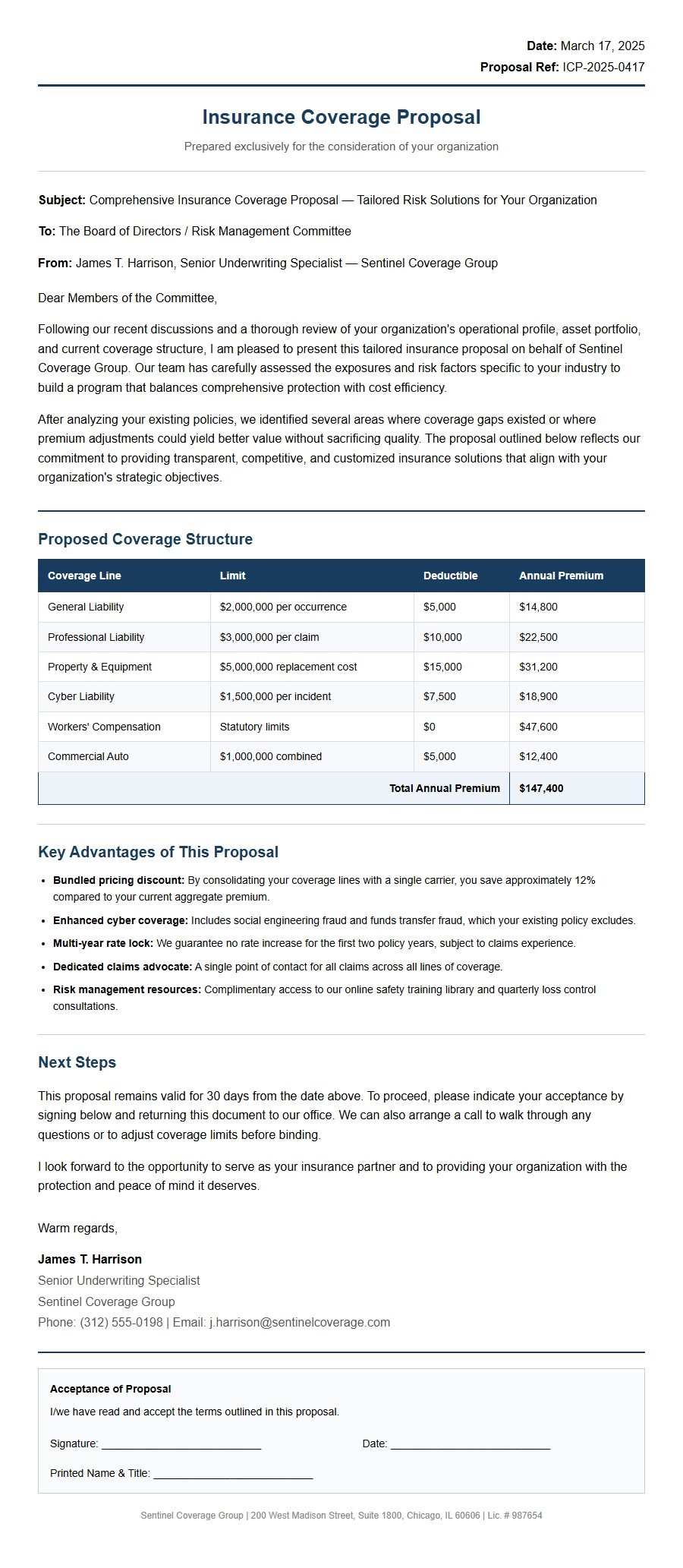
Commercial General Liability Proposal
To: GreenTech Manufacturing Inc. From: SecureShield Insurance Brokers Date: November 15, 2024 Re: Proposal for Commercial General Liability Coverage
We are pleased to present this tailored proposal for your general liability insurance needs. Based on our assessment of your operations, including the manufacturing facility and product distribution, we recommend the following coverage structure:
Coverage Component
Limit
Premium
General Aggregate
$2,000,000
$4,500
Products/Completed Operations Aggregate
$2,000,000
Included
Personal & Advertising Injury
$1,000,000
$1,200
Medical Expense (any one person)
$10,000
$350
Total Estimated Annual Premium: $6,050
This proposal includes a $500 deductible per claim and is subject to our standard underwriting guidelines. We have also included additional insured endorsement for your major clients. Please contact us for binding or any modifications.
Small Business Health Insurance Proposal
To: Bayside Consulting LLC From: HealthFirst Benefit Advisors Date: November 16, 2024 Re: Group Health Insurance Coverage Proposal
We appreciate your interest in providing comprehensive health coverage for your 12 employees. Below is our recommended plan options from PreferredCare Network with competitive rates and broad provider access.
Plan A - PPO: Low deductible, wide network, monthly premium $850 per employee
Plan B - HMO: Lower premium ($620/month), primary care gatekeeper, excellent preventive care
Plan C - High Deductible with HSA: $2,800 deductible, $480/month, employer HSA contribution eligible
Employer Contribution Options:
Contribution Level
Monthly Cost to Employer (per employee)
75% of employee-only premium
$465 – $637
100% of employee-only premium
$620 – $850
We recommend starting with a group benefits meeting. This proposal is valid for 30 days. Please let us know if you would like enrollment materials for your staff.
Fleet Auto Insurance Proposal
To: Speedy Delivery Services From: FleetGuard Insurance Agency Date: November 17, 2024 Re: Commercial Auto Coverage for 15-Vehicle Fleet
We have analyzed your fleet composition: 10 cargo vans, 3 box trucks, and 2 pickup trucks used for local and regional deliveries. Our proposal from National Fleet Insurers includes comprehensive and collision coverage with the following terms:
Coverage
Limit
Deductible
Liability per accident
$1,000,000
N/A
Collision
Actual Cash Value
$1,000
Comprehensive
Actual Cash Value
$500
Uninsured Motorist
$250,000
N/A
Total Annual Premium: $38,200 (includes safe driver discount of 10%)
Additional benefits: roadside assistance, rental reimbursement ($50/day), and fleet management telematics program. We recommend enrolling all drivers in a defensive driving course to further reduce premium. Proposal valid until December 1, 2024.
Cyber Liability Insurance Proposal
To: CloudNexus Technologies Inc. From: CyberSafe Insurance Partners Date: November 18, 2024 Re: Cybersecurity Insurance Coverage
Given your company's SaaS platform handling customer payment data, we propose the following cyber liability policy from DataProtect Underwriters. This covers first-party and third-party risks essential for technology firms.
Coverage A – Network Security & Privacy Liability: $2,000,000 limit
Coverage B – Regulatory Defense & Penalties: $1,000,000 sublimit
Coverage C – Breach Response Costs: $500,000 (including forensic, notification, and credit monitoring)
Coverage D – Business Interruption due to Cyber Event: $250,000
Deductible: $25,000 per claim Annual Premium: $18,500
Required security controls: multi-factor authentication, encrypted data storage, and incident response plan. We offer a 15% discount if you undergo an internal penetration test annually. Please review and sign the application within 60 days.
Workers' Compensation Proposal
To: StoneBridge Construction Ltd. From: SafetyNet Insurance Brokers Date: November 19, 2024 Re: Workers' Compensation Insurance Quotation
Based on your payroll classification and three-year loss history, we have obtained the following quote from StateComp Mutual. This policy covers medical expenses, lost wages, and rehabilitation for work-related injuries.
Class Code
Description
Est. Annual Payroll
Rate per $100
5059
Carpentry
$600,000
$8.25
5403
Roofing
$400,000
$12.50
8810
Clerical
$200,000
$1.10
Estimated Annual Premium: $59,200
We have applied the experience modification factor of 0.92 due to your favorable loss record and a safety training program credit of 5%. To proceed, please provide the signed application and deposit of 25% of the estimated premium. This quote is valid for 45 days.
Retail Property Insurance Proposal
To: Boutique Luxe Home Goods From: PropertyFirst Insurance Group Date: November 20, 2024 Re: Commercial Property Coverage for Downtown Store
We have evaluated your retail location (2,500 sq ft, Class A building, fire sprinklered) and inventory valued at $450,000. Our recommended coverage package from Golden Shield Insurers includes:
Business Personal Property: $475,000 actual cash value
Business Interruption: $125,000 (12-month period)
Ordinance or Law: $100,000
Inflation Guard: 3% automatic annual increase
Deductible: $2,500 per occurrence Annual Premium: $8,950
We have also included coverage for glass breakage, signs, and outdoor fixtures. A recent appraisal is needed to finalize the policy. Proposal valid for 60 days; binding requires a completed application and first premium payment.
Professional Liability (E&O) Proposal
To: Meridian Consulting Group From: LiabilityGuard Insurance Brokers Date: November 21, 2024 Re: Errors & Omissions Insurance for Consulting Services
We are pleased to propose professional liability insurance from ProRisk Specialty tailored to your management consulting practice. This policy covers claims arising from alleged negligence, misrepresentation, or failure to render professional services.
Limit of Liability
Retention (Deductible)
Annual Premium
$1,000,000 per claim / $2,000,000 aggregate
$10,000
$7,200
$2,000,000 per claim / $4,000,000 aggregate
$25,000
$11,800
Additional features: defense costs outside the limits, prior acts coverage (retroactive date 01/01/2020), and worldwide coverage. The policy also includes subpoena assistance and loss prevention hotline.
Your application disclosed no past claims, which qualifies you for a 10% new business credit. Please sign the quote acceptance and provide a copy of your standard engagement letter. This offer expires December 20, 2024.
Group Life Insurance Proposal
To: Apex Manufacturing HR Department From: LifeWise Benefit Solutions Date: November 22, 2024 Re: Employer-Sponsored Group Term Life Insurance
We are offering a group term life insurance plan through Premier Life & Accident for your 85 eligible employees. This coverage can be an important part of your benefits package at a low net cost.
Plan Design Options:
Basic Life: $50,000 per employee (employer-paid) – estimated monthly cost $2.50 per employee
Supplemental Life: Up to 5x salary (employee-paid, simplified issue) – rates based on age brackets
Dependent Life: Spouse $25,000, each child $10,000 – $1.20/month per employee
Total estimated employer contribution for basic plan: $2,550/year (0.17% of payroll)
We have also included accelerated death benefit and portability features. A minimum participation of 75% is required for the voluntary supplemental option. To proceed, please complete the enrollment worksheet and census data. This proposal is valid for 90 days.
Marine Cargo Insurance Proposal
To: BlueWave Shipping Ltd. From: OceanGuard Underwriters Date: November 23, 2024 Re: Open Cargo Policy for International Shipments
We have drafted an annual open cargo marine insurance policy for your shipments of electronics and apparel from Asia to North America. Coverage begins upon loading at origin and continues until delivery to the consignee's warehouse.
Coverage Type
Limit
Rate per $100 value
All Risks (Institute Cargo Clauses A)
$5,000,000 per vessel
$0.25
War and Strikes Risk
$5,000,000 per vessel
$0.05 (additional)
General Average & Salvage
Included
N/A
Deductible: $5,000 per claim (except total loss) Estimated annual premium based on projected $50M shipped value: $150,000
We require a completed cargo declaration each month. This policy is subject to adjacent voyage warranty. Please also note that shipments to certain high-risk ports may require individual rating. Offer valid until December 31, 2024.
Personal Umbrella Liability Proposal
To: Mr. & Mrs. Jonathan Ashford From: Elite Private Client Insurance Services Date: November 24, 2024 Re: Personal Umbrella Liability Insurance ($5M Limit)
Thank you for allowing us to propose an umbrella liability policy to protect your assets beyond your homeowners and auto insurance. We recommend a $5,000,000 umbrella from Premier Excess & Surplus.
Underlying Coverage Requirements:
Auto Liability: $500,000 per accident (currently $300,000 – needs increase)
Homeowners Liability: $500,000 per occurrence (currently met)
Watercraft Liability: $1,000,000 (if applicable – you own a 40ft yacht, must add policy)
Annual Premium: $2,800 (including $200 discount for having both auto and home with us)
This policy provides worldwide coverage for personal liability lawsuits, defense costs outside the limit, and coverage for libel, slander, and defamation. We have included uninsured/underinsured motorist coverage as an option for an additional $350.
To bind, please confirm the auto limit increase and provide current declarations pages. This quote is valid for 30 days.
 Sample Construction Bid Proposal Letter
 Enterprise Software Implementation Proposal Letter Example
 Marketing Agency Service Proposal Letter Template
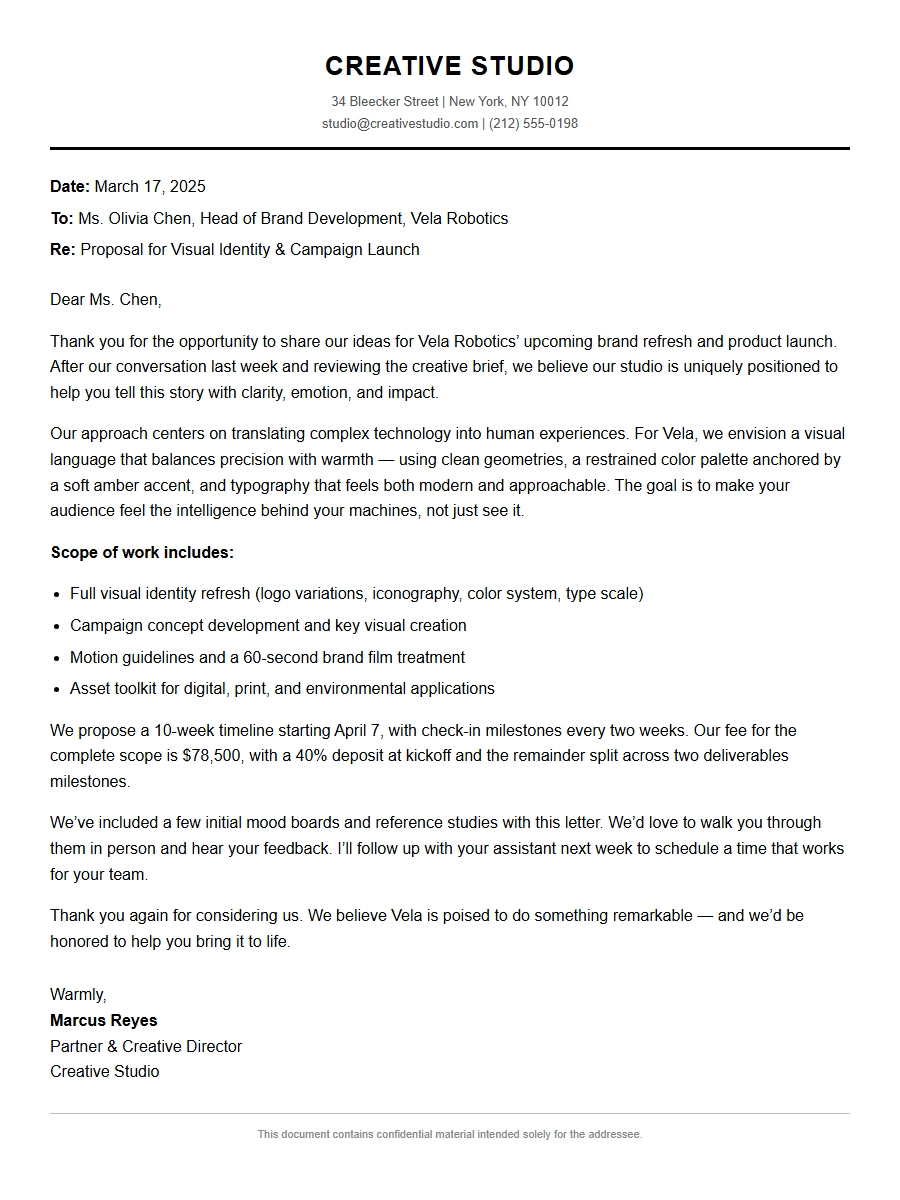 Creative Studio Project Proposal Letter
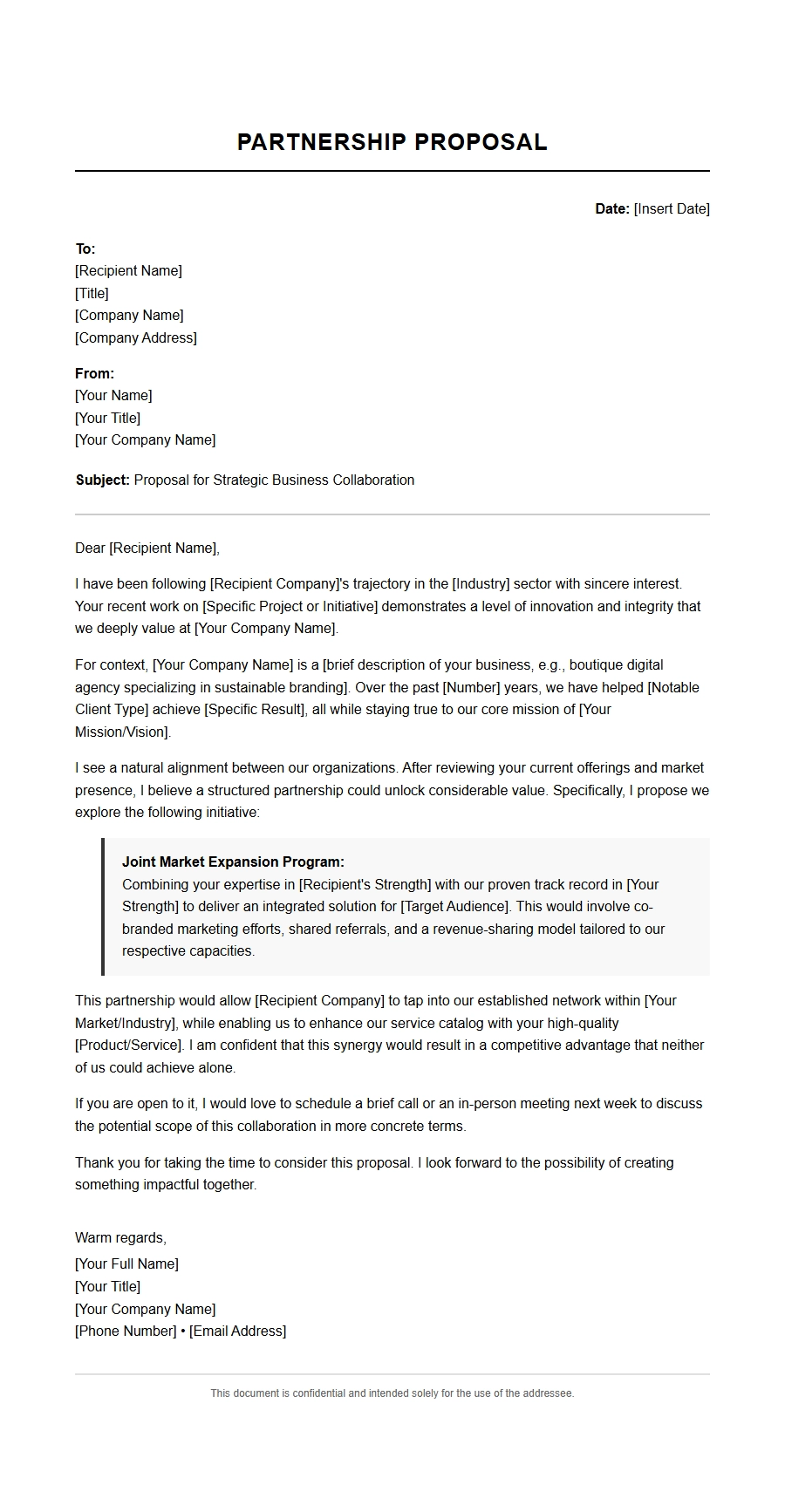 Small Business Partnership Proposal Letter Template
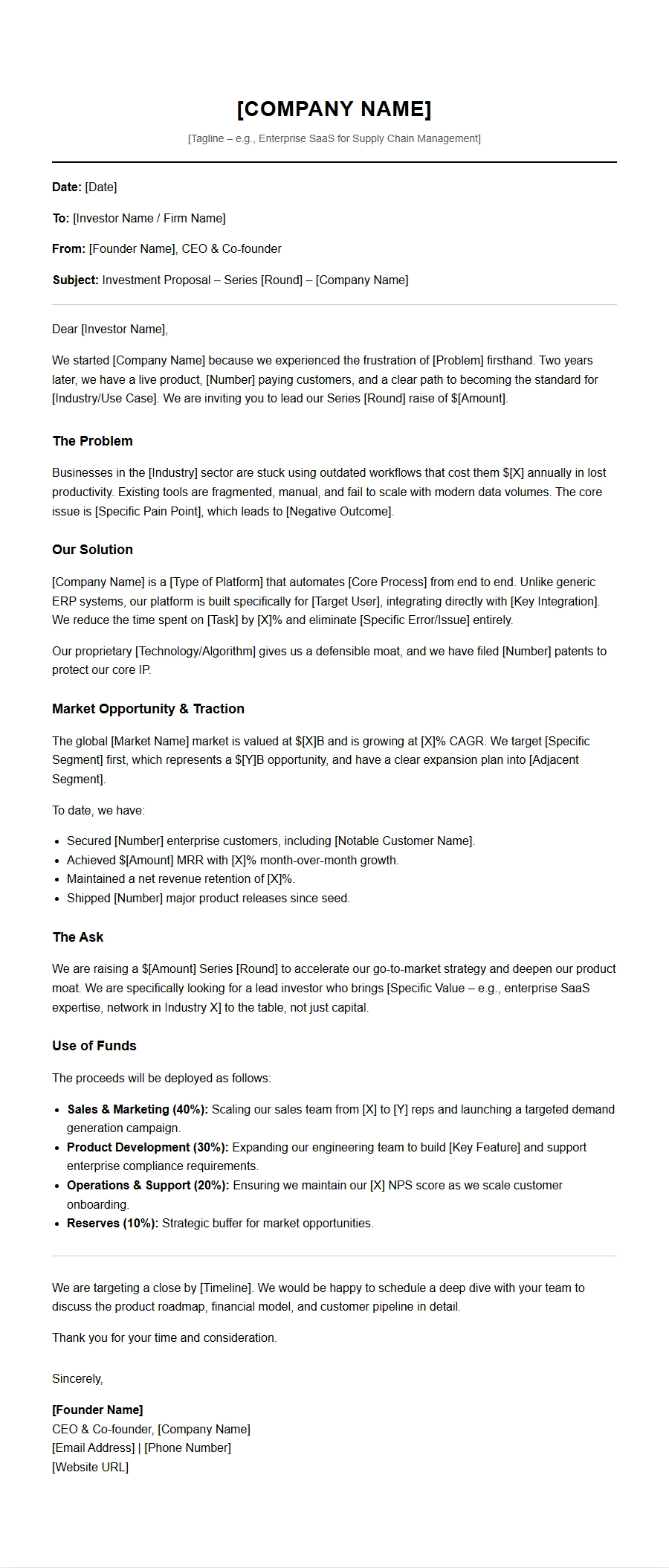 Startup Investment Proposal Letter Template