You need to send an RSVP request letter, but you’re staring at a blank page, second-guessing every word. Should it be formal? What if you sound too pushy? That freeze is normal. But with the right sample, you’ll go from anxiety to a polished draft in minutes—without losing your voice.
Why a sample isn’t cheating
Using a letter template or sample is simply smart. It gives you the structure, the right salutation and closing, and the key phrases you need. Think of it as a map: you still drive the car. You adapt the tone, add your details, and make it yours. That’s not cutting corners—it’s professional correspondence made efficient.
Choosing the right RSVP sample
Not all RSVP requests are the same. A wedding response card differs from a business event RSVP. For a formal dinner or corporate gathering, stick with a traditional business letter format: sender’s address, date, clear request, and a deadline. For a casual party, you can loosen the tone. Start by asking yourself: Who is receiving this? Your boss expects formal writing tips; your book club expects warmth.
Adapting without losing your authentic voice
Once you pick a sample, tweak the opening paragraph. That’s where the reader decides if they feel welcomed or obligated. Instead of “Please RSVP by Friday,” try “We’d love to know if you can join us—please reply by Friday.” See the difference? It’s still courteous, but less robotic. If you’re writing a digital letter format, add your reply-to email clearly. For printed invites, include a stamped envelope or a simple instruction line.
Common mistakes to avoid
Avoid outdated salutations like “To Whom It May Concern” unless you truly don’t know the recipient’s name. Also, don’t forget proofreading your letter before sending—a typo in the date or venue creates confusion. And if you’re emailing instead of mailing a physical letter, don’t skip the subject line. Something like “RSVP Request: Company Gala – Please Confirm by March 15” works better than an empty subject.
Another mistake: making the request too vague. Be specific. “Please respond by August 10” is clearer than “Let me know soon.” If you need a headcount for catering, say so. That helps guests understand why you need a firm reply.
Real-life example: wedding vs. workshop
For a wedding, you might write: “We are thrilled to invite you to celebrate our marriage. Kindly RSVP by June 1 via the enclosed card or email.” That’s classic. For a product launch customer invite, you could adapt that same structure but change the tone to more excited: “You’re invited to our exclusive product reveal—please let us know you’re coming by April 20.”
The best RSVP request letters feel both professional and personal. Don’t overthink it. Use a sample as your springboard, not your crutch. Every time you write one of these notes, you’ll get faster. Eventually, you won’t need the sample at all—just your own natural voice with a solid structure underneath.
And if you’re ever stuck again, remember: start with a simple sentence like “Please RSVP by…” and build around it. The rest will follow.
Samples for Inspiration
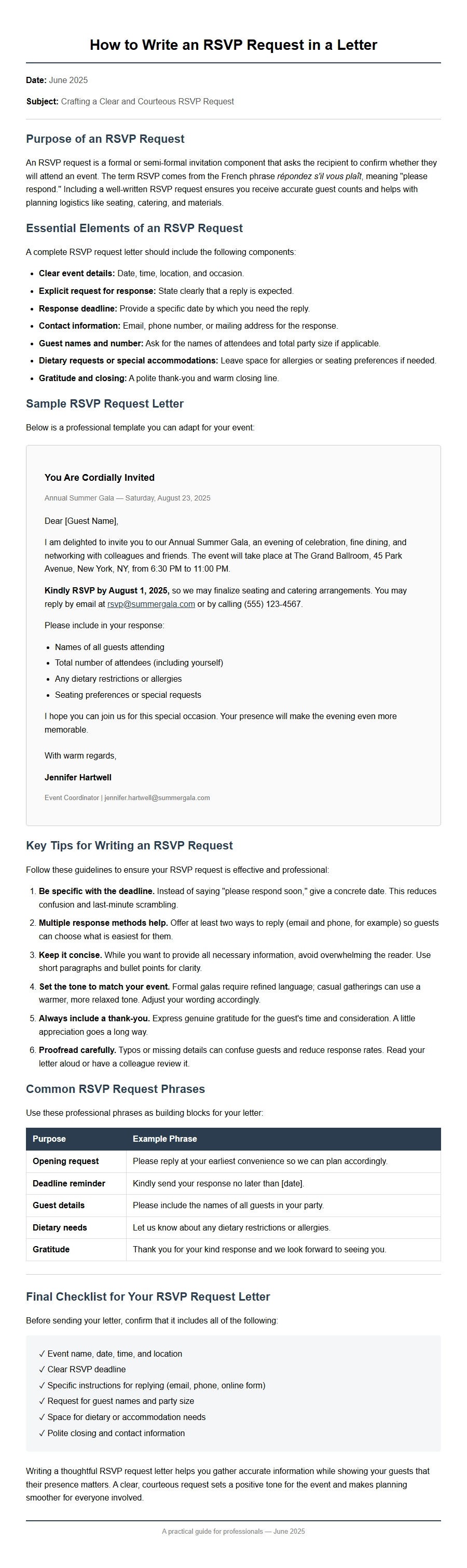
How to Write an RSVP Request Letter
Wedding RSVP Request Letter
Dear [Guest Name],
We are overjoyed to invite you to our wedding celebration. To help us finalize arrangements, please kindly respond with your attendance details by April 15, 2025.
Please indicate:
Number of guests (including children)
Dietary restrictions or allergies
Song requests for the reception
You may reply via email at [email] or by mail using the enclosed card. We look forward to celebrating with you!
With love, [Your Names]
Birthday Party RSVP Request
Hi [Friend's Name],
You are cordially invited to my 40th birthday bash on Saturday, June 10, 2025 at 7 PM. Please RSVP by June 1 so I can order the cake and arrange seating.
Kindly confirm:
Your attendance (yes/no)
Any plus-ones
Preferred drink (wine, beer, cocktail, or non-alcoholic)
Reply to this email or call [phone number]. Can't wait to see you!
Best, [Your Name]
Corporate Event RSVP Request
Dear [Colleague Name],
You are invited to the Annual Company Gala on Friday, September 12, 2025 at the Grand Ballroom. Please RSVP by August 30 to assist with catering and seating.
Please complete the following:
Item
Your Response
Will you attend?
[ ] Yes [ ] No
Number of guests
_____
Dietary requirements
_____
Send your RSVP to [email] or use the link in the calendar invite. We look forward to celebrating our achievements together.
Sincerely, Events Committee
Formal Dinner RSVP Request
Dear [Guest Name],
We have the pleasure of inviting you to a formal dinner on Thursday, November 8, 2025 at 7:30 PM at the Regent Club. Kindly RSVP by November 1.
Please include:
Your attendance confirmation
Choice of entrée: Filet Mignon, Grilled Salmon, or Vegetable Risotto
Wine preference (red, white, or none)
Reply to [email] or call [phone]. Dress code: black tie. We eagerly await your response.
Warm regards, [Host Name]
Baby Shower RSVP Request
Dear [Guest Name],
You're invited to a baby shower for [Mom-to-be] on Saturday, July 20, 2025 at 2 PM at [Address]. Please RSVP by July 10 so we can plan accordingly.
Please let us know:
Number of guests
Any dietary restrictions
If you'd like to participate in the gift raffle
You can reply via email [email] or text [phone]. The theme is safari animals – feel free to dress up!
With excitement, [Host Name]
Graduation Party RSVP Request
Dear [Guest Name],
I am thrilled to invite you to my graduation party on Saturday, May 25, 2025 from 3 PM to 8 PM at my home. Please RSVP by May 18.
Kindly confirm:
Your attendance
Number of guests coming
Any food allergies
Also, if you'd like to share a memory or advice for my next chapter, I'd love to include them in a memory book. Reply to [email] or call [phone].
Cheers, [Graduate Name]
Anniversary Party RSVP Request
Dear [Guest Name],
Please join us as we celebrate our 25th wedding anniversary on Saturday, August 16, 2025 at 6 PM at the Garden Pavilion. RSVP by August 1 to help us with seating and catering.
Please include:
Number of people attending
Dietary needs (vegetarian, gluten-free, etc.)
If you plan to say a few words during the toast
Reply to [email] or mail the card enclosed. We would be honored by your presence.
With love, [Your Names]
Housewarming RSVP Request
Hi [Friend's Name],
We have moved into our new home and would love for you to join our housewarming party on Saturday, October 5, 2025 from 4 PM onwards. Please RSVP by September 28.
Kindly let us know:
If you will attend
Any snack or drink you'd like to bring (optional)
If you need parking arrangements
Our new address is [Address]. Feel free to bring a cozy gift or just yourselves! Reply via text or email.
Can't wait to show you around, [Your Names]
Charity Gala RSVP Request
Dear [Guest Name],
You are cordially invited to the Annual Charity Gala benefiting local education on Friday, December 5, 2025 at the City Convention Center. Please RSVP by November 20.
Kindly provide the following:
Detail
Your Information
Attendance
☐ Yes ☐ No ☐ Maybe
Number of guests
_____
Dinner preference
_____ (see menu online)
Also indicate if you'd like to sponsor a table or donate an auction item. Reply to [email] or call [phone]. Thank you for supporting our cause.
Warmly, Fundraising Team
Reunion RSVP Request
Dear [Classmate/Family Member],
We are excited to announce our 10-year high school reunion on Saturday, June 28, 2025 at The Old Schoolhouse. Please RSVP by June 14.
Please fill out the following:
Will you attend? Yes / No
Number of guests (spouses/partners welcome)
Fun fact about your life since graduation
Also, we are collecting photos for a slideshow – feel free to send one. Reply to [email] or via the reunion website. Let's reconnect!
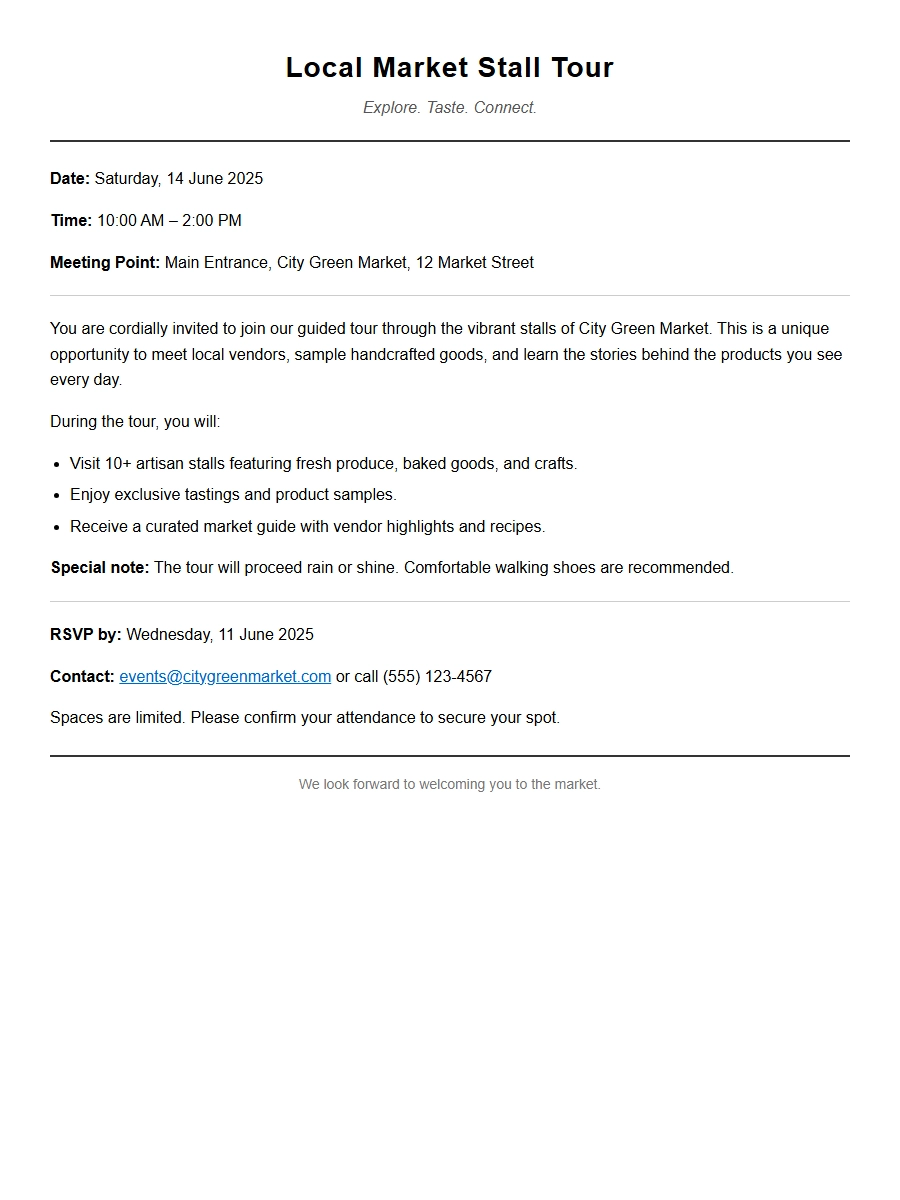 sample invitation for local market stall tour - Invitation Letters
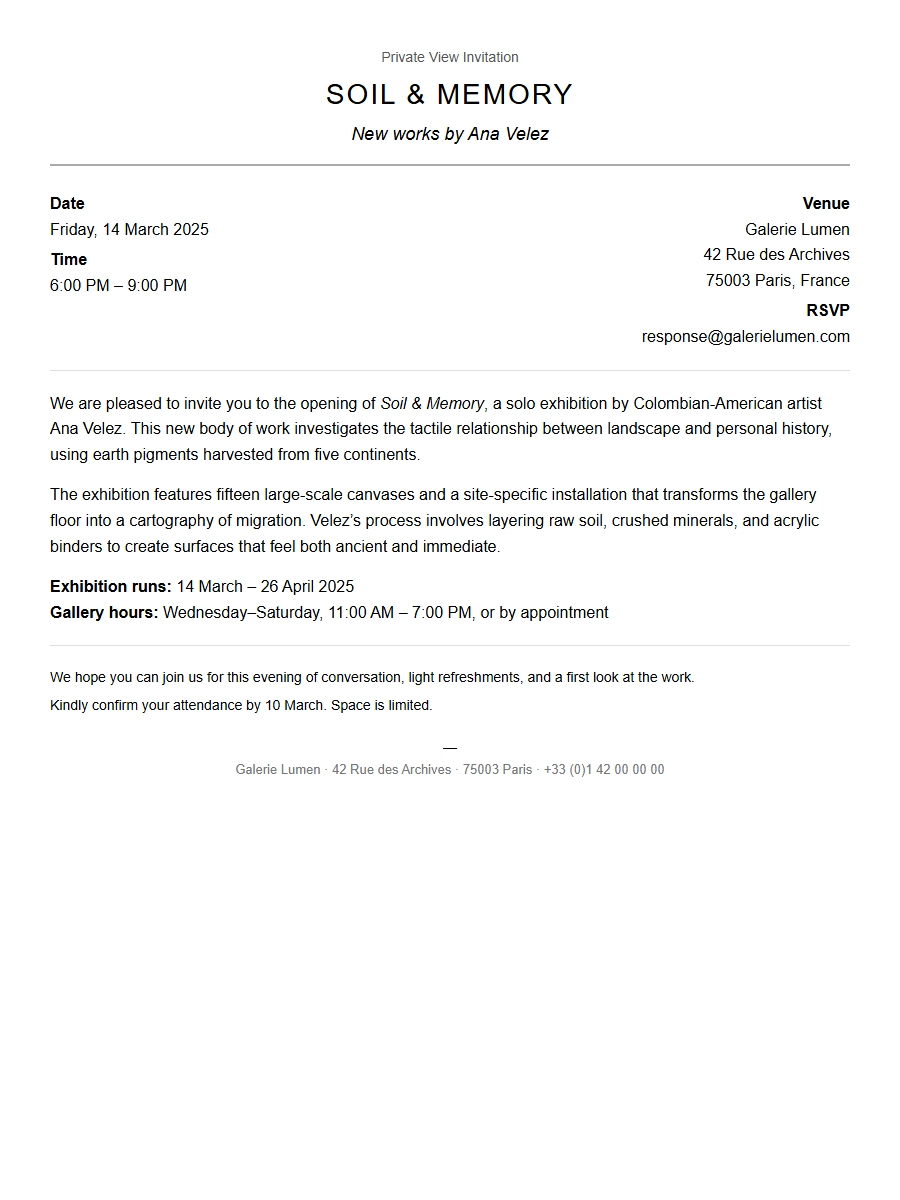 Art Exhibition Opening Invitation Wording Ideas
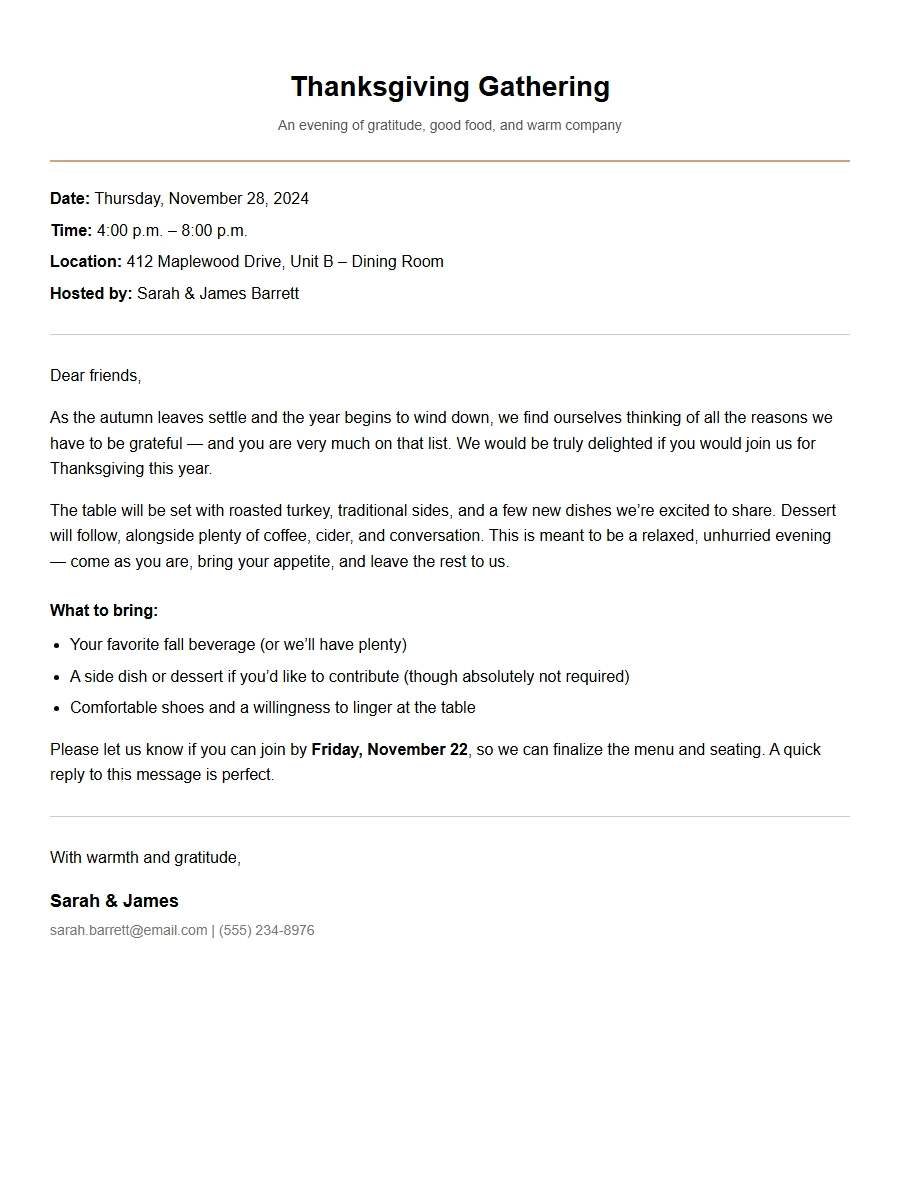 Thanksgiving Meal Gathering Invitation Text
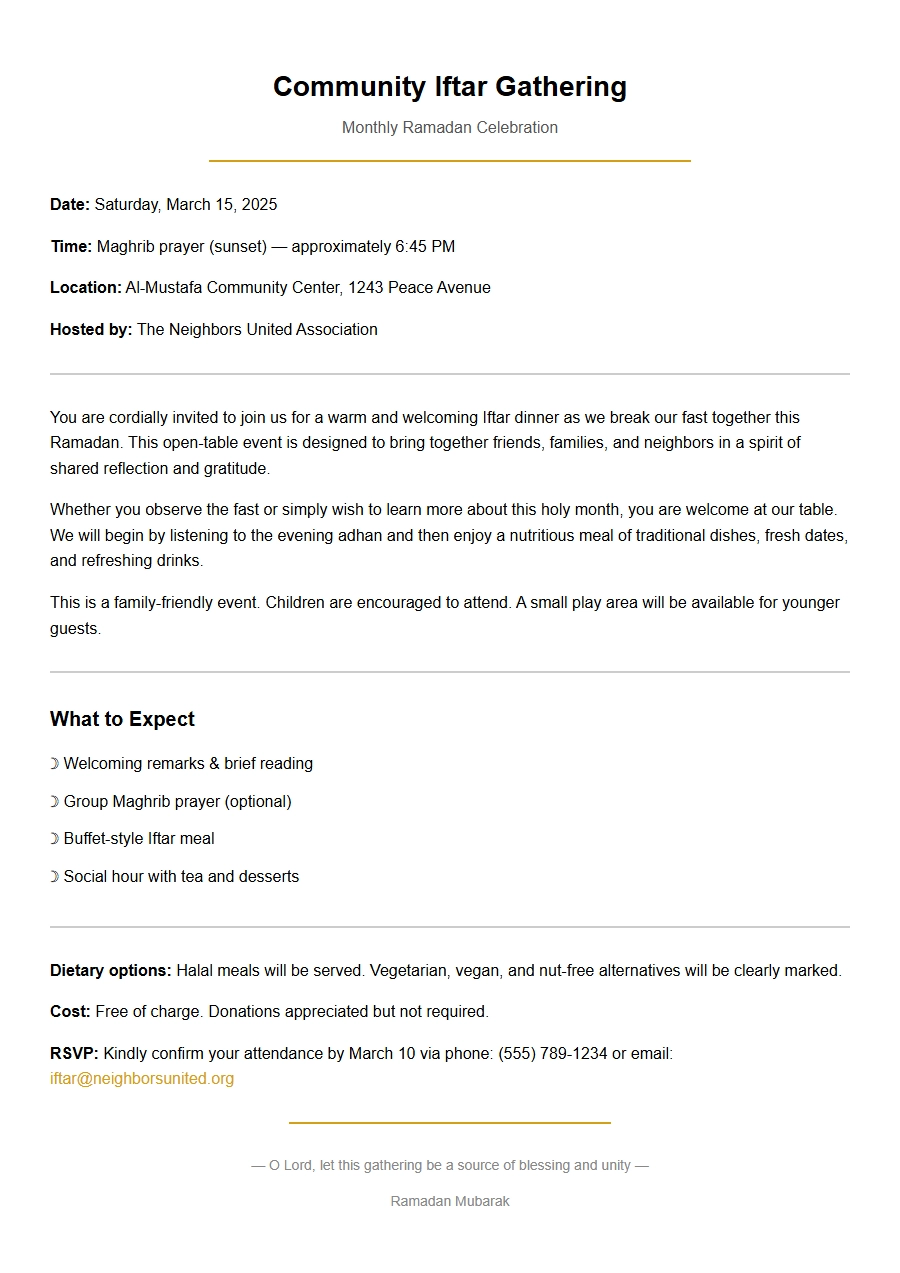 Ramadan Iftar Community Event Invitation
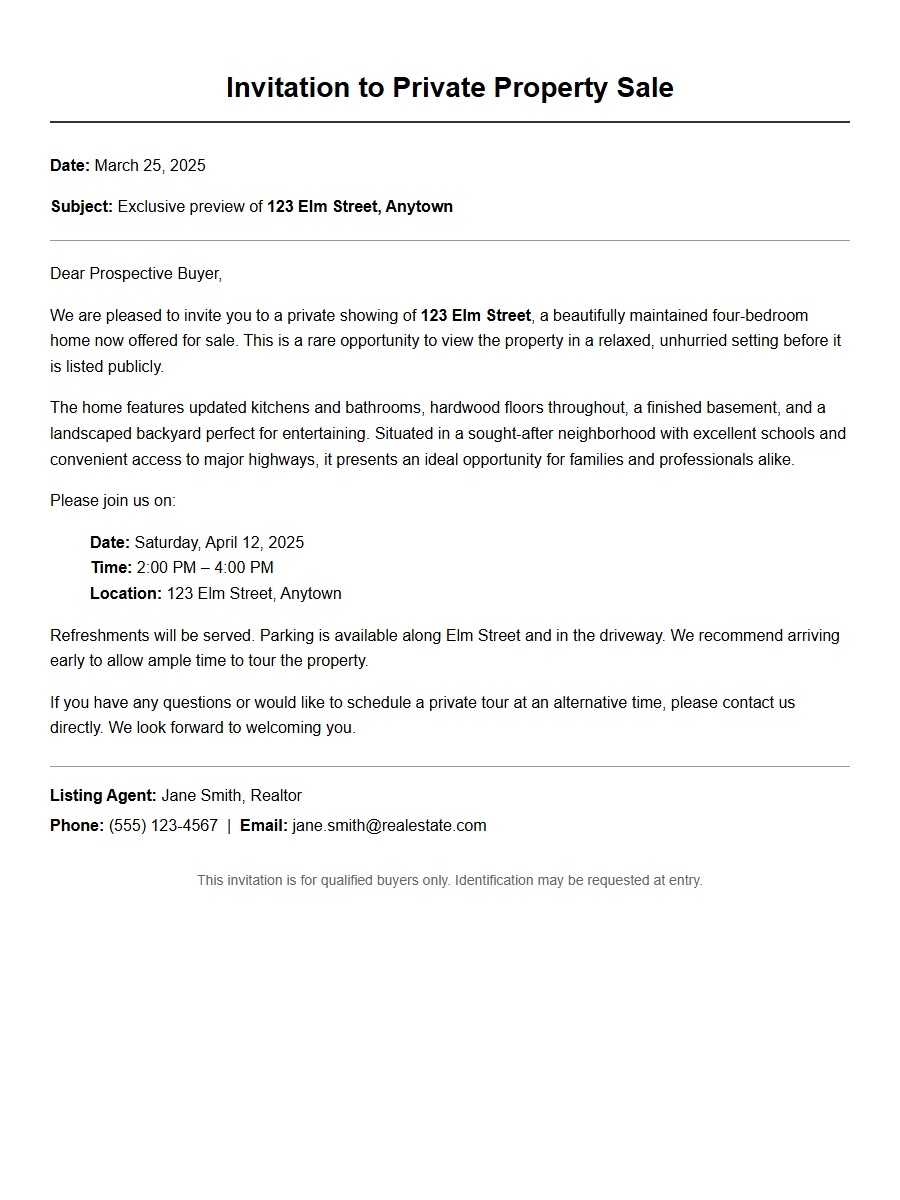 Sample Wording for Property Sale Invitations
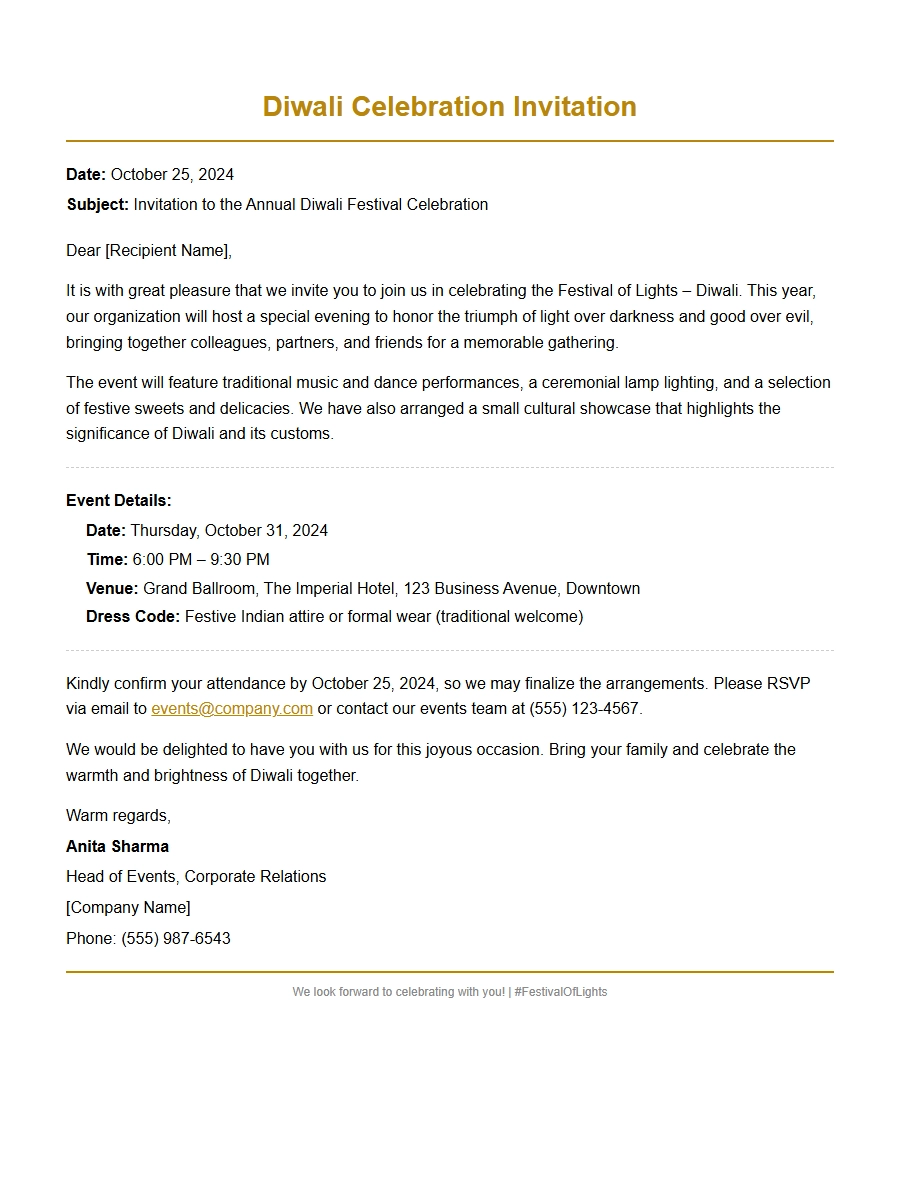 Diwali Festival Celebration Invitation Draft