You need to send a resignation letter today, but you don’t know where to begin. Maybe you’re leaving a role where no one else is lined up to take over, and that pressure makes the blank page feel even heavier. It’s a common frustration, and you’re not alone in feeling stuck.
Using a letter sample isn’t cheating—it’s a smart, time-saving strategy. A well-designed letter template gives you structure, tone, and key phrases while leaving room for your own details. Think of it as a trusted starting point, not a crutch. You’ll still bring your voice and situation into it.
Category: Resignation Letters
Resigning without an immediate replacement adds extra layers to what’s already a delicate conversation. Your employer will want to know how work gets covered, and you’ll want to leave on good terms. That’s where a strong resignation letter sample can help—it keeps you focused on professional correspondence while you figure out the practical details.
What does “without immediate replacement” mean for your letter?
It means your letter needs to be extra clear about your transition plan. Most resignation letters give two weeks’ notice and a polite farewell. But when there’s no replacement, you’ll want to explain how you’ll help minimize disruption. For example, offer to document your current projects or train a colleague who might temporarily cover your duties. That shows tone in writing that’s both professional and considerate.
Your letter structure should still follow standard business letter format: a clear salutation and closing, a direct statement of resignation, and then the specifics of your departure. If you’re sending it as an email, use digital letter format—a clear subject line, no letterhead design unless you’re attaching a PDF, and a sign-off that matches your workplace culture.
How to adapt a sample without losing your authentic voice
Start with a customizable letter that fits your industry. For a corporate job, use formal language; for a creative agency, a semi-formal tone works fine. Ever received a letter that felt too stiff or too casual? That’s the balance you want to strike.
One common mistake is using outdated letter writing etiquette like “To Whom It May Concern” when you know your manager’s name. Another is forgetting to adjust the format for email vs. printed letter. For email, skip the separate letterhead design and put your contact details below your signature.
Tailor the opening paragraph to grab attention—not with drama, but with clarity. Say something like, “Please accept this letter as formal notification that I will be resigning from my position as Marketing Specialist, effective [date]. I understand there is no immediate replacement, so I’ve outlined a transition plan below.” That’s direct, helpful, and professional.
Practical advice for managing the transition period
Your letter should acknowledge that you’ll help with handover. Mention specific steps: updating process documents, scheduling knowledge-transfer meetings, or being available for calls after your last day. That makes your professional correspondence feel proactive, not abrupt.
Don’t forget the proofreading letter step. Read it aloud to catch awkward phrasing. Check that your salutation and closing match the relationship you have with your manager. A simple “Best regards” works for most situations.
Remember, the best resignation letters feel both professional and personal. Use the sample as a springboard, not a script. Practice writing a few versions, and soon the process will feel faster and more natural. You’ve got this.
Common Sample Formats
How to Resign Without an Immediate Replacement
Resignation Letter with Transition Offer
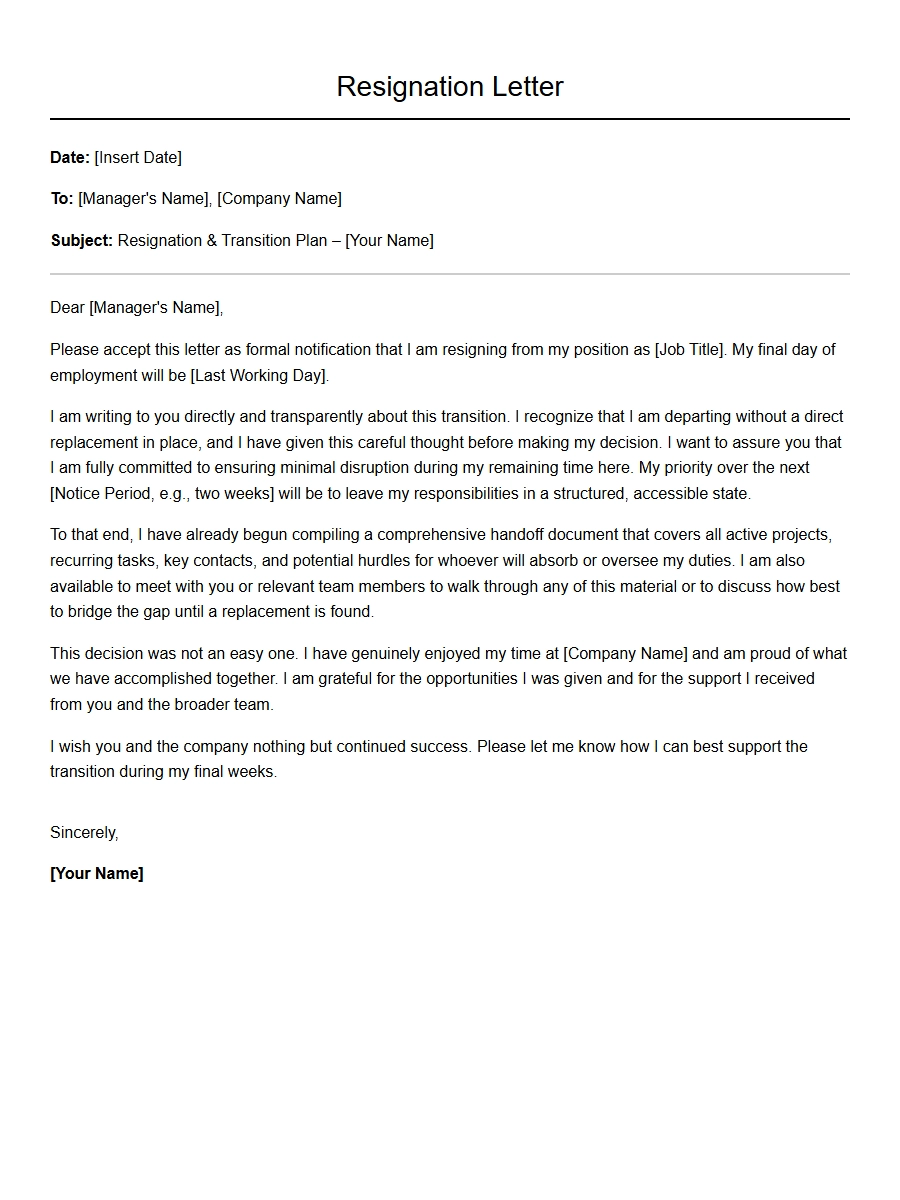
Date: [Current Date]
To: [Manager's Name]
Subject: Resignation – [Your Name]
Dear [Manager's Name],
Please accept this letter as formal notification that I am resigning from my position as [Your Job Title] at [Company Name]. My last day will be [Last Working Day].
I understand that there is no immediate replacement lined up, and I want to assure you that I am committed to ensuring a smooth transition. To minimize disruption, I propose the following:
Document all pending tasks and create a step-by-step guide for each.
Train a colleague (if available) on critical duties during my notice period.
Be available for brief calls for two weeks after my departure to answer questions.
Please let me know how I can best support the team during this change. I have attached a preliminary handover checklist for your review. Thank you for the opportunities I’ve had here.
I regret to inform you that I must resign from my role as [Job Title] effective immediately. Due to personal circumstances, I am unable to provide the standard notice period. I apologize for the inconvenience this may cause, especially because no replacement has been identified.
To help mitigate the impact, I have:
Summarised all ongoing projects in a spreadsheet with status, deadlines, and next steps.
Left clear notes on my desktop and shared drives for easy access.
Listed key contacts (clients, vendors) with whom I have regular interaction.
I am willing to be reached by email for urgent clarifications over the next week. Please consider this a sincere effort to leave on good terms. Thank you for understanding.
Sincerely, [Your Name]
Resignation Email Offering Handover Assistance
To: [Manager's Email]
Subject: Resignation and handover support – [Your Name]
Hi [Manager's Name],
I am writing to formally resign from my position as [Job Title]. My last working day will be [Date]. I know there is no immediate replacement, so I want to outline how I can help you and the team during this transition.
Proposed handover plan:
Daily check-ins for the first week to review ongoing tasks.
Creation of a standard operating procedures document covering my core responsibilities.
Record short video walkthroughs of complex processes (if desired).
Forward all future emails to a shared inbox or colleague.
I am also happy to join a few calls after my departure on an ad-hoc basis. Please let me know if you would like to schedule a meeting to discuss this plan. Thank you once again for everything I learned here.
Best regards, [Your Name]
Resignation Letter with Task Documentation Checklist
Date: [Current Date]
To: [Manager's Name]
Subject: Resignation – [Your Name]
Dear [Manager's Name],
Please accept this letter as my formal resignation from [Company Name]. My last day will be [Date]. I understand that a replacement has not yet been hired, and I want to make the handover as smooth as possible.
Below is a checklist of documentation I will complete by my last day:
Area
Document Created
Status
Daily processes
Step-by-step guides
In progress
Project files
Inventory & status list
Complete
Client contacts
Relationship summary
Planned
System access
Access & permissions list
To do
I will also hold two handover sessions (dates TBD) to walk through these materials with whoever will take over my duties. Please let me know if there are additional requests. I am committed to leaving things well organized.
Sincerely, [Your Name]
Professional Resignation for Personal Reasons
Date: [Current Date]
To: [Manager's Name]
Subject: Resignation due to personal reasons – [Your Name]
Dear [Manager's Name],
I am writing to formally resign from my role as [Job Title] effective [Last Working Day]. This decision is driven by personal reasons that require my full attention. I realise that there is no immediate replacement available, and I deeply regret any inconvenience this may cause.
To ease the transition, I will:
Document all recurring tasks and deadlines in a shared tracker.
Provide a list of critical pending items with suggested priorities.
Be reachable by phone for two weeks after my departure for urgent queries.
I have prepared a handover file that you will find in [shared drive location]. I hope this reduces the burden on the team. I appreciate all the support I have received at [Company Name] and wish the company continued success.
Please accept this letter as my formal resignation. However, given that no replacement has been identified yet, I am willing to extend my notice period by [number] weeks to facilitate a smoother handover. My new last day would be [New Last Day].
During this extended period, I propose to:
Train one or two team members on my core responsibilities.
Create a comprehensive role playbook.
Assist with recruiting and onboarding my successor if hired in time.
I have outlined a tentative schedule below:
Week
Focus Area
1
Knowledge transfer & documentation
2
Training sessions & process walkthroughs
3
Shadowing and Q&A
Please let me know if you would like to discuss this proposal further. I value this team and want to leave on the best terms possible.
Sincerely, [Your Name]
Resignation Letter Proposing Remote Support Post-departure
I am writing to resign from my position as [Job Title], effective [Last Working Day]. I understand that there is no immediate replacement, and I would like to offer part-time remote support for up to [number] weeks after my last day to help bridge the gap.
My proposed support includes:
Two hours per day (remote) for urgent questions and approvals.
Weekly status review with the interim team.
Access to my personal email for critical communications.
I have prepared a remote handover kit (login details, vendor contacts, and process maps) that will be handed over before I leave. I am open to negotiating the duration and scope of this support. I hope this arrangement alleviates some of the transition pressure.
Thank you for your understanding. I look forward to your response.
Best regards, [Your Name]
Resignation Letter Highlighting Continuity Plans
Date: [Current Date]
To: [Manager's Name]
Subject: Resignation – [Your Name] (continuity plan attached)
Dear [Manager's Name],
Please accept this letter as my formal resignation. My last day will be [Date]. Since there is no planned replacement, I have prepared a Continuity Plan that I am attaching with this letter.
The plan includes:
Role decomposition: tasks that can be delegated immediately vs. those needing a specialist.
Temporary redistribution: suggested assignments for current team members.
Escalation path: who to contact for each type of decision.
During my notice period, I will lead a one-hour workshop to walk the team through this plan and answer questions. I am also available for follow-up calls after my departure if needed.
I genuinely care about the company’s success and believe this continuity plan will keep operations running with minimal friction.
Sincerely, [Your Name]
Resignation Letter for Immediate Departure with Apology and Plan
Date: [Current Date]
To: [Manager's Name]
Subject: Resignation – [Your Name] (immediate)
Dear [Manager's Name],
I am writing to inform you that I must resign effective today. I sincerely apologise for the short notice and the fact that there is no immediate replacement. This was not my intention, but circumstances beyond my control require my immediate attention.
To minimise the disruption, I have taken the following steps before leaving:
Created a “What I do daily” checklist and left it on my desk.
Sent an email to key clients introducing [Colleague Name] as the interim contact.
Prepared a task handover spreadsheet shared with [Manager's Name].
I am reachable at [Phone Number] for the next week for any critical clarifications. I regret having to leave this way and thank you for your understanding.
Sincerely, [Your Name]
Resignation Letter Acknowledging Lack of Replacement with Solutions
Date: [Current Date]
To: [Manager's Name]
Subject: Resignation – [Your Name] (solutions for the gap)
Dear [Manager's Name],
I am writing to formally resign from my role as [Job Title]. My last day will be [Date]. I am aware that a replacement has not yet been found, and I want to offer concrete solutions to help bridge the gap.
Solution 1 – Peer coverage: Identify colleagues who can absorb high-priority tasks; I will train them during my notice period.
Solution 2 – Freelance support: I can recommend two trusted freelancers who are familiar with our systems and can take over temporarily.
Solution 3 – Delayed transition: I am open to staying part-time for an extra [number] weeks via a consulting arrangement (to be discussed).
I have already drafted a handover document and will have it ready by [Date]. Please let me know which solution (or combination) works best for the team. I am committed to leaving on good terms.
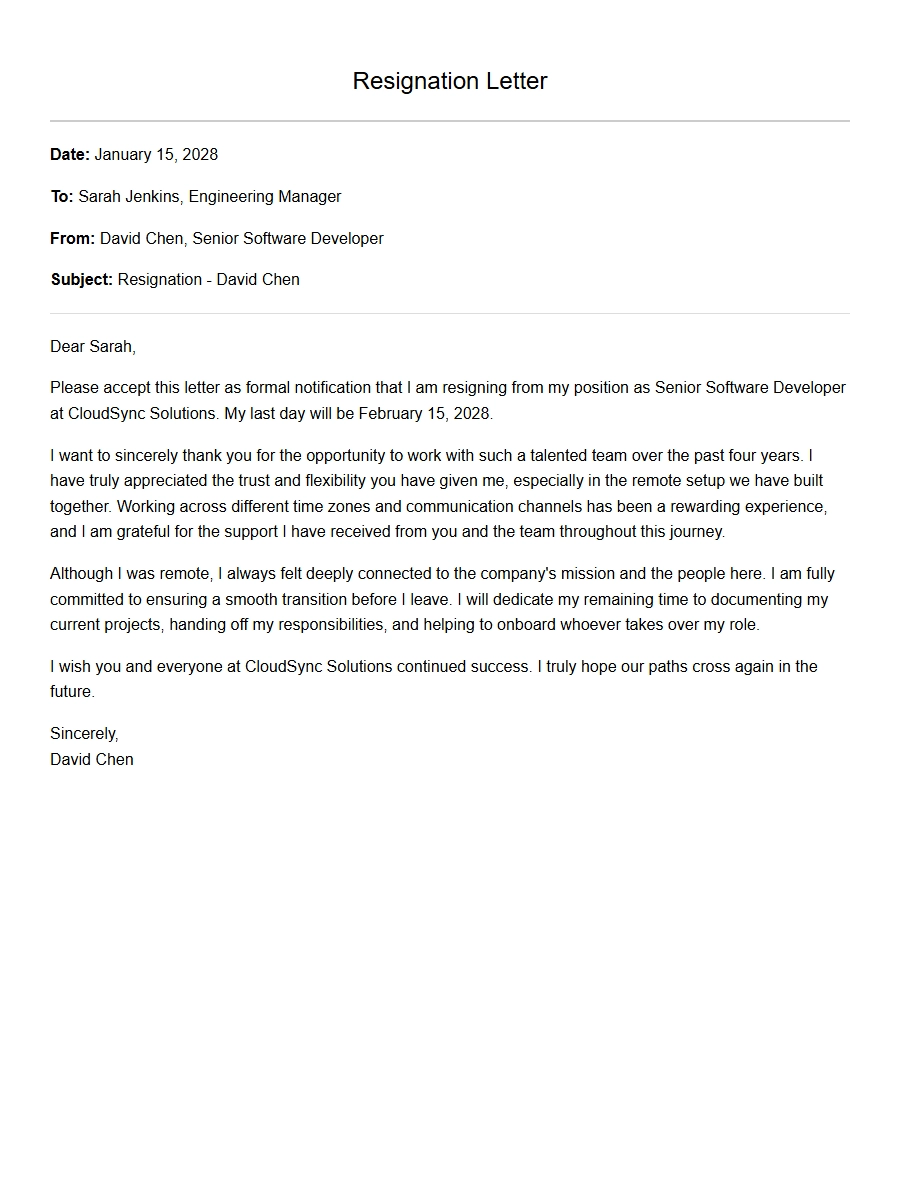 Polite Resignation Email for Remote Employees
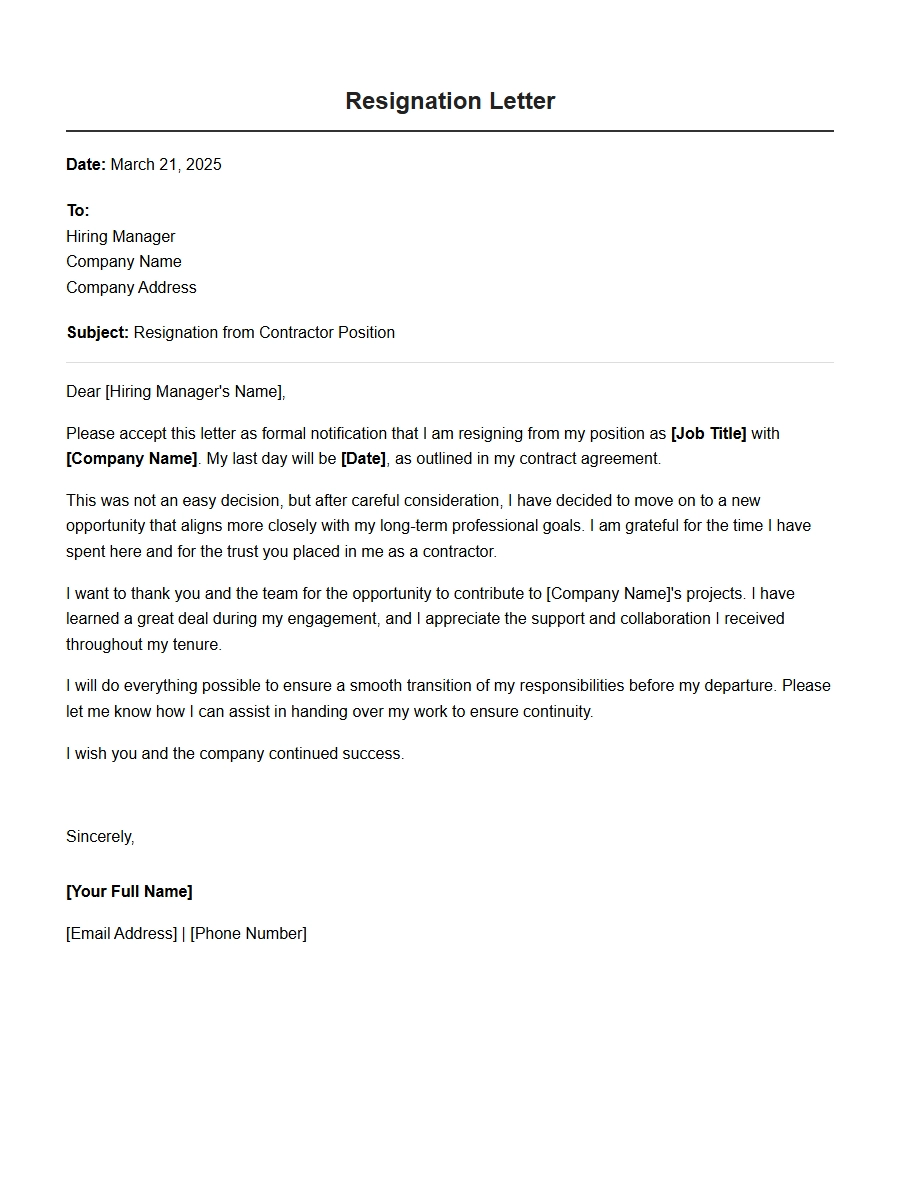 Short Resignation Letter for Contractor Position
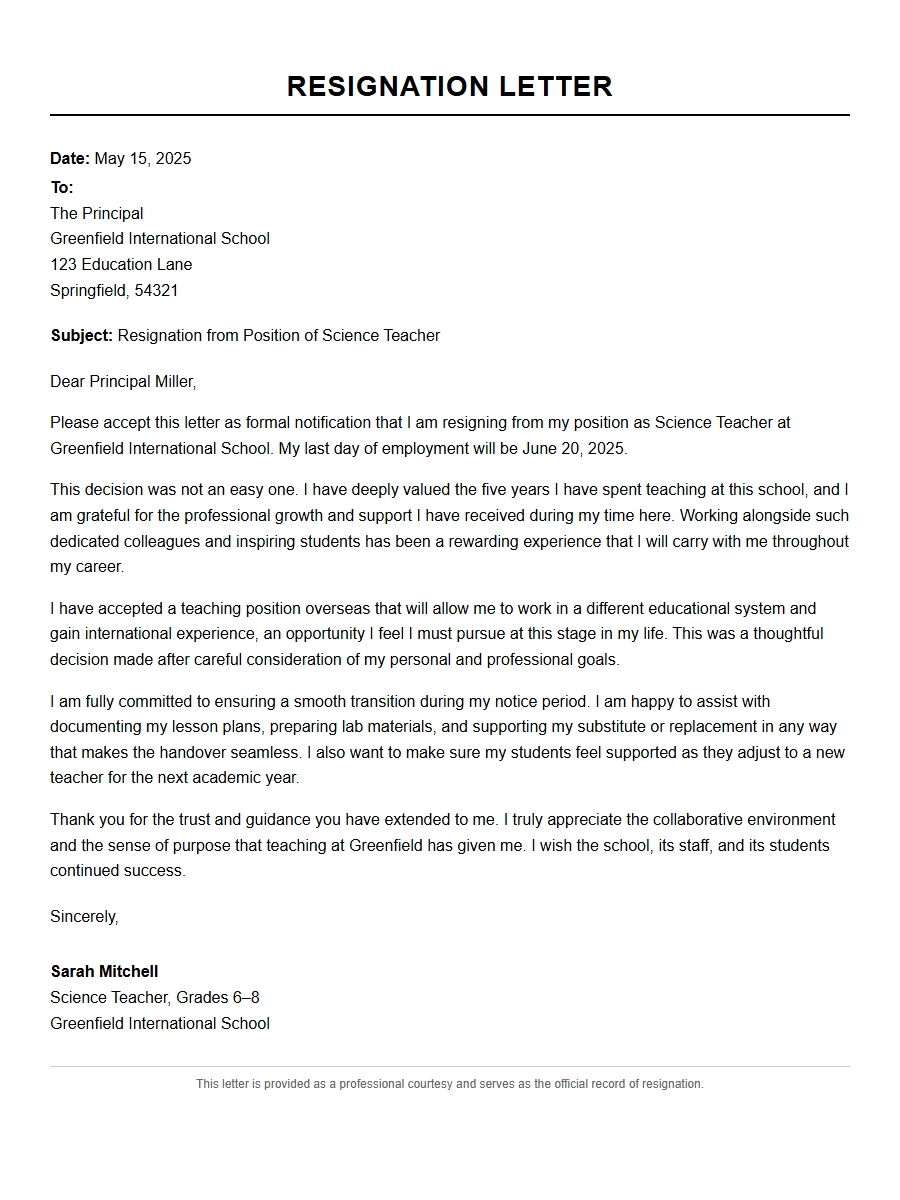 Teacher Resignation Letter Example
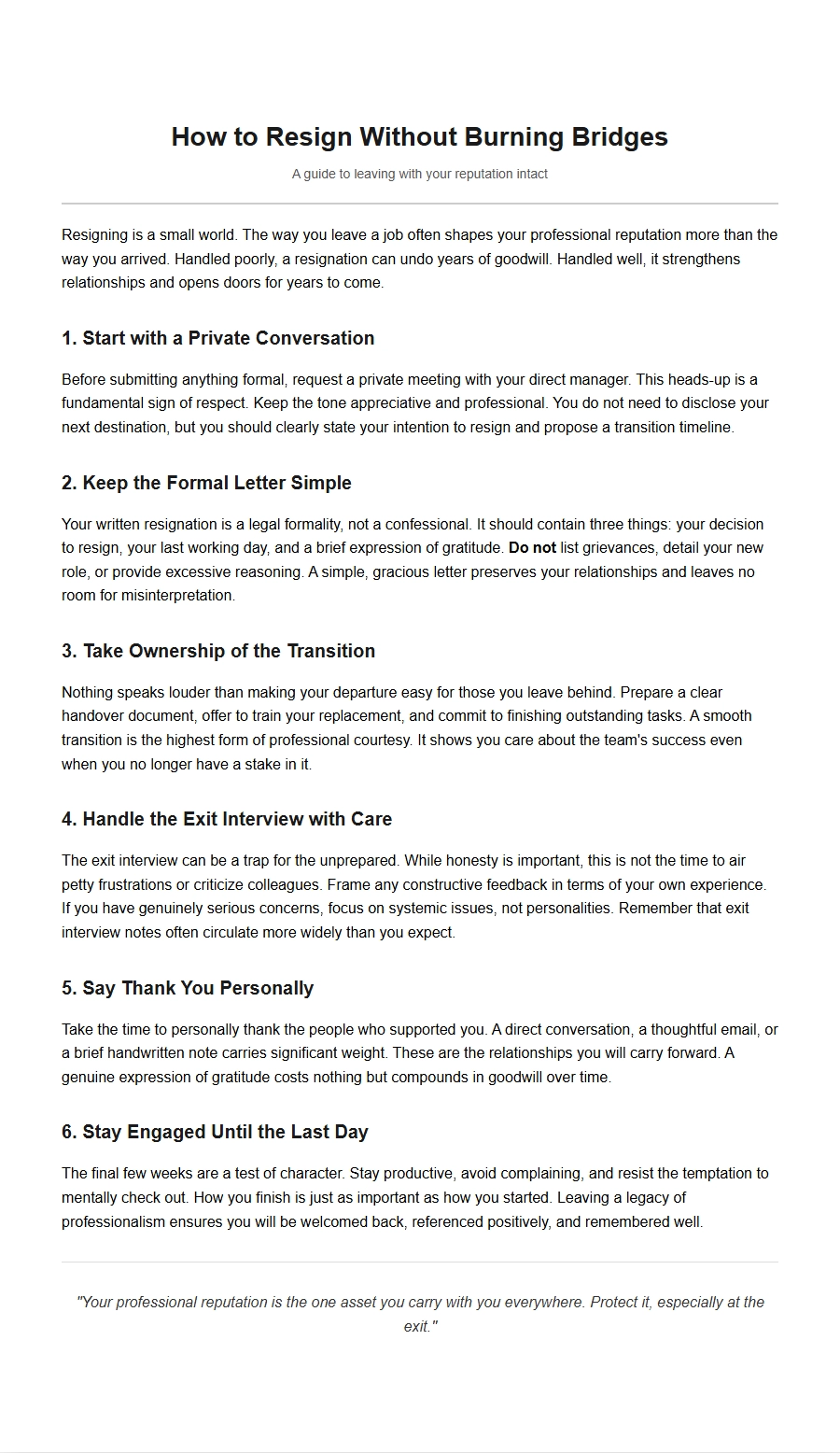 How to Resign Without Burning Bridges
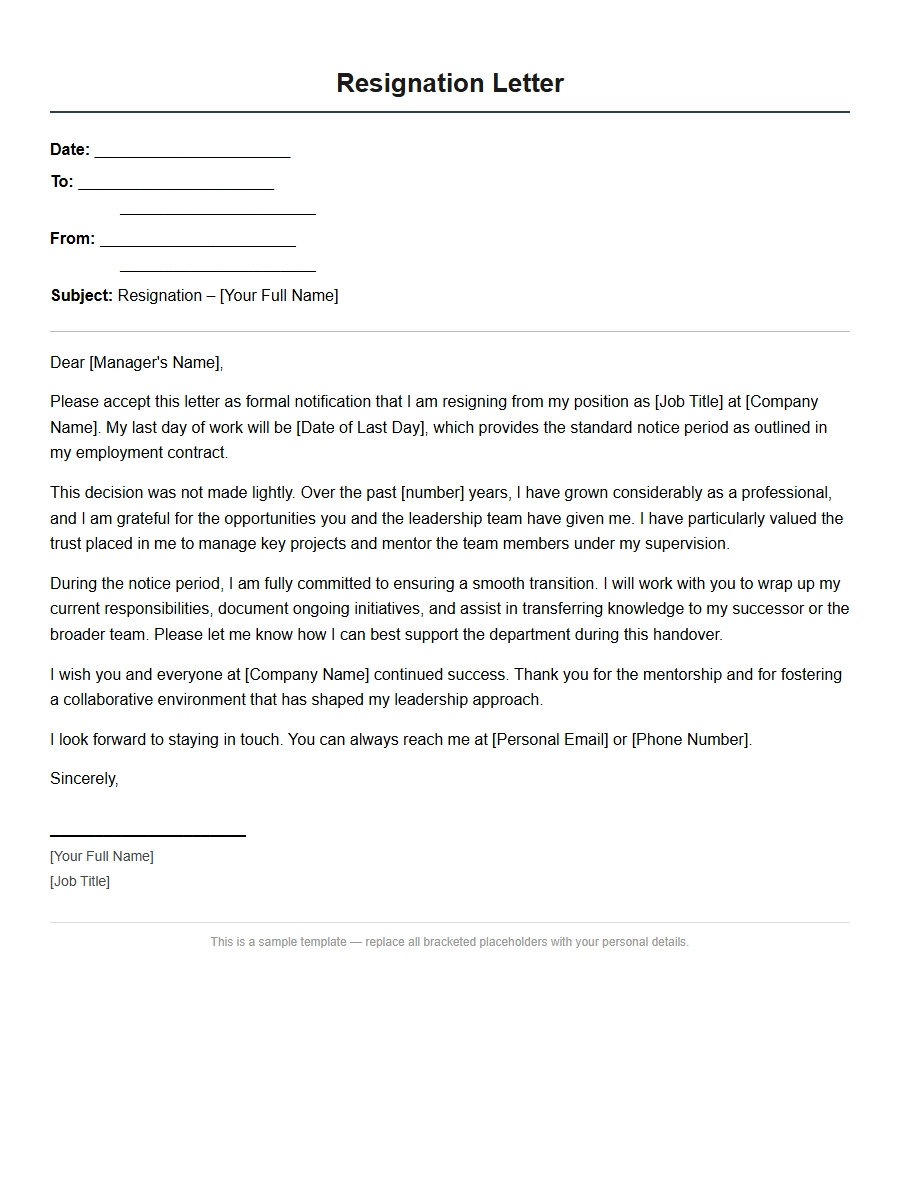 Formal Resignation Letter Sample for Manager
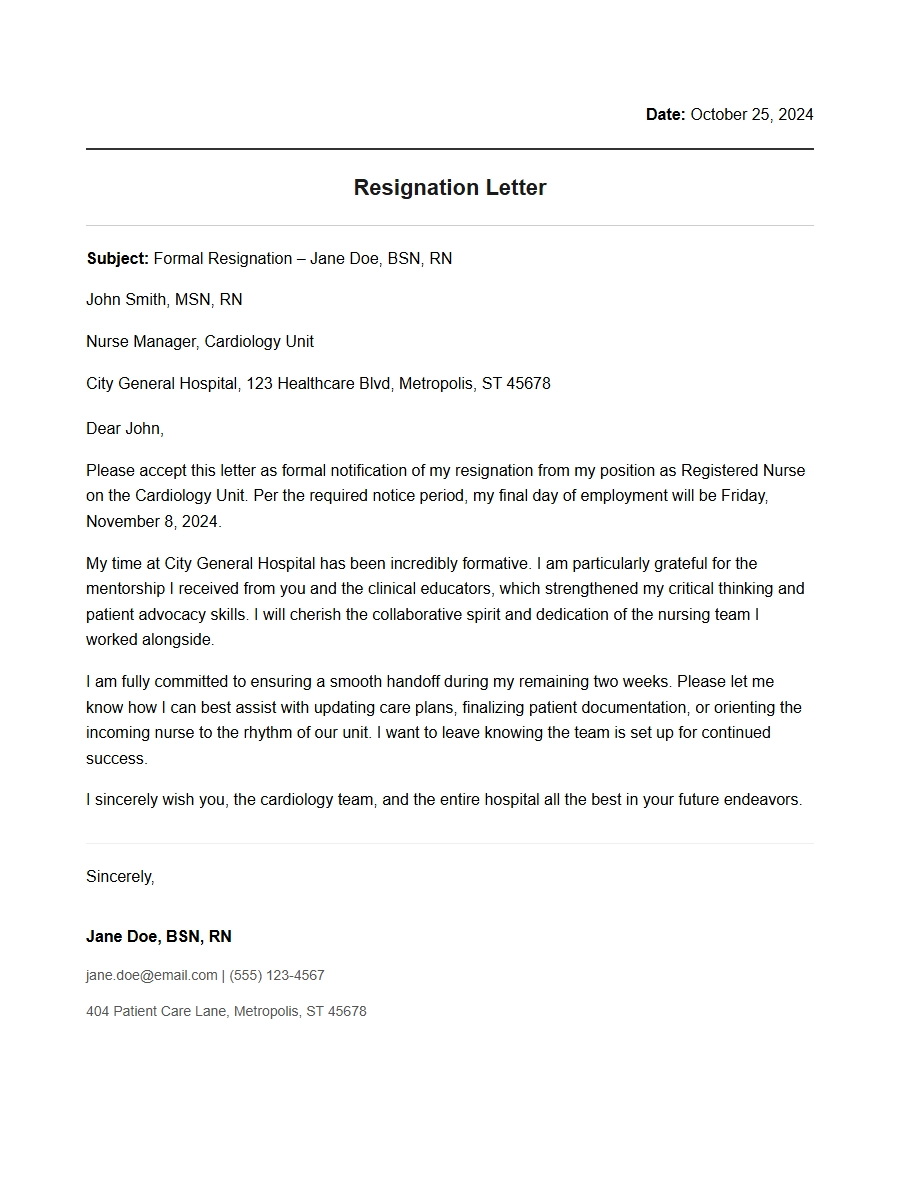 Nurse Resignation Letter with 2 Weeks Notice