how to notify supervisor of departure - Resignation Letters
You need to send a letter to notify your supervisor of your departure, but you’re not sure how to phrase it without sounding abrupt or ungrateful. Maybe you’re worried about burning a bridge, or you just want to make sure you include all the necessary details. The blank page stares back at you, and the clock is ticking.
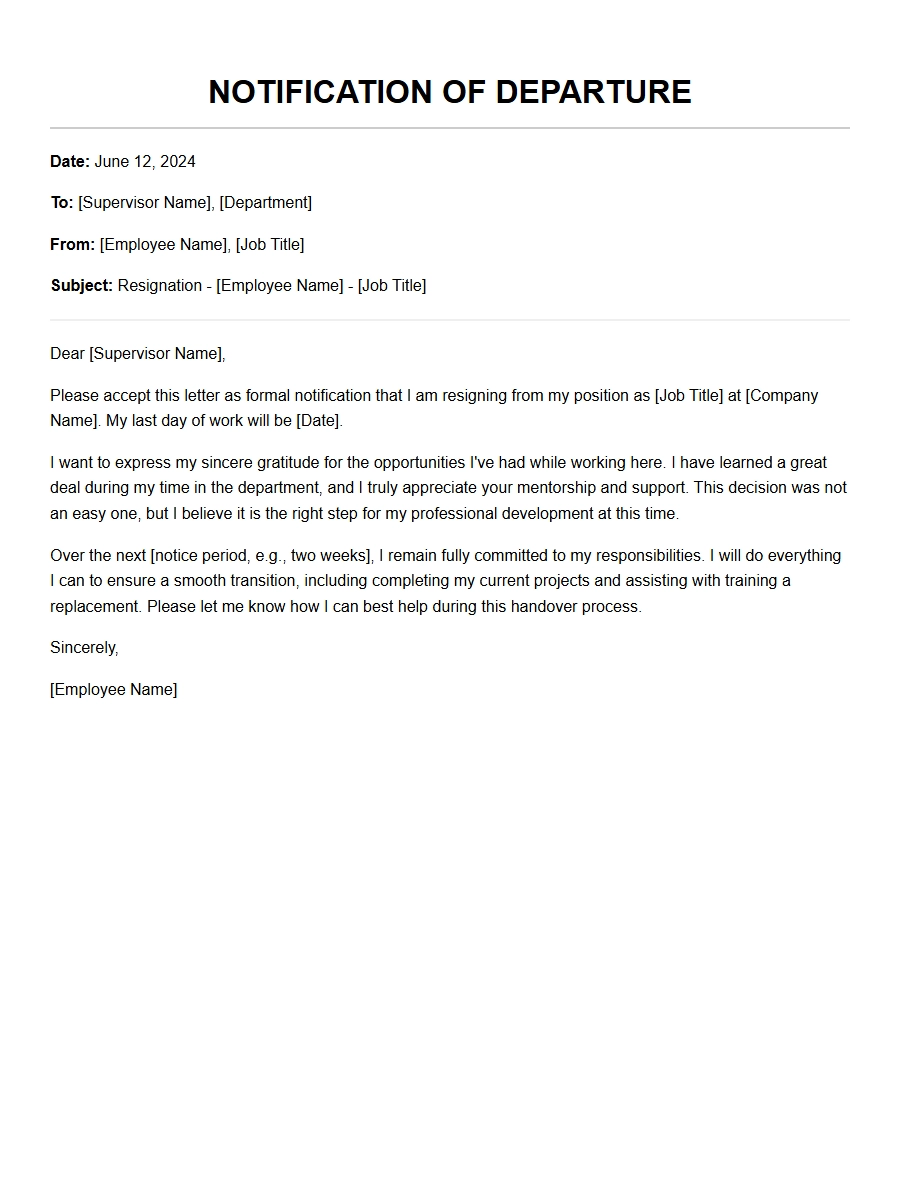
That’s the moment a solid resignation letter sample becomes your best friend. Using a sample isn’t cheating. It’s a smart shortcut. A good sample gives you the structure, the right tone, and the key phrases you need—while leaving plenty of room for your own voice. It turns that anxiety into a polished draft in minutes.
What does “notifying your supervisor of departure” actually mean?
It means formally telling your boss you’re leaving your job. The goal is to be clear, professional, and respectful. This isn’t the place to vent about frustrations or list complaints. It’s a straightforward announcement. You state your last working day, offer to help with the transition, and express gratitude for the opportunity. That’s it.
You’ll use this type of letter when you’ve accepted another position, are leaving for personal reasons, or have decided to retire. It’s a standard piece of professional correspondence that protects your reputation and keeps things clean.
How do you choose the right letter template for your situation?
Not all resignations are the same. The right letter template depends on your relationship with your boss and your industry. A formal corporate environment might call for a standard business letter format with a clear salutation and closing. A more casual startup might accept a friendly email.
How do you adapt a sample without sounding like a robot?
This is where most people get stuck. They copy a sample word for word, and it shows. The letter feels stiff, like a boilerplate form letter. The fix is simple: edit the opening paragraph to sound like you. Start with a sentence that honestly reflects your situation.
If you’re leaving because of work-life imbalance, you can say, “I’ve made the difficult decision to resign to focus on my well-being.” If you’re moving to a new city, mention that. The sample gives you the structure, but you provide the honesty. Keep the tone in writing polite but direct. Avoid phrases like “I regret to inform you” if that’s not how you actually talk. Write how you speak, just slightly more formal.
Another common mistake is using an outdated salutation and closing. “To Whom It May Concern” is almost never right for a supervisor. Use their name. And don’t forget to include a proper letterhead design—your name, address, email, and phone number at the top. If you’re sending this as an email, use a digital letter format with a clear subject line like “Resignation – [Your Name].”
What are the most common mistakes people make?
Being too vague. You must state your official last working day. “Soon” isn’t clear enough.
Ignoring the format. If you’re emailing, you don’t need the full address block. If you’re printing, use standard margins and fonts.
Skipping the transition plan. Offer to help train your replacement or finish current projects. This shows letter writing etiquette and professionalism.
Forgetting to proofread. A typo in a resignation letter looks careless. Read it aloud. Use a tool or ask a friend. Proofreading your letter before sending saves embarrassment.
This is where you prove you’re leaving on good terms. Offer a specific transition plan. For example, “I’m happy to spend my final two weeks documenting processes and meeting with team members to ensure a smooth handoff.” This takes the pressure off your supervisor and shows you’re thinking about the team.
If your departure is due to work-life imbalance, you don’t need to apologize for leaving. Just state your reasons briefly and professionally. A resignation letter due to work-life imbalance can be straightforward without oversharing.
A quick tip for tailoring the opening paragraph
The first sentence sets the tone. Don’t bury the lead. Start with something like, “Please accept this letter as formal notification that I am resigning from my position as [Job Title], effective [Last Day].” That’s direct and professional. Then, in the next sentence, add a personal touch: “I have truly enjoyed working with this team and appreciate the opportunities I’ve had here.”
Ever received a letter that felt too stiff or too casual? You know the difference instantly. Aim for warm professionalism. It’s the sweet spot.
Think of the sample as a springboard, not a crutch. The best letters feel both professional and personal. They show respect for the relationship while being clear about the decision. Practice makes this process faster. The first one might take you an hour. The second will take twenty minutes.
Samples to Guide You
how to notify supervisor of departure - Resignation Letters
Formal Resignation Letter
Date: March 15, 2025
To: [Supervisor Name], [Department]
Subject: Resignation – [Your Name]
Dear [Supervisor Name],
Please accept this letter as formal notification that I am resigning from my position as [Job Title] at [Company Name]. My last day of employment will be April 15, 2025, providing a full two weeks’ notice.
Detail
Information
Employee Name
[Your Name]
Position
[Job Title]
Last Working Day
April 15, 2025
Notice Period
2 weeks
I want to thank you for the opportunities to grow professionally during my time here. I will ensure a smooth transition by completing handover notes and assisting in training a replacement before my departure.
Sincerely, [Your Name]
Email to Supervisor – Immediate Resignation
To: [Supervisor Email]
Subject: Immediate Resignation – [Your Name]
Dear [Supervisor Name],
I am writing to notify you that I must resign from my position effective immediately due to an urgent personal situation. My last day of work is today, [Current Date].
I apologize for the short notice; this decision was unavoidable.
I have packed my personal belongings and will return all company property (laptop, badge, keys) by end of day.
I have emailed a brief handover document to [Colleague Name] for critical tasks.
Please let me know how to process final pay and any exit formalities.
I truly appreciate the support I received during my employment here. I wish the team continued success.
Best regards, [Your Name]
Two Weeks Notice with Transition Plan
Date: [Current Date]
To: [Supervisor Name]
Subject: Resignation and Transition Plan – [Your Name]
Dear [Supervisor Name],
This letter serves as my two weeks’ notice of resignation from [Company Name]. My final day will be [Last Day, e.g., March 29, 2025].
I have prepared a transition plan to minimize disruption:
Week 1 (March 15–21): Complete all current reports; document processes for each task; meet with [Backup Person] daily for knowledge transfer.
Week 2 (March 22–29): Finalize handover documents; assist in onboarding; return all company assets by March 28.
I am committed to ensuring a seamless handover. Please let me know if there are additional priorities you would like me to address before my departure.
Thank you for the opportunity to work here. I have learned a great deal.
Sincerely, [Your Name]
Resignation Letter with Reason – New Opportunity
Date: [Current Date]
To: [Supervisor Name]
Subject: Resignation – [Your Name]
Dear [Supervisor Name],
I am writing to formally resign from my position as [Job Title], effective [Last Working Day]. I have accepted a new opportunity that aligns closely with my long-term career goals.
I have enjoyed my time at [Company Name] and am grateful for experiences such as:
Leading the [Project Name] team to a successful launch.
Developing my skills in [Skill Area] under your mentorship.
Collaborating with dedicated colleagues across departments.
During my notice period, I will:
Complete all pending deliverables.
Update documentation for my role.
Provide a detailed handover to [Replacement Name].
Thank you for your understanding and support.
Best regards, [Your Name]
Thankful Resignation Letter
Date: [Current Date]
To: [Supervisor Name]
Subject: Resignation with Gratitude – [Your Name]
Dear [Supervisor Name],
It is with a mix of sadness and excitement that I submit my resignation as [Job Title]. My last day will be [Last Working Day, 2 weeks from now].
I want to express my sincere appreciation for the opportunities I have had here. Highlights of my experience include:
Experience
Impact
Mentorship from you
Improved my leadership skills
Cross‑functional project
Broadened my business understanding
Training new hires
Reinforced my own knowledge
I will ensure all current projects are tied up before I leave. Please let me know how I can best assist with the transition.
Thank you again for everything. I hope to stay in touch.
Warmly, [Your Name]
Resignation Due to Relocation
Date: [Current Date]
To: [Supervisor Name]
Subject: Resignation due to Relocation – [Your Name]
Dear [Supervisor Name],
I am writing to inform you that I must resign from my position, effective [Last Day], as my family and I are relocating to [City/State] due to [reason: spouse job transfer / personal move].
I have thoroughly enjoyed my [number] years at [Company Name]. This decision was difficult because of the supportive work environment you have fostered.
To assist with the transition:
I will complete all outstanding tasks by [date].
I have prepared a detailed role manual available on the shared drive.
I am available for calls or video meetings after my move for two weeks to answer questions.
Please let me know the procedure for returning company equipment and final settlement.
Thank you for understanding this personal decision.
Sincerely, [Your Name]
Short Notice Resignation for Health Reasons
Date: [Current Date]
To: [Supervisor Name]
Subject: Resignation – Medical Reasons – [Your Name]
Dear [Supervisor Name],
I regret to inform you that I must resign from my role effective [immediately / in 1 week]. My healthcare provider has advised me to step away from work to focus on my recovery.
I have done my best to ensure continuity:
Critical tasks have been documented and shared with [Colleague Name].
My password manager credentials have been transferred to IT.
All company files are organized in the shared folder.
I appreciate the flexibility you have shown me in the past and am sorry for the short notice. Please advise on the next steps for formalities.
Thank you for your understanding.
Best wishes, [Your Name]
Resignation with Request for Counteroffer
Date: [Current Date]
To: [Supervisor Name]
Subject: Resignation and Open Discussion – [Your Name]
Dear [Supervisor Name],
I am writing to notify you of my resignation from [Company Name], effective [Last Day], unless a suitable counteroffer can be reached.
I have received another offer that I am inclined to accept. However, I value my work here and would like to explore if there is an opportunity to stay under revised terms.
Key factors that would encourage me to remain:
Factor
Current
Desired
Base Salary
$X
$Y
Role Scope
[Current]
[Slightly expanded]
Flexible Hours
None
2 days remote
I am open to discussing this further within the next week. If no counteroffer is possible, I will proceed with my departure as scheduled and ensure a thorough handover.
Thank you for considering this.
Sincerely, [Your Name]
Resignation Letter with Handover Table
Date: [Current Date]
To: [Supervisor Name]
Subject: Resignation and Handover Plan – [Your Name]
Dear [Supervisor Name],
I am writing to formally resign from my position as [Job Title], effective [Last Day]. I will provide a full two weeks’ notice.
To ensure a smooth transition, I have outlined my current responsibilities and suggested handover actions:
Task
Status
Handover To
Notes
Monthly report
Draft ready
[Colleague A]
Template shared
Client accounts
In progress
[Colleague B]
Meeting scheduled
Inventory audit
Completed
NA
Final file linked
I will schedule daily 30‑minute handover sessions during my final week. Please let me know if there are additional tasks you want covered.
Thank you for the growth opportunities at [Company Name].
Best regards, [Your Name]
Immediate Resignation Letter – Supervisor Out of Office
I am writing to notify you of my resignation effective immediately. I realize you are out of the office, so I have also copied HR to ensure prompt processing.
This decision is due to an unforeseen family emergency that requires my full attention. I apologize for not being able to provide the customary notice.
To assist during my absence:
I have emailed a task summary to [Backup Colleague].
All relevant passwords and access details have been submitted via the IT portal.
My project files are organized in the shared team drive under “Active – [Your Name].”
I will be reachable at [phone number] for the next three days for any urgent questions.
Thank you for your understanding. I value the time I spent working here.
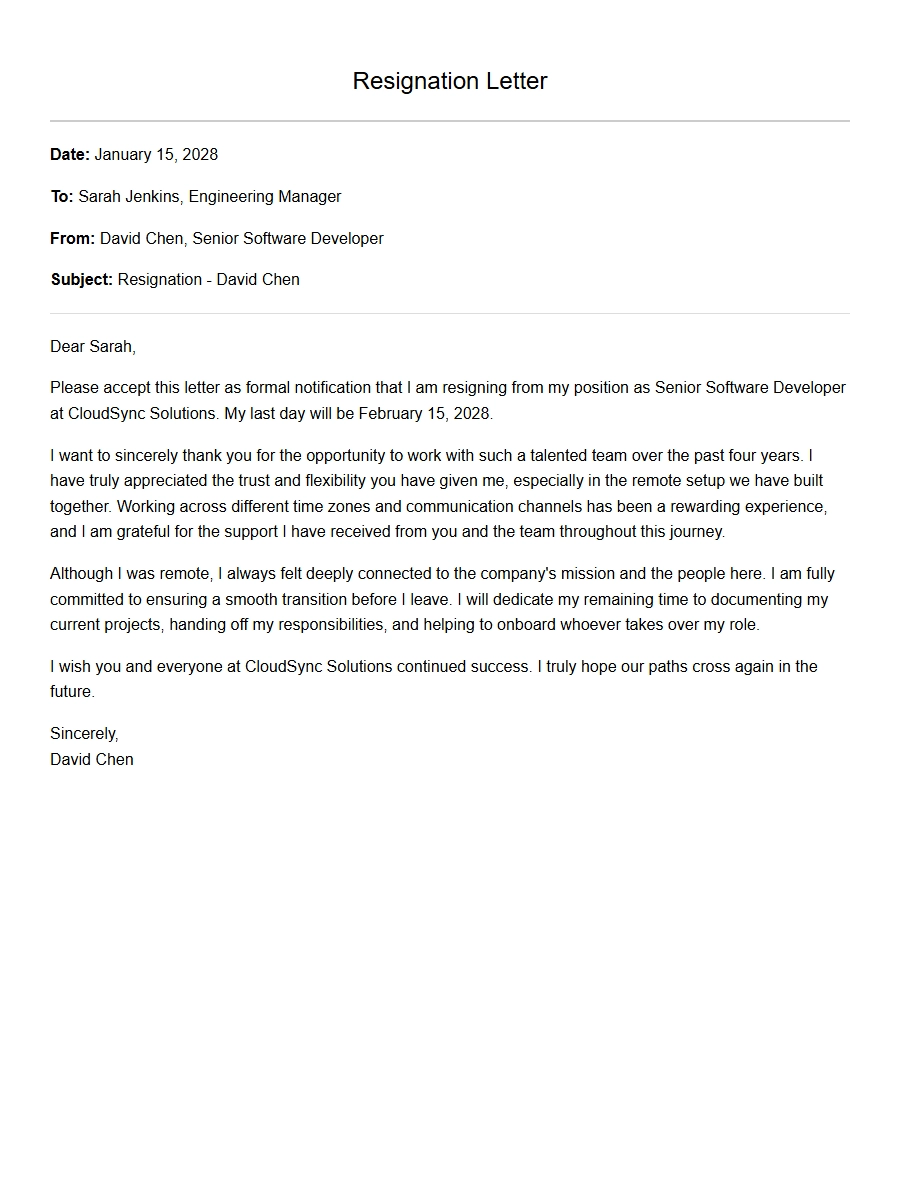 Polite Resignation Email for Remote Employees
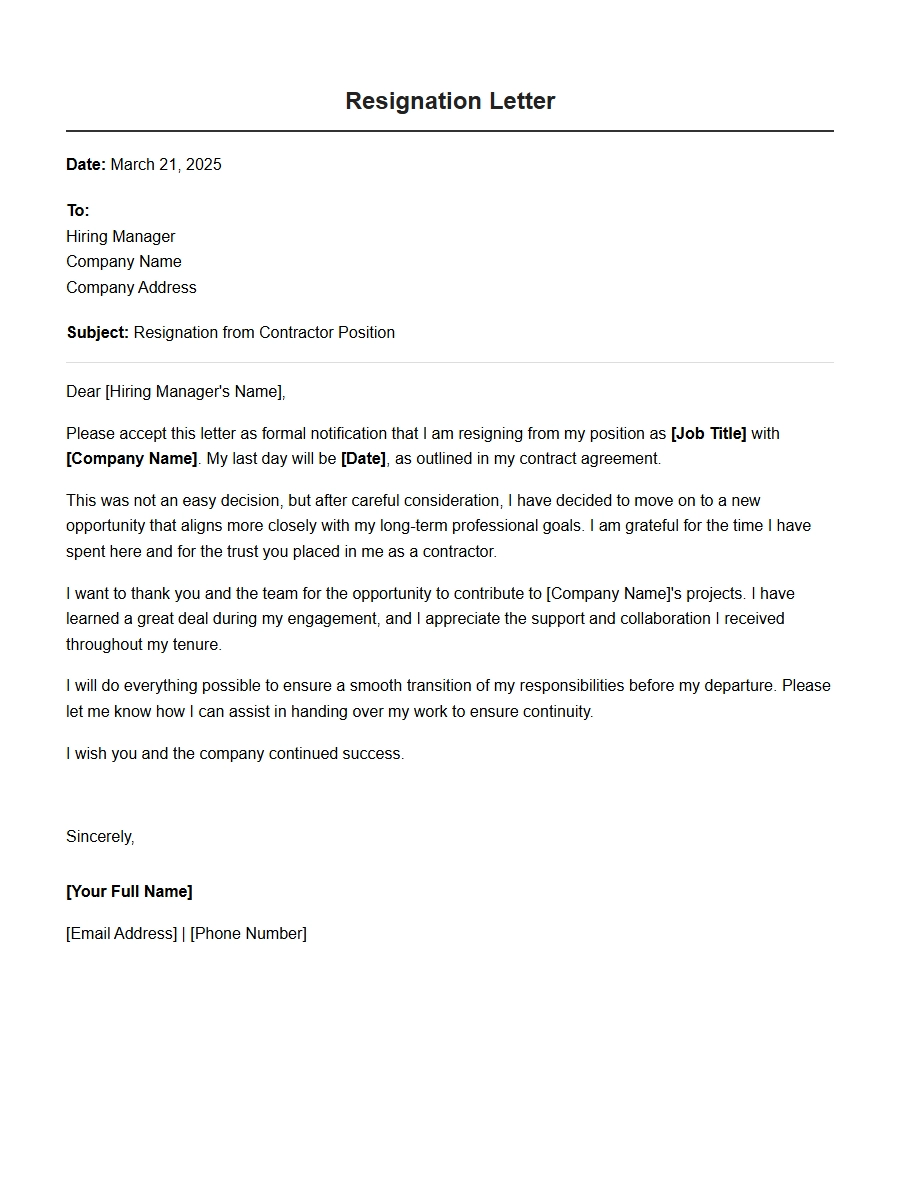 Short Resignation Letter for Contractor Position
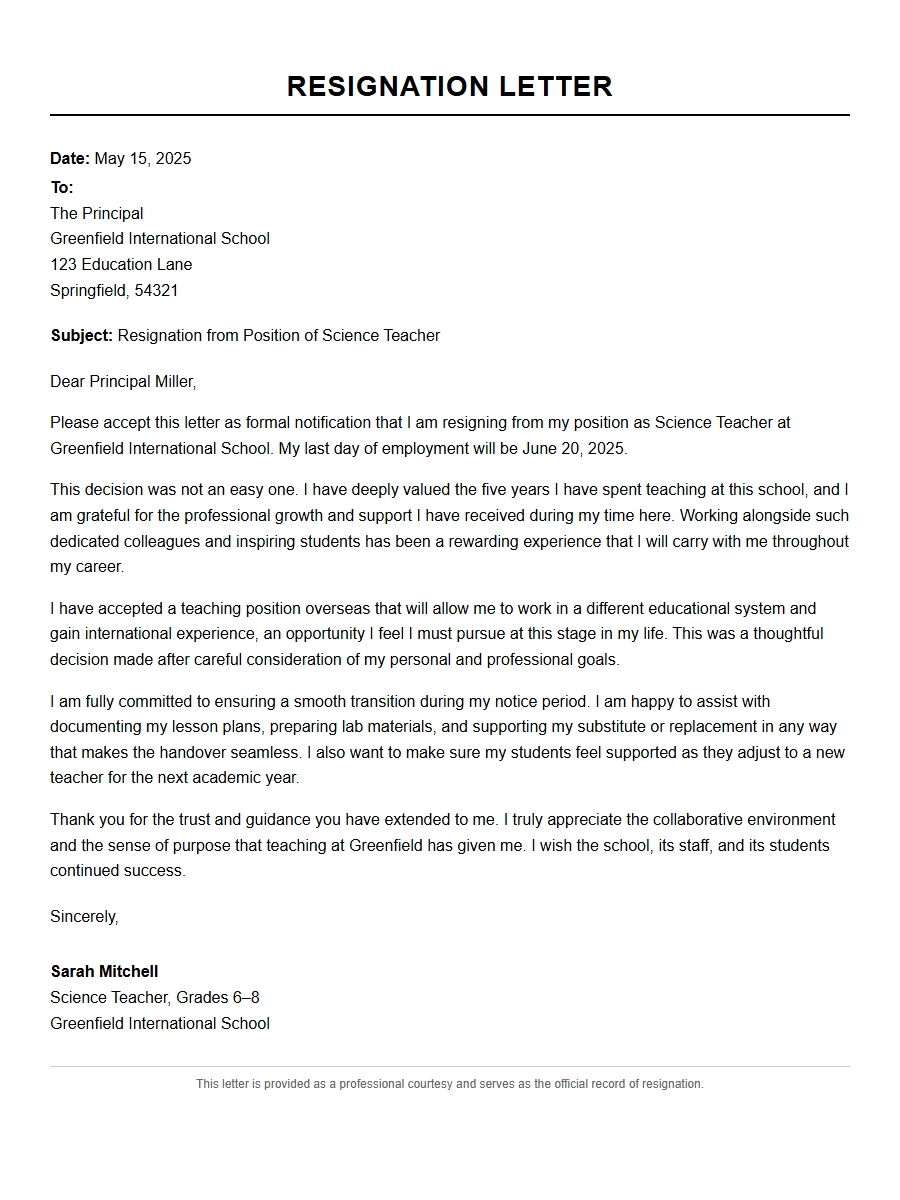 Teacher Resignation Letter Example
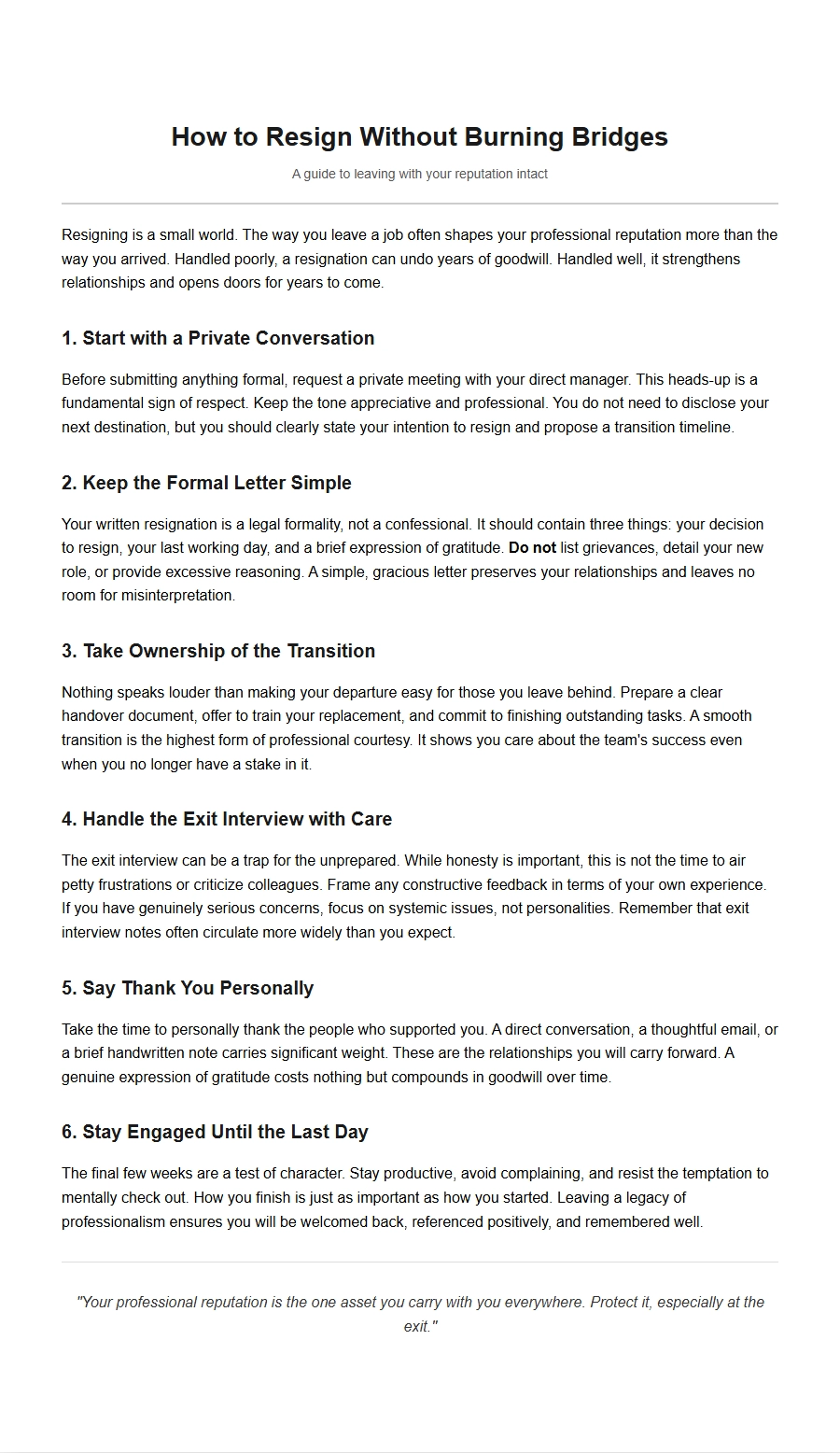 How to Resign Without Burning Bridges
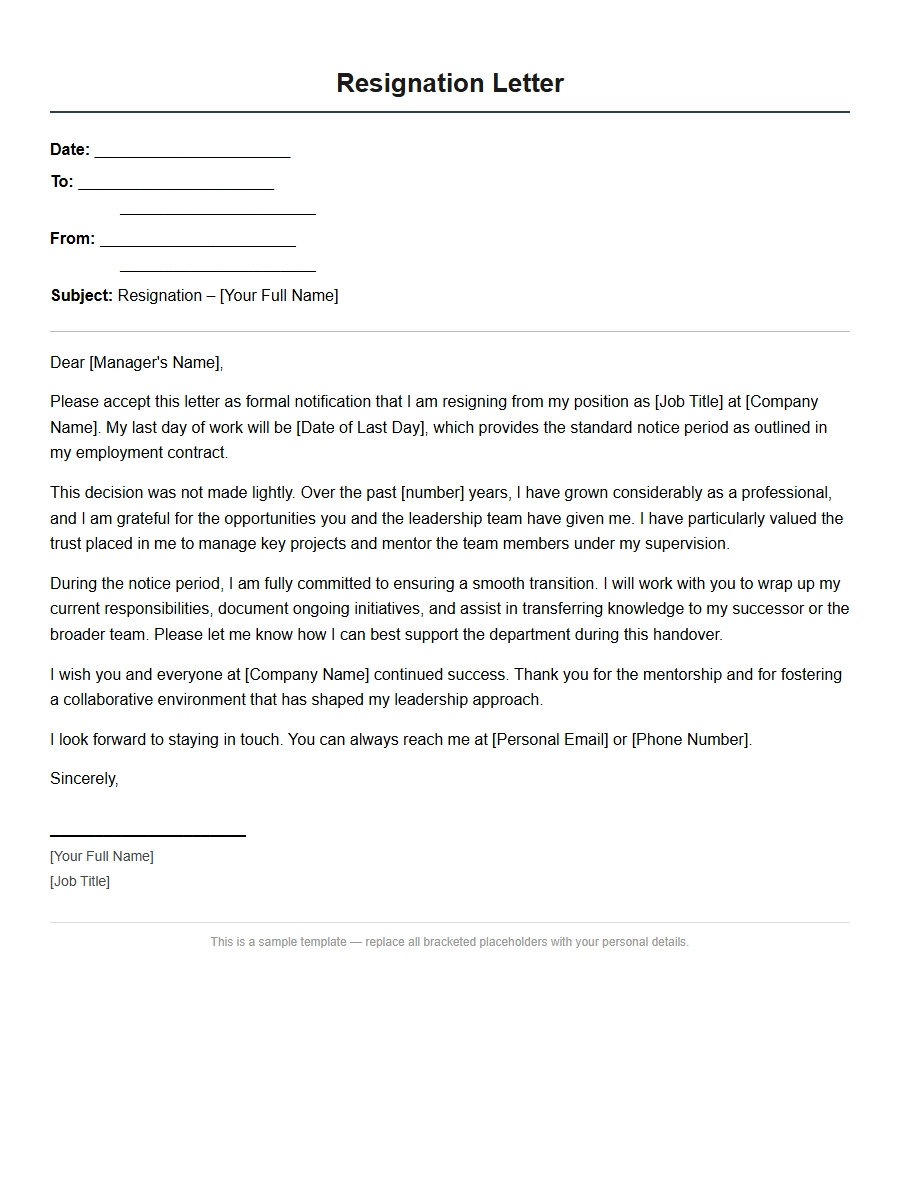 Formal Resignation Letter Sample for Manager
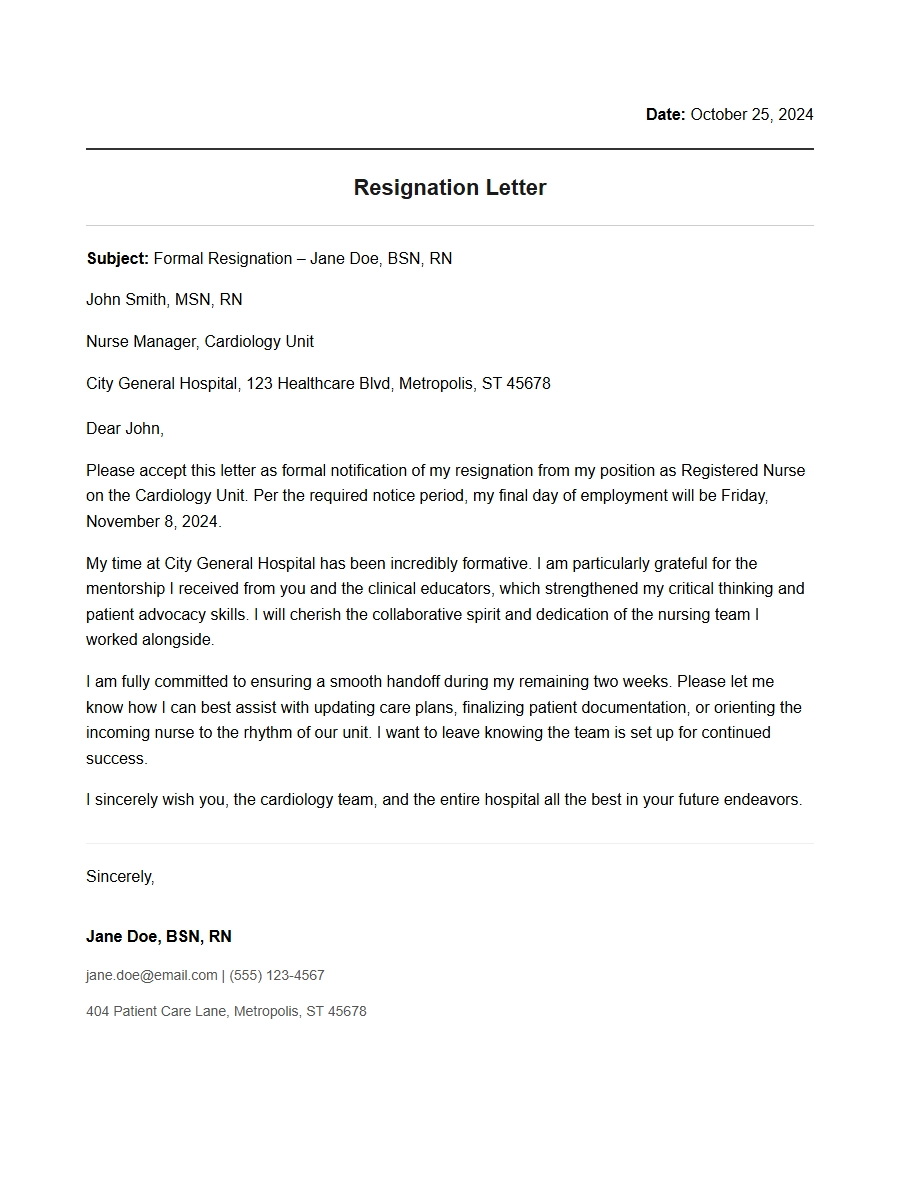 Nurse Resignation Letter with 2 Weeks Notice