Recommendation Letters for Housing Voucher Eligibility
You have to write a letter supporting someone’s housing voucher eligibility, but the blank page stares back at you. Maybe it’s a landlord reference, a letter from an employer, or a note from a caseworker. You know the person needs this letter to move forward, and the deadline is tight. That feeling of “where do I even start?” is common, but the right sample can turn that anxiety into a confident, polished draft in minutes.
Why a letter sample isn’t cheating—it’s smart strategy
Using a letter template doesn’t mean you’re cutting corners. It means you’re borrowing proven structure, tone, and key phrases that already work. A good sample gives you the professional correspondence framework so you can focus on the specific details that matter: why this person qualifies, how they’ve been a responsible tenant, or why they deserve the voucher. You’ll still customize every sentence. Think of the sample as a scaffold, not a finished wall.
What housing voucher eligibility support really means
When someone applies for a Section 8 or other housing choice voucher, they often need letters of recommendation or verification from landlords, employers, or community members. These letters help the housing authority verify income, rental history, and character. A well-written letter of recommendation can make the difference between approval and a long wait. It’s not about exaggerating—it’s about presenting facts in a clear, credible way.
How to pick the right sample for your situation
First, decide the letter’s purpose. Are you writing as a landlord confirming rent payments and behavior? That calls for a formal business letter format with dates and dollar amounts. As an employer verifying income and stability? Then a concise, factual tone works best. As a character reference from a nonprofit or spiritual counselor? You’ll want a warmer, narrative style.
If you’re unsure, look at cover letter examples for similar situations—but remember, this isn’t a job application. The reader is a housing official who needs specific evidence. Avoid flowery language. Stick to concrete facts like “Paid rent on time for 18 months” or “Works 30 hours a week at $15 per hour.”
Adapting a sample without losing your voice
Once you have a template, read it through. Change the salutation and closing to fit the recipient—something like “Dear Housing Authority Caseworker” works if you don’t have a name. Then rewrite the opening paragraph to grab attention. Start with your relationship to the applicant: “I have been John’s landlord for three years,” or “I supervise Maria at ABC Company.” That establishes credibility immediately.
Avoid common mistakes like using outdated salutations (“To Whom It May Concern” is still sometimes okay, but “Dear Housing Eligibility Team” is better). Also check the digital letter format: if you’re emailing, skip the full letterhead design and keep a clean subject line. If printing, include your contact info and date.
Tone matters more than you think
Ever received a letter that felt too stiff or too casual? The sweet spot is professional but human. Use contractions (“he’s been reliable,” “we’ve never had issues”). Keep sentences short. Don’t say “the aforementioned individual,” say “the tenant.” Use formal writing tips as a guide, but let your natural voice come through. The housing authority staff read dozens of letters; yours should feel genuine.
Quick tips for tailoring the opening paragraph
Start with your credentials and your relationship length. Then state the purpose clearly: “I am writing to support Sarah’s application for a housing voucher.” Follow with the most important fact first—steady income, on-time rent, good neighbor behavior. This front-loading helps busy reviewers get the key info fast.
Also pay attention to letter writing etiquette. Address the letter to the correct office (some vouchers are county-specific). Use a respectful salutation and closing. Proofread for typos and missing dates. A small error like a wrong apartment number can raise doubts.
[Category: Housing Assistance Letters]
Common pitfalls to avoid
Don’t write a generic “this is a good person” letter. Be specific. Mention exact dates, amounts, or examples. Avoid vague claims like “always pays on time” without proof. If you’re a landlord, include rent amount, payment history, and lease term. If you’re an employer, state job title, length of employment, and average hours.
Another mistake: ignoring the difference between email and printed letter. In an email, use a short subject line like “Landlord reference for [Name] – Housing voucher application.” Keep the body concise, and attach a PDF version if needed. For a printed letter, use letterhead design if you have one, or simply type your address at the top.
Use the sample as a springboard, not a crutch
The best letters feel both professional and personal. After you adapt the sample, read it aloud. Does it sound like you? If not, tweak the phrasing until it matches your natural speech. Practice will make the process faster. Next time someone needs your support for a housing voucher, you’ll know exactly where to start.
If you’re writing a character witness for criminal trial recommendation letters or other non-housing contexts, the same principles apply: be factual, be specific, and let your authentic voice show. For a spiritual counselor testimony recommendation letter, emphasize character, responsibility, and stability. Each situation has its own flavor, but the core structure of a strong support letter stays the same.
Extra Samples
Recommendation Letters for Housing Voucher Eligibility
Landlord Reference Letter for Voucher Holder
To: Housing Authority Review Board
From: Jennifer Martinez, Property Manager at Oakwood Rentals
Re: Recommendation of Maria Santos for Housing Voucher Eligibility
I have rented to Maria Santos for the past three years at 1425 Pine Street, Apt 3B. During this time, she has consistently paid rent on time and maintained the apartment in excellent condition. Her total monthly rent has been $950, which is well within the local housing voucher payment standard.
Key observations supporting her eligibility:
No late rent payments in 36 months
Multiple lease renewals without issue
Positive relationship with neighbors
Property inspections always passed
I fully recommend Ms. Santos for continued housing voucher support. She is a responsible tenant who deserves stable housing.
Please contact me at (555) 123-4567 for further details.
Employer Letter Confirming Income Stability
Date: October 15, 2023
To: Housing Voucher Program Coordinator
From: Robert Chen, Manager at GreenLeaf Grocery
Subject: Employment Verification for James Thompson regarding voucher eligibility
James Thompson has been employed full-time with GreenLeaf Grocery since June 2020. He currently works as a stock clerk earning $15.50 per hour with a consistent 35-hour weekly schedule. His gross monthly income averages $2,100.
Additional employment details:
Category
Details
Start Date
June 12, 2020
Position
Stock Clerk (Permanent)
Hourly Wage
$15.50
Average Weekly Hours
35
Pay Frequency
Bi-weekly
Mr. Thompson is a reliable employee who has not taken any unapproved leave in the past year. His income is stable and verifiable, making him a suitable candidate for housing voucher support. Please call me at (555) 789-0123 if needed.
Social Worker Support Letter for Family Voucher
To: Housing Authority Eligibility Department
From: Patricia Nguyen, LCSW, Community Support Services
Re: Support for the Walker Family housing voucher eligibility
I have worked with the Walker family since January 2022 as their case manager. The family includes single mother Sandra Walker and her two children, ages 4 and 7. They currently reside in a crowded one-bedroom apartment that exacerbates the children's asthma conditions.
Critical factors for voucher eligibility support:
Current housing is severely overcrowded (3 persons in 1 bedroom)
Mold issues worsen respiratory health
Rent burden exceeds 60% of monthly income
Children's school performance suffers due to unstable housing
I strongly recommend approval of a Section 8 voucher to enable the family to secure a safe, two-bedroom unit. Stable housing would significantly improve their health outcomes and overall well-being. Please contact me at (555) 234-5678 for confirmation.
Disability Advocate's Recommendation for Accessible Housing
Date: November 3, 2023
To: Voucher Program Review Committee
From: Kevin Brooks, Disability Rights Coordinator
Re: Eligibility support for David Harper
David Harper, a 45-year-old veteran with mobility impairments, requires housing voucher support to access an accessible unit. He currently resides in a third-floor walk-up with no elevator, which is medically inappropriate.
Medical accommodations needed in housing:
Requirement
Current Status
Wheelchair-accessible entrance
Not available
Wider doorways (32+ inches)
Not met
Roll-in shower
Missing
Accessible kitchen counters
Not present
Mr. Harper receives $1,200 monthly in VA benefits and $350 in SSI. He has housing costs of $850 currently, leaving insufficient funds for other needs. A voucher would allow him to move to a ground-floor unit with proper modifications. His application merits full approval.
Clergy Letter for Community Housing Support
To: Housing Voucher Eligibility Board
From: Reverend Michael Harris, St. Mary's Community Church
Subject: Recommendation for Lisa Ramirez housing voucher eligibility
I have known the Ramirez family for five years through our congregation. Lisa Ramirez is a devoted mother of three who works part-time as a home health aide. Her family currently lives in a motel room due to rental costs outpacing her $1,800 monthly income.
Community observations supporting voucher need:
Family has been homeless since August 2023
Children miss school due to unstable living situation
Lisa has maintained employment despite housing crisis
Strong ties to local community and school
I urge your committee to approve Lisa's voucher application. Stable housing would allow her children to attend school consistently and reduce family stress. The church can provide referrals for additional support services. Contact me at (555) 345-6789.
Doctor's Medical Necessity Letter for Voucher Priority
Date: September 22, 2023
To: Housing Authority Medical Review Team
From: Dr. Sarah Kim, Internal Medicine
Re: Medical necessity for housing voucher for John Davis
John Davis, age 62, suffers from severe COPD and congestive heart failure. He currently lives in basement apartment with chronic dampness, which triggers frequent respiratory exacerbations. His condition requires a dry, ground-floor unit with good ventilation.
Medical conditions impacted by current housing:
Condition
Housing Impact
COPD
Mold worsens breathing
Heart failure
Stairs cause exhaustion
Limited mobility
No elevator access
Frequent hospitalizations
4 admissions in last year
A housing voucher is medically necessary to relocate Mr. Davis to an appropriate unit. Without it, his health will continue to decline. I support his eligibility and priority status. Contact my office at (555) 456-7890.
Nonprofit Case Manager Letter for Emergency Voucher
To: Rapid Re-Housing Program Manager
From: Alicia Torres, Case Manager, Harbor Homeless Services
Re: Urgent voucher eligibility recommendation for Carlos Mendez
Carlos Mendez, age 29, became homeless after losing his warehouse job in July 2023. He has since secured part-time work at a restaurant earning $1,600 monthly. He is staying in overflow shelter and needs a voucher to secure permanent housing.
Current situation and plan:
Income: $1,600/month from part-time work
Savings: $200 after shelter expenses
Credit: Improving, no evictions
Goal: Obtain studio apartment at $700-$800 rent
Mr. Mendez has no criminal record and has maintained employment since his job loss. With voucher support, he can achieve housing stability within 90 days. I recommend prioritizing his application for emergency voucher eligibility. Contact me at (555) 567-8901.
Veterans Service Officer Letter for VASH Voucher
Date: December 1, 2023
To: HUD-VASH Program Coordinator
From: Thomas Wright, Veterans Service Officer
Subject: Recommendation for VASH voucher eligibility for Robert Jenkins
Robert Jenkins, retired Army sergeant (1998-2006), suffers from PTSD and a service-connected back injury. He currently lives in a cramped rooming house with no kitchen facilities. His monthly income is $1,450 (80% VA disability).
Voucher eligibility factors:
Criterion
Status
Homeless status
Imminent risk
Service-connected disability
70% rating
Income
Below 50% AMI
Need for case management
Yes
I strongly recommend Mr. Jenkins for a HUD-VASH voucher. He is motivated for stable housing and willing to engage with VA healthcare. Please call (555) 678-9012 for further information.
Landlord Letter for Applicant with Past Eviction
To: Housing Authority Appeals Committee
From: Gloria Adams, Private Landlord
Re: Character reference for Alicia Brown to support voucher eligibility
I rented a one-bedroom unit to Alicia Brown from 2018 to 202 [sic, 202 rent was always paid on time until she lost her job in 2020. Yes, there was an eviction filing, but it was due to a temporary medical crisis, not irresponsibility. She has since recovered and maintained steady employment.
Positive qualities observed:
Apartment was left clean and undamaged
No noise complaints from neighbors
Communicated openly about financial difficulty
Paid all back rent within three months of new job
Ms. Brown currently earns $2,200 monthly as a medical assistant. She is a reliable person who deserves a second chance with voucher support. I would rent to her again. Contact me at (555) 789-0123.
Academic Advisor Letter for Student Voucher
Date: October 30, 2023
To: Housing Choice Voucher Program
From: Dr. Linda Park, Academic Advisor, Metro Community College
Re: Voucher eligibility recommendation for student Jamal Owens
Jamal Owens is a full-time sophomore pursuing an associate degree in nursing. He works 20 hours weekly at a campus job earning $800 monthly. He currently couch-surfs with friends, making it impossible to study effectively. His housing instability threatens his GPA, currently 3.7.
Academic and financial summary:
Area
Details
Enrollment
Full-time (12 credits)
GPA
3.7
Income
$800/month work-study
Housing cost
$400-500 needed for room
A housing voucher would allow Jamal to focus on his nursing studies and graduate. He is a promising student who will become a healthcare worker in our community. I fully support his voucher eligibility. Contact: (555) 890-1234.
 Format for Graduate School Faculty Recommendation Letters
 Master's Program Reference Letter Requirements
 The Perfect Structure for a University Reference Letter
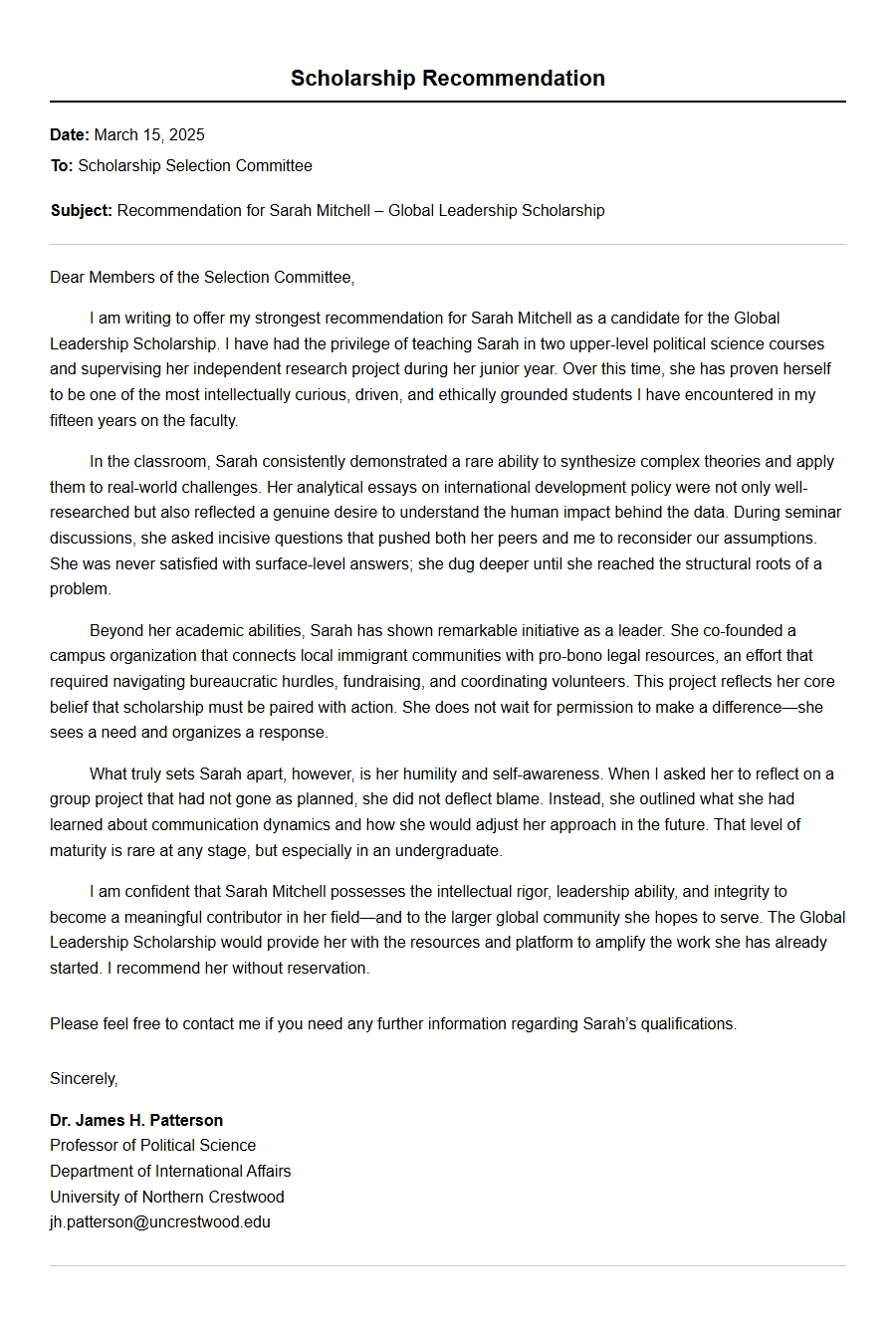 scholarship essay recommendation portion - Recommendation Letters
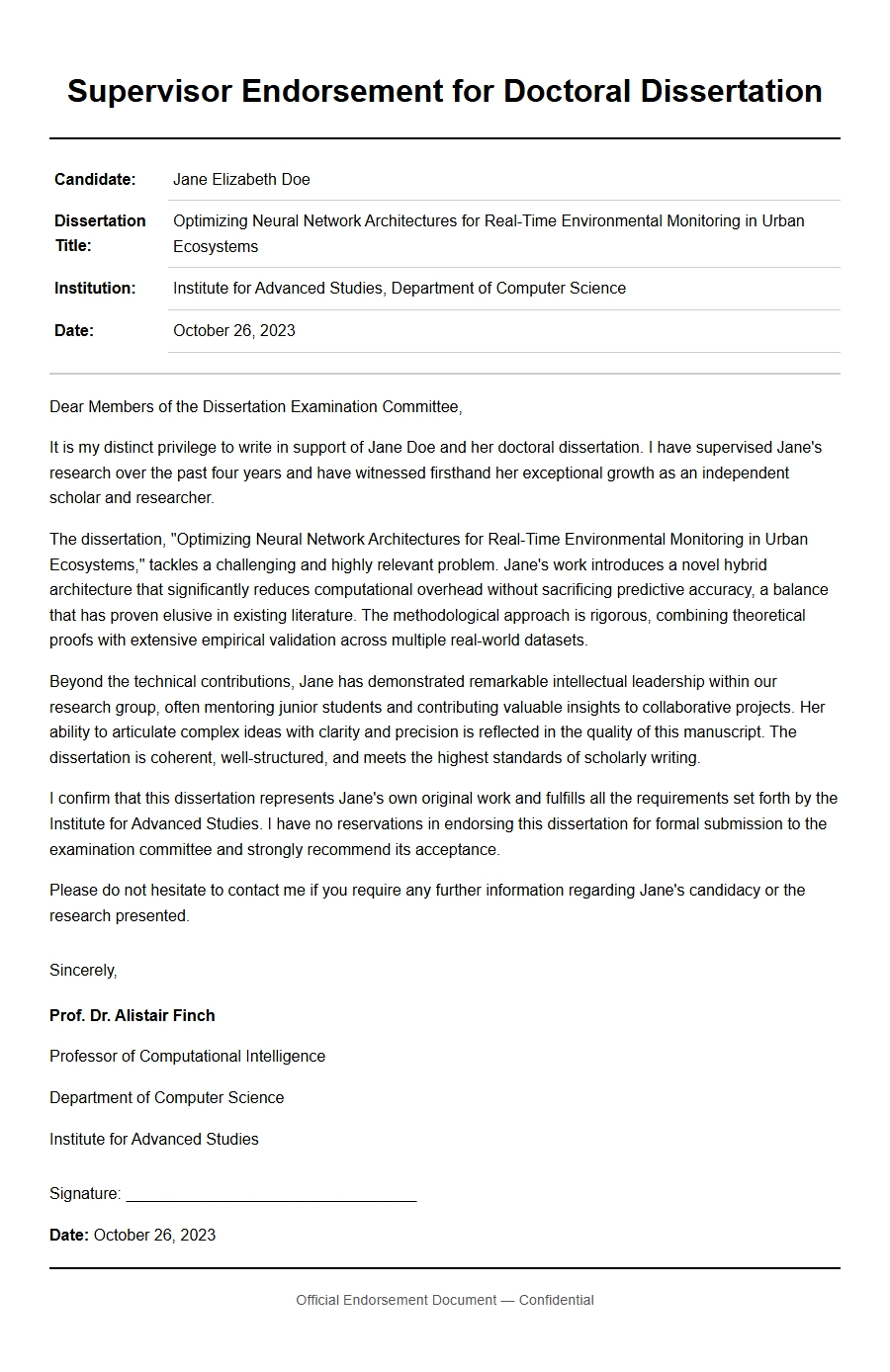 Sample PhD Supervisor Endorsement Letter
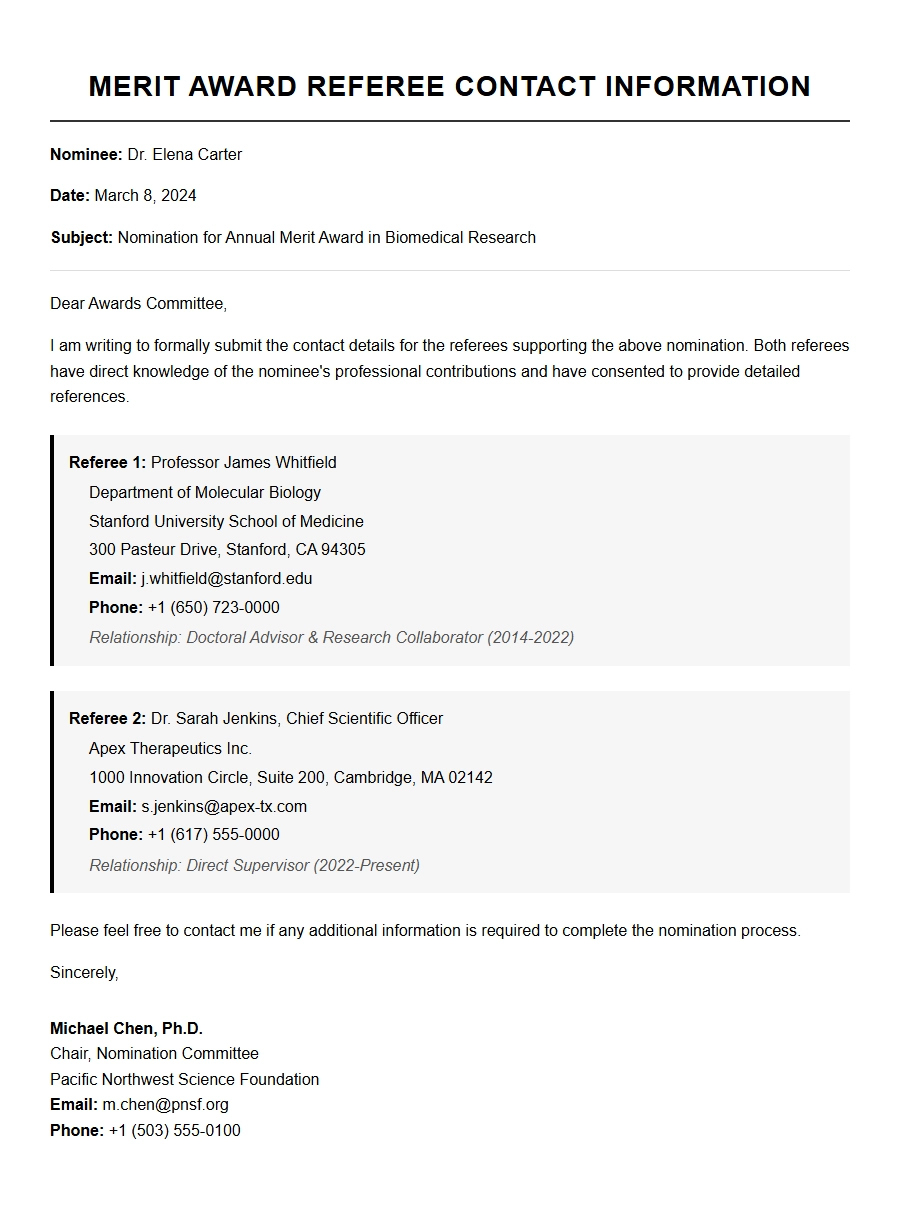 How to Find Your Merit Award Referee Contact Info