You need to write a formal letter notifying the board of your departure, and it feels like every word carries extra weight. One wrong phrase could burn a bridge. A sample letter isn't cheating—it's a shortcut to structure and tone that lets you focus on what matters most: your specific circumstances and your next steps.
A good letter template gives you the skeleton. You fill in the flesh. It saves you from staring at a blank screen and from accidentally leaving out critical details like effective dates or board protocols. The trick is choosing the right one and then making it sound like you.
Category: Resignation Letters
When you need a formal letter notifying board of departure
This isn’t the same as emailing your manager. Board members expect professional correspondence that respects hierarchy and governance. You’re not just resigning from a job; you’re stepping away from a fiduciary relationship. The letter should acknowledge that gravity without being stiff or cold.
Use this type of letter when you’re a C-suite executive, a board member yourself, or a senior leader who reports directly to the board. It’s also appropriate for founders leaving a company board. The business letter format applies: your contact info, date, inside address, salutation, body, and a formal closing.
How to pick the right sample
Not all departure letters are the same. If you’re leaving due to a high-stress environment, your tone will differ from a planned retirement after a fiscal quarter ends. A resignation letter sample that matches your situation gives you realistic language to start with.
If you work in communications—say, as a public relations officer—your letter should reflect professional nuance. For a board, you might reference the employment status change clearly and briefly. If you want to acknowledge timing, check our resignation letter referencing end of fiscal quarter for phrasing that aligns with financial cycles.
Adapting the sample without losing your voice
Start with a solid customizable letter. Then rewrite the opening paragraph to sound like you. Avoid generic lines like “I am writing to inform you.” Instead, say “I’ve decided to step down from my role as [title], effective [date].” That’s direct and respectful.
Keep your tone in writing warm but professional. You can express gratitude without gushing. “I appreciate the trust the board placed in me over the past three years” is stronger than “I’m so thankful for this opportunity.” The board wants to see you’ve thought this through, not that you’re emotional.
If you’re unsure about salutation and closing, stick with “Dear Members of the Board” and “Sincerely.” Avoid “To whom it may concern”—it looks lazy. Also consider letterhead design if the company has official stationery; it adds credibility. For digital letter format, send a PDF unless the board prefers plain text. That way your formatting stays intact.
Common mistakes to avoid
One big mistake: using outdated language like “I hereby tender my resignation.” Boards see that as boilerplate. Instead, use active, clear sentences. Another issue is forgetting to propose a transition plan. Even a single line like “I’m happy to assist in onboarding my successor” shows letter writing etiquette and smooths the relationship.
Always proofreading letter content twice. Read it aloud to catch awkward sentences. Have someone else check it—preferably someone familiar with board communication. A typo in a resignation letter to the board can overshadow your entire message.
For industry-specific roles, like PR or public relations, tailor your sample accordingly. The resignation letter for public relations officer offers cues on how to maintain a positive public stance even in your private correspondence.
Final check before sending
Run through this quick mental list:
Is the effective date clearly stated?
Did you thank the board genuinely?
Did you offer a transition plan (or at least willingness to help)?
Is the tone consistent—neither overly casual nor robotic?
Did you save it as a PDF with your signature?
Your letter structure should guide the board from “I’m leaving” to “Here’s how I’ll help” to “Thank you.” Keep paragraphs short—two to four sentences. Boards scan letters quickly; make the key points easy to find.
Use the sample as a springboard, not a crutch. The best resignation letters feel both professional and personal. With practice, writing these becomes faster and less intimidating. You already have the experience; the sample just helps you present it clearly.
Samples You Can Use
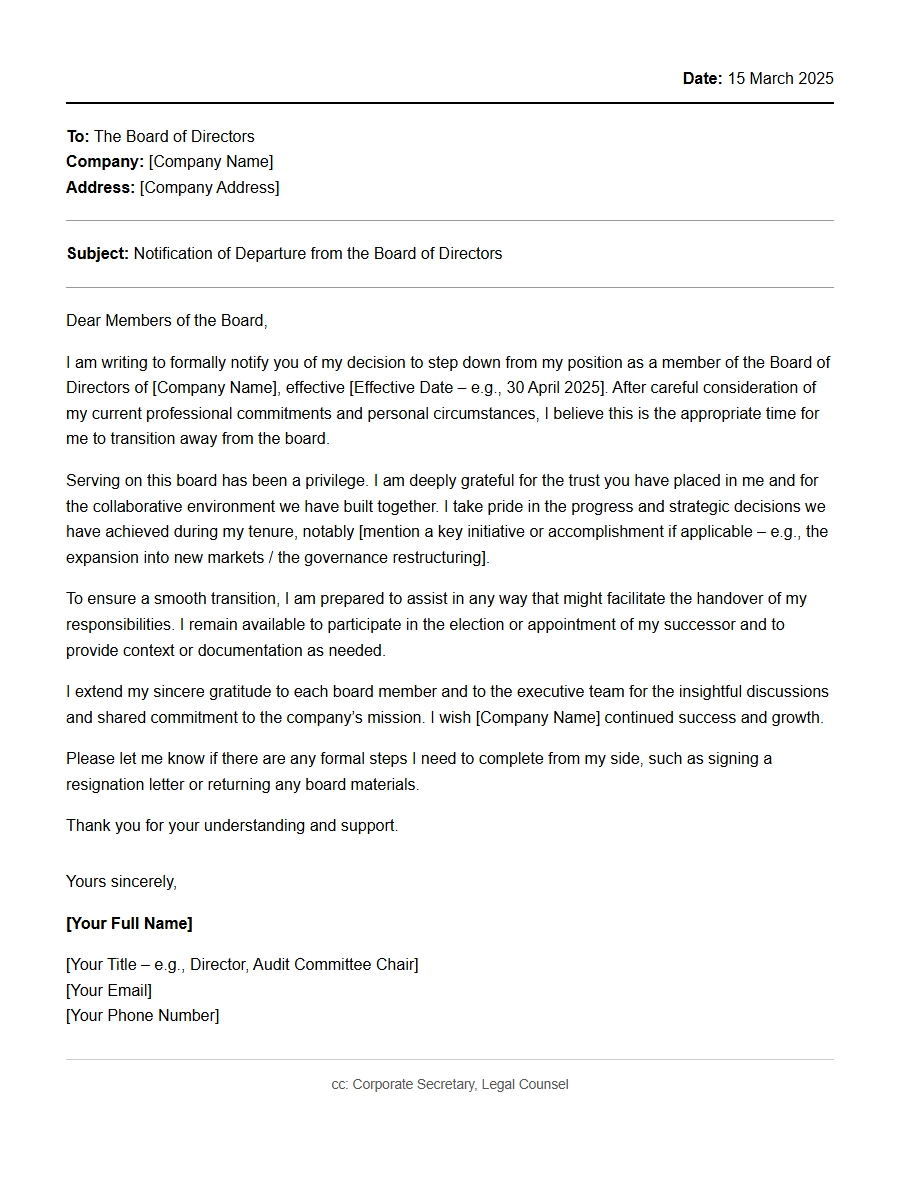
Formal Letter Notifying Board of Departure
Standard Board Resignation from CEO
To the Board of Directors,
Please accept this letter as formal notification of my resignation as Chief Executive Officer of [Company Name], effective [Date]. After careful consideration, I have decided to step down from my role to pursue new challenges.
I am grateful for the opportunity to lead this organization over the past [number] years. Together we achieved significant milestones, including [brief mention]. I will ensure a smooth transition by working closely with the incoming CEO and the leadership team during the notice period.
Detail
Information
Last Working Day
[Date]
Successor Preparation
One-on-one handover sessions schedule attached
I remain committed to the company’s success and will do everything possible to facilitate this change. Thank you for your understanding and support.
Sincerely, [Your Name]
Director Resignation for Personal Reasons
To the Board of Directors of [Company Name],
I am writing to formally resign from my position as Director, effective [Date]. This decision is due to personal family circumstances that require my full attention at this time.
I have valued my tenure on the board and the collaborative efforts we have undertaken. I am committed to ensuring a seamless transition. I will provide all necessary documentation and assist in onboarding my successor.
Resignation date: [Date]
Handover completed: [Yes/No]
Final board meeting attendance: [Date]
I appreciate the board’s understanding of my situation. I wish the company continued growth and success.
Yours faithfully, [Your Name]
Founder Stepping Down from Board
Dear Fellow Board Members,
With mixed emotions, I submit my resignation as a member of the Board of Directors and as Founder of [Company Name], effective [Date]. I believe that fresh leadership is necessary for the next phase of our growth.
I remain a loyal shareholder and will support the company in any advisory capacity if needed. Below is a summary of my transition plan:
Transition Item
Status
Strategic projects handover
Documented
Key stakeholder introductions
Scheduled
Confidential knowledge transfer
Completed
I am proud of what we built together. Thank you for the privilege of serving.
Warm regards, [Your Name]
Board Member Resignation due to Conflict of Interest
To the Chairperson and Board of Directors,
I am writing to resign from my position on the Board of [Company Name] effective immediately. My resignation is prompted by a potential conflict of interest arising from my recent appointment to [Other Organization].
In accordance with the company’s governance policies and to avoid any appearance of impropriety, I believe stepping down is the most ethical course of action. I have enjoyed serving and value the board’s integrity.
Resignation effective: [Date]
Conflict involved: [Brief description]
Return of board materials: Prepared for handover
I thank my colleagues for their understanding and wish the board continued success.
Respectfully, [Your Name]
Executive Director Resignation after Merger
To the Board of Directors,
Please accept this letter as formal notification of my resignation as Executive Director, effective [Date]. Following the recent merger with [Partner Company], I have decided that this is the right time to explore new opportunities.
I am proud of the integration work we have initiated. To ensure continuity, I have prepared a transition document outlining ongoing projects, key contacts, and pending decisions.
Area
Handover Status
Integration roadmap
80% complete
Team restructuring plans
Drafted
Client communications
Template ready
I will be available for consultation during the notice period. Thank you for the trust you placed in me.
Sincerely, [Your Name]
Non-Executive Director Resignation for Other Commitments
To the Board of [Company Name],
I am writing to formally resign from my role as Non-Executive Director, effective [Date]. My increasing commitments to other boards and personal projects prevent me from dedicating the time required to serve effectively.
I have appreciated the opportunity to contribute to the company’s strategic direction. I will complete my current committee assignments and provide a handover note for my successor.
Final board meeting: [Date]
Committee membership: [Audit/Nominations/etc.]
Outstanding tasks: Listed in attached document
I thank the board for the collaboration and wish [Company Name] all the best.
Yours truly, [Your Name]
Chairman of the Board Resignation
To the Board of Directors and Shareholders of [Company Name],
I hereby tender my resignation as Chairman of the Board, effective [Date]. After much reflection, I believe it is time for a new leader to guide this board through our next strategic cycle.
I am confident in the strength of the current board and management team. I will assist in the selection and onboarding of my successor as outlined below:
Handover Task
Timeline
Chair transition briefing
Week 1
Introduce to key stakeholders
Week 2
Provide governance records
Week 3
I remain a shareholder and will continue to support the company. Thank you for the honor of leading this board.
With gratitude, [Your Name]
Resignation from Board for Health Reasons
Dear Board Members,
It is with deep regret that I submit my resignation from the Board of Directors due to ongoing health issues. Effective [Date], I will no longer be able to fulfill my duties.
My doctors have advised me to reduce stress and focus on recovery. I have already prepared a comprehensive update on all ongoing matters for the board’s reference.
Medical leave started: [Date]
Projects handed over: [List]
Successor suggestion: [Name]
I will remain available for brief consultations if necessary. Thank you for your kindness during my tenure. I wish the board continued success.
Best wishes, [Your Name]
Resignation to Pursue New Opportunity
To the Board of Directors,
I am writing to formally resign from my position as [Title] on the Board, effective [Date]. I have accepted an exciting new opportunity that requires my full commitment.
Serving on this board has been a rewarding experience. I am committed to ensuring a smooth departure. Please find below the status of my current responsibilities:
Responsibility
Status
Board committee chair
Nominating successor
Strategic advisor to CEO
Briefing notes completed
Industry liaison
Introductory emails sent
I am grateful for the trust and collaboration. I look forward to following the company’s achievements from afar.
Yours sincerely, [Your Name]
Founder Resignation to Hand Over to Successor
Dear Board of Directors,
Having accomplished the company’s initial vision, I believe the time is right for me to step down as Founder and board member. Effective [Date], I resign from all board duties to enable new leadership to drive the next chapter.
I have worked closely with my successor, [Name], to ensure a seamless transition. The handover plan is summarized below:
Strategic vision document: Shared
Key partner introductions: Completed
Intellectual property transfer: Notarized
Advisory role: Offered for first 6 months
I am immensely proud of this company and its team. Thank you for the unwavering support.
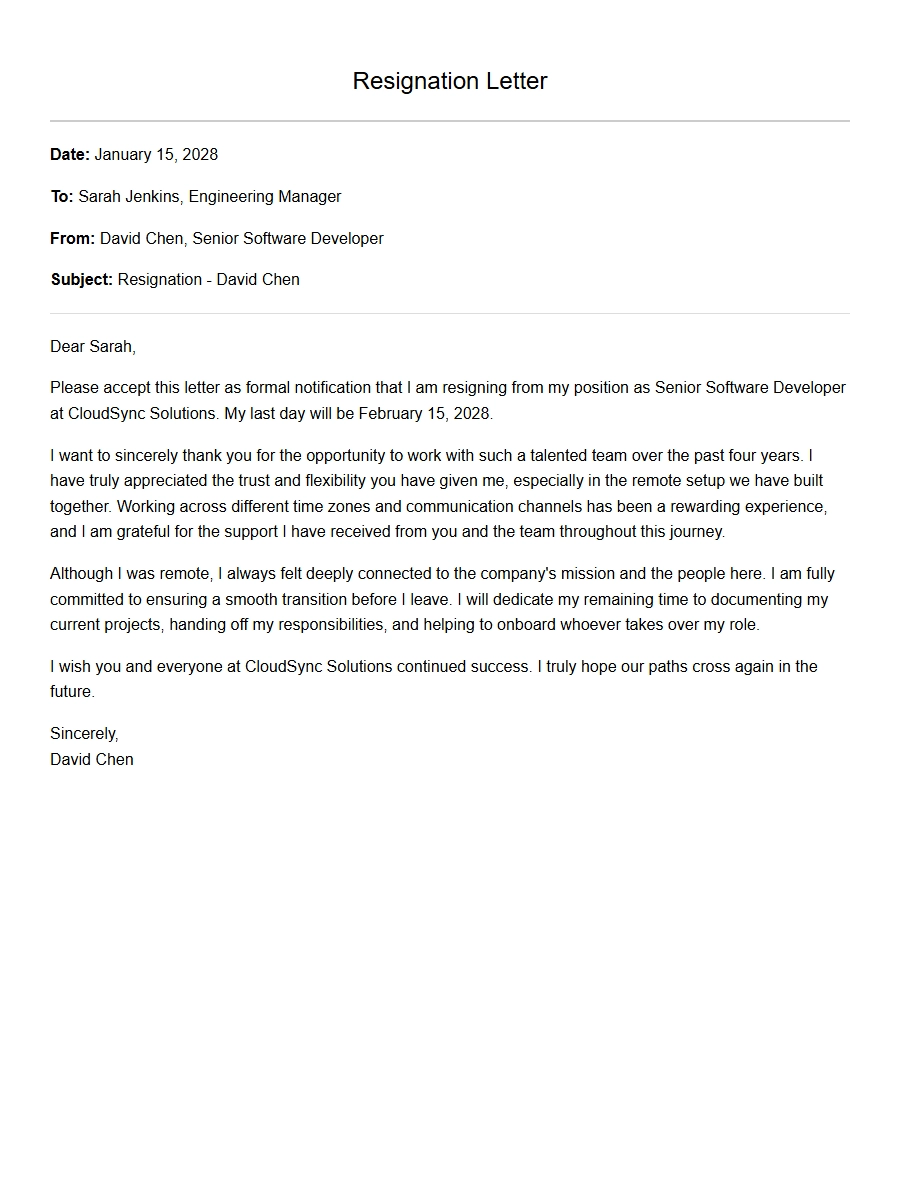 Polite Resignation Email for Remote Employees
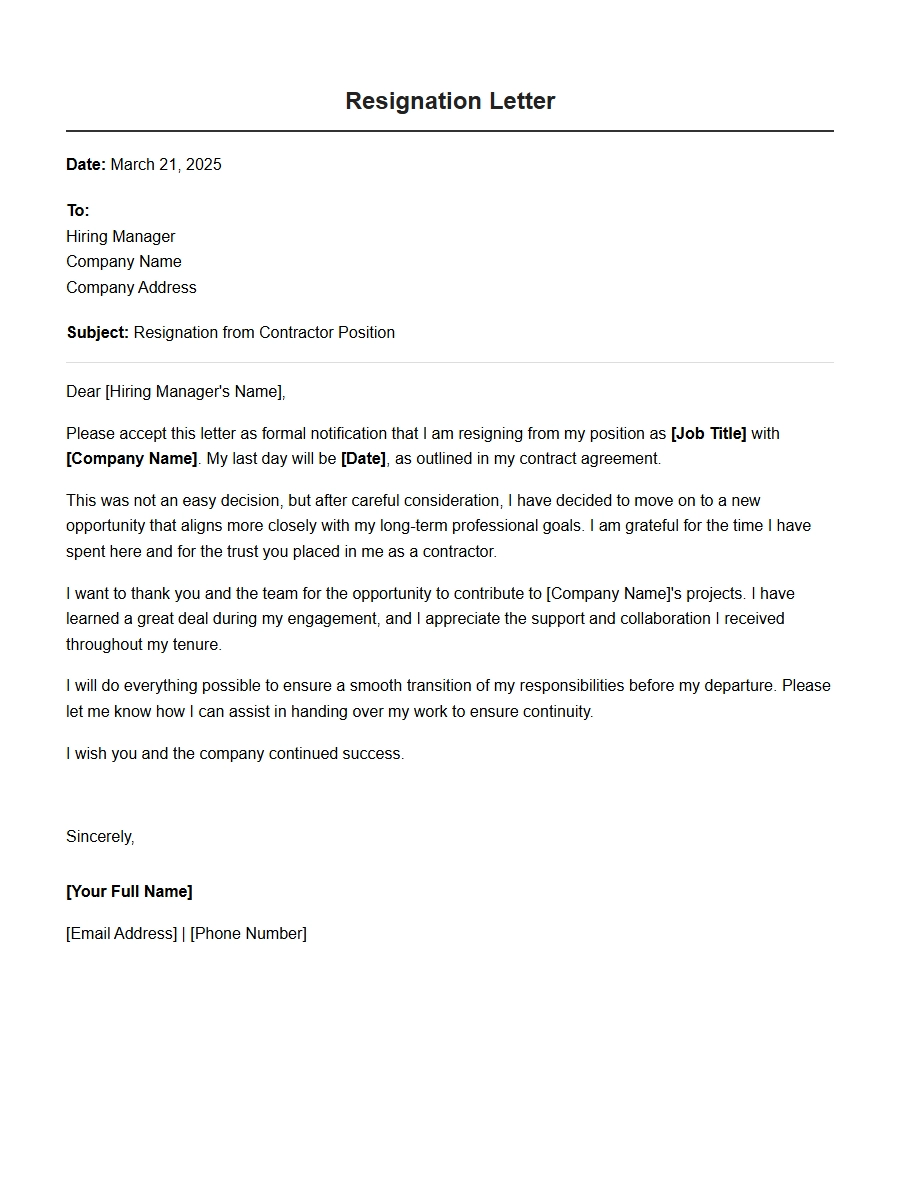 Short Resignation Letter for Contractor Position
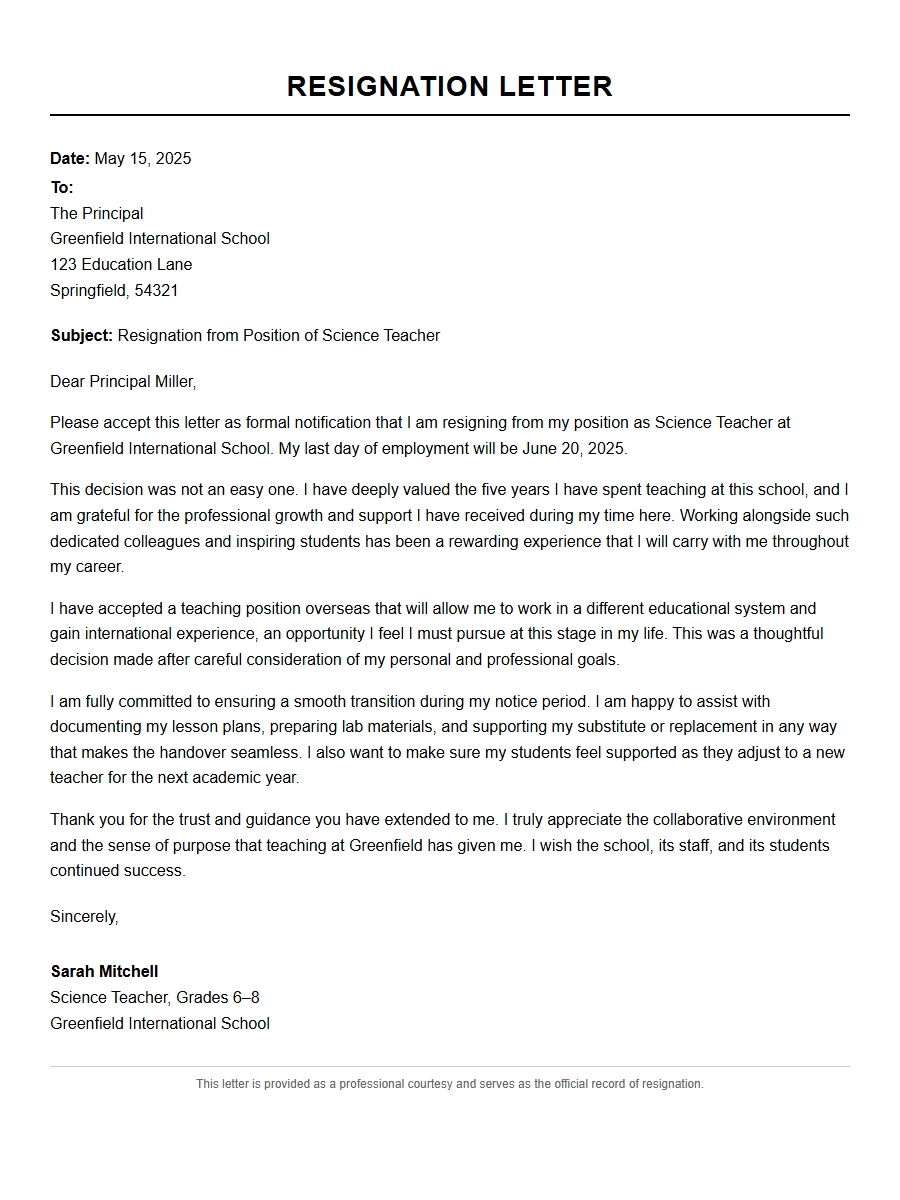 Teacher Resignation Letter Example
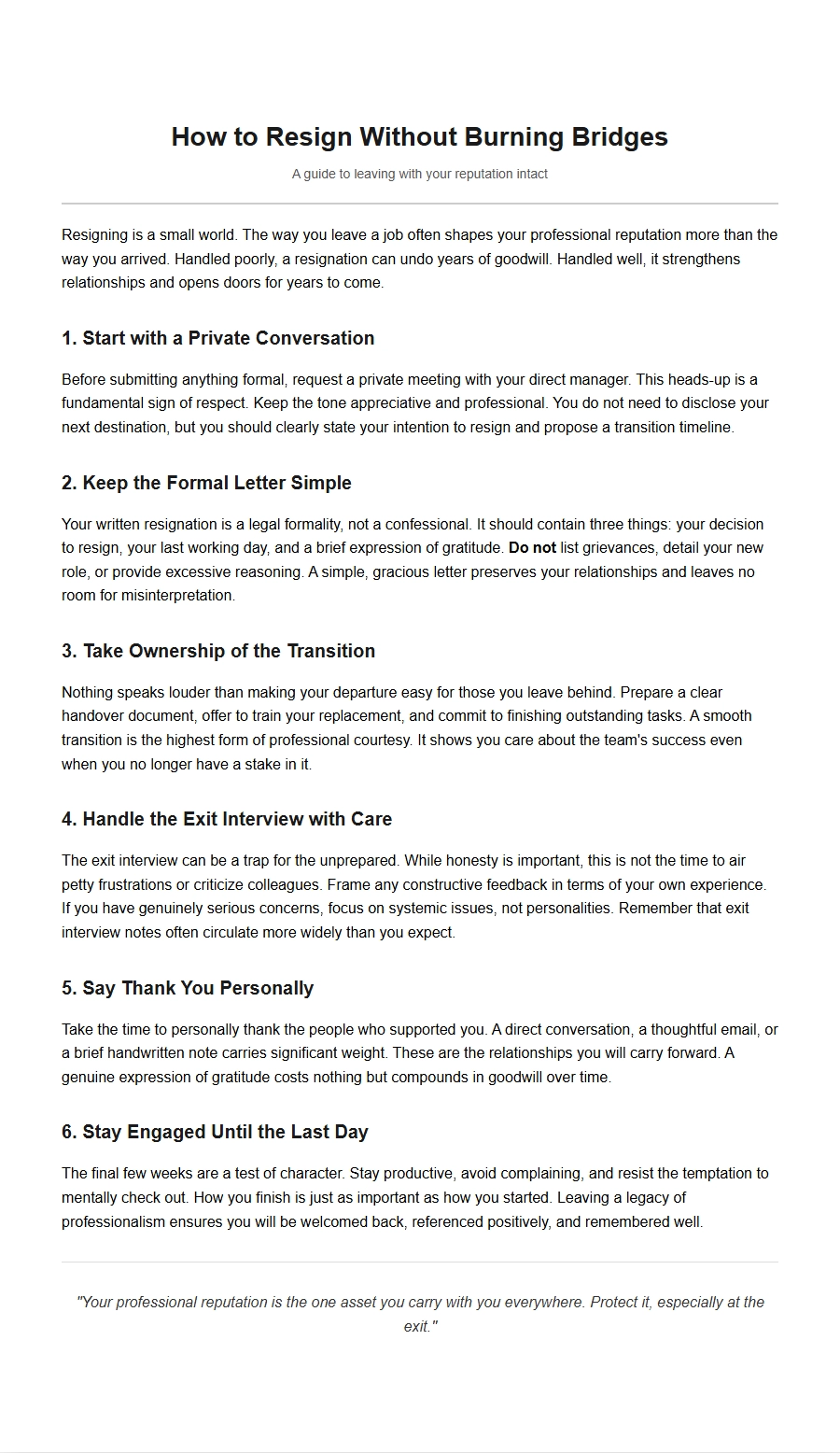 How to Resign Without Burning Bridges
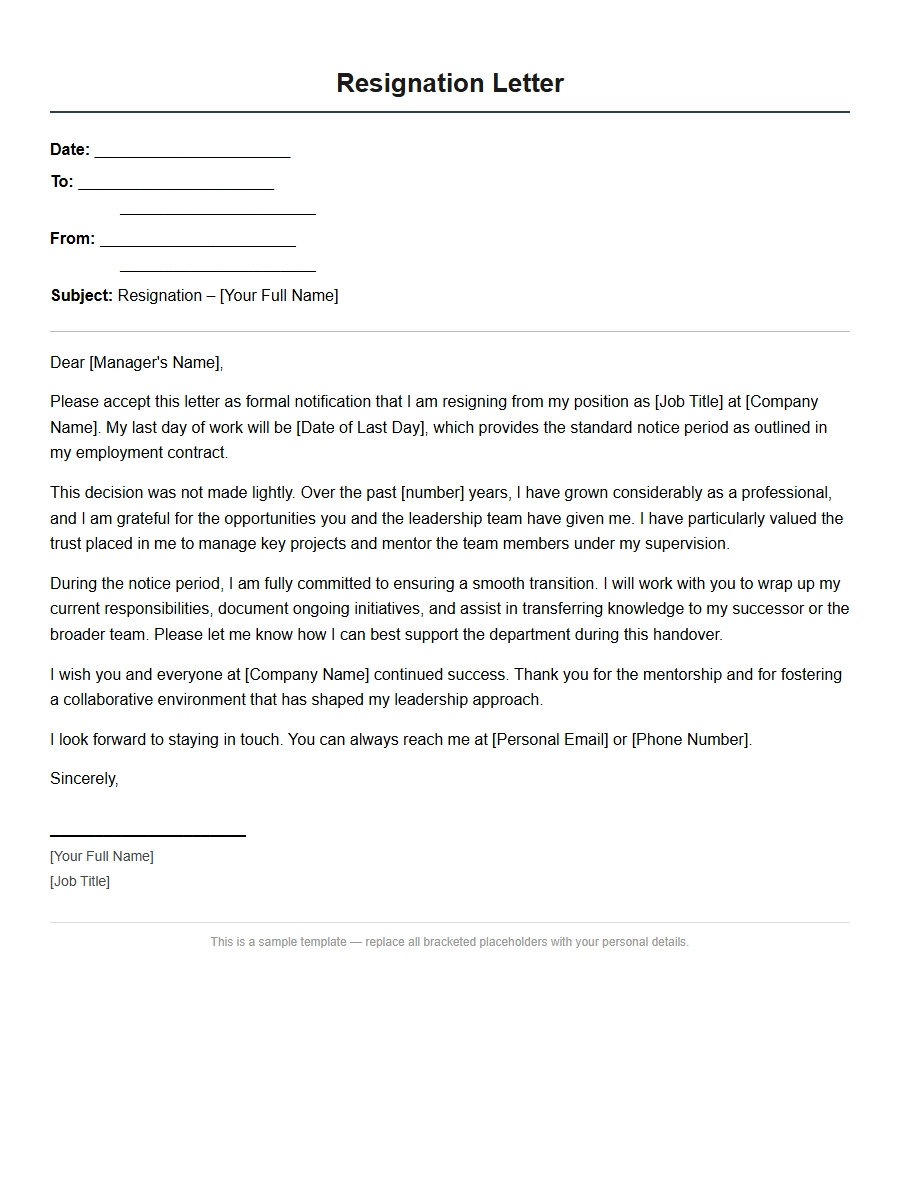 Formal Resignation Letter Sample for Manager
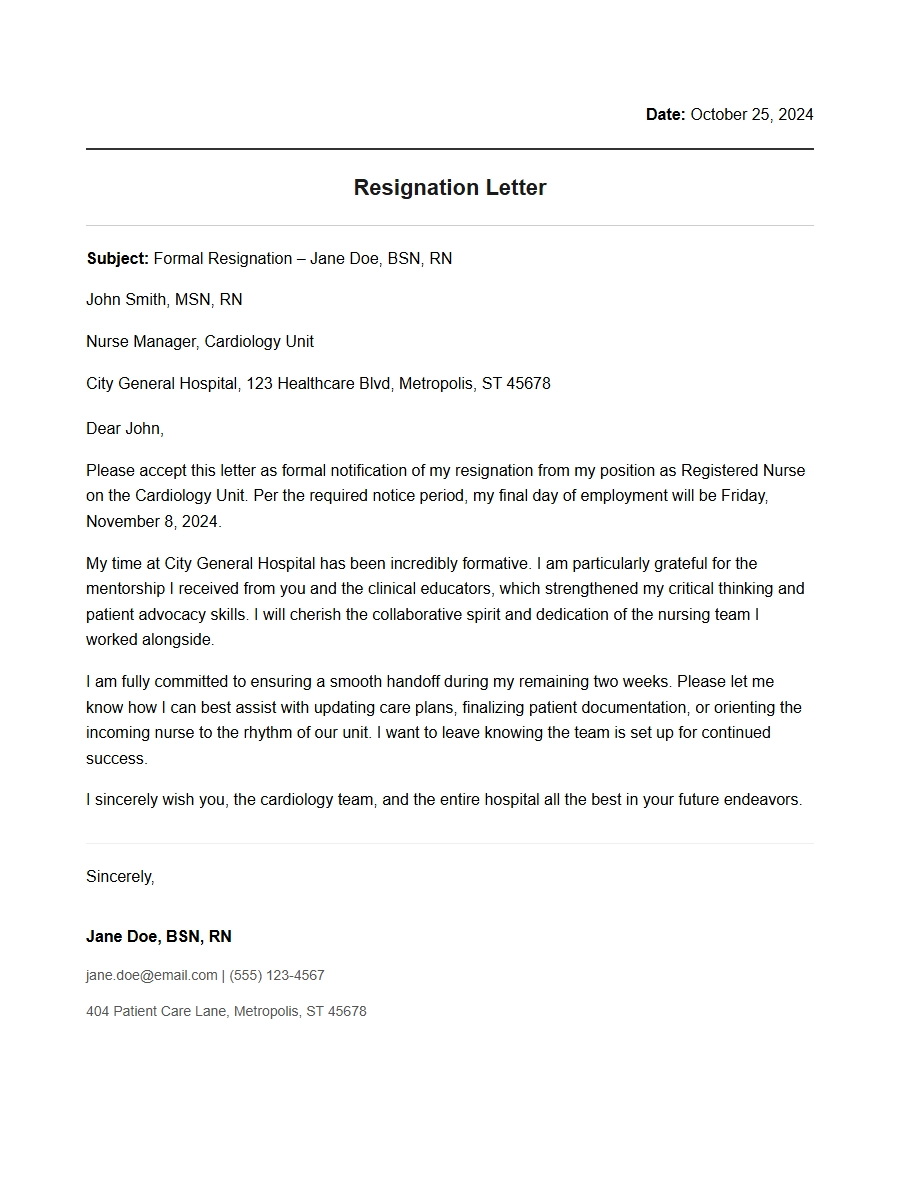 Nurse Resignation Letter with 2 Weeks Notice