You need to write a resignation letter, and you want to time it around the end of the fiscal quarter. Maybe you're leaving on good terms, or you want to give the company a clean break before their next reporting period. Either way, the blank page feels like a wall.
Using a letter sample isn't cheating—it's a smart shortcut. A good sample gives you the structure, tone, and key phrases you need for professional correspondence. You just customize it to sound like you. This article falls under our Resignation Letters category, and we'll focus specifically on letters that reference the end of a fiscal quarter.
Why reference the end of the fiscal quarter?
Timing matters. Resigning at the end of a quarter shows you understand the company's financial cycles. It respects their reporting deadlines and makes transition planning easier. It can also protect your own interests, especially if you're eligible for quarterly bonuses or performance reviews. A simple line like "I'd like my last day to coincide with the end of the fiscal quarter" signals professionalism and consideration.
But you need the right tone. Too stiff and you sound like a robot. Too casual and you undermine your seriousness. That's where a resignation letter sample becomes your blueprint—you adapt it to your relationship with your manager and your company culture.
How to choose and adapt a sample
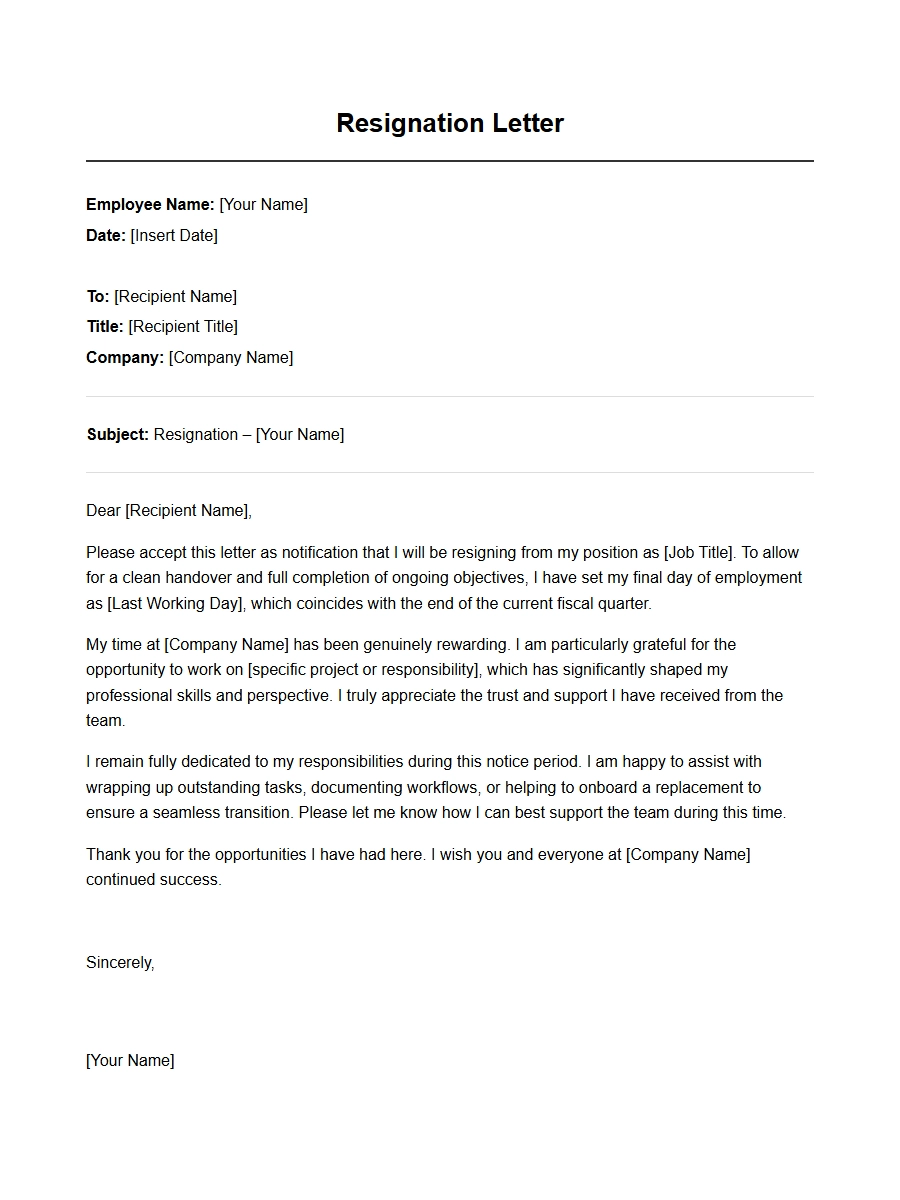
Start by deciding the format. If you're sending an email, use a digital letter format with a clear subject line like "Resignation – [Your Name] – Effective [Date]". For a printed version, stick to a standard business letter format with your name, address, date, and salutation. Most samples will show both options.
Check the tone in writing of the sample. Does it match your workplace? A startup might expect something warmer; a bank might prefer formal. You can adjust the salutation and closing—"Dear [Manager's name]" and "Sincerely" are safe, but "Best regards" works too. Avoid outdated phrases like "To whom it may concern" unless you have no direct contact.
Tailor the opening paragraph
The opening should get straight to the point. "Please accept this letter as formal notification of my resignation." Then add your reference to the fiscal quarter: "I am giving notice that my last day will be [date], which aligns with the end of the fiscal quarter." That's clear and respectful.
Some people worry this sounds too transactional. You can soften it by adding a line about appreciation: "I've enjoyed my time here, and I want to make the transition as smooth as possible." That blends professionalism with a human touch.
Common mistakes to avoid
One big mistake is using an old letterhead design that doesn't match your company's brand. If you print on personal stationery, keep it clean. Another is ignoring email vs. printed letter rules—in an email, skip the header and just start with the salutation.
Proofreading your letter is non-negotiable. A typo in your resignation date can cause confusion. Read it aloud or ask a friend to check. Also, don't forget to offer help with transition, like documenting your tasks or helping with a letter of recommendation for someone else—though that's separate from your resignation.
Different roles need different phrasing. For example, if you're in a hands-on job like construction, keep it direct—our resignation letter for construction site workers shows how to be straightforward while still professional. Warehouse supervisors often need to mention shift handoffs, and this warehouse supervisor sample covers that.
Making the letter feel like you
A customizable letter template gives you room to add personal details. Maybe your team is small and you want to mention a specific project. Maybe you'll take the time to write a separate goodbye letter to colleagues—that's a nice touch but keep it separate from the formal resignation.
Think about the letter structure: introduction, body (reason for timing and transition offer), closing. That's it. You don't need to justify why you're leaving. A simple reason like "pursuing a new opportunity" works fine.
If you're giving notice during a busy season, you might worry about burning bridges. That's where giving notice during busy season requires extra diplomacy—focus on your appreciation and your commitment to helping during the transition.
The best cover letter examples and letter templates give you a framework. They help you avoid writer's block and missed details. But the final version should sound like you. Read your draft out loud. If it feels too stiff, rephrase. If it's too casual for your industry, tighten it.
Resigning at the end of a fiscal quarter is a smart move. It shows you're thoughtful about the business. With a good sample and a few tweaks, you'll have a polished letter in minutes. Practice makes the process faster next time.
Samples for Inspiration
Resignation Letter for Fiscal Quarter End
Standard Fiscal Quarter Resignation
Date: March 28, 2025
To: Human Resources Manager
Please accept this letter as formal resignation from my position as Senior Analyst, effective April 15, 2025—the end of the current fiscal quarter.
I have appreciated the opportunities to contribute to the Q3 and Q4 reports. To ensure a smooth transition, I have prepared a hand-off document summarizing ongoing projects and key deadlines.
I am grateful for the professional growth during my tenure and will assist in any way to close the quarter without disruption.
Sincerely, John Smith Senior Analyst
Early Notification for Quarter End
Date: February 14, 2025
To: Director of Operations
I am writing to announce that my last working day will be June 30, 2025—the close of our fiscal Q4. This early notification is intended to allow ample time for recruitment and knowledge transfer before the quarter ends.
Projects I will complete before Q4 close:
Finalise annual budget variance analysis
Deliver Q3 performance review summaries
Mentor new hire on quarterly reporting tools
I remain fully committed to delivering outstanding results through the end of the quarter. Please let me know how I can best assist with transition planning.
Thank you for the support and trust over the years.
Best regards, Maria Gonzalez Operations Lead
Resignation Tied to Bonus Payout
Date: December 1, 2024
To: Compensation Committee
I hereby resign from my role as Regional Manager, effective December 31, 2024—the end of the fiscal Q2. I have chosen this date to allow full processing of the quarterly bonus payout as per our policy.
Below is a summary of my final deliverables for the quarter:
Target
Status
Completion Date
Revenue target ($2M)
On track
Dec 15
Cost reduction initiative
95% complete
Dec 20
Team training completion
Submitted
Nov 30
I will ensure all handover notes are finalised by December 28. Thank you for the rewarding experience.
Sincerely, David Chen Regional Manager
Short Notice for Quarter End
Date: September 15, 2024
To: HR Department
Please accept this resignation as Audit Supervisor, effective September 30, 2024—the final day of our fiscal Q3. Due to a personal opportunity, I must leave on short notice but I am committed to ensuring a clean handoff.
Items completed before leaving:
Finalised Q3 audit fieldwork
Submitted draft report to partner
Prepared client communication regarding findings
Pending items for handoff:
Review of two sampling files (not yet started)
Schedule final clearance meeting
I appreciate your understanding and will do my utmost to minimise disruption.
Regards, Priya Patel Audit Supervisor
Retirement at Fiscal Quarter End
Date: May 20, 2025
To: Board of Directors
I am announcing my retirement from the position of Chief Financial Officer, effective June 30, 2025—the end of our fiscal third quarter. This timing allows me to oversee the completion of the quarterly financial statement and provide a comprehensive transition.
Transition plan:
Finalise Q3 10-Q filing (June 28)
Mentor successor on board reporting cadence
Complete year-end audit preparation handoff
I have prepared a detailed transition binder covering all recurring deliverables and key stakeholder contacts.
It has been a privilege to serve this organisation for 25 years.
With gratitude, Robert Ellis Chief Financial Officer
Resignation Due to Relocation at Quarter Close
Date: October 10, 2024
To: Team Manager
Please accept this resignation from my role as Marketing Coordinator, effective December 31, 2024—the close of Q4. My family is relocating out of state, and I have timed my departure to align with the fiscal quarter end.
Final tasks:
Complete Q4 campaign performance dashboard
Transfer vendor contracts and contacts
Document standard operating procedures for social media
I will provide a weekly status update through my last day. I am grateful for the flexible work environment and the support of the team.
Best wishes, Lisa Thompson Marketing Coordinator
Mutual Separation Agreed at Quarter End
Date: March 15, 2025
To: HR Director
In consultation with management, I am submitting this mutual separation resignation effective March 31, 2025—the end of our fiscal Q1. The timing allows for a clean break with minimal impact on quarterly reporting.
Separation terms agreed:
Final salary and benefits through March 31
Two weeks of transition support (unpaid)
Return of company laptop and badge by April 4
I will complete the Q1 expense reconciliation and hand over client files by March 28.
Thank you for the collaboration and support during my tenure.
Sincerely, Alex Rivera Account Manager
Resignation for Career Change at Quarter End
Date: August 5, 2024
To: Vice President of Engineering
I am resigning my position as Software Engineer III, effective September 30, 2024—the end of our fiscal Q3. I am pursuing a career change to data science and have chosen the quarter end to minimise disruption to sprint cycles.
Handover plan:
Complete pending code reviews by Sept 20
Update documentation for three modules
Conduct knowledge transfer sessions for team Sept 25-27
I value the mentorship I received here and will ensure all deliverables for the quarter are met before departure.
Thank you for the learning opportunities.
Respectfully, Kyle Johnson Software Engineer
Resignation Due to Health at Quarter Close
Date: January 10, 2025
To: Benefits Coordinator
I must resign from my position as Customer Service Lead due to ongoing health concerns. My last day will be March 31, 2025—the end of our fiscal Q1—to allow completion of health insurance coverage transition.
Important dates:
Last working day: March 28 (to allow HR processing)
COBRA election period begins April 1
Final paystub will include unused PTO
I have already trained two team members to handle my quarterly responsibilities. A detailed transition document is attached.
I appreciate your support during this difficult time.
Warmly, Emily Davis Customer Service Lead
Resignation with Partial Quarterly Notice
Date: November 15, 2024
To: Finance Director
I am providing notice that I will resign as Financial Analyst, effective January 15, 2025—midway through the fiscal Q1. I have arranged to complete all Q1 month-end close tasks before leaving.
Deliverables through January 15:
Task
Deadline
November month-end close
Dec 5
December accruals
Jan 3
Q1 preliminary budget variance
Jan 12
After my departure, I will be available for remote consultation during the remaining quarter close period.
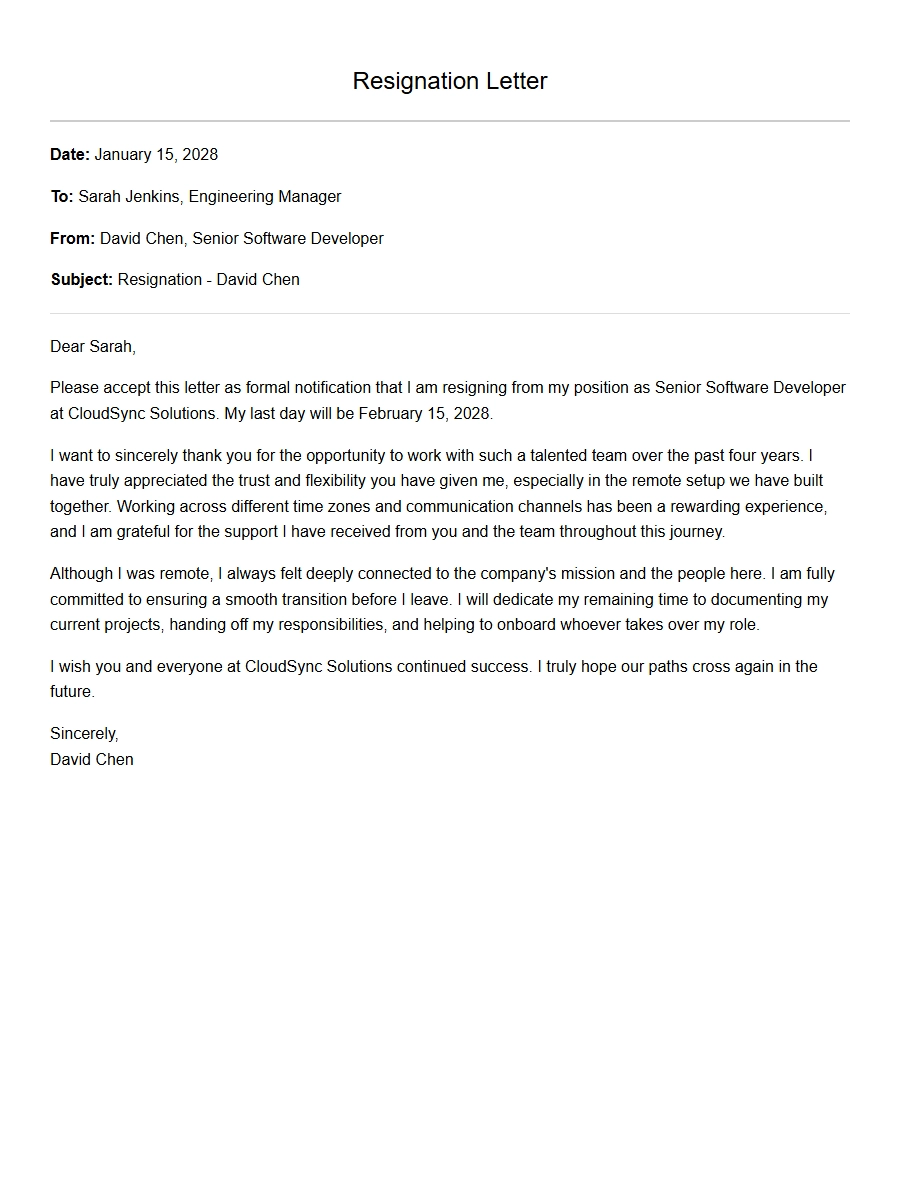 Polite Resignation Email for Remote Employees
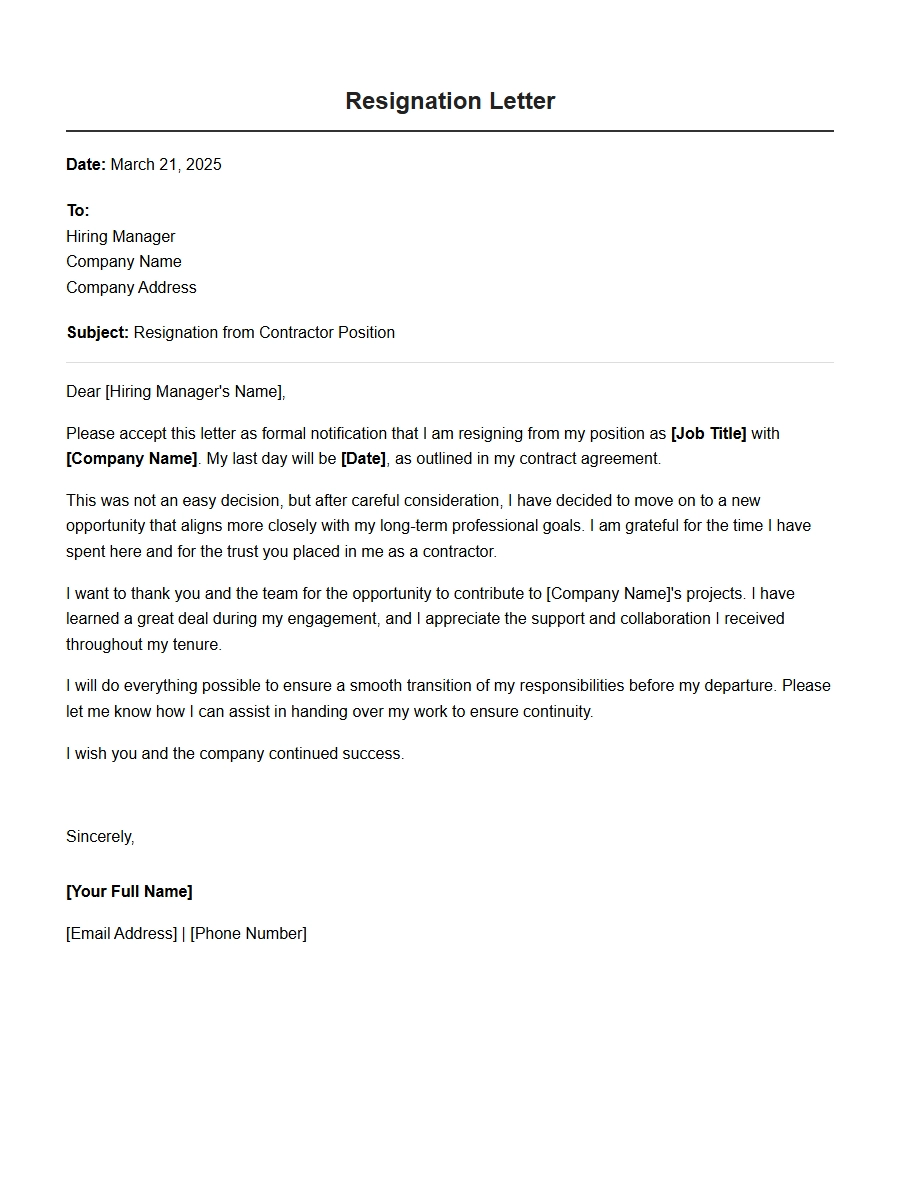 Short Resignation Letter for Contractor Position
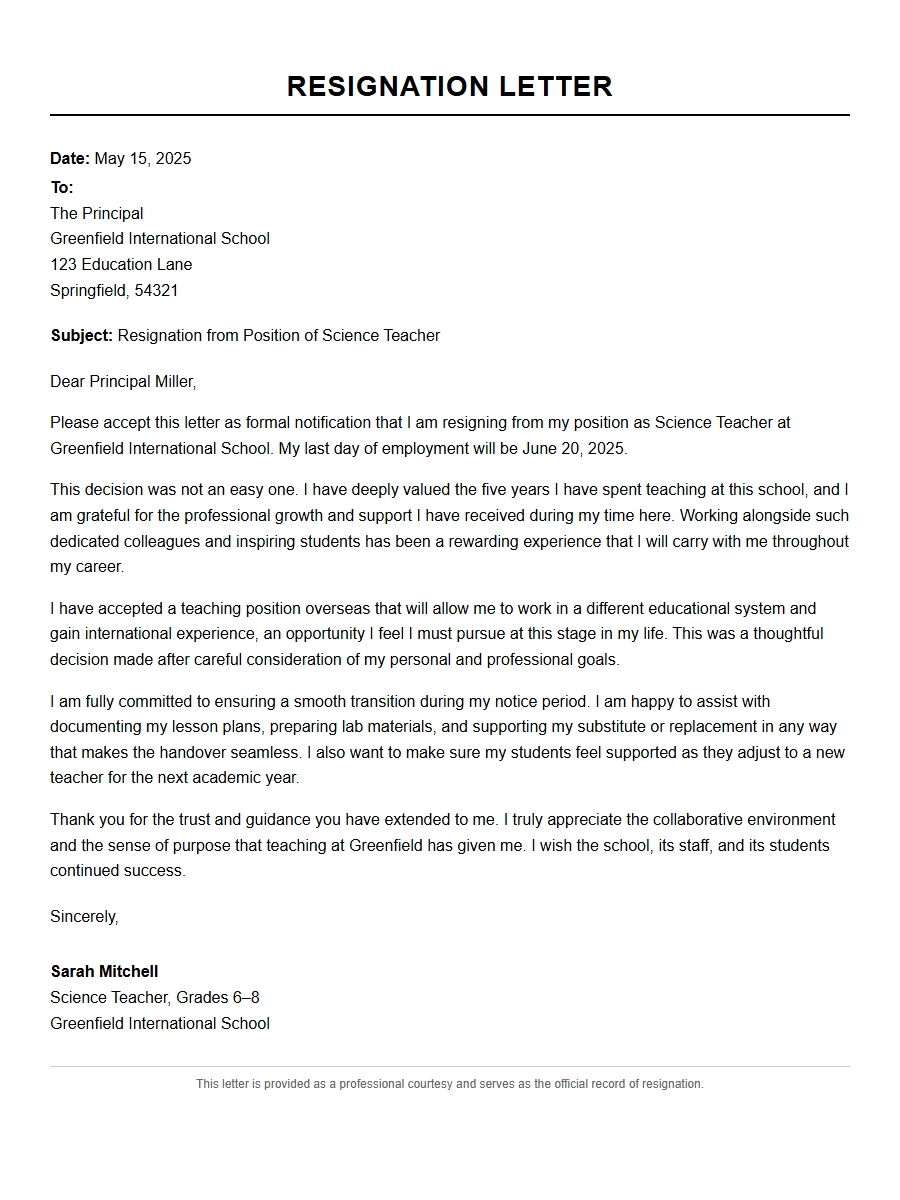 Teacher Resignation Letter Example
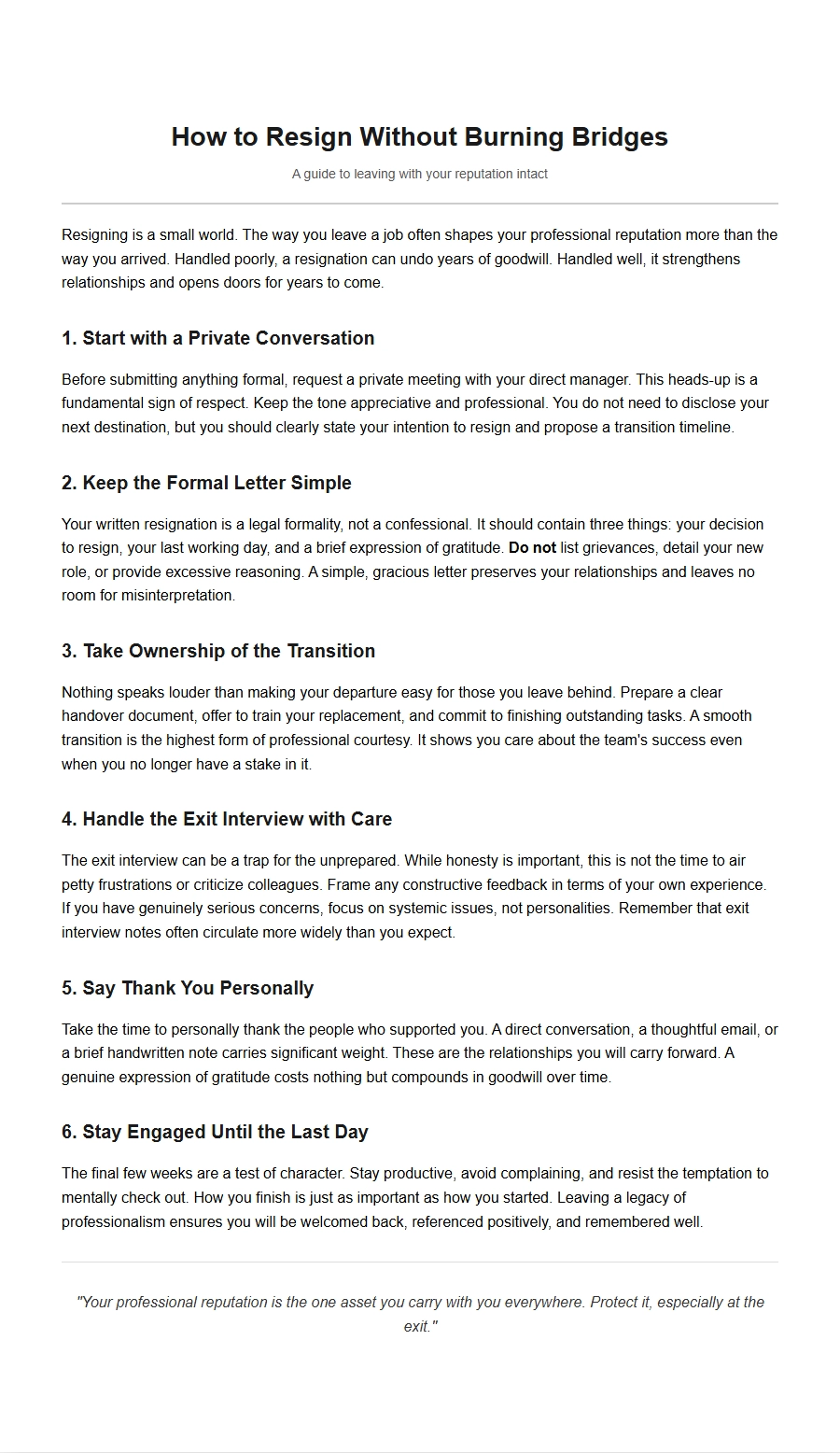 How to Resign Without Burning Bridges
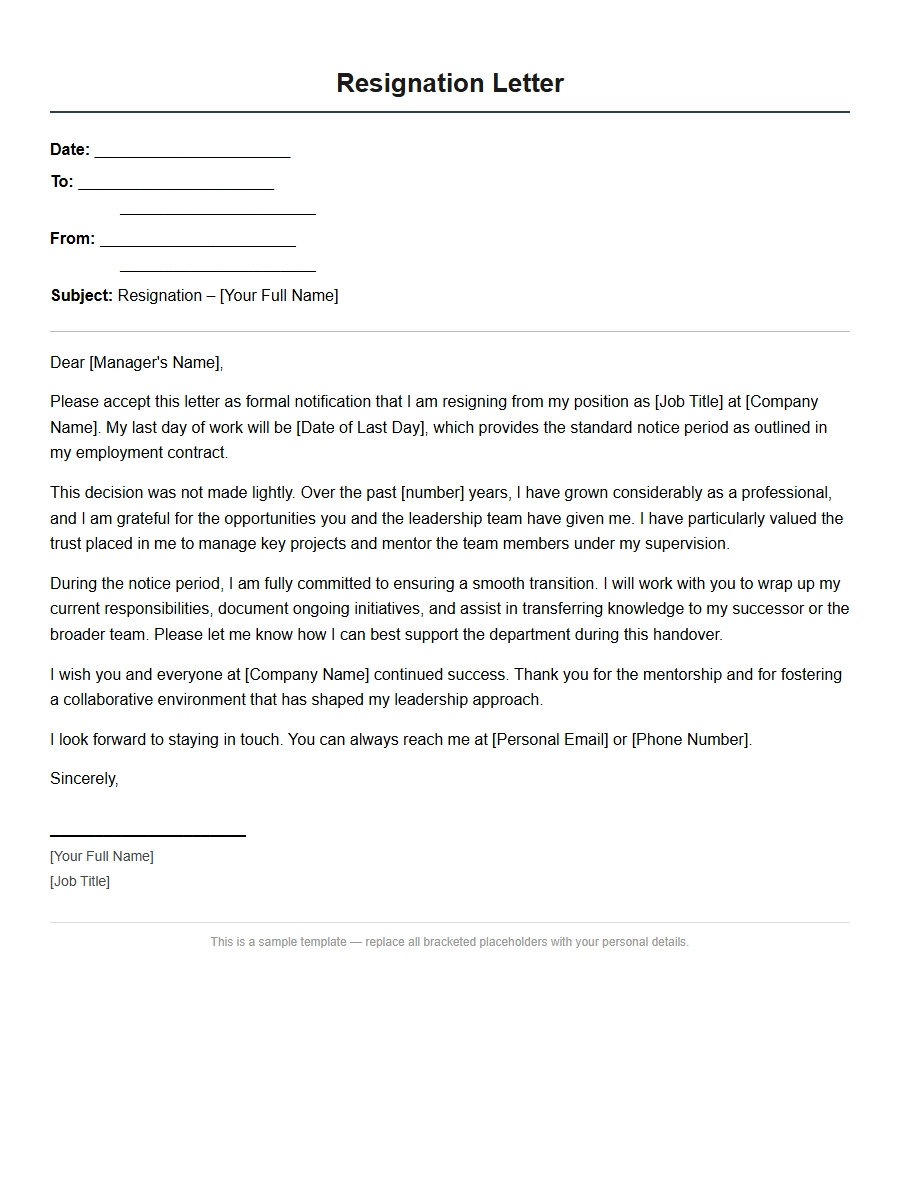 Formal Resignation Letter Sample for Manager
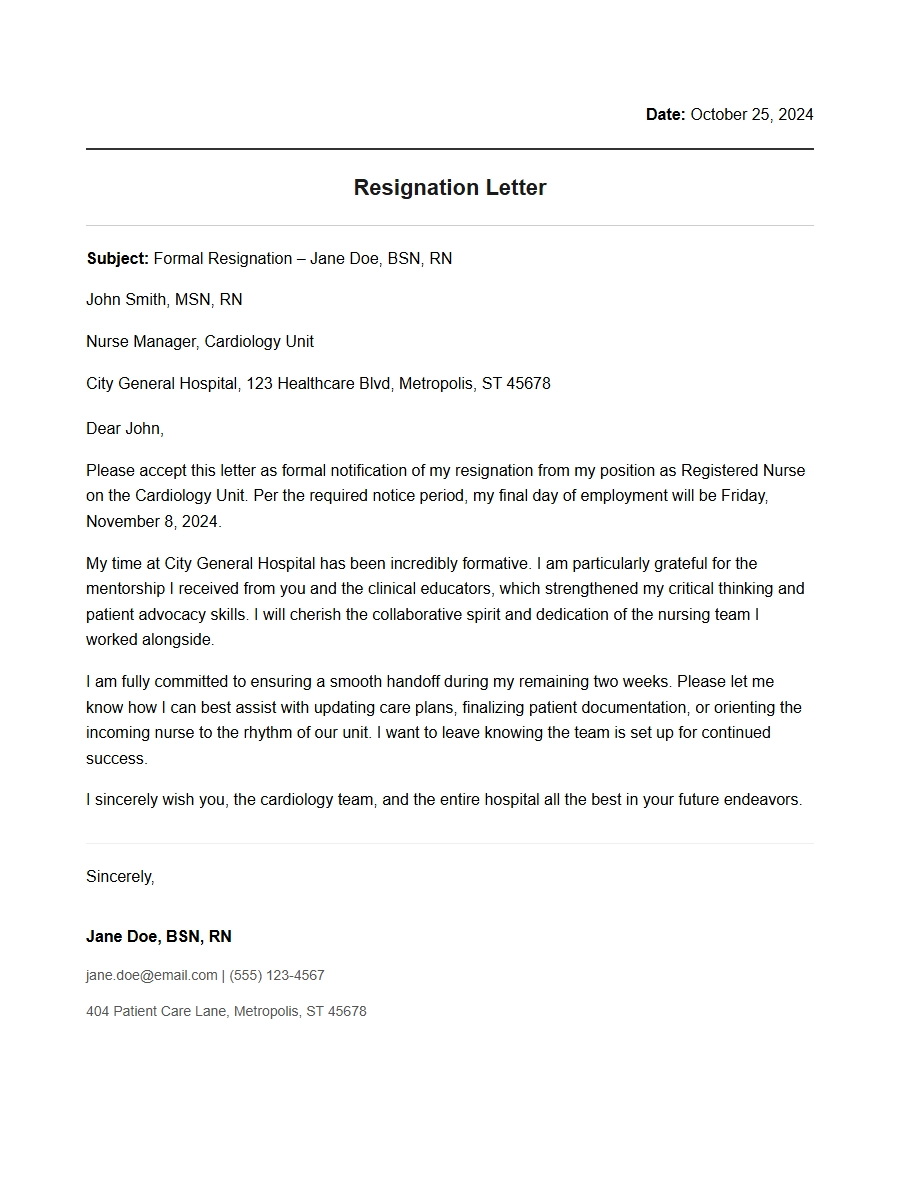 Nurse Resignation Letter with 2 Weeks Notice