Formal Corporate Business Proposal Letter Template
You’ve got a potential client interested, and they need a formal corporate business proposal letter by end of day. Your cursor blinks at you. That familiar panic sets in. But a well-chosen sample can turn that anxiety into a confident, polished draft in minutes. It’s not cheating—it’s smart.
Using a letter template gives you the structure, tone, and key phrases you need, while leaving room for your own voice. You don’t have to reinvent professional correspondence every time. The right sample shows you where to place your salutation, how to structure your argument, and what kind of closing works. Then you personalize it. That’s the whole trick.
Category: Business Proposal Letters
What makes a formal corporate business proposal letter different?
This isn’t a quick email to a colleague. A formal business proposal letter follows a standard business letter format: your letterhead (or contact info at the top), the date, the recipient’s name and title, a clear salutation, body paragraphs, and a professional closing. The tone should be respectful and confident—neither stiff nor overly casual. You’re trying to convince someone to invest time or money in your idea, so every sentence needs to earn its place.
Whether you’re sending it as a printed document with letterhead design or as a digital letter format in an email, the core structure stays the same. The main difference is that an email version should include a subject line and skip the physical letterhead. But the salutation and closing remain formal: “Dear Mr. Chen” and “Sincerely,” not “Hey” or “Cheers.”
Look for a sample that matches your industry and the relationship you have with the recipient. If you’ve already spoken on the phone, you can be slightly less formal. If this is a cold proposal, stick closer to traditional letter writing etiquette.
Adapt the sample without losing your voice
The biggest mistake people make is copying a sample verbatim. Your proposal should sound like you. Start by rewriting the opening paragraph to directly address the client’s specific need. For example, instead of “We are pleased to submit this proposal,” say “After our conversation last week, I put together a plan that tackles the deadline issue you mentioned.” That small shift makes the letter feel personal and attentive.
Also pay attention to tone in writing. A sample might use very formal language like “heretofore” or “pursuant to.” If that doesn’t fit your style, swap it for clearer phrases. The goal is to sound professional, not like you swallowed a dictionary. The same goes for cover letter examples: you want to show competence, not mimic an old template.
Common mistakes to avoid
Don’t use outdated salutations like “To Whom It May Concern” if you know the person’s name. It signals laziness. If you’re unsure, call the company receptionist to confirm the spelling and title. Similarly, avoid lengthly paragraphs that bury your main point. Keep each paragraph focused on one idea—why you’re writing, what you’re proposing, the benefits, the next steps.
Proofreading is non‑negotiable. A typo in a proposal can make you look careless. Print it out or read it aloud. Check for tense consistency, punctuation, and that your contact info is correct. If you’re sending via email, double‑check the subject line and attachment. That’s part of good letter writing etiquette.
Use the sample as a springboard
The best formal corporate business proposal letters feel both professional and personal. They show you understand the client’s problem and have a concrete solution. A sample gives you a solid starting point, but your own experience and knowledge make it real. The more you practice tailoring templates, the faster the process gets. Eventually, you’ll internalize the structure and only need a quick glance at a sample for reassurance.
So next time you’re staring at that blinking cursor, grab a relevant template. Adapt it. Edit it. Send it with confidence. You’ve got this.
Realistic Samples
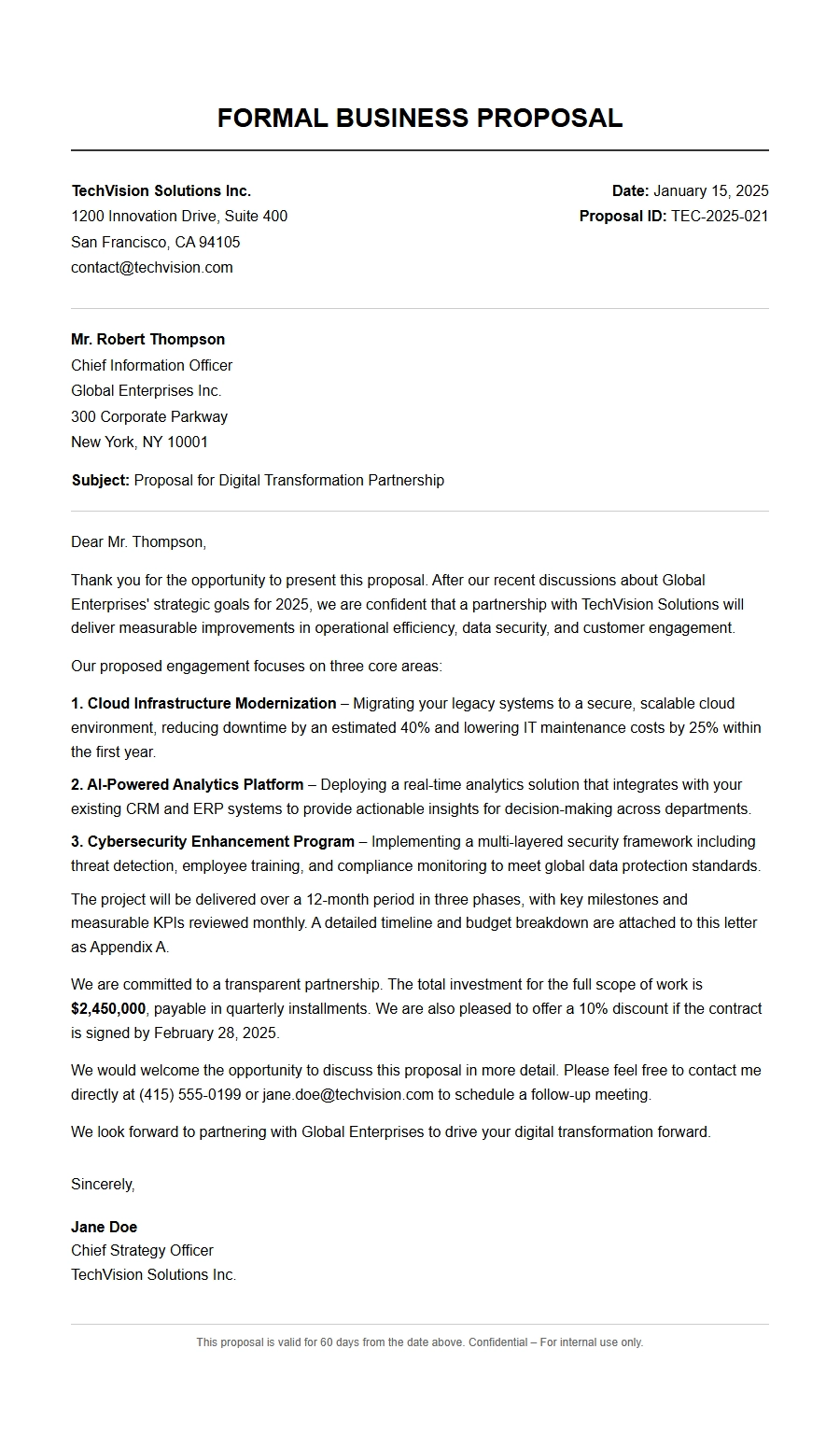
Formal Corporate Business Proposal Letter Template
IT Infrastructure Upgrade Proposal
To: Mr. Robert Chen, Chief Technology Officer, GlobalTech Inc. From: Sarah Mitchell, Senior Solutions Architect, AlphaSys Solutions Date: March 1, 2025 Subject: Proposal for Network Infrastructure Upgrade
Dear Mr. Chen,
Thank you for the opportunity to present our proposal for upgrading GlobalTech’s network infrastructure. Our assessment indicates that your current system will reach capacity within 12 months. To ensure seamless operations, we recommend the following:
Core Switching: Replace aging Cisco 3750s with new Catalyst 9300 series – estimated cost $45,000
Wireless Access: Deploy Meraki MR46 access points across all floors – $28,500
Security Suite: Implement next-generation firewall with intrusion prevention – $32,000
Managed Services: 24/7 monitoring and support for 3 years – $18,000 annually
Total Investment: $123,500 (first year, including hardware and services). We offer a 5% discount if the contract is signed by March 31, 2025.
We propose a phased rollout over 6 weeks, with minimal downtime. Please review the attached detailed schedule. We look forward to your decision.
Warm regards, Sarah Mitchell
Digital Marketing Campaign Proposal
To: Ms. Linda Garcia, Marketing Director, FreshBites Restaurant Group From: Jordan Lee, Campaign Manager, ClickStream Agency Date: March 2, 2025 Subject: Proposal for Q2 2025 Social Media & Email Campaign
Dear Ms. Garcia,
We are excited to propose a comprehensive digital campaign to boost FreshBites’ brand awareness and drive in-store traffic. The campaign will run April–June 2025 and include:
Social Media Advertising: Targeted Facebook and Instagram ads – budget $15,000
Influencer Partnerships: Collaborate with 3 local food bloggers – $8,000
Analytics & Reporting: Weekly performance dashboards and a final ROI report – $2,000
Total Campaign Cost: $30,000. We estimate a 15% increase in foot traffic and 20% growth in email subscribers.
We can begin on April 1, subject to advance payment of 50%. The remaining 50% due at campaign midpoint.
Looking forward to bringing FreshBites to more tables.
Best regards, Jordan Lee
Management Consulting Engagement Proposal
To: Mr. David Kim, CEO, Stellar Manufacturing Co. From: Dr. Patricia Owens, Senior Partner, Owens & Associates Date: March 3, 2025 Subject: Operational Efficiency Improvement Proposal
Dear Mr. Kim,
Following our initial discussions, we propose a 12-week consulting engagement to streamline Stellar Manufacturing’s production workflows. Our approach includes three phases:
Diagnostic Analysis (Weeks 1–3): On‑site observation, employee interviews, and data collection. Deliverable: Baseline Efficiency Report.
Process Redesign (Weeks 4–8): Mapping new workflows, identifying automation opportunities, and training key staff.
Implementation Support (Weeks 9–12): Hands‑on assistance with rollout and a final Performance Improvement Plan.
Fee Structure:
Phase
Duration
Cost
Diagnostic
3 weeks
$18,000
Redesign
5 weeks
$35,000
Implementation
4 weeks
$25,000
Total
12 weeks
$78,000
Payment is due 50% on signature, 25% at start of Phase 2, and 25% upon Phase 3 completion. We anticipate a 12–15% reduction in operating costs within six months.
I look forward to your approval.
Sincerely, Dr. Patricia Owens
Office Furniture Supply Proposal
To: Mr. James Wu, Facilities Manager, Horizon Financial Corp. From: Emily Torres, Sales Representative, ComfortWorks Supply Date: March 4, 2025 Subject: Proposal for Office Furniture for New Headquarters
Dear Mr. Wu,
Thank you for inviting ComfortWorks to bid on the furniture package for your new headquarters. Below is our proposal based on the floor plan you provided.
Proposed Items and Pricing:
Item
Quantity
Unit Price
Total
Executive desk (walnut)
15
$1,200
$18,000
Ergonomic chair (high-back)
50
$650
$32,500
Modular reception sofa set
2
$3,500
$7,000
Standing desk (electric)
25
$1,850
$46,250
Conference table (12-seat)
3
$4,200
$12,600
Subtotal
$116,350
Delivery within 3 weeks of order, with free assembly and 2‑year warranty. We also offer a 10% discount for payment via wire transfer. A detailed specification sheet will accompany the final contract.
We look forward to furnishing your new office.
Best regards, Emily Torres
Corporate Training Program Proposal
To: Ms. Angela Reed, VP of Human Resources, MedTech International From: Dr. Kevin Banks, Director, Leadership Excellence Institute Date: March 5, 2025 Subject: Customized Leadership Development Program
Dear Ms. Reed,
We are delighted to propose a tailored management training program for your emerging leaders at MedTech International. The curriculum is designed for 20 participants and spans 6 months.
Module 4: Coaching & Team Development (2-day workshop) – $9,000
Capstone Project: Participants apply learning to a real corporate challenge (ongoing mentorship) – $7,500
Total Investment: $40,000 (includes materials, assessment tools, and post‑program evaluation).
Sessions can be held at your facility or off‑site. We recommend a kickoff meeting in April. Payment schedule: 50% upon confirmation, 30% after Module 2, and 20% after program completion.
We are confident this program will accelerate leadership capabilities across your organization.
Yours sincerely, Dr. Kevin Banks
Custom Software Development Proposal
To: Mr. Alan Foster, CTO, RetailMax Inc. From: Maria Chen, Project Manager, CodeForge Solutions Date: March 6, 2025 Subject: Proposal for Inventory Management System
Dear Mr. Foster,
RetailMax requires a modern, cloud‑based inventory platform to replace your legacy system. Our team proposes the following scope and pricing:
Core Features:
Real‑time stock tracking across 12 warehouses
Barcode and RFID integration
Automated reorder triggers based on demand forecasting
Multi‑user role‑based access with audit logs
API integration with existing ERP (SAP)
Development Timeline & Costs:
Phase
Duration
Cost
Requirements & Design
4 weeks
$25,000
Front‑end & Back‑end Development
12 weeks
$110,000
Testing & QA
4 weeks
$25,000
Deployment & Training
2 weeks
$15,000
Total
22 weeks
$175,000
We offer a 3‑month post‑launch support at no extra cost. Hosting on AWS would be $1,200 per month. Payment milestones: 30% at design sign‑off, 40% at alpha release, 30% at go‑live.
We are eager to modernize your inventory operations.
Best regards, Maria Chen
Strategic Partnership Proposal
To: Ms. Rachel Nguyen, CEO, GreenLeaf Energy From: Mr. Steven Patel, VP of Business Development, SolarTech Corp. Date: March 7, 2025 Subject: Proposed Joint Venture for Residential Solar Expansion
Dear Ms. Nguyen,
SolarTech Corp. is excited to propose a strategic partnership to co‑develop a residential solar installation program in the Southwest. We believe combining GreenLeaf’s local customer base with our technology and installation expertise creates a powerful synergy.
Partnership Terms:
Revenue Sharing: 50/50 split on all installations completed under the joint brand “EcoSun by GreenLeaf & SolarTech”
Investment: Each party contributes $200,000 for marketing, permitting, and initial inventory
Operations: SolarTech handles installation and maintenance; GreenLeaf manages customer acquisition and local permits
Duration: Initial 2‑year agreement with annual renewal option
We project 300 installations in year one, generating combined revenue of $4.5 million. A detailed pro forma is attached.
Next steps: We propose a signing meeting within the next 30 days. Let’s schedule a call to finalize details.
Looking forward to a bright green future together.
Sincerely, Steven Patel
Building Maintenance Services Proposal
To: Mr. Paul Martinez, Property Manager, TowerView Plaza From: Daniel Brooks, Account Executive, CleanPro Facility Services Date: March 8, 2025 Subject: Comprehensive Maintenance & Janitorial Proposal
Dear Mr. Martinez,
CleanPro Services is pleased to submit a proposal for ongoing maintenance and janitorial services at TowerView Plaza. Our goal is to ensure a clean, safe, and well‑maintained environment for your tenants.
Services Included (Monthly)
Daily office & common area cleaning (5 nights per week)
Preventive maintenance on plumbing and electrical fixtures
Emergency on‑call service (24/7)
Pricing:
Service Area
Monthly Fee
Floors 1–5 (office & retail)
$4,800
Floors 6–10 (office)
$3,200
Common areas & lobby
$1,500
Add‑on emergency service retainer
$500
Total Monthly
$10,000
Contract term: 12 months, renewable. Supplies and equipment included. We request a 2‑year commitment to receive a 5% discount on the monthly rate.
We look forward to serving TowerView Plaza.
Best regards, Daniel Brooks
Event Sponsorship Proposal
To: Ms. Jessica Adams, Marketing Director, RefreshDrinks Co. From: Mark Lin, Sponsorship Coordinator, City Music Festival Date: March 9, 2025 Subject: Gold Sponsorship Opportunity for Summer Sounds 2025
Dear Ms. Adams,
We invite RefreshDrinks Co. to become a Gold Sponsor of the Summer Sounds Music Festival, August 15–17, 2025, at Riverside Park. Attendance expected: 25,000+ music fans.
Gold Sponsor Benefits:
Exclusive beverage category rights on festival grounds
Prominent logo placement on main stage banners and all print materials
Two dedicated 10x10 booths for product sampling
30‑second commercial slot between sets on two evenings
Social media mentions (Instagram, Facebook, X) reaching 50K followers
Ticket package: 100 general admission passes for client hospitality
Investment: $75,000. Additionally, RefreshDrinks will provide 5,000 sample bottles for attendees (estimated value $10,000 in kind).
We can also offer a title sponsorship for $150,000, which includes stadium naming rights. Please let us know if you are interested.
Let’s create an unforgettable experience together.
Warm regards, Mark Lin
Research Collaboration Proposal
To: Professor Susan Harper, Head of Material Science, State University From: Dr. Michael Reeves, Director of R&D, NanoTech Industries Date: March 10, 2025 Subject: Joint Research Project: Graphene‑Based Battery Electrodes
Dear Professor Harper,
NanoTech Industries is delighted to propose a collaborative research initiative to develop high‑capacity graphene‑lithium composite electrodes. We believe your group’s work on nanostructured anodes aligns perfectly with our capabilities in scalable synthesis.
Project Outline:
Objective: Create a prototype electrode with 30% higher energy density than current lithium‑ion cells.
Duration: 18 months, with deliverables at 6, 12, and 18 months.
Resources: NanoTech will contribute $250,000 in funding and use of our pilot‑scale chemical vapor deposition reactor. The university will provide two PhD‑level researchers, lab space, and analytical equipment.
IP Ownership: Joint ownership of patents; NanoTech gets first option to license for commercial use.
Budget Breakdown:
Category
Amount
Personnel (university)
$150,000
Materials & Supplies
$60,000
Equipment Maintenance
$20,000
Travel & Dissemination
$20,000
Total
$250,000
We look forward to a partnership that advances battery technology.
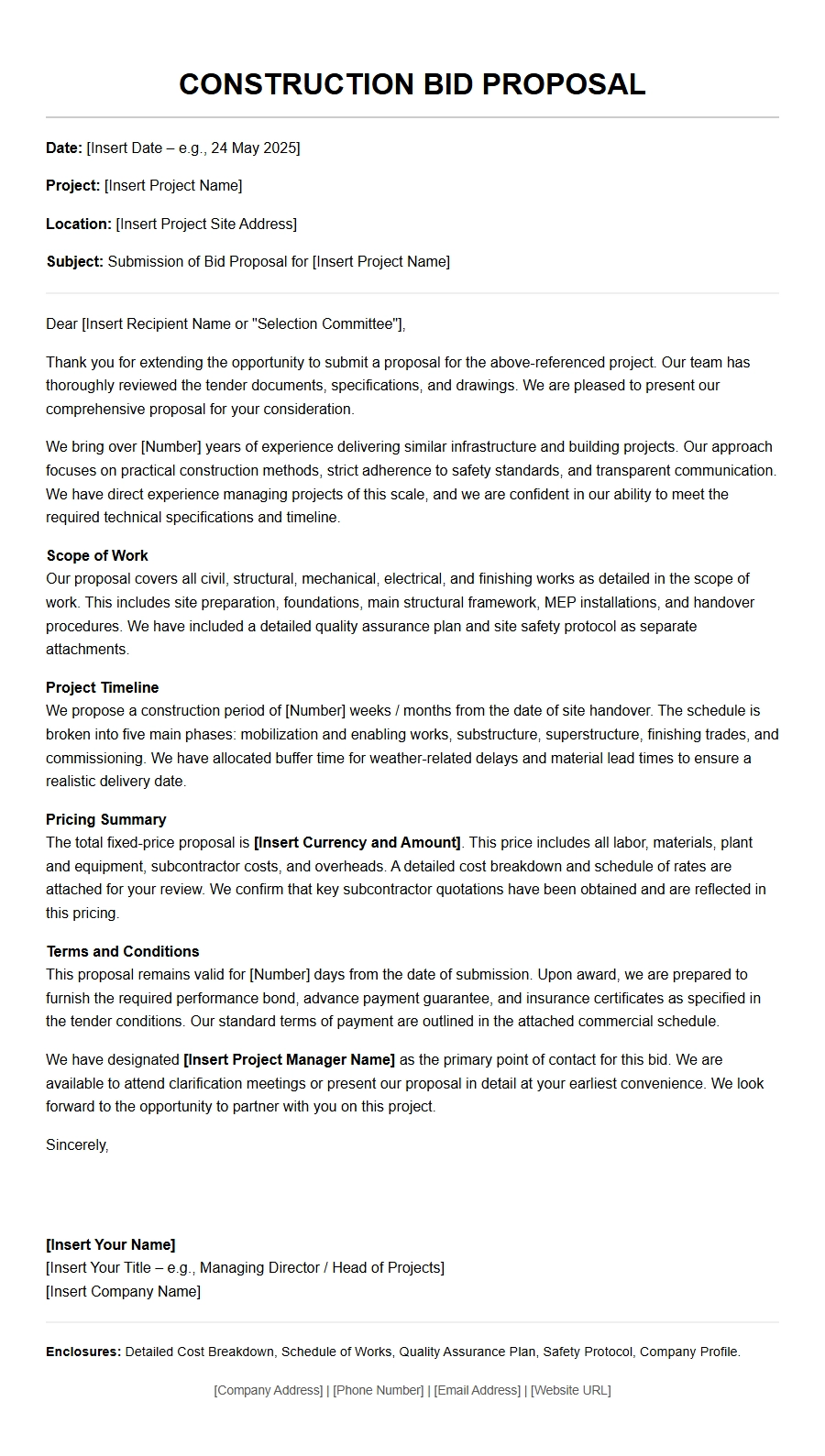 Sample Construction Bid Proposal Letter
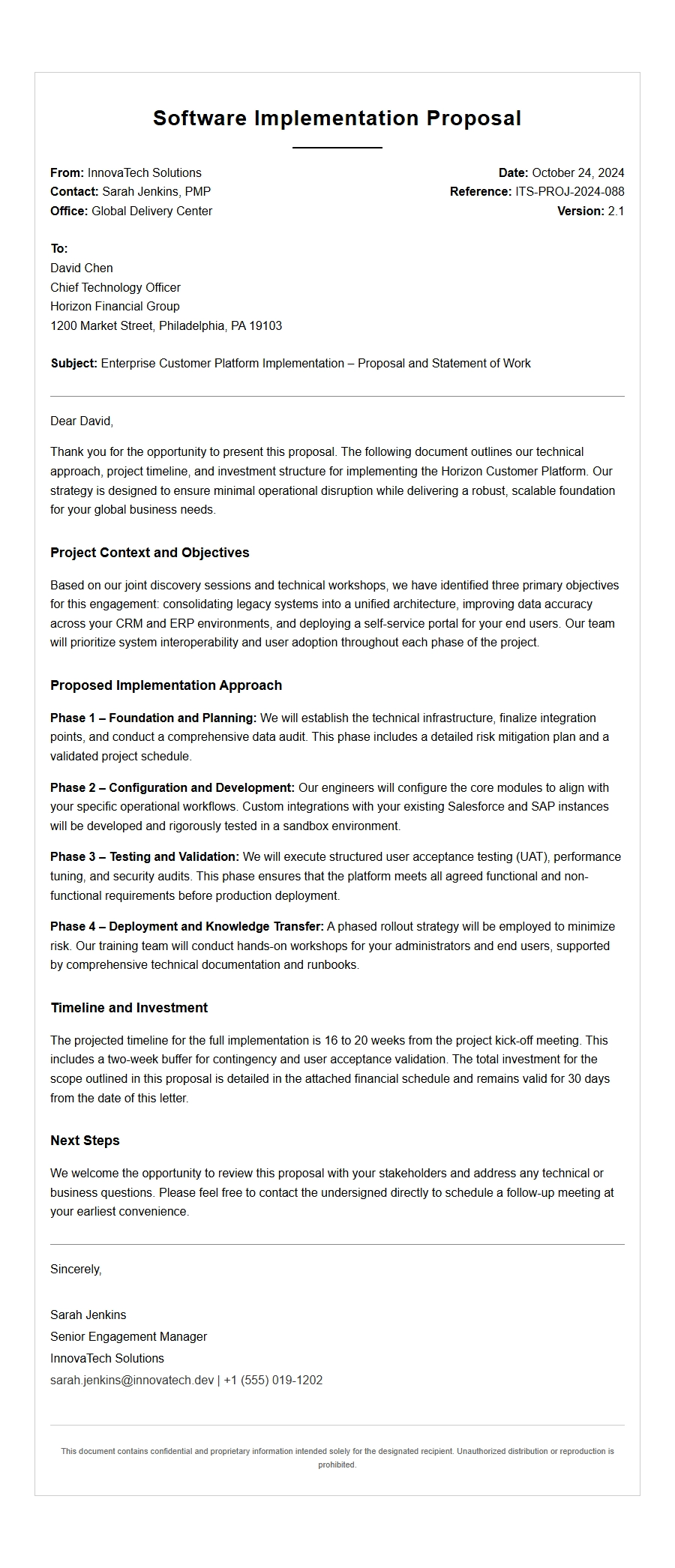 Enterprise Software Implementation Proposal Letter Example
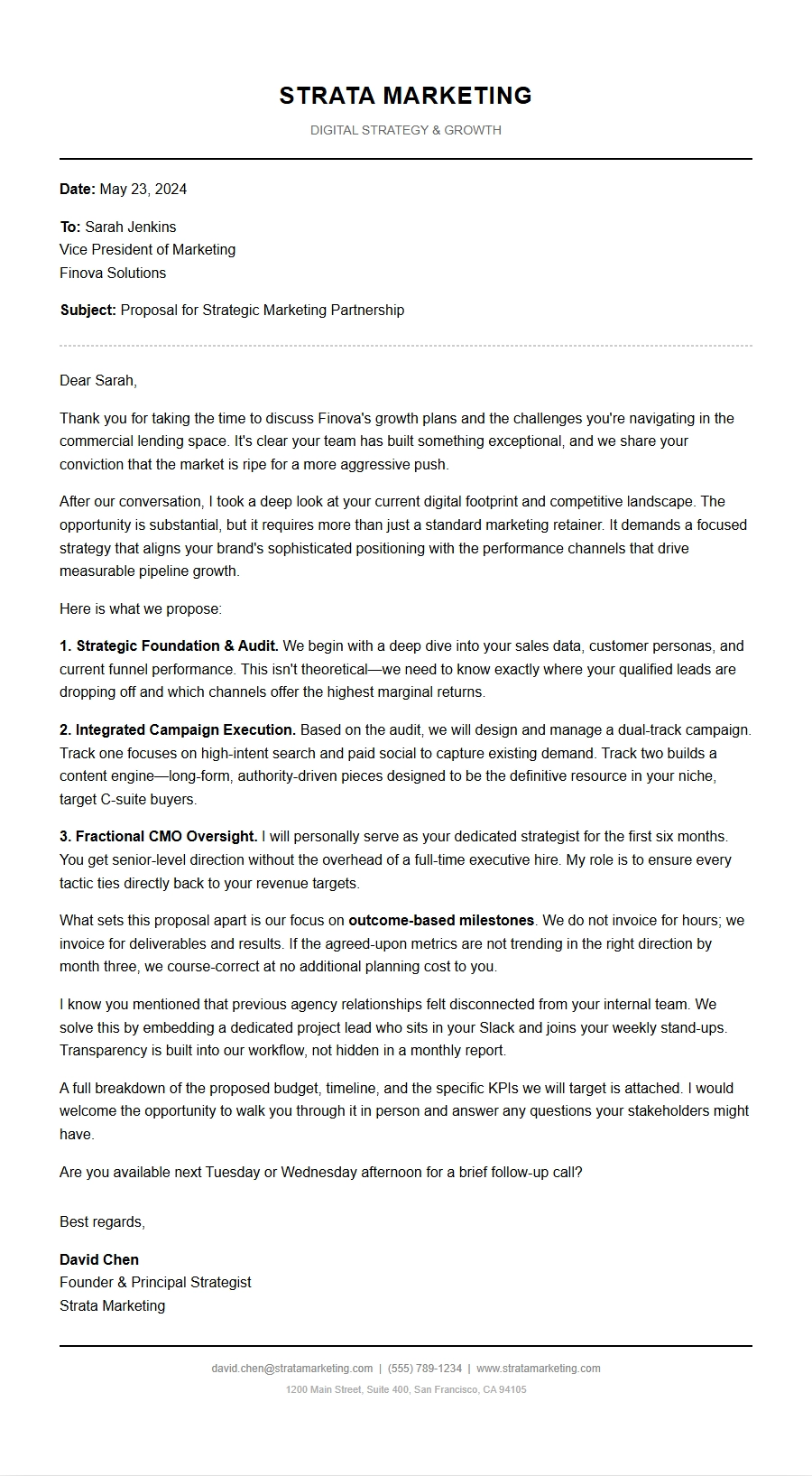 Marketing Agency Service Proposal Letter Template
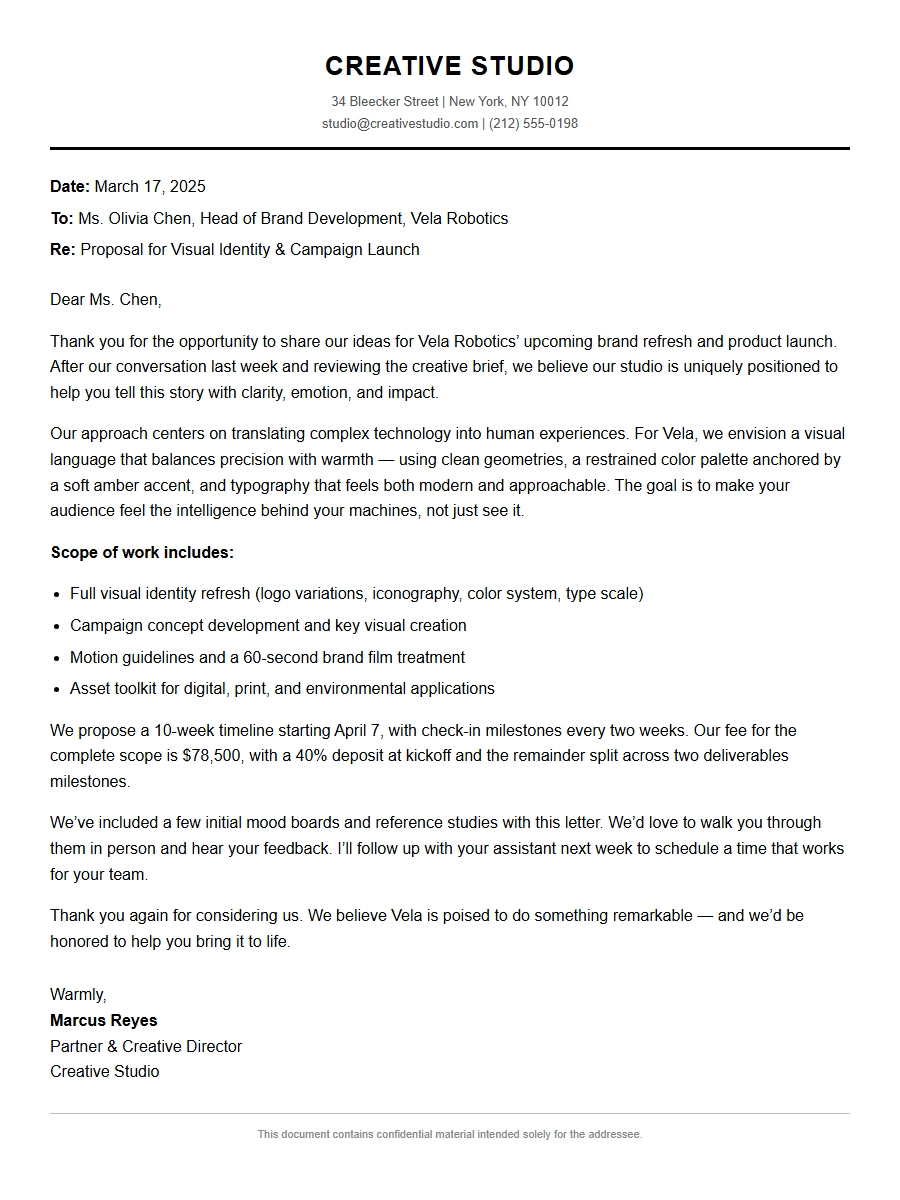 Creative Studio Project Proposal Letter
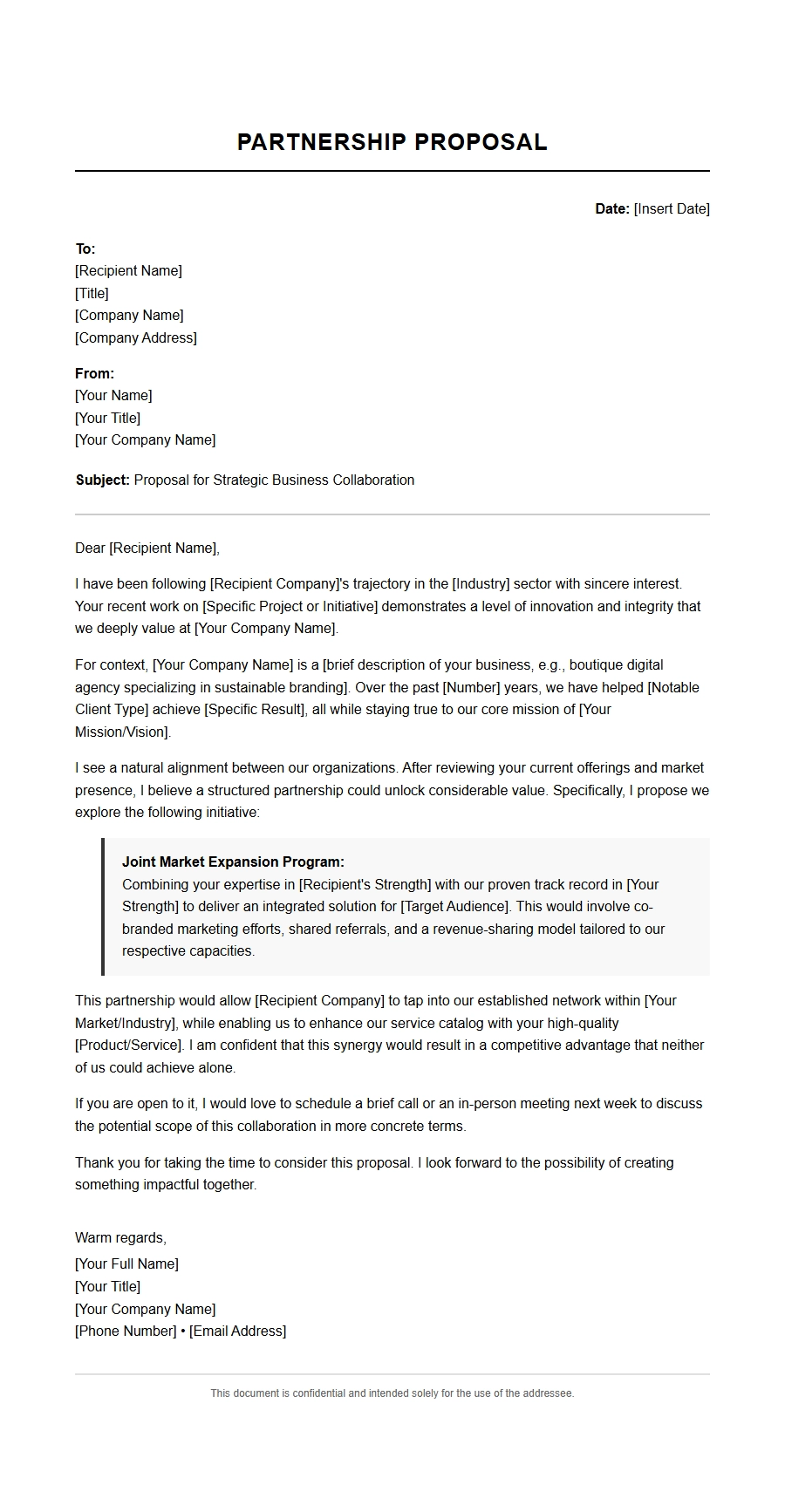 Small Business Partnership Proposal Letter Template
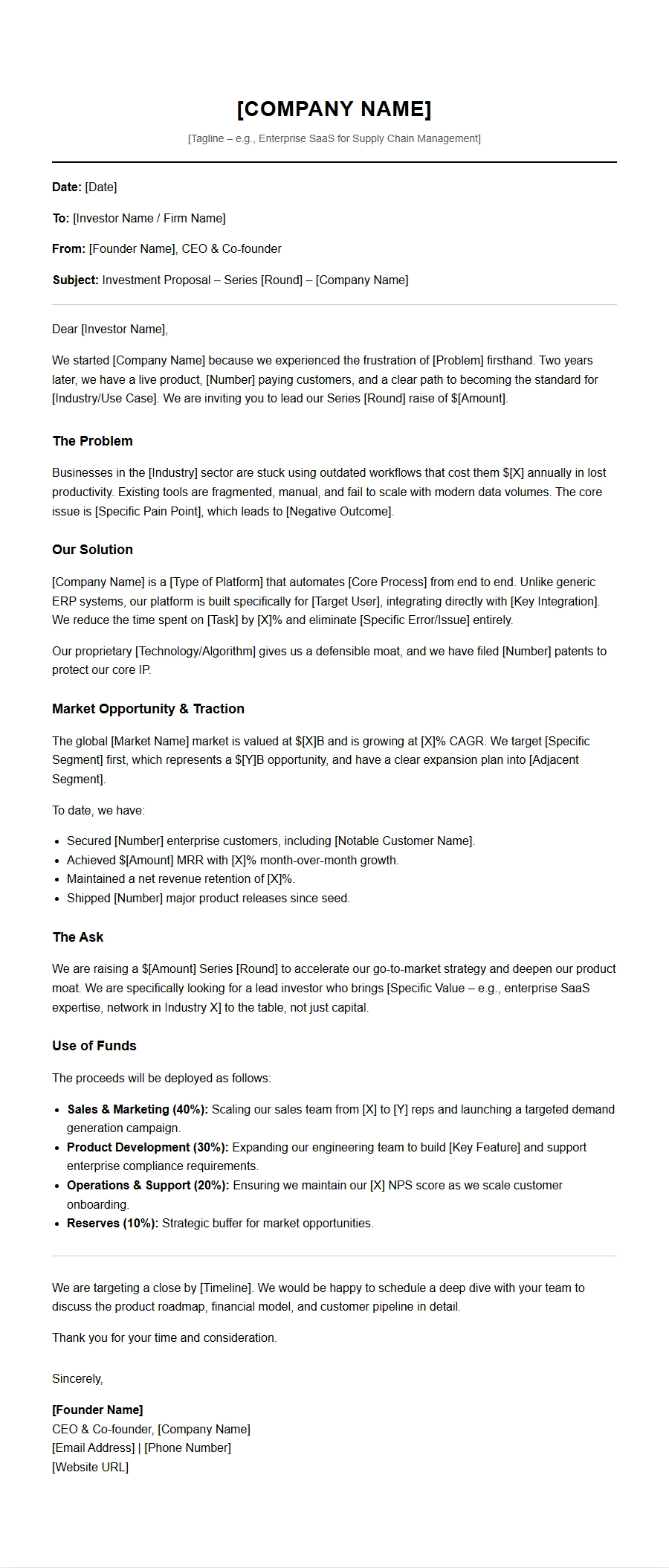 Startup Investment Proposal Letter Template