You've found the perfect airline job listing. Your experience fits. You can already picture yourself in the cabin. Then you hit the application form and that blank cover letter box stares back at you. Suddenly, your mind goes empty. That's normal. Writing a flight attendant cabin crew application from scratch is harder than it looks, especially when you know recruiters spend seconds scanning each submission.
Using a letter sample isn't cutting corners. It's working smarter. Good samples give you a clear structure, the right tone, and key phrases that work in aviation recruitment. But they leave plenty of room for your own story. Think of a sample as a framework, not a script. You fill in the real substance: your customer service experience, your flexibility with irregular schedules, your ability to stay calm under pressure.
Category: Flight attendant cabin crew application
Why a sample helps you stand out (without sounding like everyone else)
Airlines look for specific qualities: composure, reliability, and genuine warmth. A solid letter template helps you highlight those traits without forgetting the basics of professional correspondence. The goal isn't to copy-paste. It's to understand the letter structure and then adapt it with your own examples.
If you've ever worked in hospitality or a fast-paced retail role, you already have relevant stories. The sample just shows you where to place them and how to frame them for a recruiter who sees hundreds of applications.
How to pick the right sample for your situation
Not every letter works for every airline. Some carriers want a formal, traditional tone. Others look for a more personal, energetic voice. Look for a sample that matches the company culture you're applying to. A legacy airline might expect a classic business letter format, while a low-cost carrier may appreciate a shorter, punchier approach.
A cover letter example aimed at cabin crew should focus on soft skills, safety awareness, and adaptability. Avoid generic samples written for office jobs. You want something that uses aviation language naturally, not a corporate script that could apply to any role.
Adapting a sample without losing your voice
Here's the trick: use the sample's structure, but replace the filler with your real experience. If the sample says "I have strong communication skills," you write "I handled passenger concerns during a delayed flight and kept everyone informed calmly." That's the difference between a generic application and one that feels authentic.
Pay attention to the salutation and closing. "Dear Hiring Manager" is safe, but if you know the recruiter's name, use it. Avoid outdated closings like "Sincerely yours" unless the airline is very traditional. "Best regards" or "Yours faithfully" usually works fine.
The tone in writing matters a lot for cabin crew roles. You need to sound professional but approachable. Read your draft out loud. Would you say that to a passenger? If it sounds stiff, rewrite it.
Common mistakes that sink a cabin crew application
One of the biggest errors is ignoring the format. If you're applying online, your digital letter format should be plain text or a clean PDF. Don't use a fancy letterhead design unless you're mailing a physical copy. Recruiters scan digital files quickly, so clear headings and short paragraphs matter more than decoration.
Another mistake? Forgetting to proofread the letter before sending. A typo might not disqualify you, but it suggests carelessness. Airlines need people who notice details. Read it twice, then ask a friend to read it once.
Some applicants also use a resignation letter sample tone by accident, sounding too transactional. Don't do that. This is an application, not a departure. Show enthusiasm for the role and the airline.
One quick tip for a stronger opening
Your first sentence should connect your experience to their need. Instead of "I am writing to apply for the cabin crew position," try something like "After three years managing busy restaurant shifts, I know how to keep people comfortable and calm when things get hectic." That tells the recruiter who you are and why you fit, all in one line.
For more examples of how to tailor your opening to specific roles, you might look at how other positions handle this. A personal assistant cover letter often emphasizes organization and anticipation of needs, which overlaps well with cabin crew skills. Similarly, a sales executive cover letter focuses on relationship building, a core part of in-flight service.
When the sample needs more customization
If you have technical skills like first aid certification or language fluency, make sure those stand out. Don't bury them in a paragraph. Give them their own line. Airlines look for candidates who can handle medical situations and communicate with diverse passengers.
Also consider the physical demands of the job. Mentioning your comfort with long hours or your ability to remain active during a full flight day is fair game. It shows you understand what the job actually involves.
For industries that require precision and logic under pressure, the approach is similar. A DevOps engineer cover letter highlights problem-solving during system failures, much like cabin crew handle unexpected disruptions. The context differs, but the underlying skill set overlaps more than you might think.
Using the sample as a springboard
The best applications feel both professional and personal. Use the sample to get started, then make it yours. Swap out generic phrases for specific moments from your work history. Keep the structure, but let your personality come through in the examples you choose.
If you're applying to multiple airlines, create one strong base version and adjust it for each company. Change the airline name, the specific values they mention, and any unique requirements. That small effort shows you actually researched the role.
Roles that demand high-level coordination and trust, like an executive assistant cover letter, also rely on showing reliability and discretion. Those same traits are essential for cabin crew. Draw from any past role where you handled responsibility with care.
And if your background is in sales or client-facing work, your ability to read people and adjust your approach is directly transferable. A B2B sales representative cover letter often highlights active listening and problem-solving under pressure, both of which are daily realities for flight attendants.
What to do after you've written your letter
Step away for a few hours. Come back and read it fresh. Better yet, read it upside down. That trick helps you spot typos you'd otherwise skip. Check your formatting, your tone, and whether every sentence serves a purpose. If a line doesn't help your case, cut it.
Then send it and move on. The letter is just one part of the process. Your interview, your presence, and how you handle yourself in person will matter just as much. But a strong, clear application letter gets you in the door. Use the sample as your starting point, not your finish line.
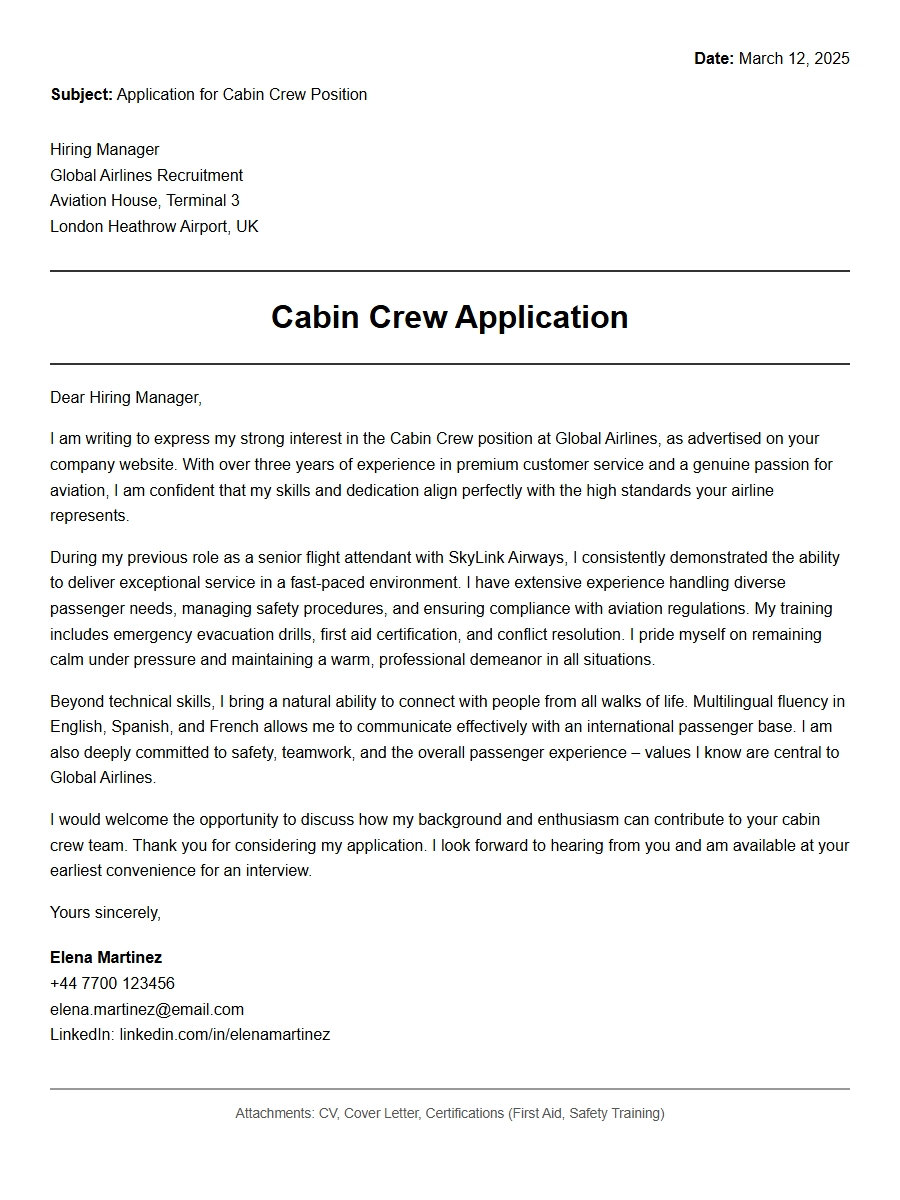
I am writing to express my strong interest in the Flight Attendant position at [Airline Name]. With over five years of experience as a cabin crew member at [Previous Airline], I bring proven expertise in safety procedures, in-flight service, and handling diverse passenger needs. My background includes:
Completion of rigorous initial and recurrent training in emergency procedures, first aid, and customer service.
Consistent recognition for exceeding service standards and earning multiple Customer Choice Awards.
Fluency in English, Spanish, and basic Portuguese, enabling effective communication with a wide range of passengers.
I am eager to bring my dedication and professionalism to your esteemed airline. Thank you for considering my application.
Sincerely, Mariana López
Customer Service Representative Transitioning to Cabin Crew
Dear Recruitment Team,
I am excited to apply for the Cabin Crew position at [Airline]. Having spent the last four years as a senior customer service representative at a major hotel chain, I have honed the interpersonal and problem-solving skills essential for delivering exceptional in-flight experiences. Key qualifications include:
Managing high-pressure situations with poise, resolving guest complaints, and ensuring satisfaction.
Leading a team of 10 service staff, fostering a collaborative and efficient work environment.
Certification in CPR and First Aid, which I understand is valuable for onboard safety.
My passion for travel and hospitality drives me to pursue a career where I can combine my communication skills with a love for aviation. I am available for immediate interview and training.
Warm regards, James Chen
Fresh Graduate with Hospitality Degree
Dear Hiring Manager,
As a recent summa cum laude graduate in Hospitality Management from [University], I am thrilled to apply for the Flight Attendant role at [Airline]. My academic foundation in service excellence, event coordination, and cross-cultural communication directly prepares me for the demands of cabin crew. During my internship at [Hotel/Resort], I:
Skill
Application
Guest Relations
Assisted VIP guests, resolving issues with empathy and efficiency.
Languages
Fluent in English and Mandarin; conversational Korean.
Teamwork
Coordinated with housekeeping and front desk for seamless service.
I am eager to bring my energy, adaptability, and dedication to passenger satisfaction to your airline. Thank you for this opportunity.
Best regards, Sophia Kim
Registered Nurse Applying for Cabin Crew
Dear Cabin Crew Selection Committee,
I am a registered nurse with three years of experience in emergency and critical care, now seeking to transition into a cabin crew role at [Airline]. My medical expertise is a unique asset in ensuring passenger safety and comfort during flights. Key highlights:
Proficient in advanced first aid, CPR, and handling medical emergencies such as anaphylaxis, cardiac events, and injuries.
Strong ability to remain calm under pressure and make quick, sound decisions.
Excellent communication skills for explaining procedures to passengers and coordinating with pilots.
I understand the high standards of service expected at your airline and am fully prepared to complete all required training. Please find my resume attached.
Sincerely, Dr. Amanda Ruiz, RN
Former Military Aircraft Crew Member
Dear Hiring Team,
With six years of service as an aircraft crew member in the [Branch] military, I am confident in my ability to excel as a Flight Attendant at [Airline]. My military background has instilled discipline, teamwork, and a razor-sharp focus on safety protocols. Qualifications include:
Extensive training in emergency evacuation, firefighting, and decompression procedures.
Leading teams of up to 15 personnel in high-stress operational environments.
Top-secret security clearance, demonstrating trustworthiness and integrity.
I am seeking a role where I can apply these skills in a civilian aviation environment while providing outstanding customer service. I am available for immediate start and relocation.
Respectfully, Marcus Johnson
Bilingual Candidate with Language Skills
Dear Recruitment Manager,
I am writing to apply for the Cabin Crew position at [Airline], drawn to your global network and reputation for excellence. I offer fluency in French, Arabic, and English, along with a deep appreciation for diverse cultures. My customer service background includes:
Two years as a flight attendant for a regional carrier, handling international routes.
Experience assisting non-English speaking passengers, providing translation and cultural mediation.
Certification in passenger service and safety from [Training Academy].
I am eager to contribute to your airline’s commitment to personalized service. Thank you for considering my application.
Best regards, Leila Benali
Mature Applicant with Extensive Travel Experience
Dear Sir or Madam,
At 42, I bring a maturity and wealth of life experience that would make me an outstanding Flight Attendant for [Airline]. Having visited over 40 countries and worked in hospitality for 15 years, I possess:
Deep understanding of diverse passenger needs and cultural sensitivities.
Proven ability to de-escalate tense situations with calm professionalism.
Unwavering commitment to punctuality, reliability, and safety.
I recently completed the required cabin crew training and hold a valid Medical Certificate. I am physically fit and ready to embrace the dynamic lifestyle of a flight attendant. Thank you for your time.
Sincerely, Patricia O’Connor
Recent Graduate with Aviation Internship
Dear Hiring Team,
I am excited to submit my application for the Cabin Crew position at [Airline]. I recently graduated with a degree in Aviation Management and completed a 6-month internship with [Airline/Company], where I gained hands-on experience in airport operations and customer service. Highlights include:
Competency
During Internship
Passenger Handling
Assisted at check-in and boarding, resolving special requests.
Safety Awareness
Participated in safety drills and learned emergency protocols.
Multitasking
Managed multiple tasks under time constraints with precision.
I am fully committed to representing your airline with professionalism and warmth. I look forward to the possibility of contributing to your team.
Warmly, Daniel Park
Career Changer from Teaching
Dear Recruitment Team,
After eight years as a high school teacher, I am eager to channel my passion for education and service into a Flight Attendant career at [Airline]. My teaching background has equipped me with transferable skills:
Excellent public speaking and clear communication, even in noisy environments.
Ability to manage large groups, maintain order, and ensure safety protocols are followed.
Empathy and patience when dealing with diverse individuals, including those with special needs.
I have also earned my First Aid and CPR certifications in anticipation of this role. I am ready to complete all airline training and embrace the challenges of cabin crew life.
Sincerely, Robert Lin
Passionate About Travel and Service – Limited Experience
Dear Hiring Manager,
While I am new to formal aviation roles, my deep passion for travel and proven dedication to customer service make me a strong candidate for the Flight Attendant position at [Airline]. Over the past four years, I have worked in retail and hospitality, consistently earning recognition for:
Exceeding sales targets while maintaining high customer satisfaction ratings.
Resolving complaints with empathy and creativity.
Working effectively in fast-paced team environments.
I have completed a Cabin Crew Foundation Course and hold a valid passport with no travel restrictions. I am eager to learn, adaptable, and fully committed to representing your airline with pride. Thank you for considering my application.
 Recent College Student Cover Letter for Internship
 Entry Level Teacher Cover Letter Examples
 Career Changer Administrative Assistant Cover Letter
 High School Student Part Time Job Cover Letter
 Fresh Graduate Nursing Application Letter
 University Alumni Referral Email Cover Letter