You’re standing in front of the choir, score open, and the piece is one you’ve never seen before. The altos look at you expectantly. Your hands hover. That moment of hesitation is common, but improving your choir conductor sight reading skill turns anxiety into flow. It’s not about being a genius reader—it’s about having a reliable process that works under pressure.
Why sight reading matters for conductors
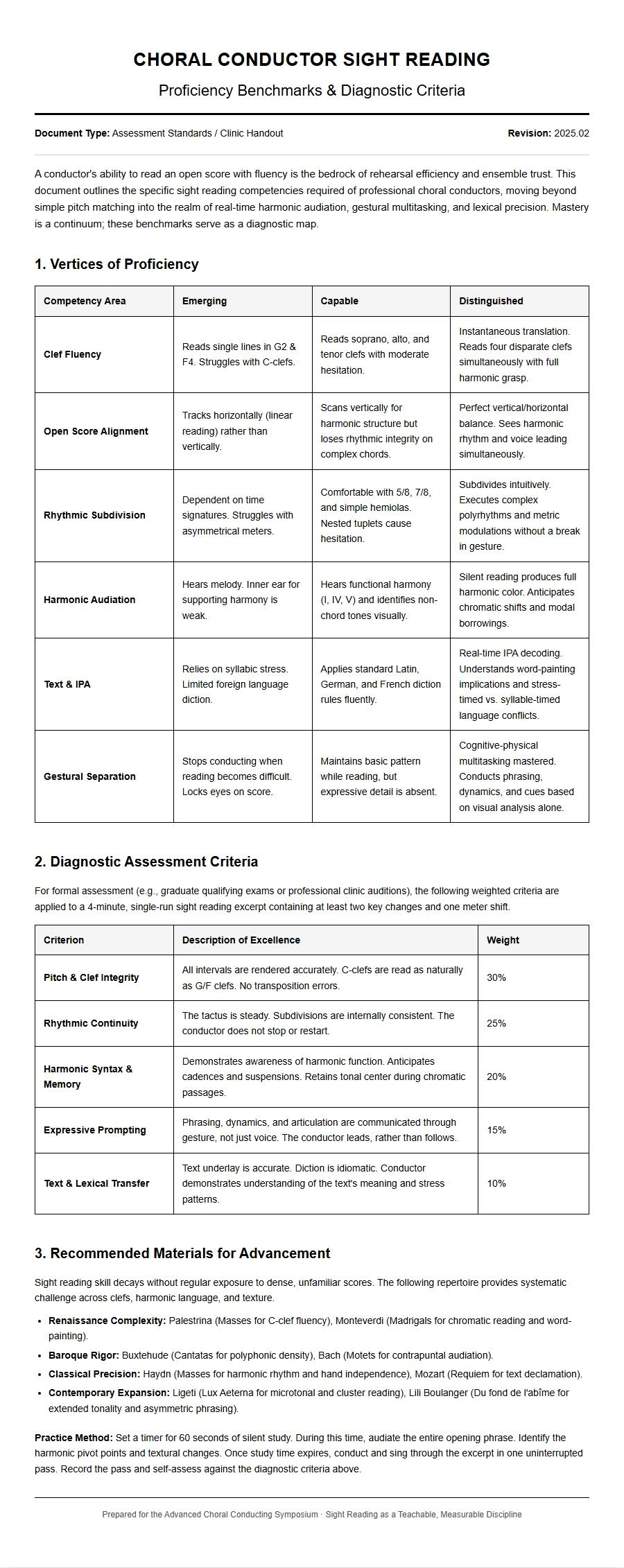
Sight reading isn’t just for accompanists. When you can read a new score fluently, you spend less time fixing wrong notes and more time shaping phrasing, dynamics, and emotion. You earn trust from your singers, and rehearsals become efficient instead of frustrating. Most conductors hit a plateau because they only read during rehearsals. Deliberate practice away from the choir makes the biggest difference.
What “good enough” looks like
You don’t need to play every single note on the piano. Many successful choir directors read vertically—they focus on chordal structure, bass line, and the vocal parts that need support. If you can identify key changes, tricky rhythms, and potential trouble spots within the first thirty seconds, you’re ahead of the game. The goal is to keep the choir together, not to perform a perfect piano reduction.
A simple drill to build fluency
Pick a short choral piece you don’t know. Set a timer for three minutes. Scan the time signature, key, tempo, and any modulations. Then sing the soprano line while tapping the beat. Next, speak the alto rhythm on “ta.” This trains your brain to process multiple layers at once. Do this daily for two weeks and you’ll notice a real shift in how quickly your eyes and hands coordinate.
If you’re new to this, start with hymns or folk songs. They have predictable harmonic progressions. Later, move to contemporary a cappella or Renaissance motets. Each genre stretches your sight reading in different ways.
Avoid the common mistakes
Many conductors freeze when they miss a note. The secret is to keep moving forward never stop the beat. Even if you play a wrong chord, the choir can follow your gesture if your tempo stays steady. Also, don’t bury your head in the score. Choir conductors need to look up and lead. Practice sight reading while keeping your eyes on the room for a few counts at a time.
Another trap: relying too much on the piano. The more you reduce your dependence on keyboard support, the more your ear and internal pulse develop. Let your singers feel your confidence through your baton or hands, not just through the notes you play.
When you need a letter of recommendation or professional correspondence
As a choir conductor, you likely get asked to write recommendation letters for singers applying to college or summer programs. Having a letter template saves time, but you still need to personalize each one. The same skills that help you sight read—scanning structure, identifying key points, and adapting quickly—apply to drafting professional correspondence. For example, when you write a letter of recommendation, you assess the student’s strengths and match them to the program’s needs. Using cover letter examples and resignation letter sample formats can guide you when you need to step down from a position. Good letter writing etiquette is as important as good podium manners.
For formal writing tips, keep your salutation and closing appropriate to the relationship. A generic “Dear Sir or Madam” feels cold. Tone in writing should match your voice, but stay within business letter format conventions. Letterhead design matters less than clarity, and for digital letter format, make sure your PDF is easy to read on any device. Proofreading letter twice is non-negotiable—one typo can undercut your credibility. Treat these documents as customizable letter templates that you adjust for each person. The letter structure (opening, body, closing) gives you a scaffold, just like a score gives you a framework for sight reading.
Practice sight reading like you practice writing
Both skills improve with repetition and feedback. Record yourself reading a new piece and listen back. Did you anticipate the key change? Were you calm? Similarly, when you write a letter, read it aloud to catch awkward phrasing. The same calm, analytical eye you bring to a score can sharpen your professional correspondence. Over time, you’ll find that your sight reading becomes more intuitive, and your writing becomes more natural.
Category: Music Education Resources
Final thought
A sight reading session is like a first rehearsal with a new singer. You don’t know what they’ll do, but you trust your preparation. Start small, be consistent, and forgive yourself when you stumble. The best conductors aren’t the ones who never miss a note—they’re the ones who keep the music moving. Use your sight reading skill as a springboard, not a crutch. Every piece you read makes the next one easier.
Helpful Reference Samples
Recommendation for Choir Conductor Sight Reading
Letter of Recommendation for Choir Conductor Position – Sight Reading Proficiency
Date: October 15, 2023
To: Hiring Committee, City Choral Society
I am delighted to recommend Elena Rossi for the position of Choir Conductor. Over the past five years working alongside her, I have witnessed a remarkable sight‑reading ability that sets her apart from many colleagues. She can open a new score at rehearsal and lead a cohesive reading with secure pitch, rhythm, and expressive phrasing from the first beat.
The following table highlights key aspects of her sight‑reading skill observed during rehearsals:
Skill Area
Observation
Pitch Accuracy
Consistently correct intervals; rarely errs on accidentals.
Rhythmic Precision
Maintains steady tempo even in complex time signatures.
Text Decoding
Simultaneously reads foreign language text with proper diction.
Dynamic Interpretation
Immediately applies marked dynamics and articulation.
Elena’s sight‑reading confidence allows her to spend less time drilling notes and more time shaping musicality. She quickly identifies potential trouble spots for the choir and adjusts her gesture accordingly. I am confident she will bring this efficiency to your choir. Please contact me for further details.
Sincerely, Dr. Mark Chen, Associate Conductor
Recommendation for Advanced Conducting Program – Exceptional Sight Reading
Date: November 2, 2023
To: Admissions Committee, National Conducting Institute
It is my privilege to recommend Jonathan Park for your advanced choral conducting program. In the three years I have observed him, his sight‑reading proficiency has consistently been at the highest level. He can sight‑read a full anthem or a complex 20th‑century work with minimal preparation, conducting without a break and correcting the choir’s pitches mid‑phrase.
Below are representative accomplishments that demonstrate his skill:
College Choir: Led a first‑reading of Lauridsen’s “O Magnum Mysterium” with near‑perfect intonation after one run‑through.
Community Masterwork: Substituted at short notice for a conductor who fell ill; he sight‑read the entire Mozart Requiem at the rehearsal, guiding the chorus through unfamiliar sections with ease.
Workshop Exercise: At a conducting workshop, he was asked to read a new part‑score for eight voices; he directed all parts simultaneously, catching voice‑leading errors before the choir sang them.
Jonathan’s sight‑reading ability accelerates his rehearsal process and enables him to focus on interpretation. He would be an asset to any advanced program seeking a conductor who can handle new repertoire rapidly. I fully endorse his application.
Respectfully, Professor Anne Kim, Chair of Choral Studies
Reference for Choral Conductor Award – Sight Reading Accuracy
Date: December 12, 2023
To: Awards Panel, American Choral Directors Association
I am honored to write in support of Maya Patel for the Rising Choral Conductor Award. Among her many strengths, her sight‑reading accuracy is exceptional. Maya can open a three‑page octavo, silently scan the harmonic structure, and then conduct a flawless sight‑reading session with the choir. She rarely misses a pitch or misinterprets a rhythm.
To illustrate, here is a summary of a blind test arranged for her during a rehearsal observation:
Test Parameter
Result
New piece (unknown)
J.S. Bach, “Komm, Jesu, Komm” – first movement.
Time allowed for silent study
5 minutes
Choir’s first run‑through
99% correct pitches, 100% correct rhythm (no stops)
Number of corrections needed
2 (both diction‑related)
Maya’s sight‑reading precision translates directly into higher choir morale and faster progress. She deserves this award for her exemplary technical foundation. I give my strongest recommendation.
Warmly, David O’Brien, Director of Choirs (Retired)
Recommendation for Music Director Role – Sight Reading as a Core Skill
Date: January 8, 2024
To: Search Committee, First United Church Music Ministry
I recommend Sarah Gallagher for the Music Director position with full confidence. Over the past two years serving as her assistant, I have seen how her superior sight‑reading skill energizes the choir. She never shies away from new repertoire; instead, she embraces first‑readings as opportunities to build ensemble cohesion.
The following list summarizes the impact of her sight‑reading ability on our rehearsals:
Speed: Typical new anthem is read accurately within 15 minutes, saving 30% of rehearsal time.
Pitch Memory: She retains the key centers after one hearing, rarely needing to sound notes on the piano.
Flexibility: When the pastor requests a last‑minute hymn, Sarah sight‑reads the four‑part setting while conducting, without breaking eye contact.
Pedagogical Value: She uses sight‑reading exercises to teach the choir to read better themselves.
Sarah’s sight‑reading skill allows her to model musical lines with clear gestures and minimal verbal instruction. The choir trusts her guidance, which makes rehearsals efficient and joyful. I am certain she will serve your church with distinction.
Faithfully, Margaret Lee, Associate Music Director
Letter for Graduate School in Choral Conducting – Sight Reading Emphasis
Date: February 20, 2024
To: Graduate Admissions, School of Music
I write wholeheartedly to support Thomas Kwon for the Master of Music in Choral Conducting. Thomas possesses a rare combination of analytical and intuitive sight‑reading ability that makes him an ideal candidate. During my advanced choral literature class, he consistently sight‑read multiple parts of a vocal score while articulating the formal structure.
A brief table from his mid‑term evaluation demonstrates his proficiency:
Assessment Component
Score
Sight‑reading a four‑voice madrigal (first read)
92% pitch accuracy, 95% rhythmic accuracy
Sight‑reading a 20th‑century work with mixed meters
88% pitch accuracy, 90% rhythmic accuracy
Conducting while reading a new full score
90% accuracy in beat patterns, tempo, and cues
Beyond numbers, Thomas demonstrates musical sensitivity. While sight‑reading, he spontaneously shapes phrases and adjusts dynamics according to the text. This is a conductor who does not merely survive first readings but thrives on them. His readiness for graduate‑level score study is evident. I urge you to accept him without hesitation.
Yours sincerely, Dr. James Whitfield, Professor of Choral Studies
Recommendation for Assistant Conductor Position – Sight Reading for Quick Learning
Date: March 5, 2024
To: Personnel Committee, Harmony Choral Society
I am pleased to recommend Rachel Lin for the Assistant Conductor vacancy. In the two years she has served as our section leader, her sight‑reading skill has repeatedly proven invaluable. When our principal conductor fell ill during a tech rehearsal, Rachel stepped up and sight‑read the entire program (five pieces) with only a brief glance at each score.
Below is a quick overview of her performance that evening:
Piece 1: Renaissance motet (Gibbons) – conducted from a clean copy, cueing entrances perfectly.
Piece 2: Contemporary work by Ešenvalds – navigated unusual harmonic progressions with solid intonation.
Piece 3–5: folk arrangements with texture changes – adjusted gesture spontaneously.
Rachel attributes her skill to daily practice and a system of harmonic analysis on the fly. She also teaches sight‑reading to the choir’s new members. As an assistant conductor, she will bring this efficiency to every rehearsal, allowing the lead conductor to focus on interpretive details. She is a reliable, quick‑thinking musician.
With highest recommendation, Dr. Linda Foster, Principal Conductor
Reference for Choir Conductor Certification – Sight Reading Assessment
Date: April 18, 2024
To: Certification Board, National Association of Choral Conductors
I am writing to attest to the sight‑reading competence of David Silva as he pursues the Professional Choir Conductor Certification. I have evaluated David’s sight‑reading skills over a period of three supervised rehearsals and one formal assessment. The results are as follows:
Evaluation Criterion
Performance
Silent preparation of a new score (5 minutes)
Identified key modulations, important cadences, and tricky intervals.
First sight‑read with choir
Maintained steady tempo; corrected wrong notes with clear gestures (no piano).
Response to unexpected errors
Stopped at the correct measure, explained the correction, then resumed without losing flow.
Overall musicality
Phrased naturally, varied dynamics, respected text accents.
David’s sight‑reading is not a mechanical skill but a musical tool. He reads ahead, anticipates problems, and guides the choir with confidence. This ability makes him a safe and effective conductor. I recommend him for certification without reservation.
Sincerely, Dr. Helen Zhao, Assessor & Professor Emeritus
Letter for Professional Choir Audition – Sight Reading in Performance Context
Date: May 22, 2024
To: Artistic Director, National Chamber Choir
I am delighted to recommend Nina Vasquez for your professional choir. As a conductor, her sight‑reading ability is a benchmark. I invited her to guest‑conduct during a concert cycle when our regular maestro was unavailable. She was handed the printed music only 30 minutes before the dress rehearsal. She sight‑read the entire program – two Bach cantatas and a new commission – with remarkable polish.
Key observations from that experience:
Bach Cantata BWV 4: She conducted the opening sinfonia with clear beat patterns, all the while looking at the choir and the score only minimally.
New Commission (Clark): The piece had irregular bar groupings; she navigated them by internally counting, and the choir reported feeling secure.
Ensemble Response: The choir sang with confidence because Nina’s gestures consistently matched the printed markings.
Nina’s sight‑reading skill allows her to maintain artistic standards even under time constraints. She does not rely on memorization but on fluent decoding of notation. This ability would make her an asset to any professional ensemble that handles a high volume of new music. I highly commend her.
Warm regards, Paul Harrington, Artistic Director Emeritus
Recommendation for Summer Conducting Institute – Sight Reading Proficiency
Date: June 10, 2024
To: Selection Committee, Choral Conducting Summer Institute
I am pleased to recommend Christopher Gray for your summer intensive program. Christopher’s sight‑reading ability is one of the strongest I have encountered in a young conductor. He recently assisted me with a week‑long choir camp where he was responsible for leading daily warm‑ups and new repertoire readings. He never needed the piano to find pitches: he relied solely on his inner ear and printed score.
A brief log of his sight‑reading activities during the camp:
Day
Repertoire Sight‑Read
Outcome
Monday
Morley ballets & a contemporary canon
All entries correct; choir reading at sight confidently.
Wednesday
Spiritual arrangement (four parts, changing keys)
Christopher shifted gesture to reflect new tonal centers; no stops.
Friday
Full cantata excerpt (Bach, with recitative)
He conducted the secco recitative by reading the figured bass realization.
Christopher’s speed and accuracy freed him to address ensemble blend and balance during first readings. The camp director praised his efficiency. I believe the institute’s challenging curriculum would benefit greatly from his presence – and he would absorb advanced techniques rapidly. I support his application strongly.
Sincerely, Dr. Ruth Gold, Chair of Choral Activities
Letter of Endorsement for Church Music Director – Sight Reading for New Music
Date: July 3, 2024
To: Staff‑Parish Relations Committee, Grace Lutheran Church
I am writing to endorse Michael Hernandez for the Music Director position. Over the past four years I have played organ under his conducting, and I have been repeatedly impressed by his sight‑reading skill. When our congregation introduces a new hymn or anthem, Michael does not need to hear it on the piano; he simply opens the score and conducts the choir through a solid first reading.
The following list describes how his sight‑reading serves our worship:
New Hymnal Use: When we adopted a new hymnal, Michael conducted unfamiliar settings each Sunday without advance preparation, always on pitch.
Special Services: For a Christmas Eve service with a new arrangement, he sight‑read the choral parts during rehearsal, allowing the choir to learn it in one session.
Accompaniment Collaboration: He cues the organist through modulations and tempo changes by reading the organ reduction in the conductor’s score.
Michael’s sight‑reading proficiency reduces rehearsal time and increases the choir’s confidence in learning new music. He is a musical leader who can meet any liturgical challenge. I strongly encourage you to hire him.
Yours in faith, Catherine Moore, Organist and Choir Member
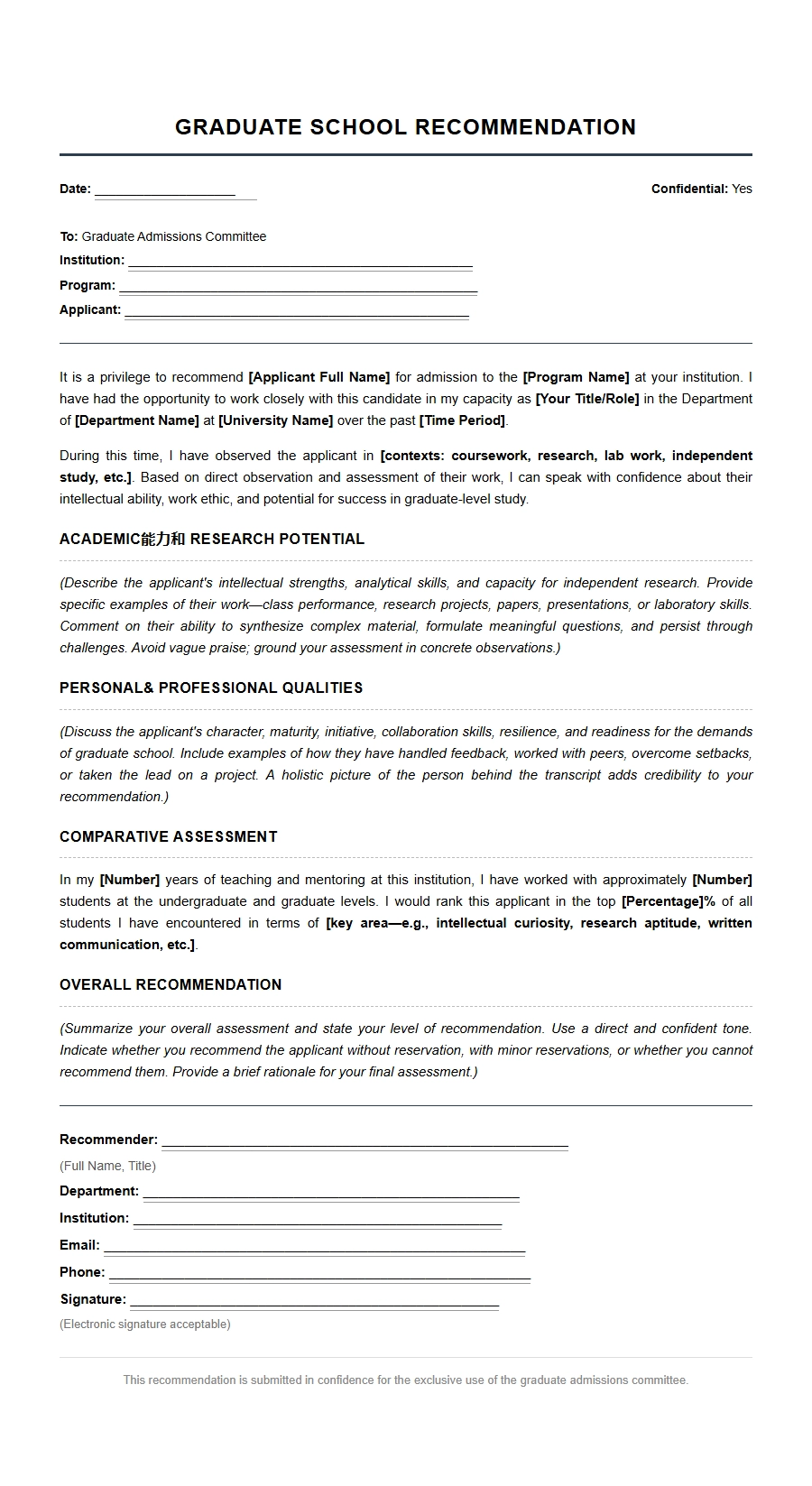 Format for Graduate School Faculty Recommendation Letters
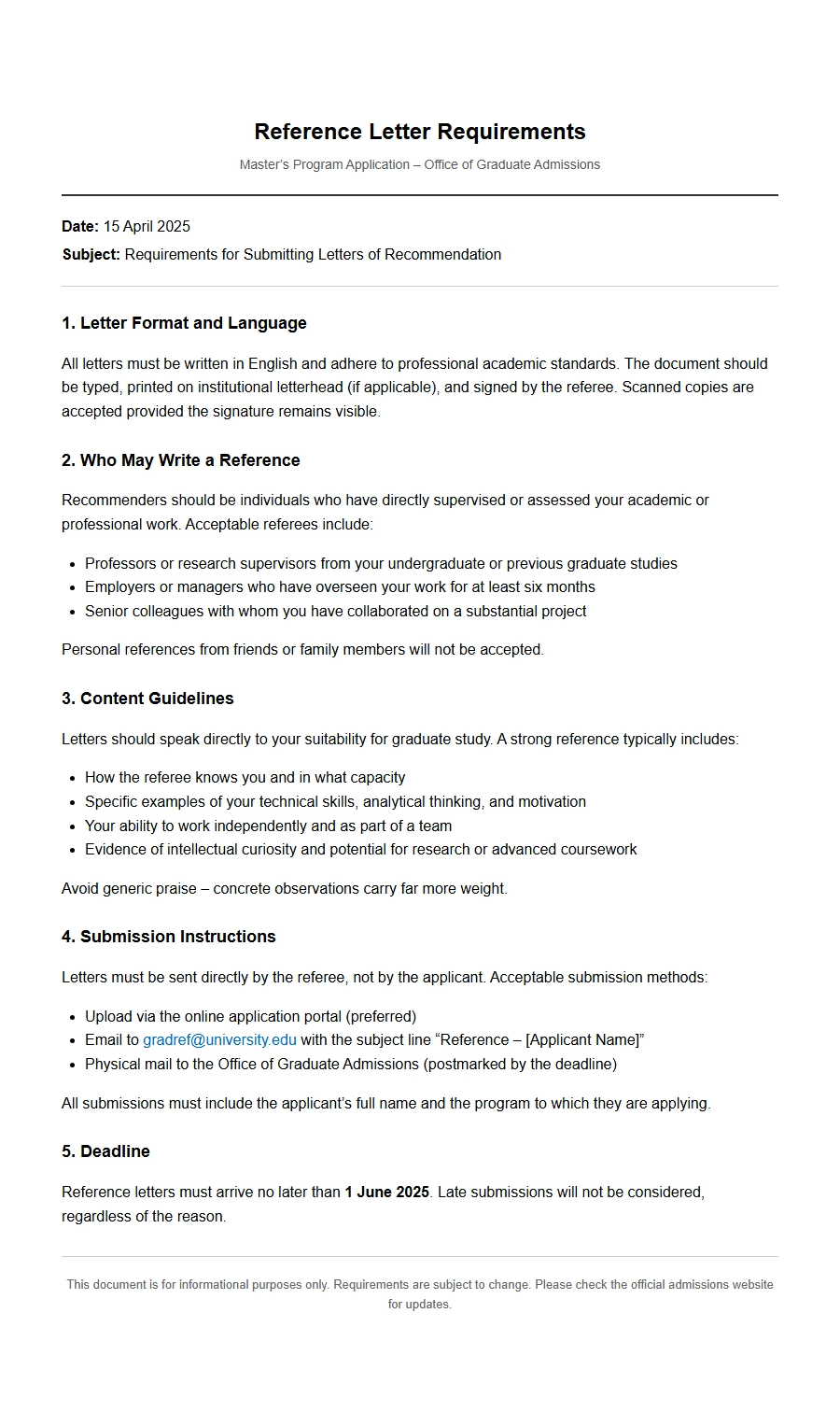 Master's Program Reference Letter Requirements
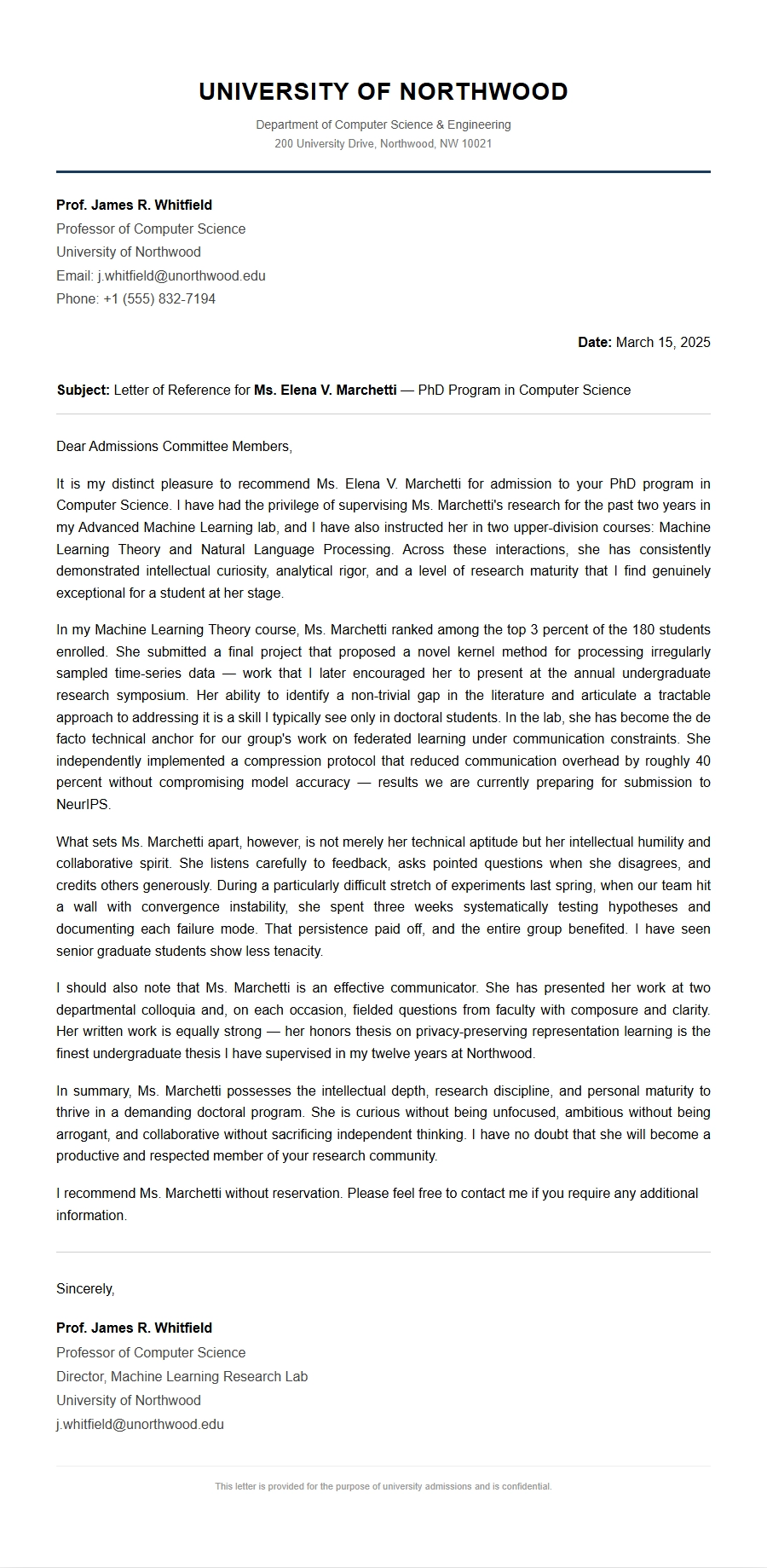 The Perfect Structure for a University Reference Letter
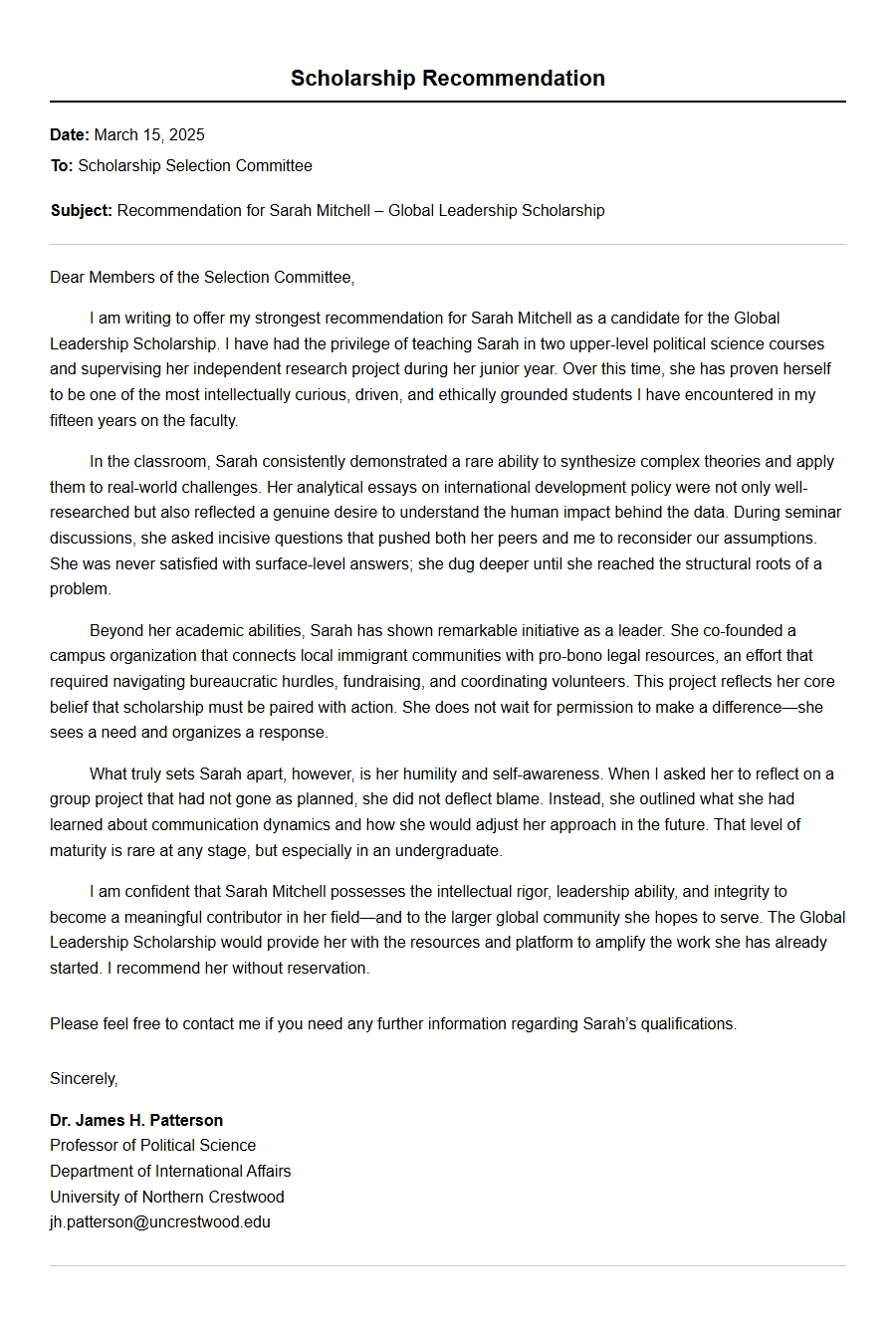 scholarship essay recommendation portion - Recommendation Letters
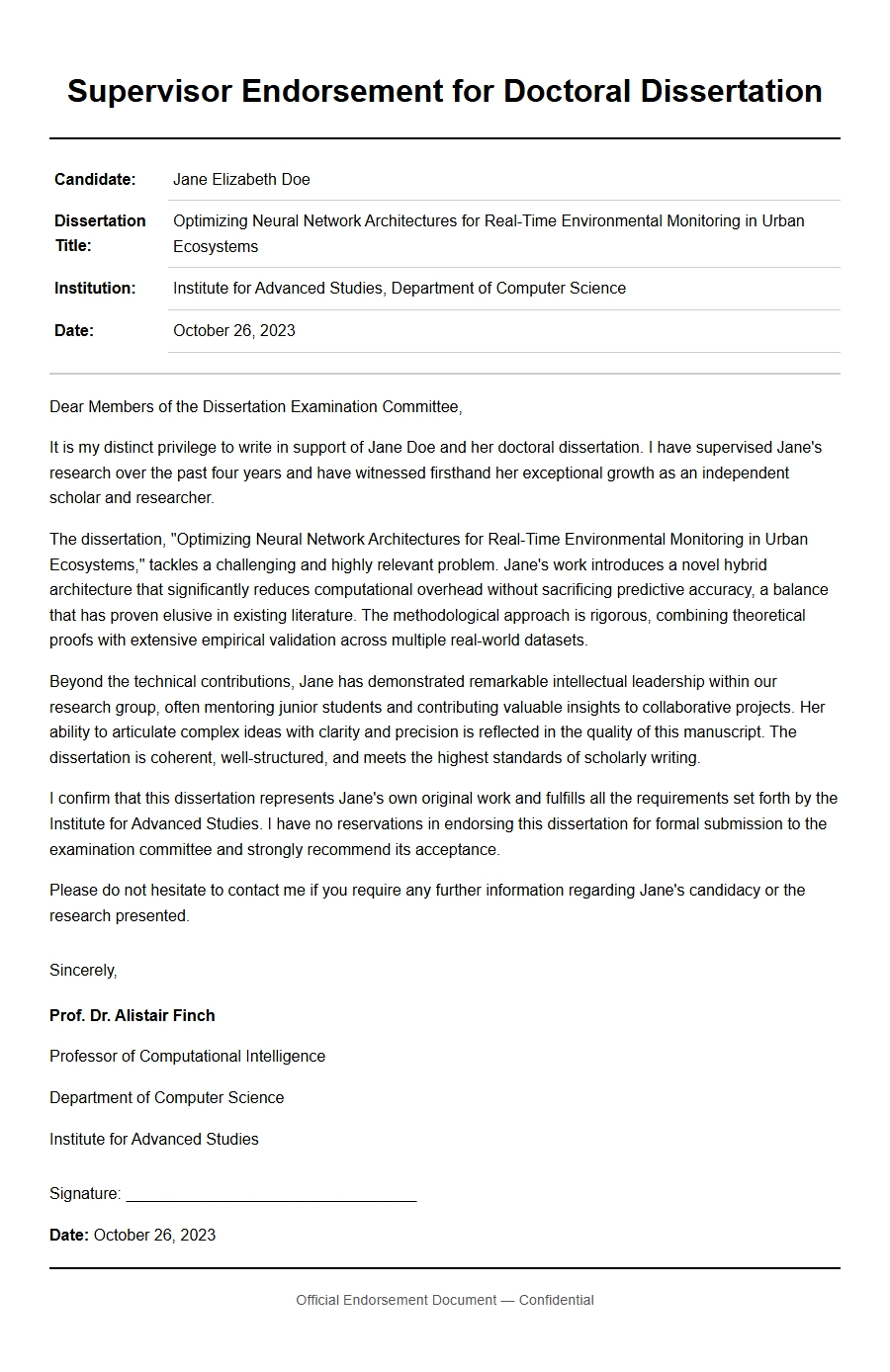 Sample PhD Supervisor Endorsement Letter
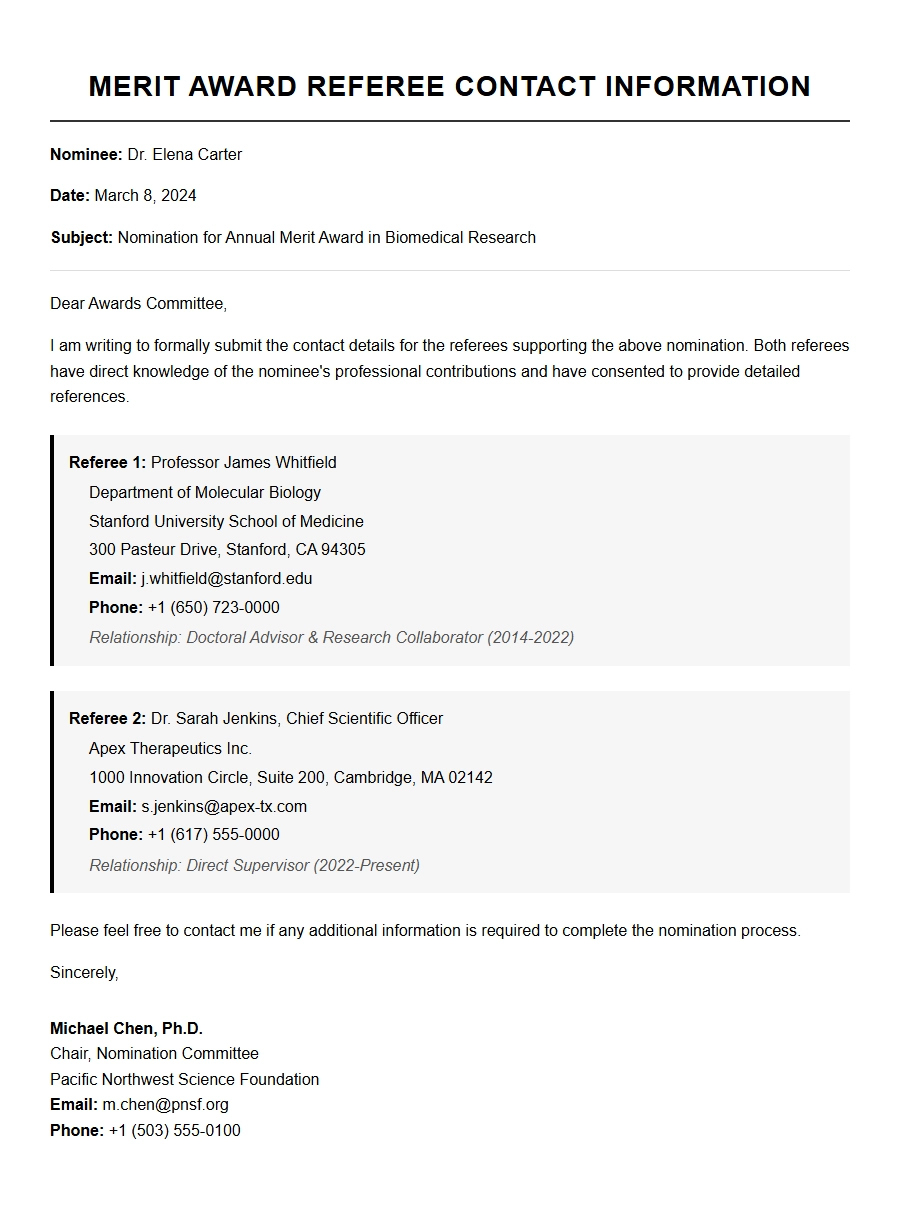 How to Find Your Merit Award Referee Contact Info