You stare at the screen, cursor blinking. That volunteer gave up their weekend, maybe more. You want to say thank you in a way that feels genuine, but every draft sounds either too stiff or too gushy. You’re not alone. Writing an appreciation letter for volunteer work often trips people up because you’re balancing professional courtesy with real warmth. The good news? A solid example can cut that anxiety down to size.
Using a sample is not cheating. It’s a smart shortcut that gives you a reliable letter structure—a clean salutation and closing, logical flow, and the right tone in writing. Think of it as a scaffold. You still bring your own voice, specific details, and authentic gratitude. The sample just keeps you from reinventing the wheel every time you need to write professional correspondence.
Category: Personal Letters
What to look for in an appreciation letter for volunteer work example
Not every sample fits every situation. If you’re writing to a long-time board member, you’ll want a more formal business letter format. For a one-time event helper, a friendly email does fine. The best letter template gives you a customizable letter framework—placeholders for names, dates, and specific contributions rather than a fill‑in‑the‑blank that sounds generic.
Pay attention to the opening. A strong first sentence should name what the volunteer did and why it mattered. “Thank you for organizing the food drive last Saturday” is far better than “I am writing to express my gratitude for your volunteer service.” Specificity shows you see them as a person, not just a helper.
How to adapt a sample without losing your own voice
Start by reading the sample through once. Notice its structure: a warm greeting, a paragraph about the impact of their work, maybe a line about how their effort made others feel, then a closing that leaves the door open for future involvement. Now rewrite each section in your own words. Keep the architecture, swap the details.
For example, if the sample says “your dedication inspired the team,” you might say “seeing you show up early every Saturday pushed the rest of us to give a little more.” That’s you. It’s honest, and it connects directly to your shared experience.
One common mistake is copying the sample’s salutation and closing without thinking. “Dear Sir or Madam” is outdated for almost any volunteer letter. Use the person’s first name unless you’re writing on behalf of a very formal organization. For the closing, “With sincere thanks” works in most cases. Avoid overused phrases like “Yours truly” unless you’re writing a formal letter of recommendation for their resume.
Formatting matters more than you think
Whether you’re sending the letter by email or snail mail affects the layout. For digital letter format, keep paragraphs short and skip the full letterhead design—just your name and title at the bottom. For a printed version, a simple letterhead design with your organization’s logo adds a professional touch. But don’t overdo it. The focus should be on the words.
Always proofreading letter before sending. A typo in the volunteer’s name or the date of the event can undermine the sincerity. Read it aloud. Does it sound like you? If not, tweak the tone in writing until it feels natural.
Think about how you approach other personal letters. For instance, when updating your current employer on an external opportunity, you balance honesty with professionalism. The same principle applies here: be direct, be grateful, and keep it real. Similarly, requesting a credit report correction demands precision—so does a letter of appreciation. Double‑check every detail. If you’ve ever declared a name change to relevant agencies, you know that accuracy builds trust. The volunteer’s name and the event description are the smallest details that carry the most weight.
What to skip in volunteer appreciation letters
Don’t turn the letter into a list of statistics or a formal report. The goal is to connect, not to impress. Avoid vague statements like “your hard work is appreciated” without saying what that hard work looked like. Also avoid overly casual language if the volunteer gave months of service—it can feel dismissive. Find the middle ground.
Another pitfall: copying the same letter for every volunteer. Each person contributed differently. A little personalization takes five extra minutes and makes the letter feel like it was written for them, not mass‑produced.
If you’re stuck on how to structure a more formal version, you might look at how wedding invitation details via postcard example manage to be both structured and warm. The same idea applies—clear format, personal touch.
Use the sample as a springboard, not a crutch
The best appreciation letters feel professional and personal at the same time. They make the volunteer feel seen, not just thanked. Start with a sample to get the bones right, then layer in your own memories, your own voice, your own specifics. Over time, you’ll get faster at it. You might even start writing them without a sample at all. But until then, keep a good example handy. It’s not a shortcut out of thinking—it’s a launchpad for genuine connection.
Practical Writing Samples
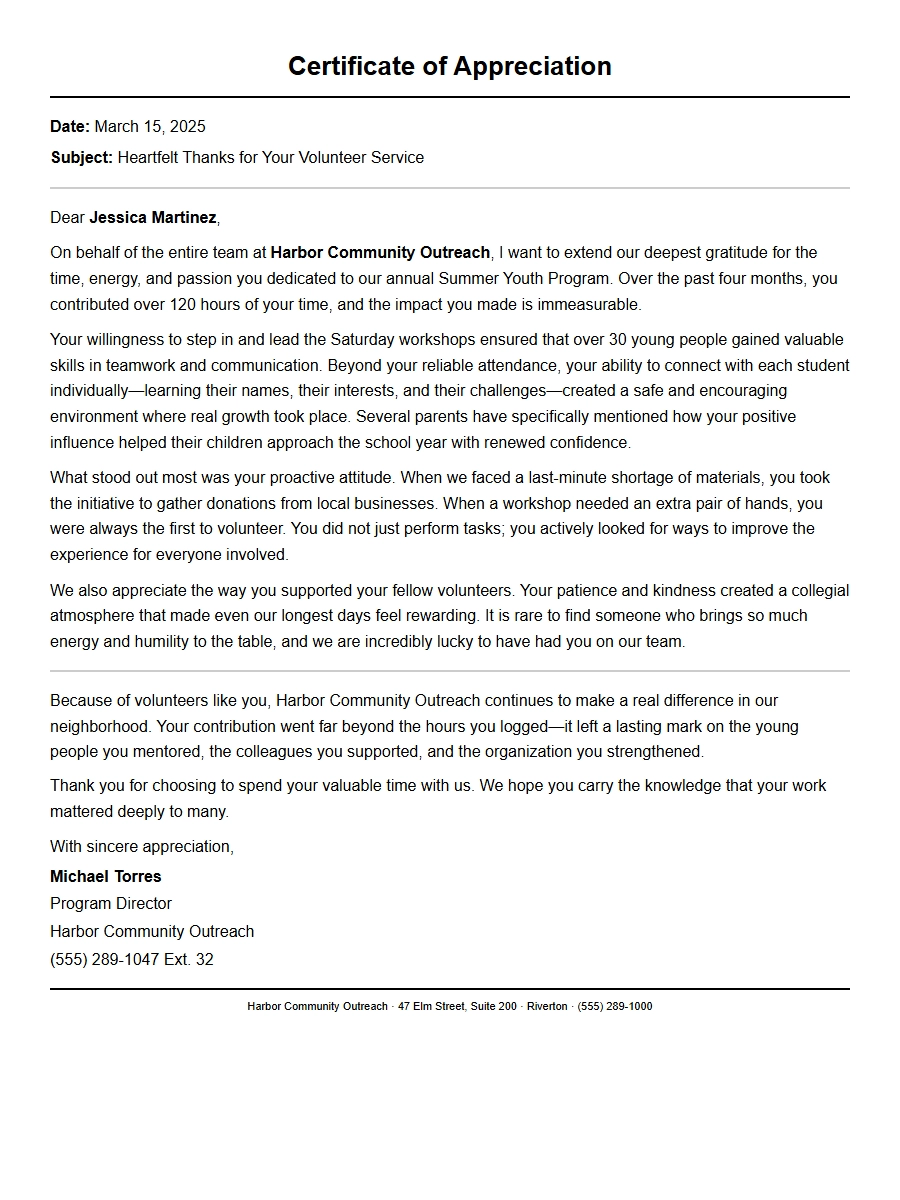
Appreciation Letter for Volunteer Work Example
Thank You for Event Support
Dear Sarah,
I am writing to express my heartfelt gratitude for your outstanding support during our annual Community Fun Day on May 15th. Your willingness to step in as a registration coordinator made the event run smoothly from start to finish.
Specifically, you managed the check-in of over 200 participants, resolved scheduling conflicts, and even assisted with clean-up. Below is a summary of your contributions:
Task
Hours
Impact
Registration desk
4
Efficient check-in, reduced wait times by 30%
Conflict resolution
1
Handled 3 volunteer shift swaps seamlessly
Clean-up crew
2
Ensured venue was ready for next-day rental
Your professionalism and positive attitude inspired others. Thanks to you, we raised 25% more funds than last year. Please know that your effort is deeply appreciated. We look forward to your continued partnership.
With warm thanks, Linda Green Event Coordinator
Appreciation for Dedicated Service
Dear Marcus,
On behalf of the entire board, I want to thank you for your six years of dedicated service as a literacy tutor. Your commitment to helping adults improve their reading skills has changed lives.
During your tenure, you worked with 15 students, many of whom advanced two grade levels in reading proficiency. Your patience and personalized teaching methods were often praised in feedback forms. Here are just a few highlights:
Helped Maria earn her GED after three years of tutoring.
Developed a phonics workshop that became a model for new volunteers.
Never missed a session, even during winter storms.
We understand that volunteering at this level requires sacrifice. Your reliability and compassion embody our mission. As a small token, we have added your name to our Wall of Honor in the main lobby.
Thank you for making literacy accessible to those who need it most.
Warm regards, Dr. Angela Reyes Program Director
Gratitude for Fundraising Efforts
Dear Jordan,
I cannot thank you enough for the incredible energy you brought to our spring fundraising campaign. Your idea to host a virtual 5K exceeded all expectations, raising over $12,000 for our youth scholarship fund.
You coordinated with local businesses for sponsorships, designed promotional materials, and personally recruited 45 runners. The following table shows the key results:
Metric
Goal
Actual
Participants
50
78
Sponsors
5
8
Funds raised
$8,000
$12,450
Your creativity and determination were contagious. Many participants mentioned that they joined because of your enthusiastic posts on social media. This event would not have been possible without your leadership.
Please accept my sincere appreciation for turning a simple idea into a community celebration.
Best wishes, Terry Mitchell Development Manager
Acknowledgment of Mentorship Contributions
Dear Priya,
I am writing to officially acknowledge the profound impact you have had as a mentor in our STEM Pathways program. Over the past year, you guided three high school students through robotics projects, culminating in their first-place win at the regional fair.
Your commitment went beyond the scheduled sessions. You spent weekends troubleshooting code, secured donated parts from local engineers, and even wrote recommendation letters for the students. One parent described you as “a role model who opened doors for my child.”
The students’ growth is a direct reflection of your mentorship. They not only learned technical skills but also developed confidence and teamwork. Here is what two of them said:
“Priya taught me that failure is part of the process.” – Aisha
“She believed in me when I didn’t believe in myself.” – Leo
Thank you for investing your time and expertise in the next generation of innovators. We are lucky to have you.
With deepest gratitude, Carlos Mendez Program Coordinator
Thanks from a Community Member
Dear Volunteer Team,
I am a resident of Pinewood neighborhood, and I want to personally thank each of you for the incredible work you did during the summer cleanup drive. I have lived here for 15 years, and the park has never looked better.
I watched you paint benches, plant flowers along the creek, and remove trash from the playground. One volunteer even brought a guitar and sang with the children while others worked. It felt like a true community festival.
Because of your efforts, my family feels safer and prouder of our neighborhood. My daughter now asks me when she can join the next cleanup. You planted more than flowers – you planted hope. Thank you for bringing people together and showing that small actions can create big smiles.
I especially appreciate that you took the time to talk to residents and listened to our ideas for future improvements. Please know that your work is seen and cherished.
Yours sincerely, Margaret O’Brien Pinewood Resident
Recognition of Long-Term Volunteer Commitment
Dear David,
I am delighted to recognize your ten years of faithful service at the Downtown Food Pantry. Few volunteers have shown such consistent dedication, and we are honored to celebrate this milestone with you.
Since 2014, you have logged over 1,200 hours sorting donations, packing bags, and greeting clients with a warm smile. Your reliability has been a cornerstone of our operations. Even on holidays, you were often the first to arrive and the last to leave.
Some highlights of your tenure include:
Volunteering every Tuesday without fail for 520 consecutive weeks.
Mentoring 8 new volunteers who later became shift leaders.
Developing an inventory system that reduced food waste by 15%.
Your example inspires others. Many clients have mentioned that your kind words made a difficult day easier. To mark this anniversary, we are adding a permanent plaque in the volunteer lounge.
Thank you for a decade of generosity and heart.
Gratefully, Rita Chang Executive Director
Appreciation for Administrative Help
Dear Elena,
I want to thank you for the exceptional administrative support you provided during our quarterly grant reporting cycle. Your attention to detail saved us from missing an important deadline and ensured the accuracy of our data.
You organized over 300 files, verified financial records, and formatted the final submission package. Your work directly contributed to our successful grant renewal of $75,000, which funds our after-school programs.
Below is a summary of the tasks you completed:
Task
Time Saved
Impact
Data entry audit
15 hours
Caught 12 errors in expense reports
Document formatting
8 hours
Made report compliant with funder’s style guide
File organization
4 hours
Streamlined future retrieval
Your quiet competence makes a huge difference behind the scenes. We often focus on front-line volunteers, but administrative volunteers like you are the backbone of our operations. Thank you for stepping up when we needed it most.
With appreciation, Tom Harrison Finance Officer
Thank You for Environmental Cleanup
Dear Riverbank Restoration Team,
I am writing on behalf of the Environmental Council to express our sincere gratitude for your participation in the watershed cleanup last Saturday. In just one afternoon, you collected 47 bags of trash and removed two abandoned tires from the creek.
Your work has a direct impact on local wildlife. The creek is now safe for spawning fish, and the improved water clarity will enhance the habitat for birds and insects. One of our biologists noted that the progress you made usually takes two weekends.
Thank you also for the educational booths you set up; many families learned about recycling and native plants. The spirit of teamwork you displayed – sharing gloves, cheering each other on – set a wonderful example for passersby.
List of team achievements for the day:
Cleared 1.2 miles of creek bank
Separated recyclables from waste, diverting 30% from landfill
Planted 50 native saplings along the eroded banks
You showed that environmental stewardship is a cause we can all rally behind. Thank you for making our community cleaner and greener.
Yours in nature, Sylvia Kowalski Cleanup Coordinator
Gratitude from Program Beneficiary
Dear Ms. Akana,
I am writing this letter to thank you for the meals you delivered to my family every week during my mother’s illness. You may not know me by name, but you came to our door every Wednesday with a warm smile and a hot meal.
There were days when I didn’t have the energy to cook, and your kindness meant we could still gather around the table. My mother, who has since recovered, often asked about you. She said your cheerful words lifted her spirits more than any medicine could.
I also want to mention that you remembered our preferences – no onions for my dad, extra vegetables for me. That personal touch made a huge difference. On weeks when we had appointments, you left the meals in a cooler with a note.
Please know that your volunteer work is not just about food. It is about showing people that they are not alone. You gave us hope during a dark time. Thank you from the bottom of my heart.
With profound thanks, Amara Nguyen
Year-End Volunteer Recognition Letter
Dear Valued Volunteers,
As the year comes to a close, we want to take a moment to recognize the extraordinary contributions of every volunteer who supported our mission in 2024. Your generosity has allowed us to serve over 5,000 individuals across our programs.
Together, you contributed a total of 8,700 hours – the equivalent of five full-time employees. Your impact spans multiple areas, as summarized below:
Program
Volunteers
Hours
People Served
Food distribution
120
3,400
2,800
Tutoring
45
2,100
320
Senior outreach
60
2,200
1,100
Administration
25
1,000
N/A
Whether you ladled soup, taught a child to read, or filed paperwork, you made our organization stronger. We are especially grateful to those who volunteered in challenging weather or took on extra shifts during our holiday campaign.
Thank you for being the heart of our community. You inspire us every day, and we look forward to another year of partnership.
Happy New Year, Brenda Liu Director of Volunteer Services
 Thanking a Mentor for Guidance: Sample Messages
 Expressing Gratitude: Handwritten Letter Example
 Expressing Thanks in a Formal Personal Letter
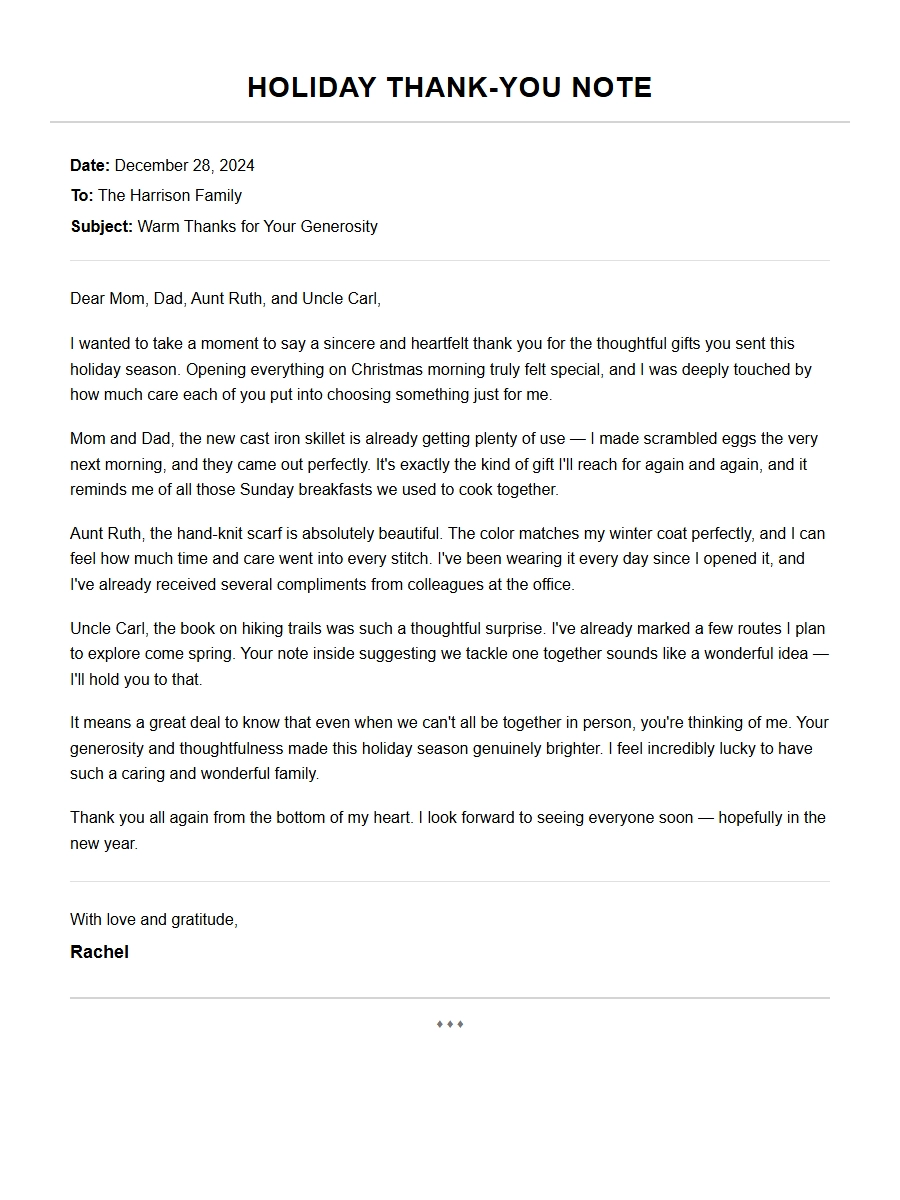 Thank You Letter Examples for Family Holiday Gifts
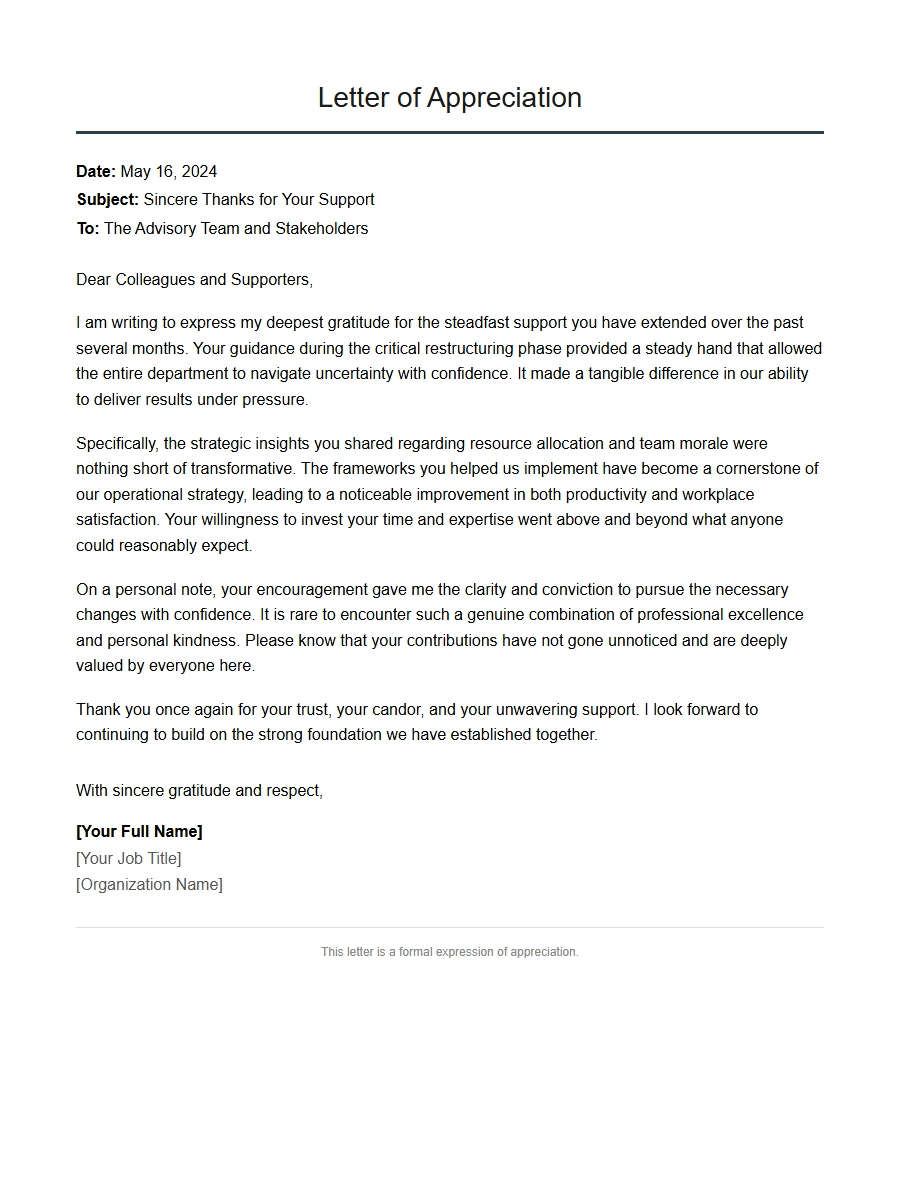 Sample Thank You Letter for Support
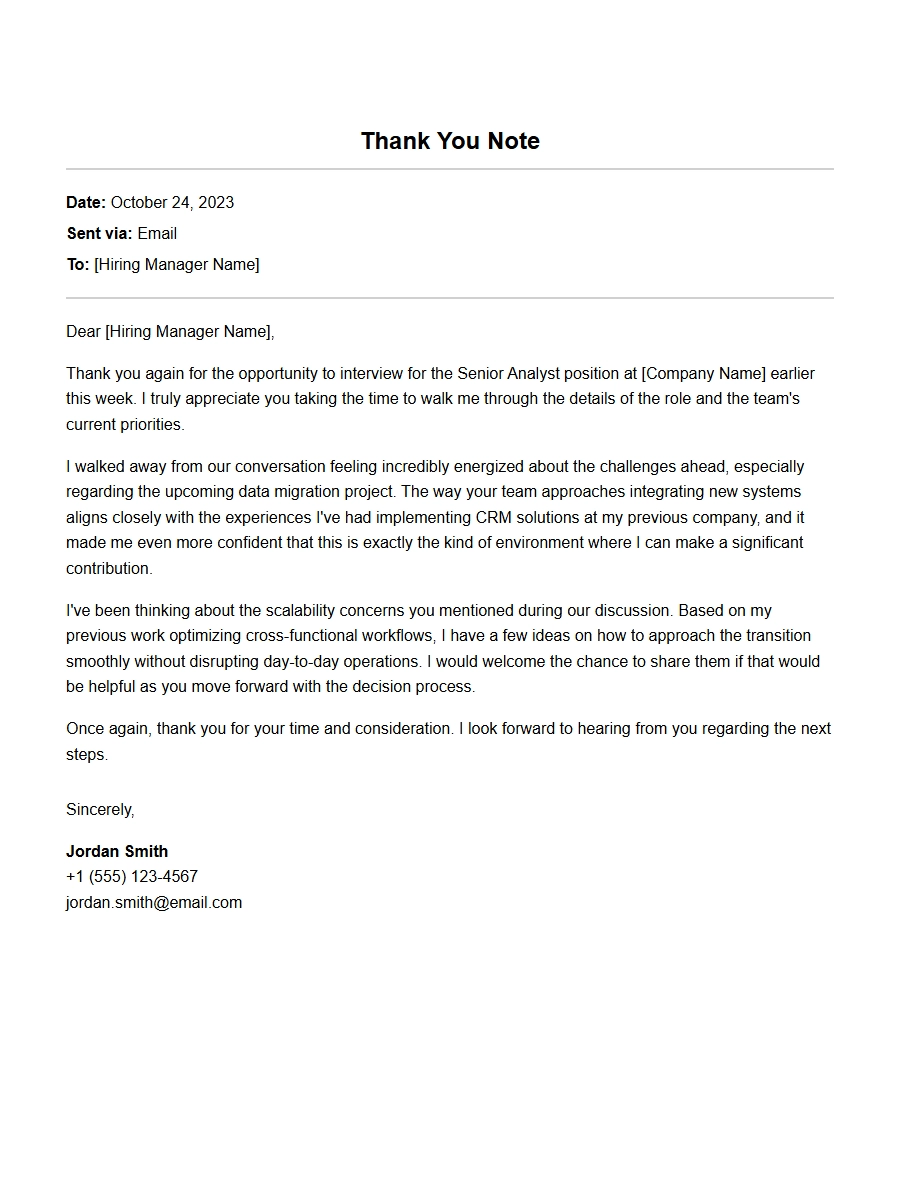 How to Write a Personal Thank-You Note After an Interview