You know that uneasy feeling when you need to propose a new business partnership, but the first person you want to approach is someone you already know and trust? A referral from a mutual contact can open doors, but putting that connection into a formal letter still requires the right tone. You do not want to sound too pushy or too casual. The trick is to write a warm referral business proposal letter that feels personal without losing its professional edge.
Using a sample for this kind of letter isn’t cheating—it’s a smart shortcut. A well-designed letter template gives you the structure, opening etiquette, and closing phrases that work. It saves you from staring at a blank screen. But you still need to customize it so the recipient hears your voice, not a robot’s. Think of it as a scaffold for your own message.
Category: Business Proposal Letters
What makes a referral proposal letter “warm”?
A warm referral letter starts with the connection. The opening sentence should mention the person who referred you, and why they thought the two of you should talk. For example: “Our mutual colleague Sarah suggested I reach out because of your work in medical practice expansion.” That immediate context builds trust. It also tells the reader this isn’t cold outreach—it’s an introduction backed by someone they respect.
From there, the letter needs to explain what you’re proposing in clear, straightforward language. Avoid jargon. If you’re offering a service, say what it is and how it helps. If you’re suggesting a strategic alliance, outline the mutual benefit. The tone should be confident but not arrogant. You’re a partner, not a sales rep.
Choosing the right sample for your situation
Not all business letter formats fit every scenario. A formal, printed letter on letterhead design works well for a traditional partnership proposal. But if you’re emailing, digital letter format matters more: keep paragraphs short, use a clear subject line, and avoid attachments unless necessary. A customizable letter sample lets you adjust the salutation and closing to match the relationship. For a referral from a close contact, “Dear [First Name]” is fine. For a more formal introduction, use “Dear Mr./Ms. [Last Name].”
One common mistake is copying a sample without changing the tone. Ever received a letter that felt too stiff or too casual? That happens when you ignore tone in writing. Read the sample aloud. Does it sound like you? If not, rephrase the key sentences. Keep the structural flow but swap out generic phrases for specific details about the referral and your proposal.
How to adapt a sample without losing your authentic voice
Start by filling in the blanks: the referring person’s name, your connection to them, and the core offer. Then adjust the opening paragraph to grab attention. Instead of “I am writing to propose a partnership,” try “When Sarah mentioned your plans to expand your clinic network, I knew we could help.” That small shift makes the letter feel personal. It also shows you’ve done your homework.
Next, check the letter structure. A strong body should have two or three short paragraphs. The first explains the referral and your shared context. The second outlines your proposal and its benefits. The third includes a clear next step—like a call to schedule a brief chat. Avoid cramming everything into one block. White space helps the reader scan quickly.
Also watch the salutation and closing. “Sincerely” works for most professional correspondence, but “Best regards” feels warmer for a referral. If the referral comes from a close friend of the recipient, you might even use “Warmly.” Match the closing to the tone you’ve set.
Common mistakes to avoid
Using outdated salutations like “To Whom It May Concern” immediately kills the warm vibe. Since you have a referral, use the person’s name. Another pitfall is ignoring formatting differences between email and printed letters. For an email, put your contact info below your name—no need for a full letterhead at the top. For a printed letter, include your letterhead design and a formal date line.
Proofreading letter mistakes is non-negotiable. A typo in the referring person’s name or your own contact details makes you look careless. Read the letter twice, once out loud. Better yet, ask a colleague to glance at it. A small error can shake the trust a referral builds.
Using your sample as a springboard
The best referral proposal letters feel both professional and personal. They rely on a sample for the skeleton but breathe their own life into the words. Over time, you’ll get faster at customizing these letters—and you might not need a template at all. But when you’re under deadline or facing a blank page, a solid sample is your best friend.
So next time you need to write a warm referral business proposal letter, grab a template you trust. Then make it yours. Change the opening, adjust the tone, double-check the details. The referral gives you the introduction. Your words seal the deal.
Extra Samples
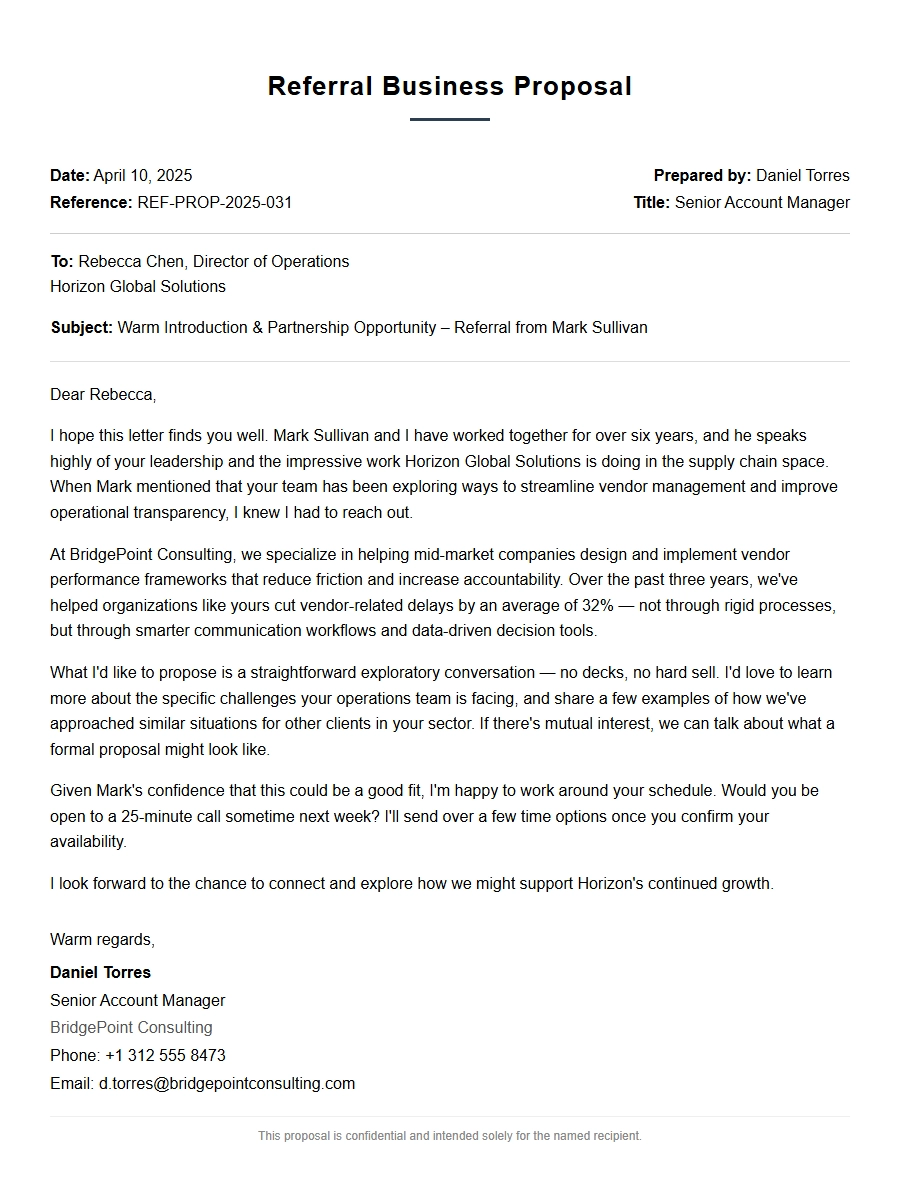
Sample Warm Referral Business Proposal Letter
Consulting Proposal via Client Referral
Date: March 15, 2025
To: Jane Smith, CEO of TechVisions Inc.
From: Mark Wilson, Lead Consultant at GrowthPeak Advisors
Re: Strategic Growth Consulting – Referred by your partner, Lisa Chen
Dear Jane,
During our conversation last week, Lisa Chen mentioned the impressive work your team is doing at TechVisions. She also shared that you are exploring ways to scale your market presence. Based on her warm referral, I would like to propose a tailored consulting engagement to help you achieve a 30% revenue increase within 12 months.
Our proposed approach includes three phases:
Phase 1 – Diagnostic Audit (4 weeks): Review current operations, market positioning, and customer feedback.
Phase 2 – Strategy Development (3 weeks): Create a bespoke growth plan with clear milestones.
Phase 3 – Implementation Support (ongoing): Monthly check-ins and adjustment guidance.
Estimated investment: $25,000 (see table below for breakdown).
Phase
Duration
Cost
Diagnostic Audit
4 weeks
$8,000
Strategy Dev.
3 weeks
$10,000
Implementation
Monthly
$2,000/mo
I have enclosed a brief case study showing how we helped a similar firm gain 40% efficiency. I look forward to discussing this further at your earliest convenience. Please call or email me to schedule a discovery call.
Warm regards, Mark Wilson GrowthPeak Advisors
Partnership Opportunity via Business Referral
Date: March 18, 2025
To: Alex Rivera, Head of Partnerships at DataSync Corp.
From: Ruth Kim, Director of Strategic Alliances at CloudBridge Solutions
Re: Joint Offer for Integrated CRM Analytics – referred by Tom Brennan
Dear Alex,
Tom Brennan, your former colleague at Orbital Systems, suggested we connect. He spoke highly of DataSync’s expertise in data integration and believes a collaboration between our firms could unlock significant value for mutual clients.
We propose a co-marketed bundle: CloudBridge’s AI-driven CRM tools paired with DataSync’s ETL platform. This combination would allow clients to seamlessly move from raw data to actionable insights. Our joint offering would be sold through a revenue-share model, with an initial pilot program for three enterprise clients.
Key benefits of this proposed partnership:
Combined market reach: Over 5,000 mid-market accounts.
Reduced integration friction for clients (single API).
Shared marketing budget and lead generation.
We envision a timeline as follows:
Milestone
Target Date
Agreement signed
April 15, 2025
Technical integration
May 30, 2025
Pilot launch
June 15, 2025
I have drafted a preliminary term sheet which I can share upon request. Thank you for considering this opportunity through Tom’s warm introduction. I am eager to explore this with you.
Best regards, Ruth Kim
Project Collaboration Referral from Former Employee
Date: March 20, 2025
To: Sarah Evans, Senior Developer at InnoWorks
From: David Osei, Freelance UX Designer
Re: Collaborative Proposal for a FinTech Dashboard – referred by your former team lead, Priya Nair
Dear Sarah,
Priya Nair, who once managed your team at AppNest, recently connected us. She mentioned your outstanding front-end skills and suggested we could work together on a new FinTech dashboard project that requires both UX design and development.
I am currently contracted to design the user experience for CapitalFlow, a startup building a personal finance management tool. The project needs a skilled developer like you to implement the interactive prototype. I would like to propose that we partner as a two-person team, with me handling design and user testing, and you building the React-based interface.
Budget: $15,000 total, split 60/40 (designer/developer). The client is flexible. If you are interested, I can arrange a call with the startup founders next week. Priya assures me you’d be a fantastic fit.
I look forward to potentially collaborating with you.
Cheers, David Osei
Product Upgrade Proposal via Vendor Referral
Date: March 22, 2025
To: Claire Huang, Procurement Manager at EcoPack Solutions
From: James Foley, Account Executive at GreenTech Machinery
Re: Proposal for Upgrade to EcoPress 5000 – referred by your current vendor partner, Susan Hart
Dear Claire,
Susan Hart, whom you work with at Raw Materials Inc., has been using our latest machinery for the past six months. She suggested I reach out to you because she knows your current press line is reaching end-of-life and that you value energy efficiency.
I propose upgrading your existing press to the EcoPress 5000, which reduces power consumption by 35% and increases throughput by 20%. This model is a direct replacement for your current machine, requiring minimal installation downtime.
Key features and benefits:
Energy saving: Variable speed drive cuts electricity use.
Enhanced output: Up to 500 units per hour vs. your current 350.
Low maintenance: Self-lubricating bearings reduce service calls by 50%.
Here is a cost comparison over three years:
Current Machine
EcoPress 5000
Purchase Price
N/A (owned)
$85,000
Annual Energy Cost
$12,000
$7,800
Annual Maintenance
$8,000
$4,000
With the energy and maintenance savings, the upgrade pays for itself in about 2.5 years. I can arrange a demo at Susan’s facility next Tuesday. Let me know if you’d like to join.
Looking forward to your response. Thank you, Claire.
Sincerely, James Foley
Investment Proposal via Board Member Referral
Date: March 25, 2025
To: Richard Tanaka, Managing Partner at Horizon Capital
From: Ellen Park, CEO of MedTech Innovators
Re: Series A Investment Opportunity – referred by your board colleague, Michael Stern
Dear Richard,
Michael Stern, who serves on both your investment committee and our advisory board, suggested I share our Series A opportunity with you. He believes that MedTech Innovators aligns well with your firm’s focus on digital health solutions.
We are developing a remote patient monitoring platform that reduces hospital readmission rates by 45% in early trials. We have already secured three pilot contracts with regional health systems. To scale our engineering and sales teams, we are raising $2.5 million. Your investment would help us capture a projected $50 million market within three years.
Key metrics and use of funds:
Current ARR: $500,000 (growing 15% month-over-month)
Use of funds: 40% engineering, 30% sales, 20% regulatory compliance, 10% working capital
Term sheet highlights:
Item
Details
Raise Amount
$2.5M
Valuation Cap
$12M (SAFE)
Discount Rate
20%
Proposed Close
June 30, 2025
Per Michael’s introduction, I have reserved a place in our data room for your team. I welcome a call to walk through the pitch deck. Thank you for considering this warm referral.
Warmly, Ellen Park
Membership Proposal Referred by Professional Association
Date: March 28, 2025
To: Dr. Anita Vasquez, Independent Consultant
From: Chris Morgan, Membership Director at National Business Alliance (NBA)
Re: Corporate Membership – referred by your friend and NBA member, Laura Jenkins
Dear Dr. Vasquez,
Laura Jenkins, a long-time member of the NBA, spoke highly of your consulting practice and thought you would benefit from joining our network. As a warm referral, we would like to offer you a specially discounted first-year corporate membership.
The NBA provides access to exclusive industry reports, quarterly networking events, and peer mentoring circles. As a corporate member, you can also list your services in our member directory, which receives 10,000+ monthly visitors.
Membership tiers and benefits (corporate level highlighted):
For referrals like yours, we waive the $150 initiation fee. I have attached a sample report and event calendar. If you decide to join by April 15, we will also include a free one-hour consultation with an NBA business advisor.
I hope to welcome you to our community. Please feel free to call me with any questions.
Best regards, Chris Morgan
Team Collaboration Proposal via Former Manager Referral
Date: March 30, 2025
To: Olivia Torres, Engineering Lead at NexGen Robotics
From: Dr. Kevin Liu, AI Research Scientist at DeepLab Ltd.
Re: Joint R&D on Vision-Based Navigation – referred by your former manager, Dr. Sandeep Rao
Dear Olivia,
Dr. Sandeep Rao, who managed your team at RoboTech Inc., recently recommended you as the ideal partner for an exciting new project. He mentioned your expertise in real-time embedded systems and your pragmatic approach to innovation.
DeepLab is developing a vision-based navigation system for autonomous delivery vehicles. We have a working prototype that achieves 95% accuracy in structured environments, but we need a hardware integration partner to optimize power consumption and latency. I believe NexGen’s modular controller could be the perfect platform.
I propose a six-month joint research collaboration with the following deliverables:
Month 1-2: Port our neural network to your controller hardware.
Month 3-4: Bench testing and iteration for real-time performance.
Month 5-6: Field testing on a medium-duty delivery vehicle.
Funding: We have secured a $200,000 grant from the National Robotics Initiative that can cover shared costs. A draft memorandum of understanding is available for review. Given Dr. Rao’s strong recommendation, I am confident we can achieve breakthrough results together.
I look forward to discussing this possibility.
Warm regards, Dr. Kevin Liu
Service Follow-Up via Client's Friend Referral
Date: April 2, 2025
To: Brian Aldridge, Owner of FreshBites Café
From: Mia Chen, Senior Consultant at CleanAir HVAC Solutions
Re: Post-Installation Maintenance Plan – referred by your friend, David Kim
Dear Brian,
David Kim, who owns the bakery next door, mentioned that you recently installed our PureAir filtration system at FreshBites. He raved about the improvement in air quality and energy savings, and he suggested I reach out to ensure you are also taking advantage of our preferred maintenance plan.
We offer a comprehensive maintenance package specifically designed for restaurant environments. Regular servicing extends equipment life, maintains peak efficiency, and ensures compliance with health department ventilation standards.
What our maintenance plan includes:
Quarterly filter replacement – using HEPA-grade filters (cost included in plan).
Semi-annual deep inspection – check coils, ductwork, and fans.
Priority emergency service – 4-hour response time for breakdowns.
Annual efficiency report – with recommendations for upgrades.
Pricing for café-sized systems:
Plan Duration
Monthly Fee
Total Savings vs. Pay-Per-Visit
12 months
$175
$300
24 months
$150
$720
36 months
$130
$1,260
Since David referred you, I can offer a 10% discount on the first year if you sign up before April 15. I would be happy to come by and review your current system free of charge. Let me know a convenient time.
Best, Mia Chen
Joint Venture Proposal via Networking Group Referral
Date: April 5, 2025
To: Samantha Lee, COO of GreenGrow Farms
From: Robert Torres, CEO of UrbanFoods Distribution
Re: Proposed Joint Venture for Local Produce Supply Chain – referred by your networking group host, Angela Peters
Dear Samantha,
At the recent Metropolitan Business Networking meeting, our mutual contact Angela Peters suggested that GreenGrow and UrbanFoods could form a powerful partnership. She mentioned that you are looking for reliable distribution channels for your organic produce, while we are seeking consistent, high-quality local sources for our retail and restaurant clients.
I propose a joint venture (JV) where GreenGrow supplies produce exclusively to UrbanFoods for a two-year term, and we invest in your greenhouse expansion in exchange for preferred pricing. This would allow you to scale production without marketing costs, and we would secure a supply of premium local produce.
Proposed JV structure:
Capital investment: $150,000 from UrbanFoods toward new greenhouses.
Volume commitment: Minimum 500 lbs/week of mixed vegetables.
Angela has offered to mediate our initial discussions. I would like to invite you to tour our distribution center next week. Let’s set a date to explore this further.
Looking forward, Robert Torres
Strategic Alliance Proposal via Trusted Advisor Referral
Date: April 8, 2025
To: Dr. Fiona Whitmore, Director of Research at BioGen Labs
From: Peter Grayson, Managing Director at PharmaBridge Consulting
Re: Strategic Alliance for Drug Repurposing Analytics – referred by your trusted advisor, Dr. James Hart
Dear Fiona,
Dr. James Hart, who has advised both of our organizations, strongly recommended that we explore a strategic alliance. He believes that BioGen’s extensive compound library combined with PharmaBridge’s AI-driven repurposing engine could accelerate your pipeline up to 40%.
We propose a collaborative framework: PharmaBridge will grant BioGen access to our RapidRepurpose Platform for a period of 18 months, in exchange for shared intellectual property rights on any new indications discovered during the term. BioGen would also receive a 10% royalty on any licensed compounds resulting from our joint work.
Governance: Joint steering committee with two representatives from each firm.
Funding: Each party covers its own costs; shared patent filing costs split 50/50.
Estimated timeline for a proof-of-concept study:
Stage
Months
Data integration & model training
1-3
In silico screening of top 200 compounds
4-6
Validation against 20 candidate targets
7-12
Dr. Hart has offered to facilitate an initial joint meeting. Please let me know if you would like a confidential discussion of the technical details. I am excited by this potential alliance.
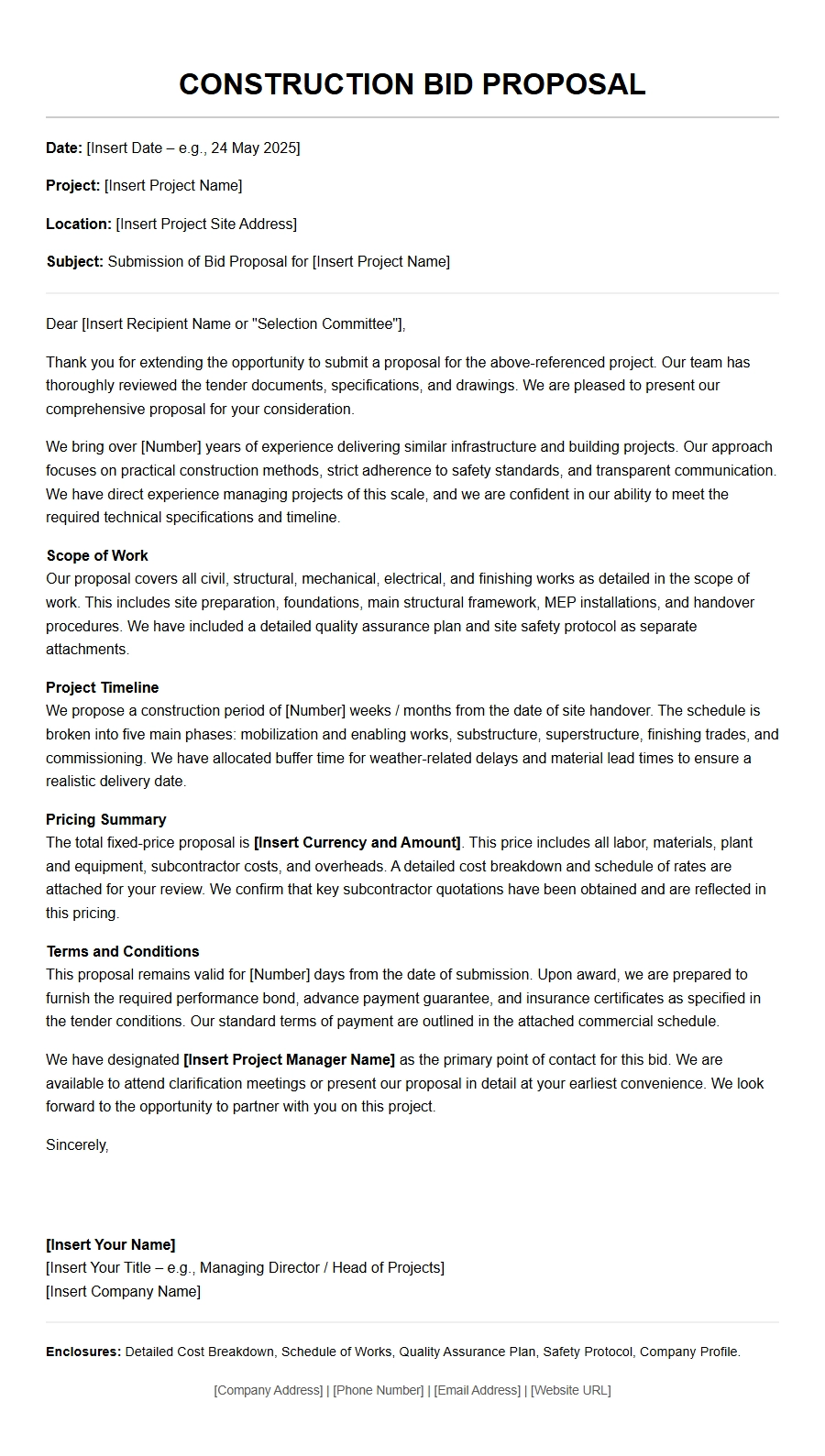 Sample Construction Bid Proposal Letter
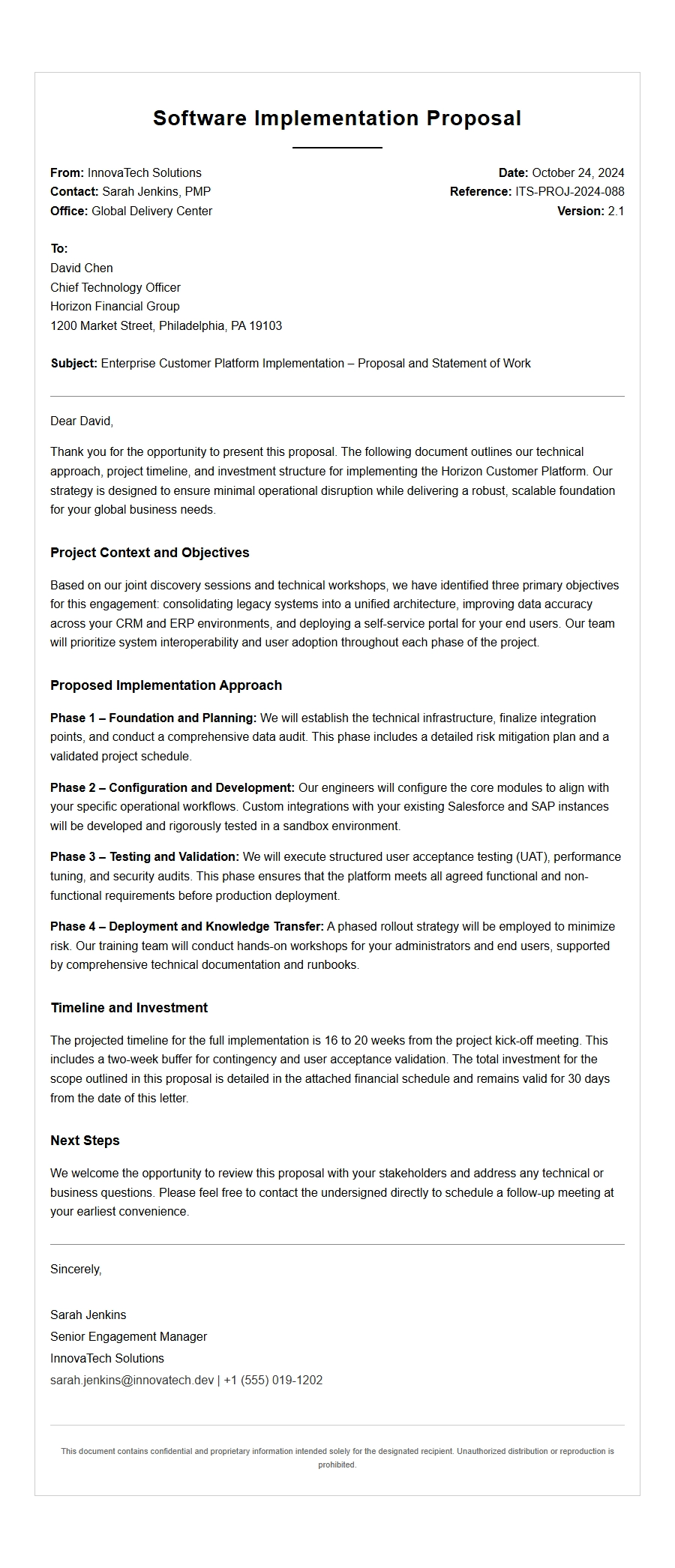 Enterprise Software Implementation Proposal Letter Example
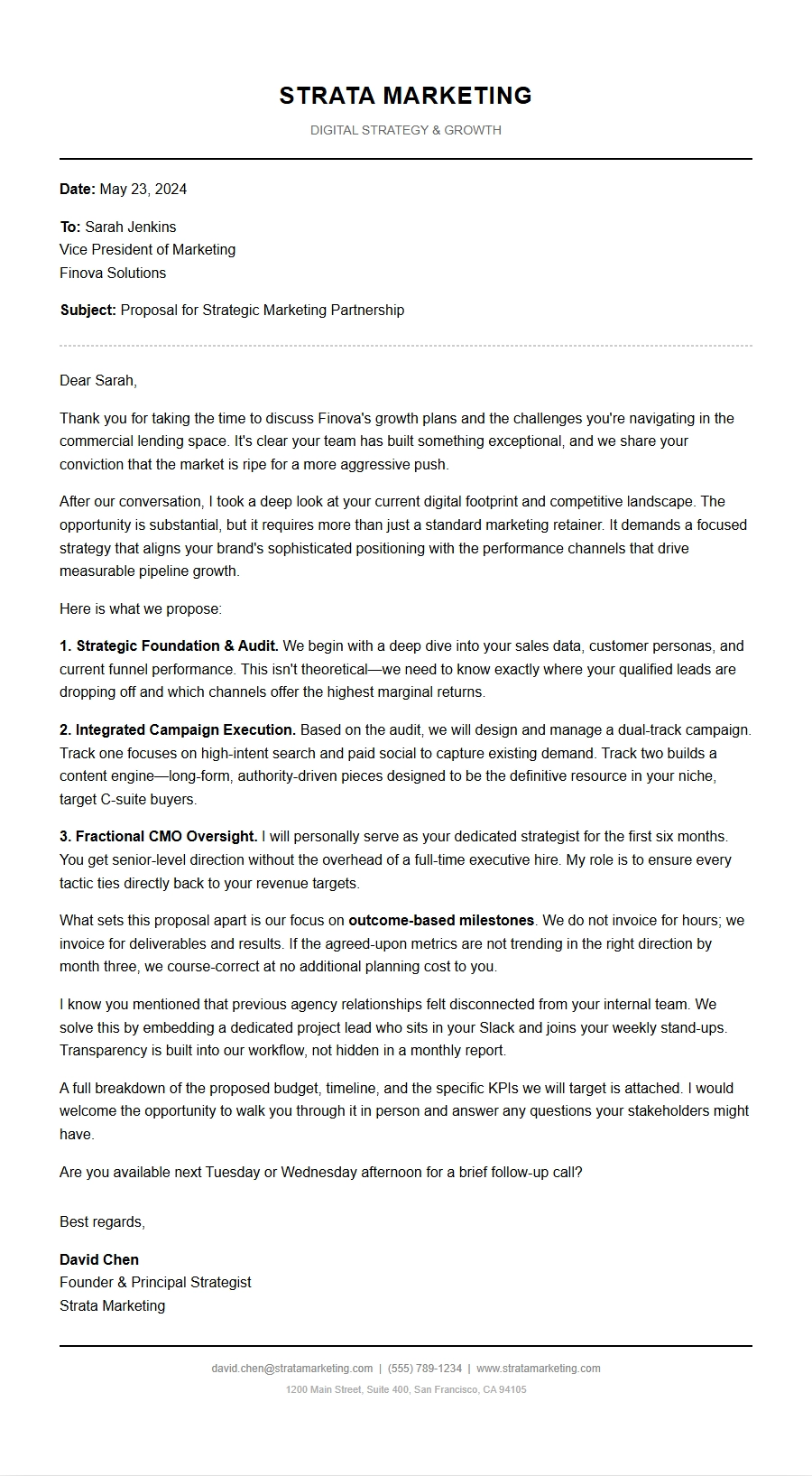 Marketing Agency Service Proposal Letter Template
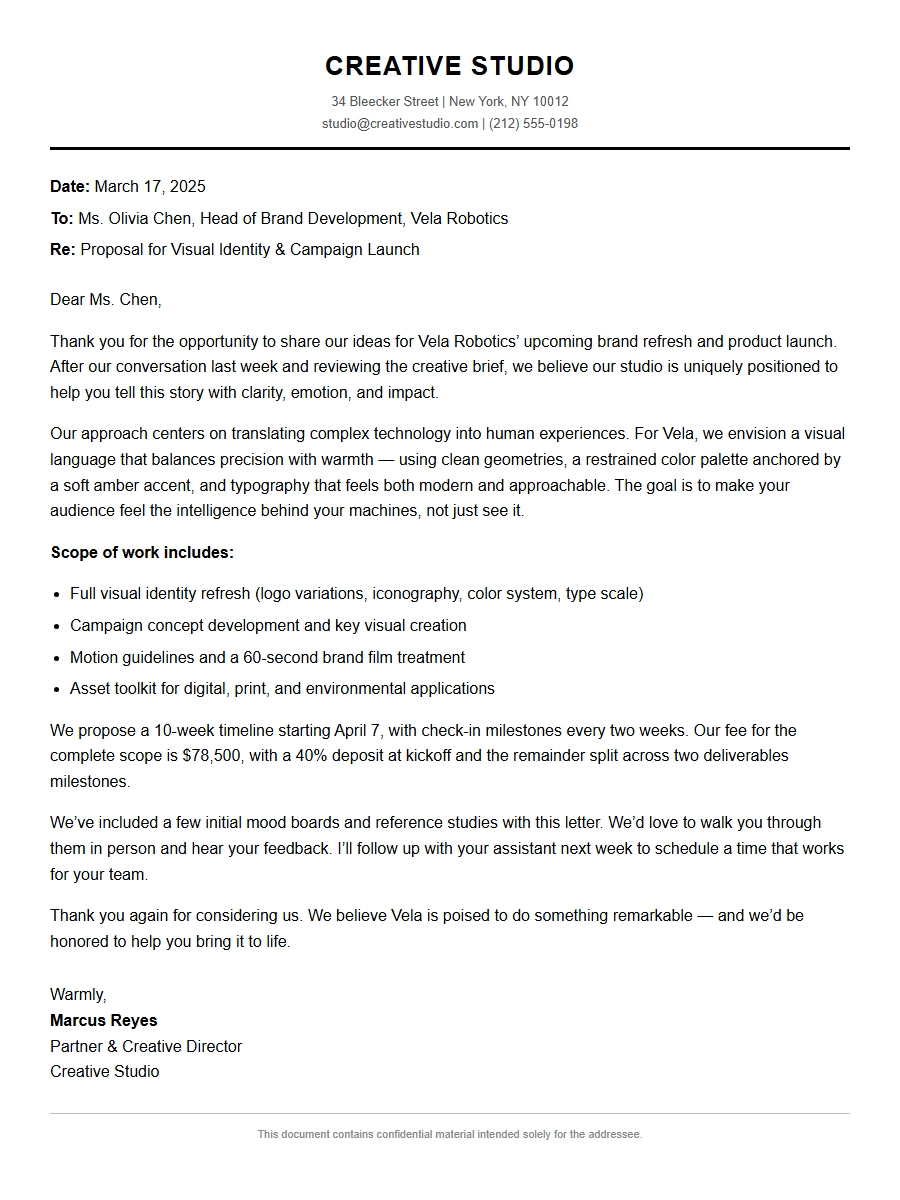 Creative Studio Project Proposal Letter
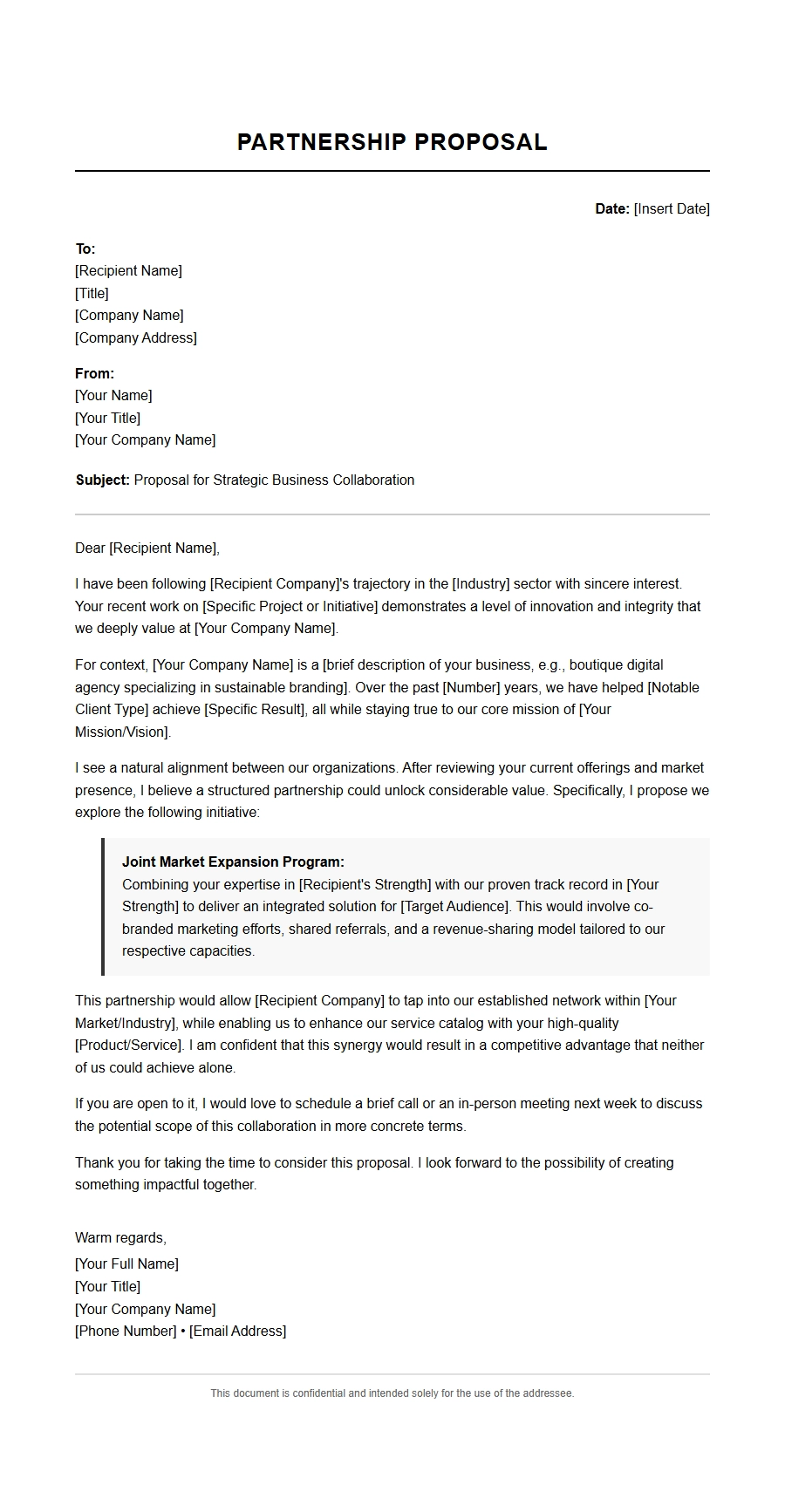 Small Business Partnership Proposal Letter Template
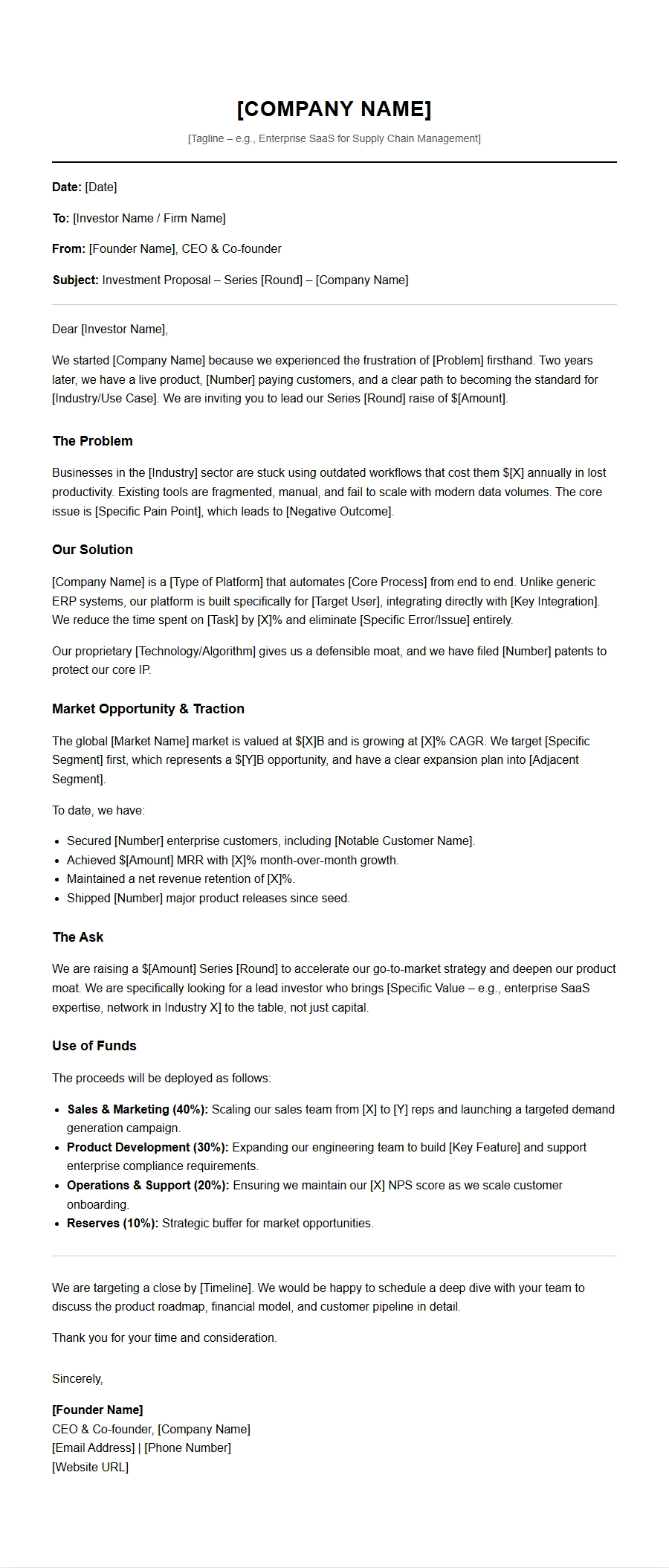 Startup Investment Proposal Letter Template