We’ve all been there. You open the mail or your email and see a notice about a traffic violation. Maybe it’s a photo enforcement ticket for running a yellow light that was barely yellow. Or a ticket for an expired registration you honestly thought you’d renewed. Your first reaction is frustration, then maybe panic. You know you need to respond in writing, but the blank page stares back at you. The thought of composing a formal letter while feeling defensive is enough to make anyone procrastinate. That’s where a traffic violation mitigation affidavit comes in. It’s not a magic wand, but it is a structured way to explain your side and potentially reduce the penalty.
What is a traffic violation mitigation affidavit?
Simply put, it’s a written statement where you admit to the violation but explain the circumstances that led to it. You’re not saying you didn’t do it. You’re saying, “Yes, I did this, but here’s why, and here’s why the standard fine feels too harsh.” Courts and traffic bureaus use these to decide if they should lower a fine or offer a deferred disposition. The key is that it’s a formal document. It needs to follow a basic business letter format and include a salutation and closing that respects the court or agency you’re addressing.
Why a sample is your smartest starting point
Writing a letter like this from scratch is tough because you’re juggling emotion and formality. A good sample gives you a reliable letter structure to follow. It shows you where to put the date, the case number, and your contact info. More importantly, it gives you a tone in writing that’s respectful without being groveling, and factual without being cold. Using a letter template isn’t cheating. It’s professional efficiency. You still have to supply the honest details that make your situation unique.
How to adapt a sample without losing your voice
Pulling a sample off the internet and just changing your name won’t work. The court reads these all day. They spot a copy-paste job immediately. Instead, treat the sample as a skeleton. Start with the professional correspondence basics: your address, the court’s address, a clear subject line like “RE: Citation #12345.” Then, in the body, write your story in your own words.
For example, if you got a ticket for speeding because you were rushing your sick child to urgent care, say that. But don’t just state the excuse. Acknowledge that you were speeding, explain the unusual circumstances, and mention that you’ve since adjusted your morning routine to avoid it happening again. This shows accountability. The sample helps you format this cleanly, but your voice provides the sincerity.
Common mistakes that hurt your affidavit
One frequent error is using an outdated salutation. “To Whom It May Concern” feels lazy. If you know the court’s name, use “Dear Clerk of the Court” or check the citation for a specific judge’s name. Another mistake is treating an email like a printed letter. If you’re submitting it digitally, you still need proper formatting: a clear subject line, a formal salutation and closing, and the text should not be a wall of words. Also, watch the length. Keep it to three or four paragraphs. A judge doesn’t need your life story, just the relevant facts.
Many people also forget to include the case number in the first paragraph. Without it, your letter might get misfiled. And never blame the officer. Stick to the facts of your situation. Complaining about the enforcement feels defensive, not mitigating.
Quick tips for the opening paragraph
The first two sentences decide if anyone reads the rest. Don’t start with a generic “I am writing to request mitigation.” Instead, say something like, “I received citation #67890 on March 15 and would like to respectfully explain the circumstances.” Then immediately state that you accept responsibility for the violation. That one sentence moves you from defensive to cooperative. It sets the right tone in writing for the rest of the document.
When to use a formal letter versus an online form
Some jurisdictions now accept mitigation requests through an online portal. In that case, your digital letter format matters less, but the content still does. You’ll have limited character counts, so tighten your wording. If you have the option to upload a letter, that’s usually better. You can control the letterhead design and formatting, making it look more considered. Think of the sample as a guide for what to say even if the field looks like a small text box.
Mistakes to avoid in your closing
Ending a formal letter is just as important as starting one. Avoid “Sincerely” if you’re not sure it fits the relationship. “Respectfully submitted” is safer for legal correspondence. Below your signature, type your full name and phone number. If you’re emailing it, don’t assume the subject line is enough. Repeat your full name and case number in the body text. Also, proofreading letter before you send is critical. One typo in the case number could delay the process by weeks. Read it out loud. Have a friend glance at it. Typos don’t invalidate your request, but they create a sloppy impression.
For related situations where you need to write a formal statement about a neighbor’s behavior, you might find our guide on a neighbor noise complaint letter useful. Similarly, if you ever need to support someone going abroad, a study abroad authorization letter follows a different format but shares the same need for clarity and respect.
A final thought on using a sample
Think of the sample as training wheels. It keeps you from falling flat on your face while you find your balance. The more you write these letters, the less you’ll need the template. But even experienced writers keep a few examples bookmarked for structure. The best letters feel professional but also distinctly human. That balance comes from writing honestly within a clean format. So grab a sample, fill in your details, tell your story simply, and send it off. You’ll feel better just having done it. And the court will appreciate the straightforward effort.
I am writing this letter on behalf of my employee, John Smith, who has been a dedicated member of our team for over five years. John holds the position of Senior Technician and has an exemplary employment record with no disciplinary actions. He is responsible, punctual, and operates our company vehicles safely daily. The citation he received is an isolated incident that does not reflect his usual cautious driving habits. Losing his driving privileges would severely impact his ability to commute and perform his job duties, which require occasional travel between client sites. I respectfully request the court to consider a reduced penalty or alternative sentencing such as traffic school. John has already expressed genuine remorse and has voluntarily taken a defensive driving course. We believe this single mistake should not define his overall character as a safe and conscientious driver.
Employee Name
Position
Years of Service
Incident Date
John Smith
Senior Technician
5
2023-09-15
Thank you for your leniency.
Sincerely, Jane Doe HR Manager, ABC Corp jane.doe@abccorp.com
Pastor’s Letter of Character and Community Service
To the Presiding Judge,
I am the pastor of Grace Community Church, and I have known Margaret Williams for over eight years as an active member of our congregation. Margaret coordinates our weekly food drive, volunteers at the homeless shelter, and drives elderly parishioners to medical appointments. She is a person of integrity and moral character. The speeding ticket she received was a lapse in judgment, but she has since expressed deep regret and has donated her time to our safe-driving awareness program. A license suspension would halt her volunteer transportation services for dozens of seniors who rely on her. I ask the court to consider a lesser penalty, such as probation or community service hours, rather than suspension. Margaret is committed to being a safer driver and has already installed a speed monitoring device in her vehicle. I respectfully endorse her request for mitigation.
Parishioner
Role in Church
Years Known
Volunteer Hours/Week
Margaret Williams
Volunteer Coordinator
8
15
May God guide your wise decision.
In faith, Reverend Thomas Green
Spouse’s Hardship Statement for License Retention
Dear Judge,
I am writing to request leniency for my husband, Robert Coleman, regarding his recent traffic violation. Robert is the sole breadwinner for our family of four, and he drives our children to school, takes our elderly mother to dialysis appointments, and commutes twenty miles each way to his job. Without his license, our household would face severe financial and logistical hardship. He has already lost his job once due to a previous suspension, and we cannot afford that again. Robert is a careful driver who made a mistake, but he has since completed an online defensive driving course and uses a dashcam to monitor his habits. I plead with the court to allow him to attend traffic school or perform community service instead of a suspension. Our family needs his ability to drive to maintain stability. I attest to his remorse and commitment to safe driving going forward.
Family Member
Relation
Dependents
Medical Needs Requiring Transport
Robert Coleman
Husband
2 children + 1 elder
Dialysis (3x/week)
Thank you for your compassion.
Respectfully, Emily Coleman
Professor’s Recommendation for Student Driver
To the Traffic Violations Court,
I am a professor of engineering at State University, and I have taught Amanda Reyes for two semesters. She is an outstanding student with a 3.9 GPA, and she commutes daily from a rural area where public transportation is unavailable. The citation she received occurred during a medical emergency when she was rushing to reach a sick relative. Amanda has no prior violations and is a careful driver who respects traffic laws. A license suspension would force her to drop out of her program, as she cannot afford to live on campus. I strongly recommend that the court allow a mitigation alternative such as a defensive driving course or a reduced fine. Amanda has learned from this incident and has since planned alternative routes to avoid similar stress. She will be a productive citizen and needs her driving privileges to complete her education.
Student Name
Major
GPA
Commute Distance
Amanda Reyes
Mechanical Engineering
3.9
35 miles one-way
Please grant her leniency.
Sincerely, Dr. Alan Martinez Professor, State University
Neighbor’s Affidavit of Good Driving Habits
Honorable Judge,
I have lived next door to David Chen for ten years and have observed his driving habits daily. He is a cautious driver who always obeys speed limits, signals properly, and looks out for pedestrians and cyclists. The single citation he received for running a red light was an anomaly; I witnessed the intersection had a malfunctioning traffic light that day. David immediately reported the issue to the city. He has been a responsible neighbor, helping shovel snow for elderly residents and never causing any disturbances. I am confident that this incident does not reflect his usual behavior. A suspension would hinder his ability to care for his disabled mother, whom he drives to appointments. I urge the court to consider a reduced penalty, such as a warning or traffic school. David is an asset to our community and deserves a second chance.
Neighbor
Years Adjacent
Driving Observations
Community Role
David Chen
10
Safe driving, no prior incidents
Caregiver for mother
Thank you for your time.
Respectfully, Linda Park 123 Oak Street, Anytown
Volunteer Coordinator for Senior Transport
To the Court,
I am the volunteer coordinator at SeniorsFirst, a nonprofit that provides free transportation to elderly residents. Susan Baker has been one of our most reliable volunteer drivers for three years, completing over 200 trips without any incidents or complaints. Her recent citation for a rolling stop occurred on a deserted road late at night; she has already taken a refresher safe-driving course. Susan is essential to our program, especially for driving seniors to chemotherapy and grocery runs. If her license is suspended, our organization will struggle to serve 50+ seniors who depend on her. We request the court to impose an alternative penalty such as community service or a defensive driving program instead of suspension. Susan is remorseful and committed to safe driving. Her record shows a pattern of responsible behavior except this minor infraction.
Volunteer
Years Active
Trips Completed
Seniors Served Weekly
Susan Baker
3
230
12
We appreciate your consideration.
Sincerely, Michael Torres Volunteer Coordinator, SeniorsFirst
Physician’s Letter for Medical Necessity
Your Honor,
I am Dr. Sarah Wong, a primary care physician. My patient, James Henderson, has severe chronic back pain and requires biweekly visits to my clinic for treatments. He also transports his wife, who is undergoing cancer therapy. The traffic citation he received was due to a sudden health episode causing distraction – he has since managed his condition better. James is a responsible individual who strictly follows medical advice. Losing his driving privileges would directly harm his and his wife's health outcomes. There is no public transit available in his area. I recommend that the court allow him to retain his license with conditions such as a medical exemption or a restricted permit. James has no history of reckless driving, and this one citation should not jeopardize his necessary medical care. I vouch for his character and need for driving.
Patient Name
Condition
Appointment Frequency
Distance to Clinic
James Henderson
Chronic back pain; spouse cancer
Every 2 weeks
30 miles
Please grant leniency for health reasons.
Respectfully, Dr. Sarah Wong, MD
Employer for Commercial Driver with One Offense
Dear Traffic Court Judge,
I am the fleet manager at QuickDelivery Logistics. Our driver, Carlos Garcia, has been with us for seven years and has logged over 500,000 accident-free miles. His recent speeding ticket (15 mph over limit) occurred on an empty highway early morning. This is his first moving violation. Carlos is a professional driver who maintains a clean CDL record and regularly exceeds safety standards. A suspension would cost him his job, as he requires a valid license to operate our trucks. We have already enrolled him in a company-sponsored safe driving course. I ask the court to consider a reduced fine or probation instead of suspension. Carlos is an exemplary employee, and this isolated incident should not overshadow his excellent safety record. He is essential to our delivery operations.
Driver Name
Years Employed
Accident-Free Miles
Violation Type
Carlos Garcia
7
500,000+
Speeding (15 over)
We urge the court for mitigation.
Sincerely, Maria Lopez Fleet Manager, QuickDelivery
Coach’s Character Reference for Youthful Offender
To the Honorable Court,
I am the head soccer coach at Lincoln High School, and I have coached Kevin Nguyen for three years. Kevin is a team captain, a peer mentor, and an honor roll student. His traffic citation for failure to yield occurred while he was driving to a team practice after school. He immediately accepted responsibility and has since completed an online driver improvement program. Kevin is a role model for younger athletes and often organizes safe-driving campaigns among peers. A license suspension would prevent him from attending away games, tutoring his teammates, and maintaining his scholarship. I believe he deserves a second chance and request the court to impose a lesser penalty, such as community service or a restricted license for school and work only. Kevin has learned from this mistake and will continue to be a safe, responsible driver.
Student
Sport
Position
GPA
Kevin Nguyen
Soccer
Team Captain
3.8
Thank you for your understanding.
Respectfully, Coach Robert Lee
Community Leader’s Affidavit for Mitigation
Your Honor,
I am the president of the Westside Neighborhood Association. Angela Diaz has been an active member for twelve years, organizing block clean-ups, neighborhood watch, and youth programs. Her single traffic violation for running a red light was a mistake; she has no prior record and is known for her careful driving. Angela is a single mother who relies on her car to take her child to school and to her own job as a nurse. A suspension would cause severe hardship for her family and deprive our community of a key volunteer. I respectfully request that the court consider deferring the penalty, reducing the fine, or allowing a defensive driving course. Angela has demonstrated remorse and has already paid for a safety course. I can attest to her upstanding character and safe driving habits over many years.
Community Member
Years Involved
Role
Impact of Suspension
Angela Diaz
12
Volunteer organizer
Loss of job, childcare, volunteer work
Please grant her leniency.
Sincerely, Patricia Owens President, Westside Neighborhood Association
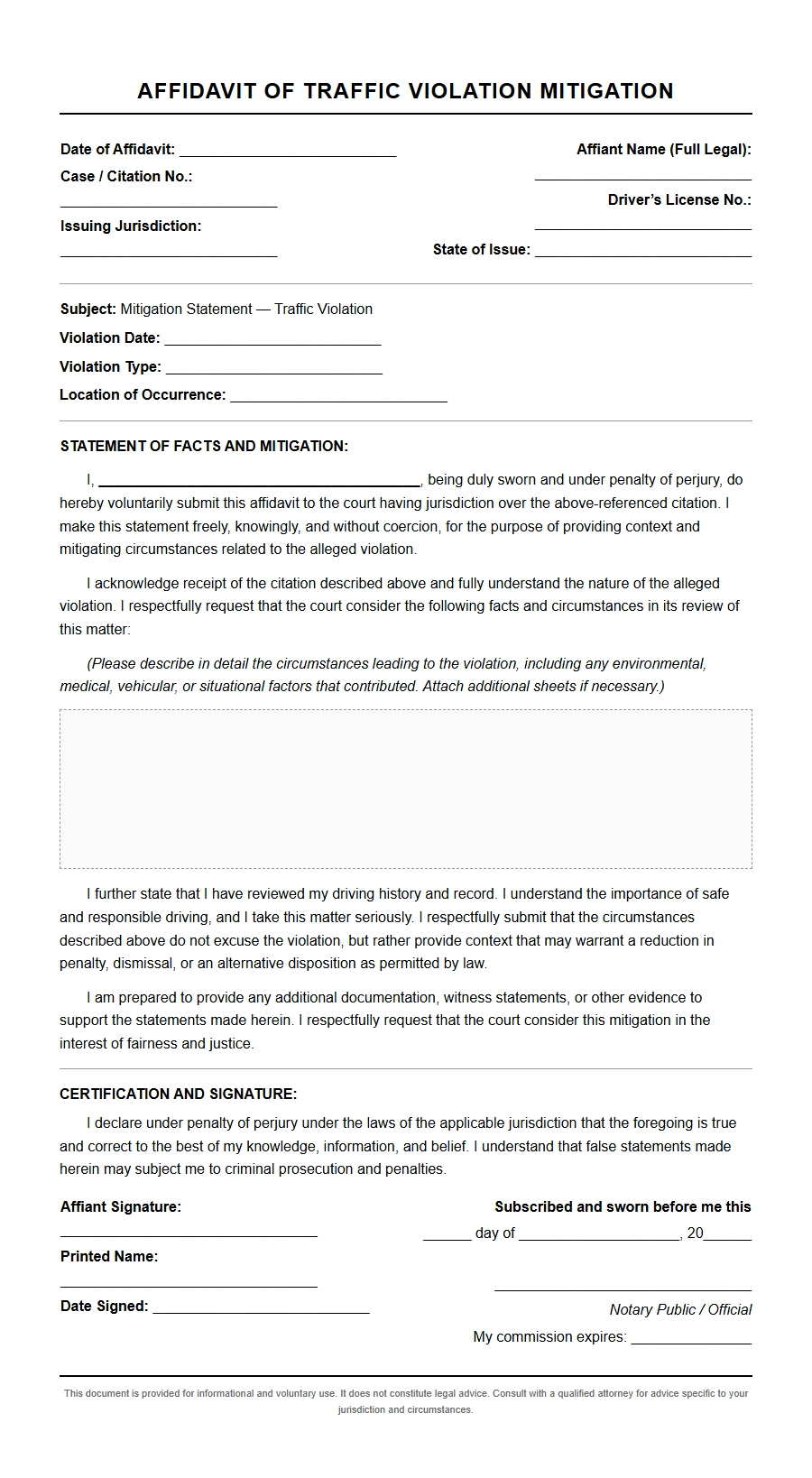
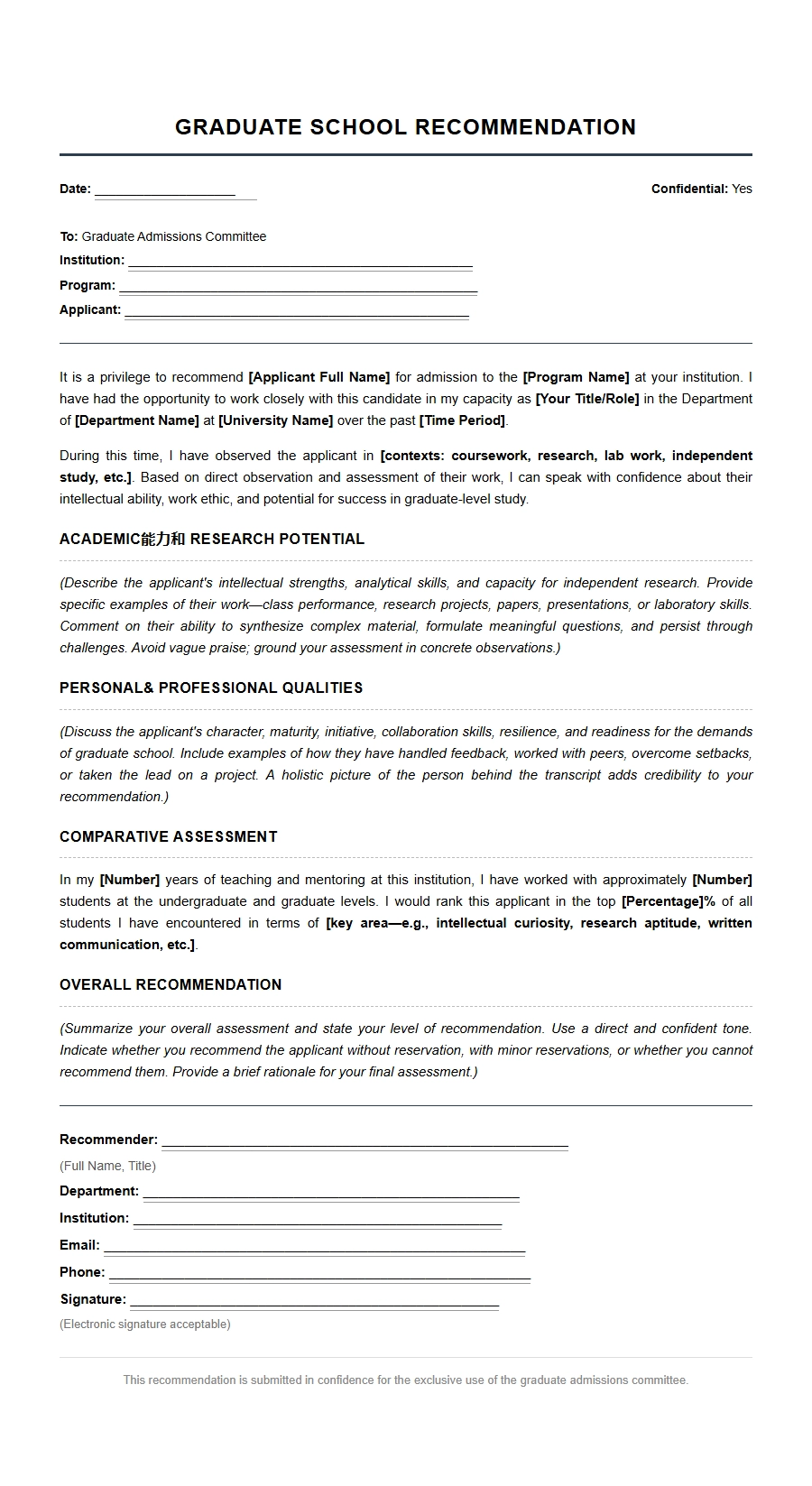 Format for Graduate School Faculty Recommendation Letters
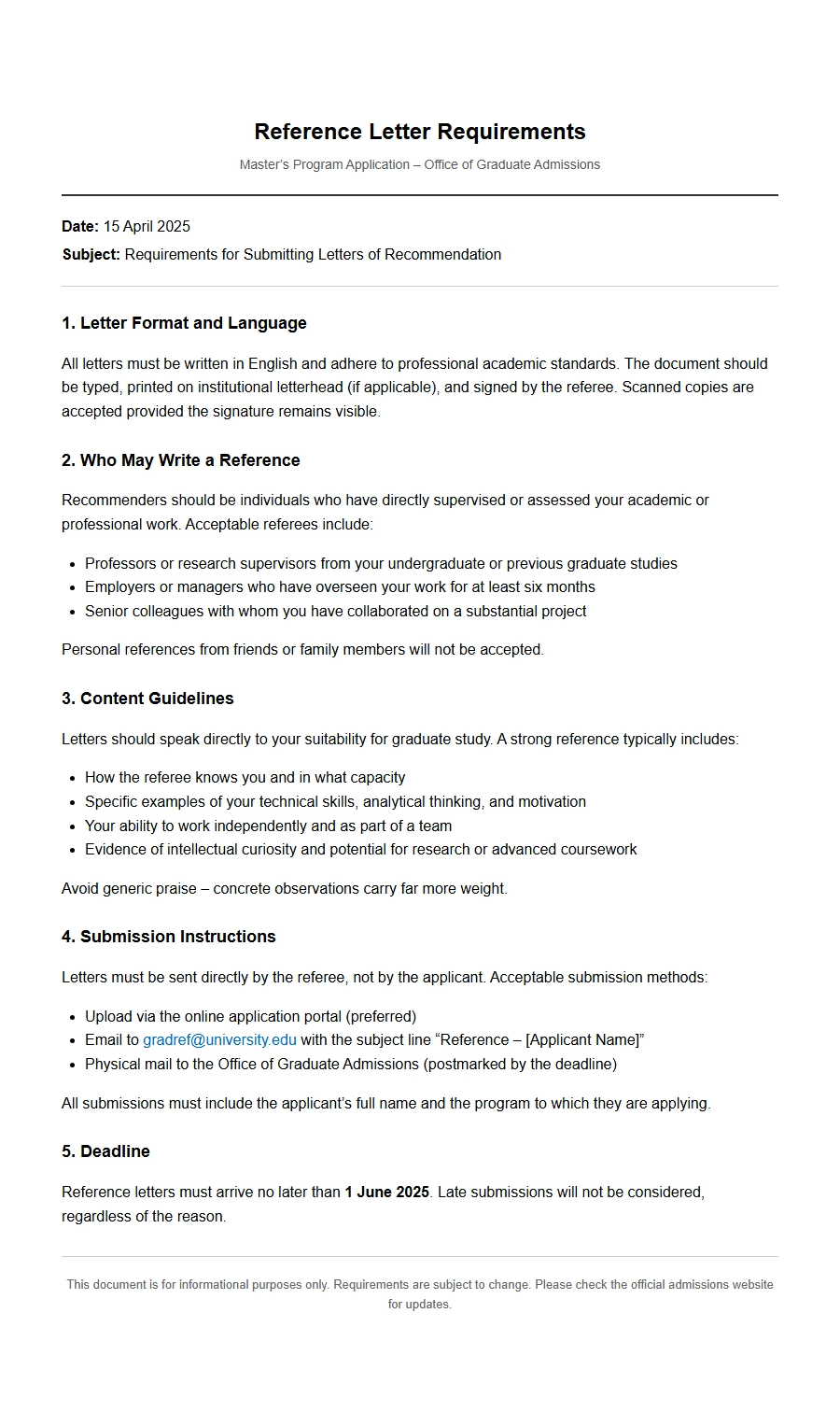 Master's Program Reference Letter Requirements
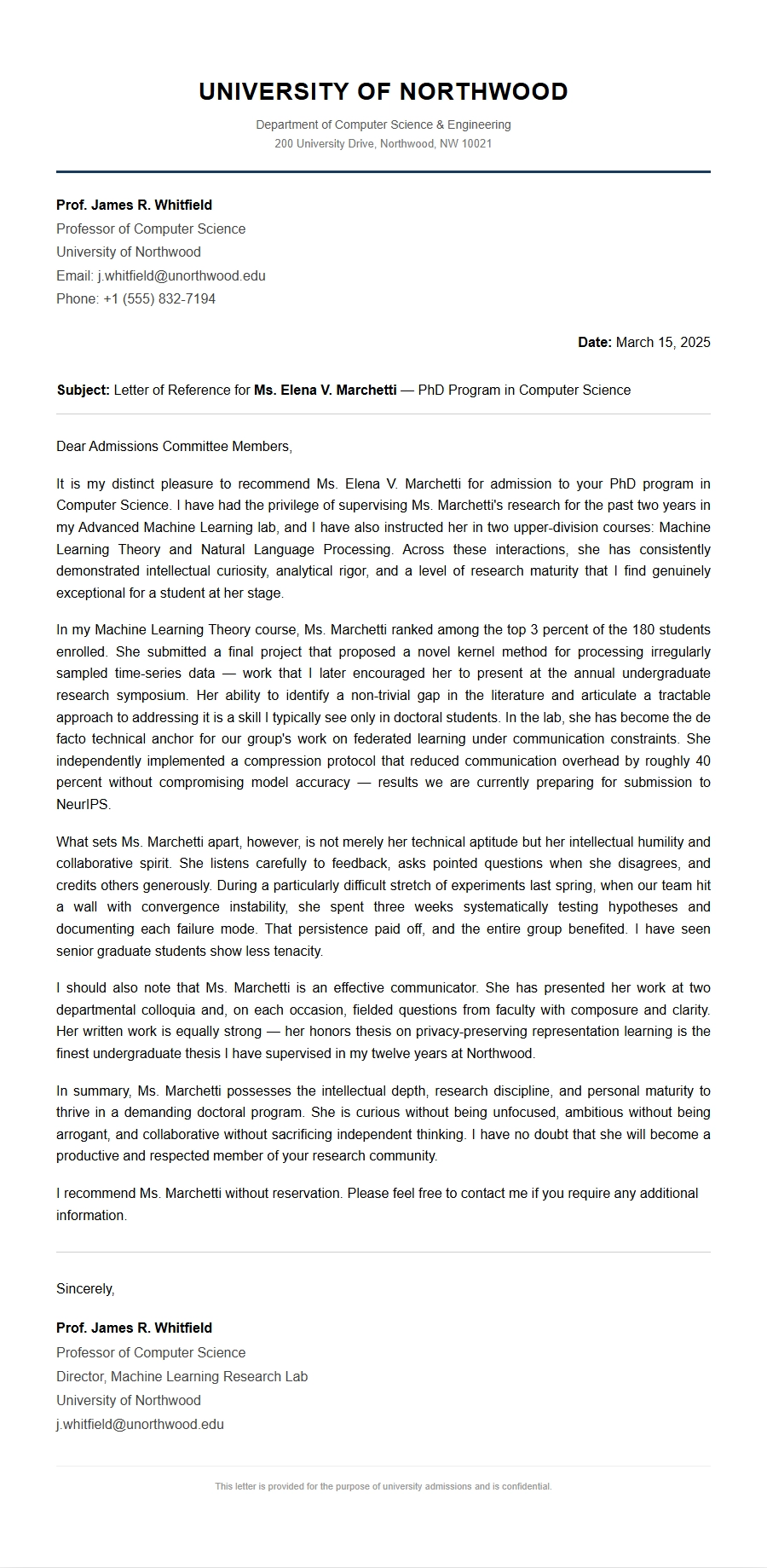 The Perfect Structure for a University Reference Letter
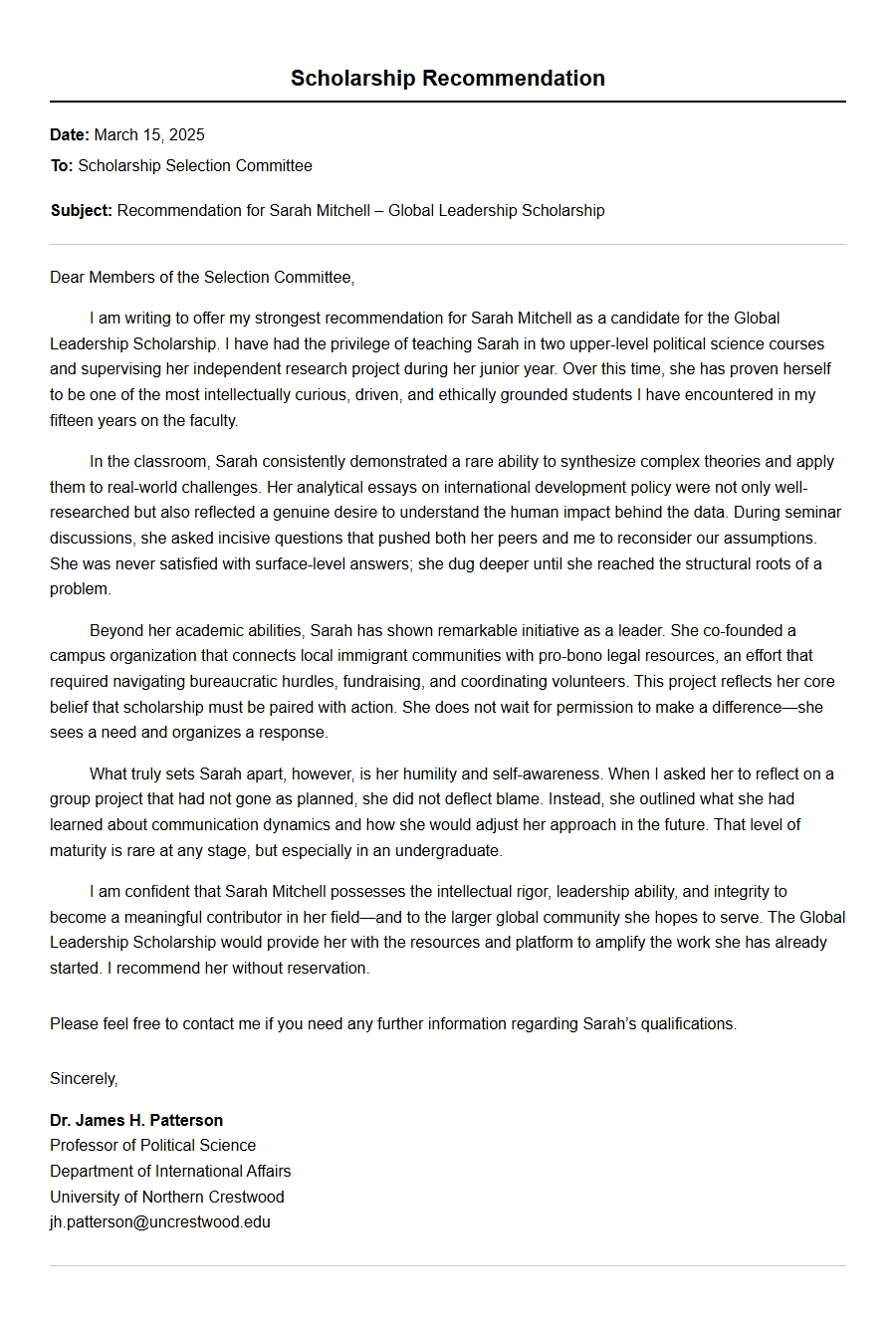 scholarship essay recommendation portion - Recommendation Letters
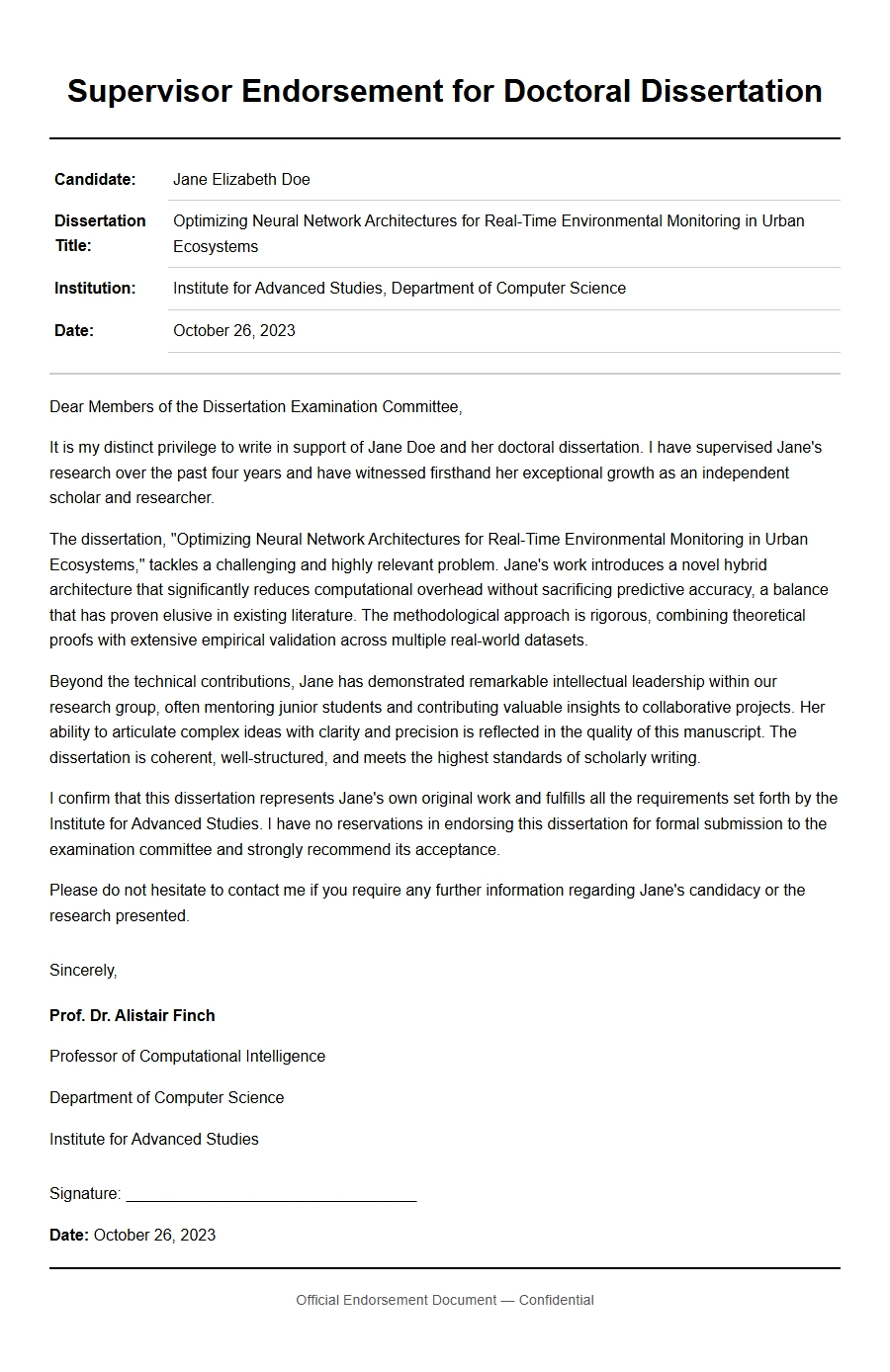 Sample PhD Supervisor Endorsement Letter
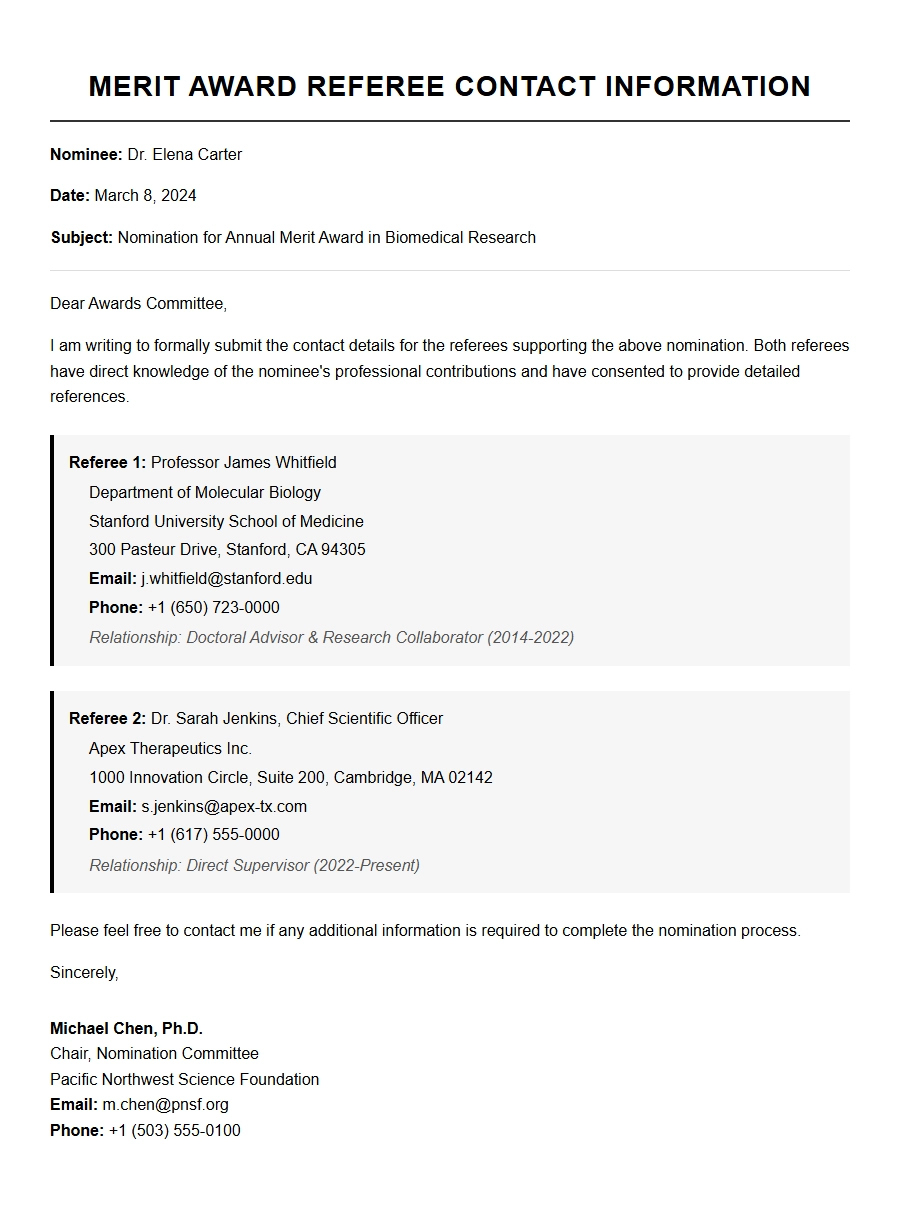 How to Find Your Merit Award Referee Contact Info