thank you letter for podcast interview participation - Thank-You Letters
You just finished a great podcast interview. The host was engaging, the conversation flowed, and now you need to send a thank-you note. But what exactly do you say? You want to sound grateful and professional, but the perfect words don’t come easily. That’s where a solid thank-you letter sample helps.
Using a letter template isn’t cheating. It’s a smart way to start. A sample gives you the right structure, a warm but polished tone, and the key phrases you need. You still add your own personality. Think of it as a framework, not a script.
Category: Thank You Letters for Podcast Appearances
Why Bother with a Formal Thank-You?
A podcast interview might feel casual, but the host likely spent time preparing, recording, and editing. A short, genuine thank-you builds a lasting impression. It also keeps you on their radar for future opportunities. Professional correspondence like this shows you value their time and respect the relationship.
What Makes a Podcast Thank-You Letter Different?
Unlike a cover letter examples for a job, a podcast thank-you is shorter and less formal. You don’t need a full business letter format with letterhead. A few paragraphs in an email or a handwritten note works fine. The salutation and closing should match the podcast’s vibe. If the host called you by your first name, “Hi Sarah” is better than “Dear Ms. Jones.”
Pay attention to tone in writing. Be appreciative, not effusive. Avoid over-the-top praise. A simple “I really enjoyed our conversation about [topic]” goes a long way. If you discussed something specific—like a shared hobby or a follow-up question—mention it. That personal touch makes your note memorable.
How to Adapt a Sample Without Sounding Robotic
Most letter writing etiquette guides tell you to personalize. Here’s how you do it for a podcast thank-you:
Change the opening. Instead of “Dear Host,” use the host’s name and refer to the episode title or topic. Example: “Hi Mark – thanks again for having me on The Creative Spark to talk about storytelling.”
Add a specific detail. “I loved your question about overcoming writer’s block – it made me think of a new angle.”
Close with a next step. Offer to share the episode with your network, suggest future topics, or simply say you hope to collaborate again.
If the interview was formal, you might follow formal writing tips like using complete sentences and avoiding emojis. For a laid-back show, a friendly tone works better. The key is matching the digital letter format to the context. Many hosts appreciate a quick email over a printed note.
Common Mistakes to Avoid
Ever received a letter that felt too stiff or too casual? Podcast thank-yous often go wrong in two ways:
Ignoring timing. Send your note within 24-48 hours. Waiting a week feels like an afterthought.
Using outdated salutations. “To Whom It May Concern” has no place here. Use the host’s name.
Also, watch the length. Keep it to 3-4 short paragraphs. A wall of text is hard to read. And always proofreading letter before hitting send. A typo in a thank-you note undermines your professionalism.
Where to Find the Right Sample
You don’t need a custom letterhead design for a podcast note. A simple email template works. Many cover letter examples for interviews can be adapted—just swap job talk for podcast topics. For instance, a professional thank-you for interview appointment scheduling follows similar etiquette, but you’d replace the interview follow-up with episode-specific appreciation.
The best thank-you letters feel both professional and personal. Start with a sample, but rewrite it in your voice. Swap out generic phrases for real memories from the conversation. Don’t be afraid to keep it short—sometimes “Thanks so much for the chat, I loved your take on [topic]” is plenty.
Practice makes the process faster. The next time you’re a podcast guest, you’ll know exactly what to write. Use a sample as a springboard, not a crutch. Your genuine gratitude will shine through.
Samples You Can Use
thank you letter for podcast interview participation - Thank-You Letters
Sincere Gratitude to the Host
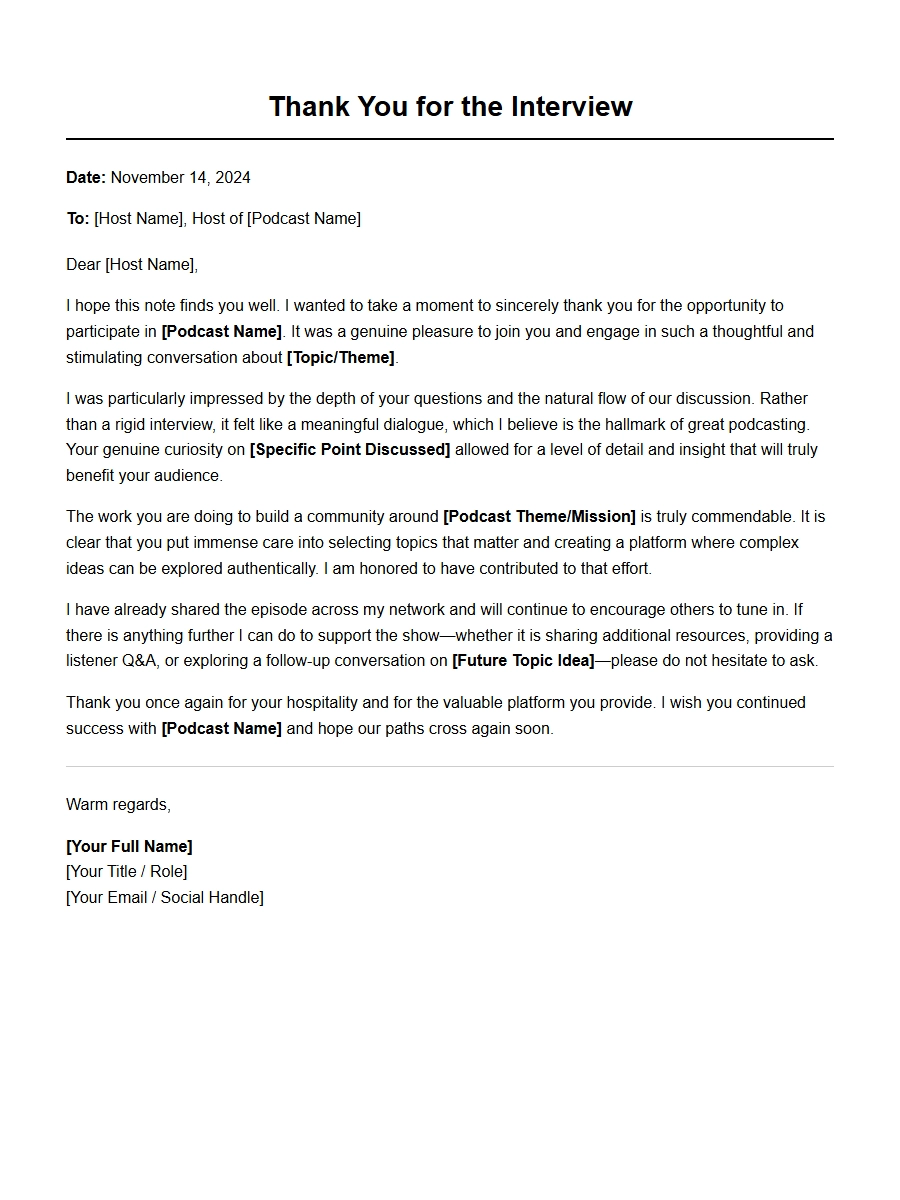
Dear [Host Name],
Thank you so much for having me on the [Podcast Name] podcast. I truly enjoyed our conversation about [topic] and appreciated your thoughtful questions that allowed me to share my insights in depth. Your preparation and engaging style made the interview a delightful experience.
I was particularly grateful for the way you steered the discussion toward practical takeaways for listeners. It is always a pleasure to speak with a host who genuinely cares about providing value to the audience.
Please let me know when the episode goes live—I would be happy to help promote it across my social media channels. I look forward to staying in touch and hope we can collaborate again in the future.
With warm regards, [Your Name]
Thank You to the Production Team
Hello [Team Name / Producer Name],
Thank you all for the seamless experience during my recent interview on [Podcast Name]. From the initial scheduling to the technical checks on the recording day, everything was handled professionally and efficiently.
I especially want to thank [Specific Person] for the detailed pre-interview briefing—it helped me prepare the right stories and talking points. The team’s coordination made me feel welcomed and at ease throughout the session.
Recording quality: excellent
Pre-interview communication: clear and timely
Overall experience: 10/10
Please let me know if there’s anything else I can provide, such as a short bio or links to my work. I’ll be sure to share the episode once it’s published.
Best regards, [Your Name]
Follow-Up with Episode Sharing Details
Dear [Host Name],
Thank you again for the wonderful conversation on [Podcast Name]. I have shared the episode link with my network and have already received positive feedback from several colleagues who found the discussion valuable.
To make it easier for your audience, I have summarized a few key points from our interview that I think resonate well:
Key insight 1: [brief point]
Key insight 2: [brief point]
Actionable tip: [brief point]
If you ever want a text version of these highlights for show notes or social media, I am happy to provide that. Thank you for creating a platform that encourages such meaningful conversations. I look forward to cross-promoting the episode and staying connected.
Warmly, [Your Name]
Post-Interview Appreciation for Engaging Discussion
Hi [Host Name],
I wanted to write a quick note to say how much I enjoyed being a guest on [Podcast Name]. Your ability to dive deep into the nuances of [topic] made the interview feel less like a Q&A and more like a stimulating dialogue. I left the conversation feeling inspired and energized.
I especially appreciated how you connected my points to current events and listener experiences—that is a sign of a true thought leader. If you ever decide to do a follow‑up episode or a series on this topic, I would be honored to participate again.
Thank you for the warm welcome and for providing such a valuable platform for sharing ideas.
All the best, [Your Name]
Thank You for Remote Interview Excellence
Dear [Host Name],
Thank you for making the remote recording of our interview for [Podcast Name] so smooth and enjoyable. Despite the physical distance, your hosting style created an intimate and focused atmosphere. The pre‑call technical check and clear instructions helped me feel confident from the start.
I also want to thank your team for providing the connection details and backup plan in case of any glitches—everything worked flawlessly.
As a token of appreciation, I have listed a few resources that listeners might find useful from our discussion:
Resource
Link or Description
Book recommendation
[Title by Author]
Tool mentioned
[Tool name]
Relevant article
[Title & URL]
I look forward to seeing the final episode and sharing it widely.
With gratitude, [Your Name]
Gratitude with Offer to Promote Episode
Hi [Host Name],
Thank you so much for having me on [Podcast Name]. I had a fantastic time sharing my experiences and learning from your perspective as well. Your audience’s engagement during the Q&A portion was remarkable—it shows the strong community you have built.
To help promote the episode, I can provide:
A short video testimonial about the podcast
Social media posts with tagged highlights
A blog post summarizing key takeaways
Please let me know if any of these would be useful for your marketing efforts. I am also open to contributing a written article related to our conversation.
Thank you again for this opportunity. I look forward to staying connected and supporting [Podcast Name] in any way I can.
Best wishes, [Your Name]
Thank You for a Live Podcast Interview
Dear [Host Name],
Thank you for the incredible opportunity to be part of a live episode of [Podcast Name]. The energy of the audience and the real‑time interaction added an exciting layer to our discussion about [topic]. I appreciate how you kept the conversation flowing naturally despite the live format.
I also want to acknowledge your team’s effort in handling the technical production and audience questions seamlessly. It was a professional and memorable experience.
For those who may have missed the live broadcast, I have summarized a few core themes we covered:
Theme 1: [brief description]
Theme 2: [brief description]
Theme 3: [brief description]
I hope to join you again for another live session in the future. Until then, thank you for your passion and hospitality.
Warm regards, [Your Name]
Appreciation to Host and Co‑Host
Hello [Host Name] and [Co‑Host Name],
Thank you both for the lively and insightful conversation on [Podcast Name]. Your complementary styles—[Host Name]’s probing questions and [Co‑Host Name]’s relatable anecdotes—made the interview dynamic and enjoyable.
I felt that the combination of your perspectives helped bring out different facets of my work on [topic]. It is rare to find a duo that balances depth with humor so well.
I have already heard from several listeners who appreciated the discussion, and I am confident the episode will become a valuable resource for your audience.
If you ever need a guest for a future topic that aligns with my expertise, I would be delighted to return. Thank you for the warm hospitality and for creating such a welcoming environment.
With gratitude, [Your Name]
Thank You for a Panel‑Style Podcast
Dear [Host Name],
Thank you for inviting me to participate in the panel discussion on [Podcast Name] about [topic]. I really appreciated the collaborative atmosphere and the chance to exchange ideas with the other guests. Your moderation kept the conversation focused and inclusive, allowing each panelist to contribute meaningfully.
I have summarized a few standout moments that I think will resonate with listeners:
Moment
Key Takeaway
Discussion on [subtopic A]
Diverse approaches to [challenge]
Q&A from audience
Practical solutions for [issue]
Closing roundtable
Actionable next steps for listeners
Thank you also for the follow‑up email with the episode links and promotional graphics—that made it easy to share. I look forward to future collaborations.
Warmly, [Your Name]
Second Interview Gratitude and Continuation
Dear [Host Name],
Thank you for having me back on [Podcast Name] for a second interview! It was a wonderful opportunity to dive deeper into [specific topic] and update your audience on the progress since my last appearance. Your ability to connect the dots between our previous conversation and the current developments made the episode feel like a natural continuation.
I especially enjoyed the listener‑submitted questions segment—it showed how engaged your community is and allowed me to address real‑world challenges.
To make it easy for first‑time listeners, here’s a quick comparison of the two episodes:
Episode
Focus
Listener Takeaway
First (Date)
Introduction to [topic]
Foundation and key concepts
Second (Date)
Advanced strategies & updates
Actionable growth tactics
Thank you for your continued support and for providing a platform that grows with your audience. I look forward to what’s next!
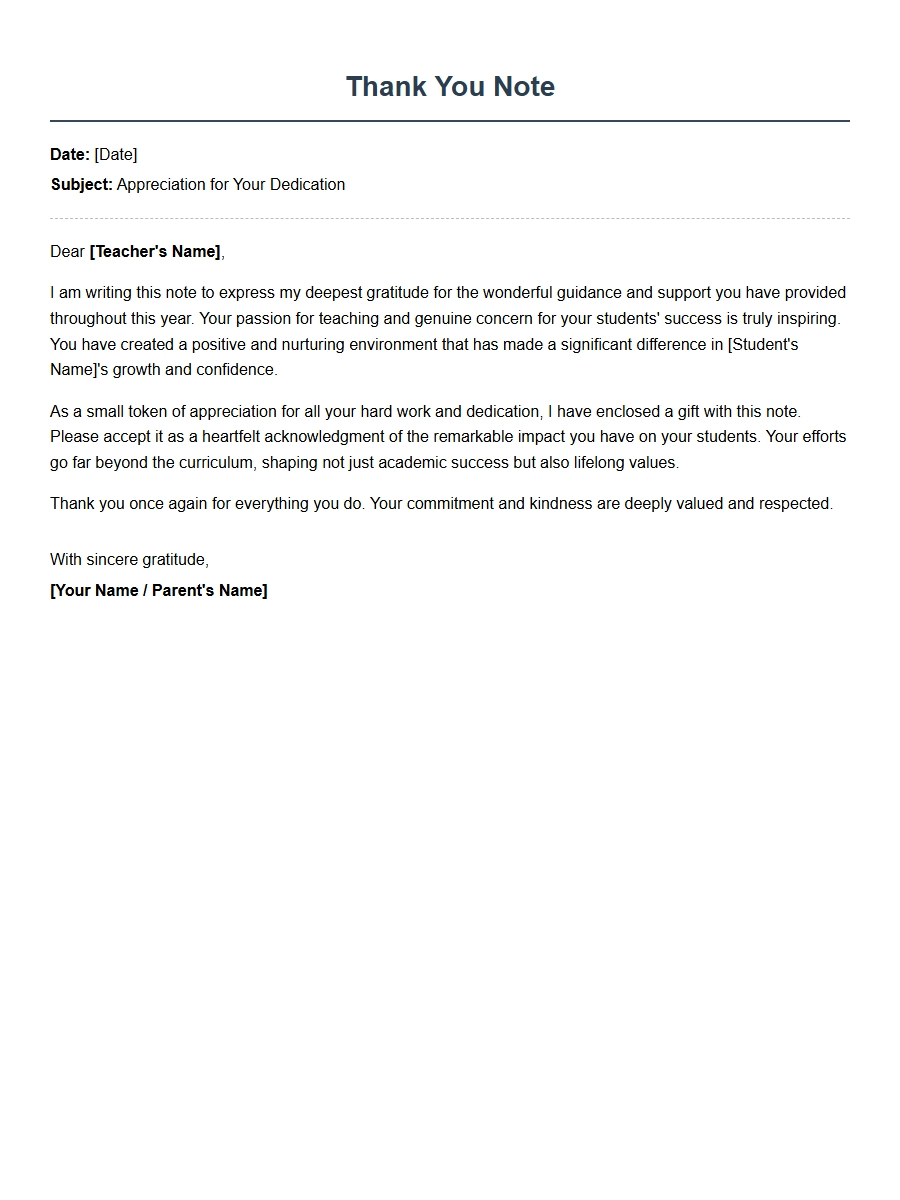 Sample Thank You Note for Teacher Gift
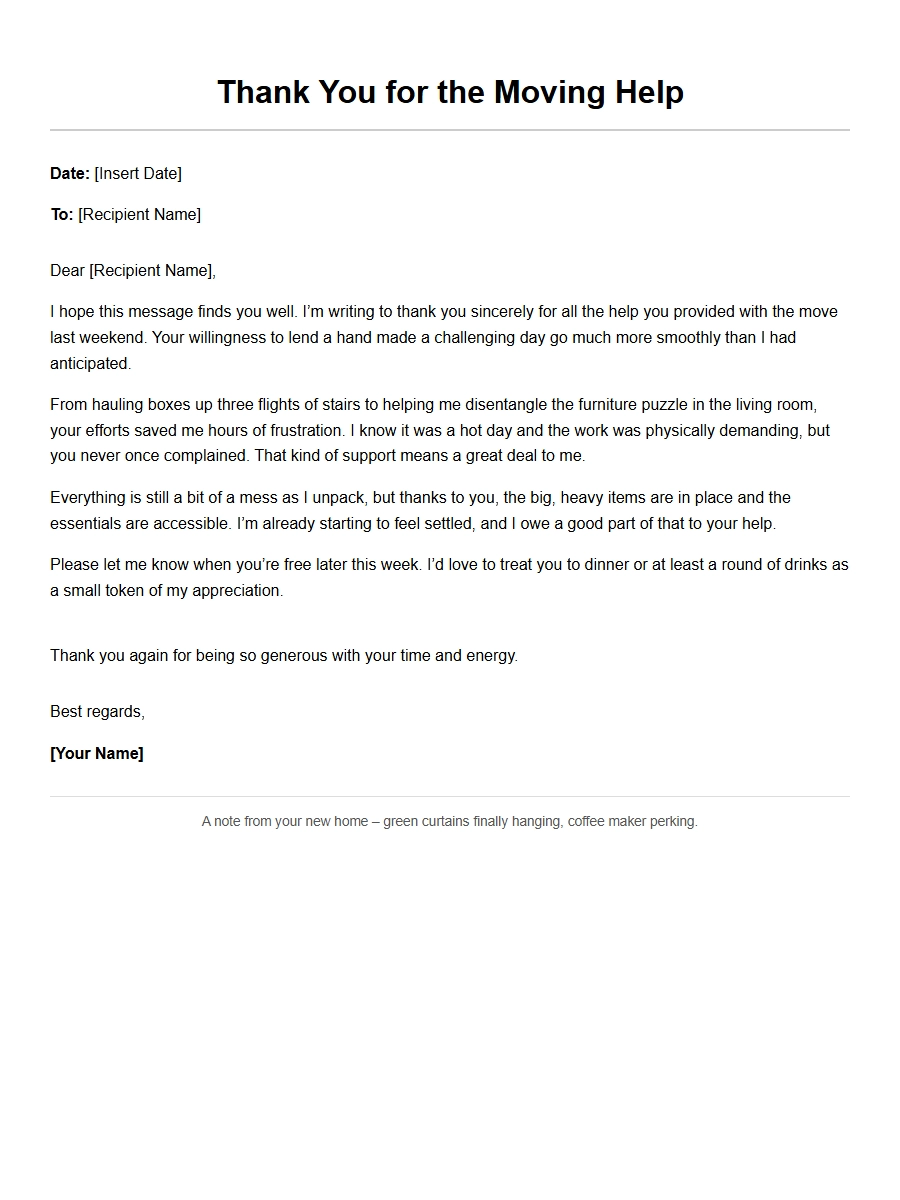 Thank-You Letter for Help with Moving
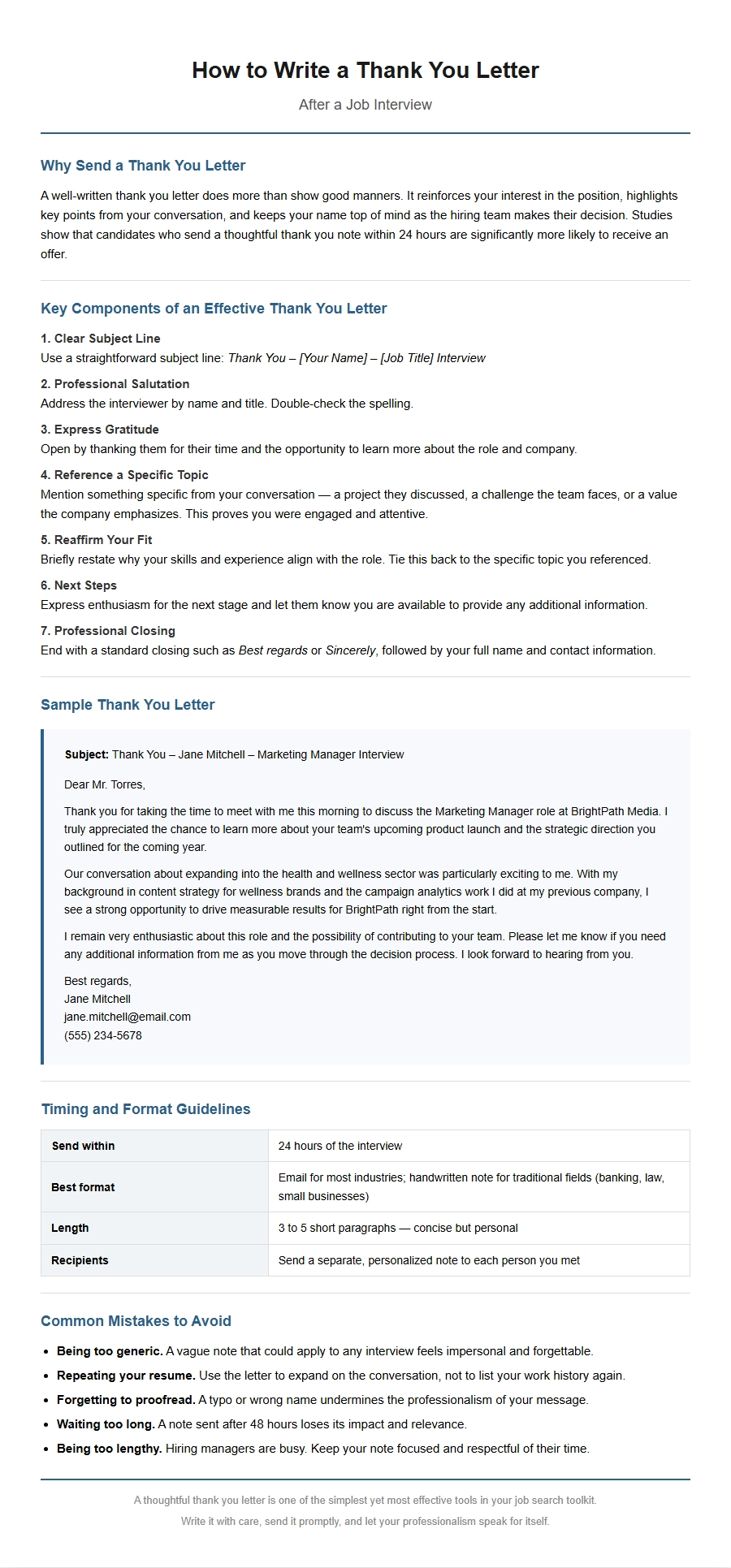 How to Write a Thank You Letter After an Interview
 professional thank you email example for client - Thank-You Letters
 Business Mentor Thank-You Letter Guide
 Thank You Letter for Sponsor Donation