You open a fresh document and the cursor just blinks back at you. Maybe you're resigning after years in a role, or perhaps you need to formalize a voluntary separation agreement. The words won't come, and that blank page can feel like a wall between you and moving forward.
Using a letter sample isn't taking shortcuts. It's a practical strategy that experienced writers use all the time. A solid template gives you the structure, salutation and closing, and the right tone in writing without forcing you to reinvent business letter format from scratch. What matters is how you adapt it to sound like you.
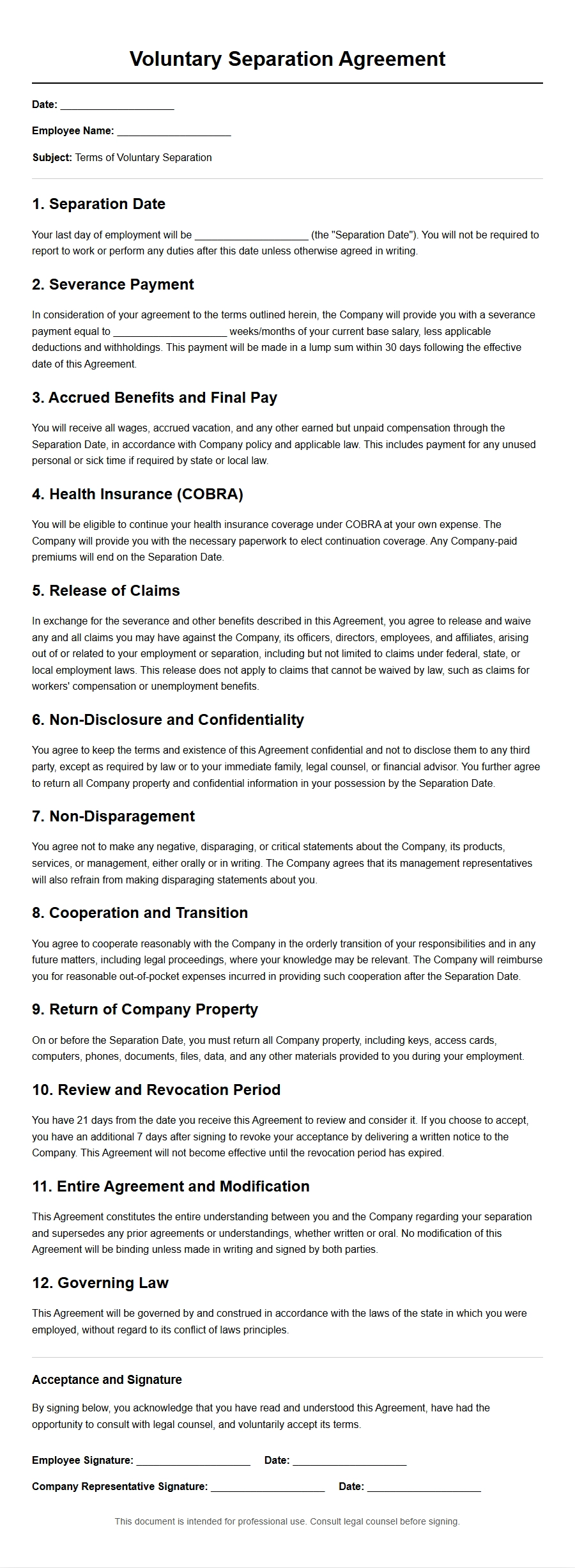
Terms Associated with Voluntary Separation Agreement
When you leave a job by mutual agreement rather than being fired, you're dealing with a voluntary separation agreement. These letters have their own language: "mutual separation," "severance terms," "release of claims," and "transition period" show up a lot. Understanding these terms helps you write professional correspondence that protects your interests while maintaining good relationships.
A resignation letter sample for voluntary separation needs to acknowledge the agreement clearly. For example, you might write: "I accept the terms of our voluntary separation agreement dated [date] and confirm my final day of employment as [date]." That one sentence does a lot of heavy lifting. It confirms your understanding, shows professionalism, and creates a paper trail.
How to Pick the Right Sample for Your Situation
Not all letter templates fit every resignation. Are you leaving on good terms? That calls for a warmer, appreciative tone. Is the separation tense or negotiated? You'll want more formal, careful language. Your industry matters too. A corporate resignation letter looks different from one in a small nonprofit or creative agency. The key is finding a sample that matches the relationship you have with your employer.
A cover letter examples site won't help here—you need resignation-specific samples. Look for ones that include phrases about handing over responsibilities, final pay, and benefits. A good resignation letter sample already has these pieces in place.
Adapting Without Losing Your Voice
Here's the trick: take the structure from a sample, but rewrite the opening paragraph in your own words. That first few sentences set the tone. If you copy them word-for-word, your letter will feel hollow. Instead, think about what you genuinely want to say. "I'm grateful for the opportunities I've had here" sounds different depending on your actual experience. Say what's true for you.
Avoid common mistakes that make letters feel outdated or lazy. Dear Sir went out with typewriters. Use the person's name. If you're sending via email, drop the letterhead design and use a clear subject line instead. For printed letters, include your contact info at the top, but keep the format clean. Digital letter format is simpler than paper—no need for addresses on both sides.
One error people make is treating a voluntary separation agreement letter like a standard resignation. If you're negotiating severance terms, your letter should reference the agreement specifically. You can see how to address severance package in resignation letters for examples of how to phrase this without sounding demanding.
Tailoring the Opening to Grab Attention
Busy managers scan letters. Your first paragraph should state your intention clearly: "I am writing to confirm my departure under the terms of our voluntary separation agreement." That's direct and professional. Then you can add warmth or detail in the next paragraph. Don't bury your purpose in polite small talk.
Proofreading letter samples often miss the personal details that make correspondence feel human. After you adapt a template, read it out loud. Does it sound like something you would actually say? If not, adjust the wording until it does. Formal writing tips can help, but your authentic voice matters more than perfect grammar.
Mistakes to Avoid with Voluntary Separation Letters
People slip up in a few predictable ways. First, they use language that sounds like they're being fired rather than leaving voluntarily. If your agreement is voluntary, your letter should reflect that choice. Second, they ignore the business letter format expectations of their workplace. Some companies want formal structure; others appreciate a shorter, warmer tone. Third, they forget to include practical details like last working day and return of company property. A good letter template will remind you of these.
Another common mistake is not customizing the letter for your specific audience. A resignation letter for human resources manager resignation letters needs to be precise because HR will file it. A letter to your direct supervisor can be slightly more personal. Know who's reading and adjust accordingly.
Keeping It Professional and Personal
The best letters strike a balance. They follow professional correspondence norms but include a genuine, personal touch. Maybe it's a specific memory of a project you enjoyed, or a mention of a colleague you'll miss working with. Those details make the letter memorable and protect your network for future opportunities.
If you're leaving under difficult circumstances, keep things neutral. Don't vent in writing. Focus on the practical steps of the transition. If you're on good terms, a warm closing paragraph goes a long way.
If your situation is more complicated—like resigning while on leave—check how to resign while on sick leave resignation letters for guidance on handling sensitive timing.
Using Samples as a Springboard
Think of a letter sample as training wheels. It keeps you from falling over while you build confidence. Once you've written one good resignation letter, the next one comes faster. You learn what structure feels right, what tone fits your style, and what details matter most. Eventually, you won't need the sample at all—you'll know the shape of the letter instinctively.
The goal isn't a perfect letter on the first try. It's a letter that communicates clearly, respects the relationship, and gets you to the next chapter of your career. Start with a sample, make it yours, and send it with confidence.
Simple Examples
Voluntary Separation Agreement Letter Examples
Acceptance of Voluntary Separation Offer
Dear [Manager Name],
I am writing to formally accept the voluntary separation offer presented to me on [Date]. I have reviewed the terms outlined in the Separation Agreement and understand that my resignation is effective [Date]. I acknowledge the following key terms:
Severance payment of [Amount] to be paid in [Number] installments.
Continuation of health benefits until [Date].
Full release of all claims against the company.
Return of all company property by [Date].
Confidentiality and non-disparagement obligations.
I confirm that I have had sufficient time to consider this agreement and have consulted with legal counsel as needed. Thank you for the professional support during this transition.
Sincerely, [Your Name]
Resignation Letter with Separation Agreement Reference
Dear [Manager Name],
Please accept this letter as formal notification of my resignation from [Company Name], effective [Date]. This resignation is part of the voluntary separation agreement we discussed on [Date].
I understand and agree to the terms set forth in the Separation Agreement, including:
Severance package as detailed in Section 4.
Release of all claims against the company.
Confidentiality of company information.
Non-disparagement of the company or its employees.
I will ensure a smooth handover of my responsibilities before my departure. I appreciate the opportunities I have had at [Company Name] and wish the team continued success.
Best regards, [Your Name]
Mutual Separation Agreement Letter
This letter confirms the mutual separation agreement between [Employee Name] and [Company Name], effective [Date].
Term
Description
Severance Pay
$[Amount] gross, less deductions
Benefits End
[Date]
Release of Claims
General release in favor of Company
Confidentiality
Permanent, covering all proprietary info
Non-Disparagement
Mutual, no negative statements
Both parties agree to the above terms voluntarily. The employee acknowledges receipt of a signed copy and has had 21 days to review. This agreement supersedes any prior understandings.
I hereby resign from my position effective [Date]. This resignation is voluntary and is made pursuant to our separation agreement dated [Date]. As part of this agreement, I waive any and all claims against [Company Name], including but not limited to claims for wrongful termination, discrimination, or breach of contract.
I understand that this waiver is irrevocable and that I am entitled to receive the following in exchange:
Severance payment of $[Amount].
Outplacement services for [Duration].
Positive reference upon request.
I confirm that I have consulted with an attorney regarding this waiver. Thank you for the support during this process.
Sincerely, [Full Name]
Confidentiality Clause Acknowledgment Letter
To: [HR Department]
Re: Acknowledgment of Confidentiality Obligations under Voluntary Separation Agreement
I, [Employee Name], acknowledge that my voluntary separation agreement with [Company Name] includes a confidentiality clause that remains in effect indefinitely. I agree to:
Not disclose any trade secrets or proprietary information.
Return all confidential documents and data by [Date].
Delete any electronic copies from personal devices.
I understand that breach of this clause may result in forfeiture of severance benefits and legal action. I confirm that I have received a copy of the confidentiality policy and the separation agreement.
Signed: [Signature] Date: [Date]
Severance Payment Terms Letter
This letter outlines the payment terms under your voluntary separation agreement, effective [Date].
Component
Amount
Schedule
Base Severance
$[Amount]
Lump sum within 30 days
Accrued Vacation Payout
$[Amount]
With final paycheck
COBRA Subsidy
$[Amount/month]
For [Months] months
Stock Options
Vested only
Per plan document
Your resignation is voluntary. By signing this letter, you acknowledge these terms and agree to release any further claims. Please sign below and return by [Date].
Accepted: [Signature] Date: [Date]
Non-Disparagement Agreement Letter
Dear [Employee],
As part of your voluntary separation agreement, you are required to adhere to a non-disparagement clause. This clause prohibits you from making any negative or critical statements about [Company Name], its officers, employees, products, or services.
Specifically, you agree not to:
Post negative comments on social media or review sites.
Make derogatory remarks to former colleagues or clients.
Participate in legal actions that involve disparaging the company.
This obligation extends to all forms of communication and is binding for [Duration] after separation. Violation may result in termination of severance benefits. Please acknowledge by signing below.
I understand and agree: [Signature] Date: [Date]
Return of Property Acknowledgment
To: [Company Name]
Re: Return of Company Property
I, [Employee Name], confirm that in connection with my voluntary separation effective [Date], I have returned all company property as listed below:
Item
Condition
Returned Date
Laptop (Serial #)
Good
[Date]
Company Phone
Good
[Date]
ID Badge
Returned
[Date]
Files/Documents
All digital copies deleted
[Date]
I understand that failure to return any item may result in deduction from final pay as per the separation agreement. I have no outstanding company property.
Signed: [Employee Signature] Date: [Date]
Release of Claims Letter
Dear [Company Name],
This letter serves as my formal release of all claims associated with my employment and voluntary separation from [Company Name]. In exchange for the severance package described in the Separation Agreement dated [Date], I hereby release and forever discharge the company from any and all claims, known or unknown.
This release includes but is not limited to:
Claims under Title VII, ADEA, ADA, and state laws.
Contract and tort claims.
Claims for wages, bonuses, or benefits beyond what is provided.
I understand that I am giving up rights to file a lawsuit. I have had 21 days to consider this release. I sign this voluntarily.
Signed: [Employee Name] Date: [Date]
Voluntary Separation Package Offer Letter
Dear [Employee Name],
We are pleased to offer you a voluntary separation package in connection with your resignation. The terms are summarized below:
Item
Details
Resignation Date
[Proposed Date]
Severance Amount
[Amount] weeks of base pay
Benefits Continuation
Medical through [Date]
Outplacement Services
Provided by [Vendor] for 6 months
Reference Policy
Neutral verification only
To accept this package, please sign the enclosed Separation Agreement and return it by [Deadline]. You have the right to consult an attorney. This offer is voluntary and does not constitute an adverse employment action.
We appreciate your contributions and wish you success.
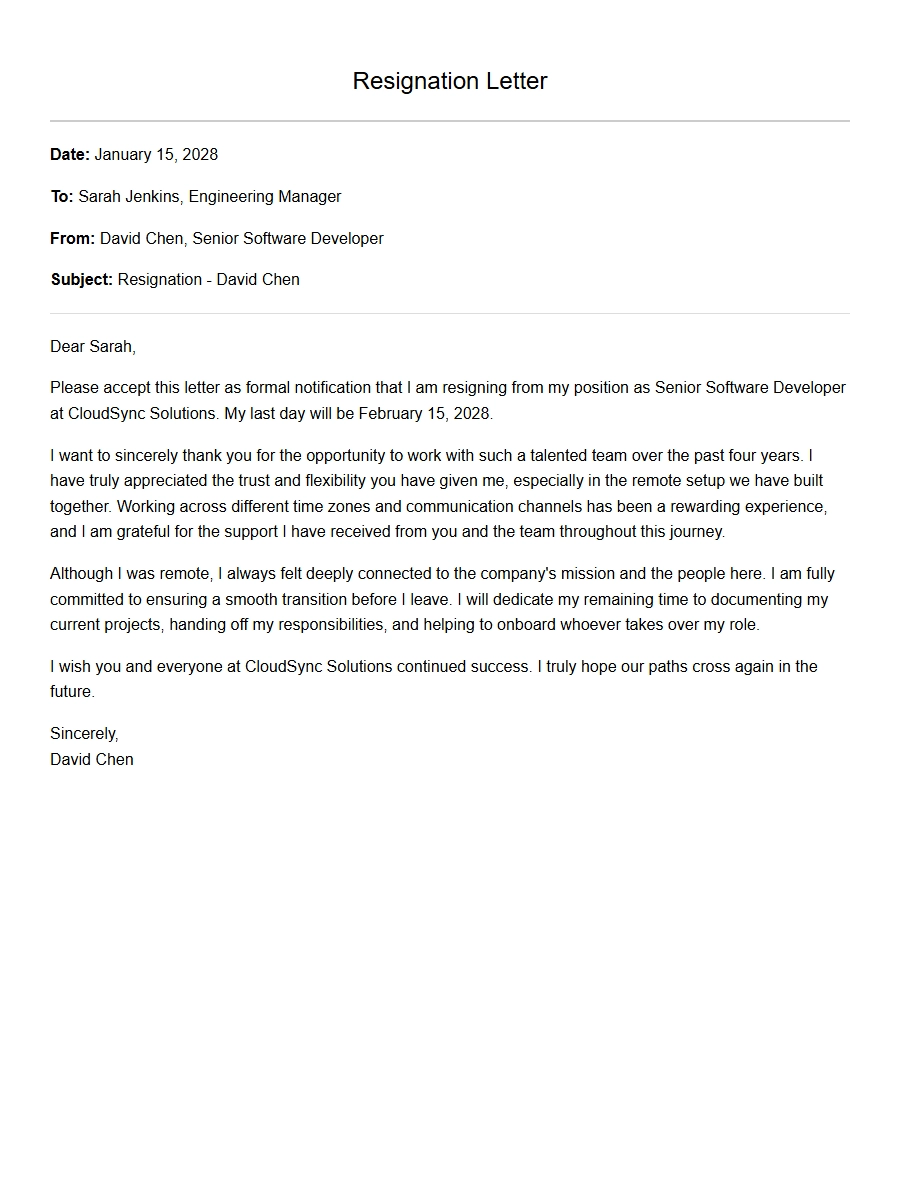 Polite Resignation Email for Remote Employees
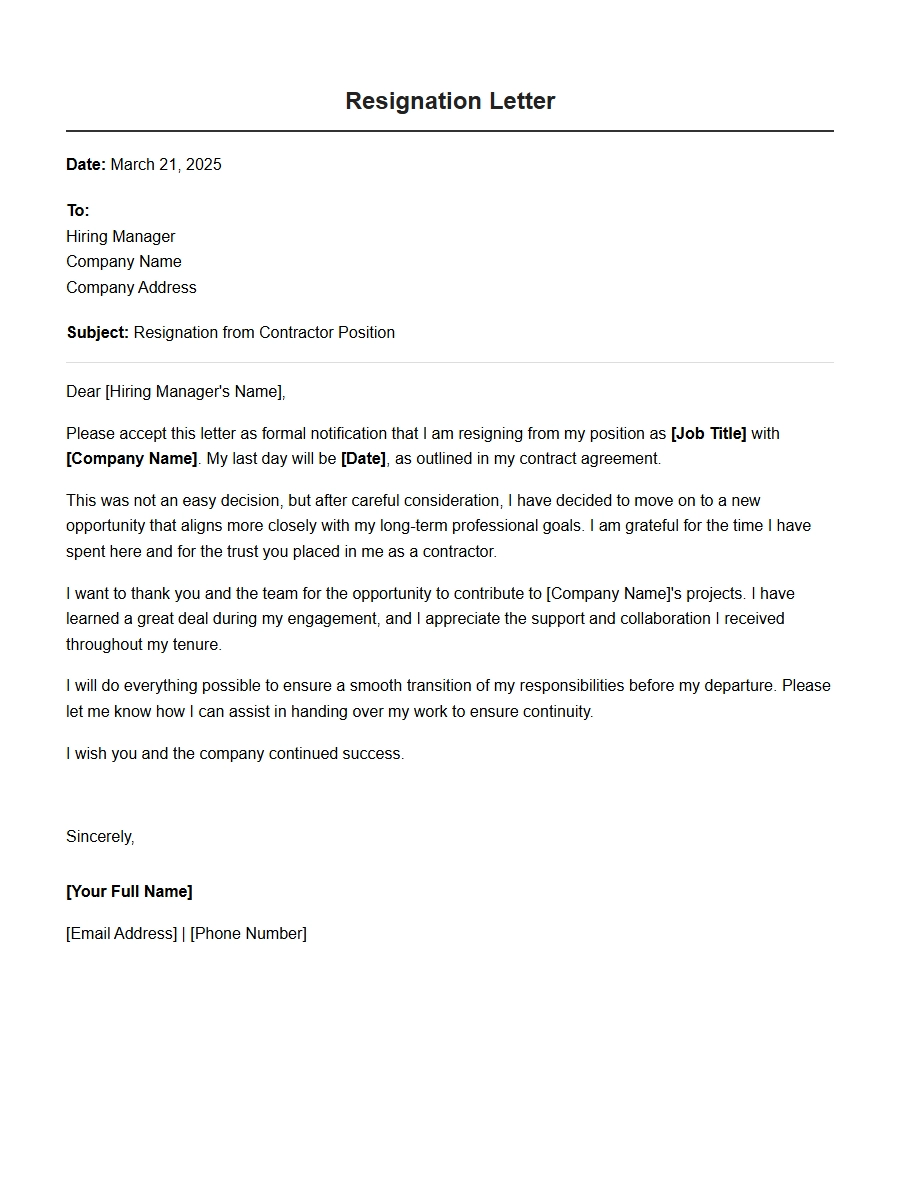 Short Resignation Letter for Contractor Position
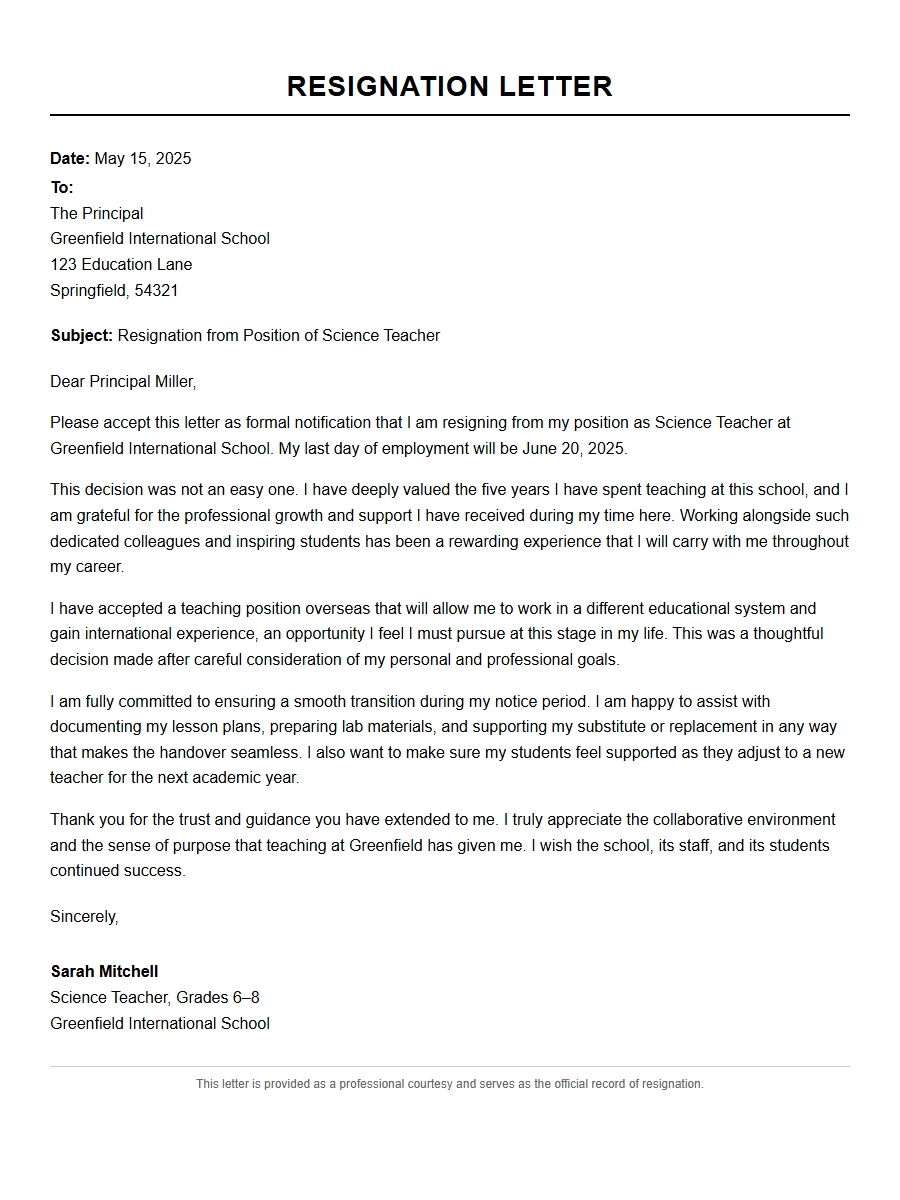 Teacher Resignation Letter Example
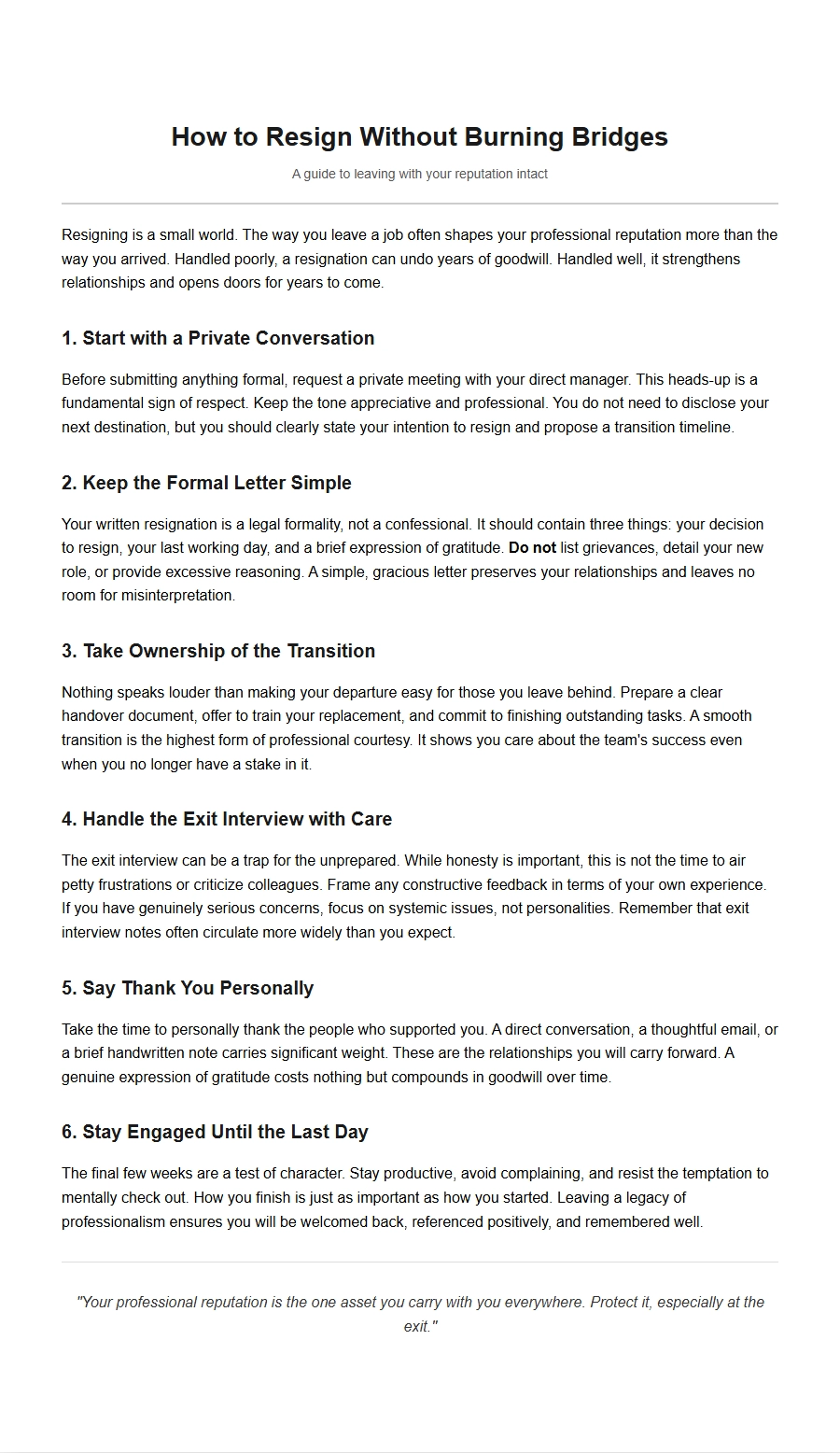 How to Resign Without Burning Bridges
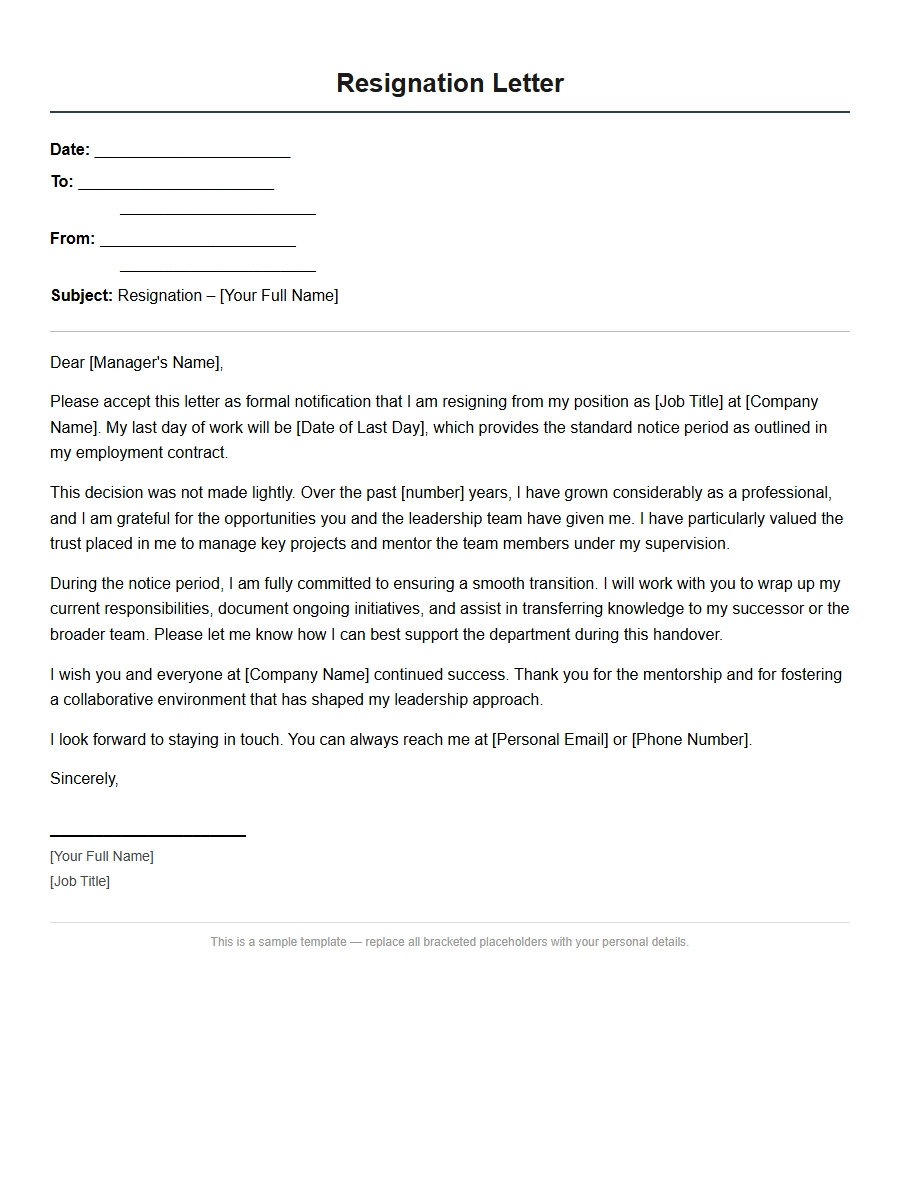 Formal Resignation Letter Sample for Manager
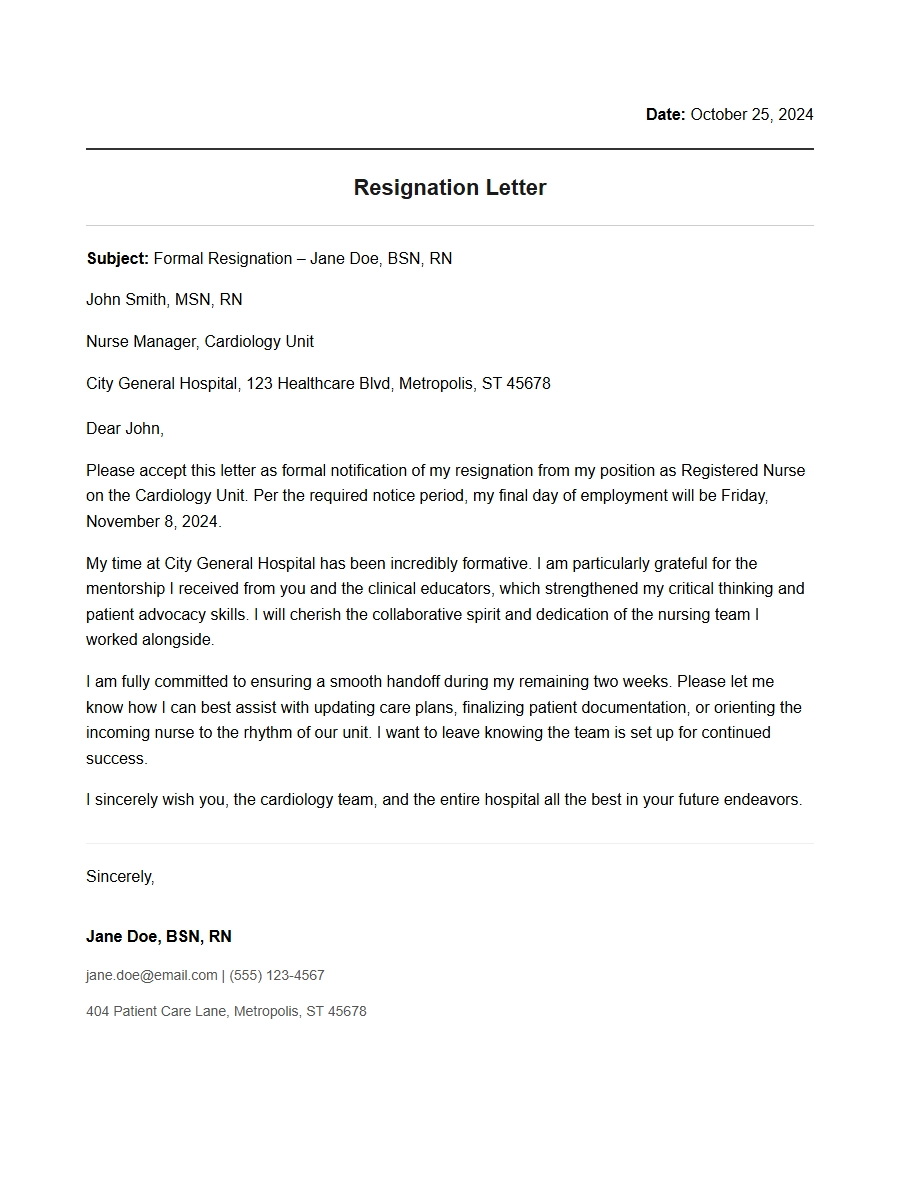 Nurse Resignation Letter with 2 Weeks Notice