sample resignation for data science lead - Resignation Letters
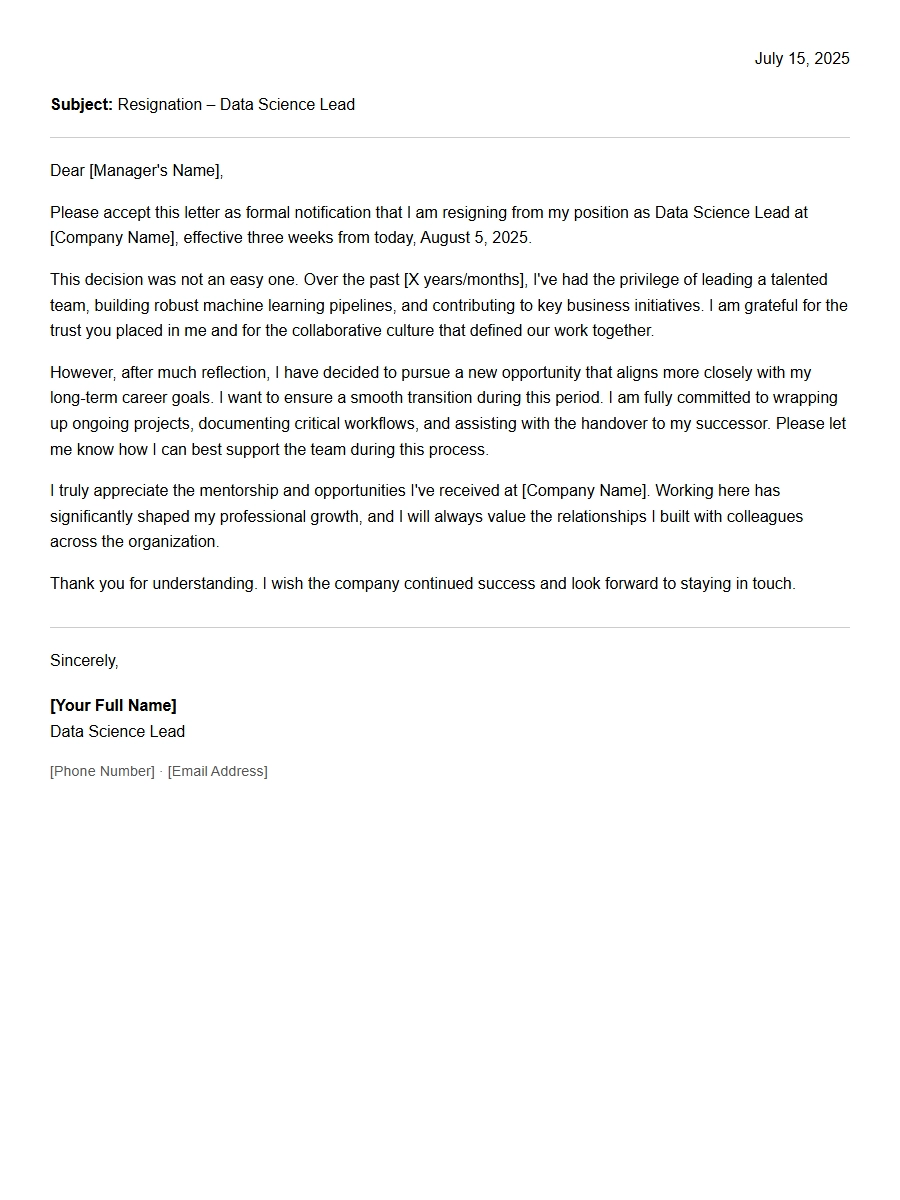
You’ve made the decision to leave your Data Science Lead role, but now you’re stuck staring at a blank page. The pressure to get the wording just right — professional, gracious, clear — can freeze anyone. A good sample resignation letter cuts through that anxiety. It gives you a structure and tone you can adjust in minutes, so you send something polished without overthinking every sentence.
Using a sample isn’t cheating. It’s a smart shortcut. Letter templates are built on proven formats that work across industries. They handle the formal writing basics (salutation, closing, business letter format) so you can focus on personalizing the message. The key is to treat the sample as a starting point, not a script to copy blindly.
Category: Resignation Letters
Is a Data Science Lead resignation different from other roles?
In a way, yes. You likely manage a team, own major projects, and deal with cutting-edge tools. Your resignation letter should reflect that level of responsibility. A generic one-liner won’t do. You’ll want to acknowledge the work your team does, maybe mention specific initiatives, and offer a transition plan. But you don’t need to rewrite the universe. A sample tailored to a senior technical role can give you the right phrasing for professional correspondence without sounding robotic.
Look for a resignation letter sample that includes room for project handoff notes or team acknowledgments. That level of detail signals you’re leaving thoughtfully — and that matters for your reputation and any future letter of recommendation you might need.
How to choose the right sample for your situation
Not all samples are equal. If you work in a startup with a flat culture, a hyper-formal board-level resignation will feel stiff. On the other hand, if your company values strict hierarchy, a casual note might come across as disrespectful. Match the tone in writing to your workplace culture. Most samples offer variations — pick one that feels like you, then adjust.
If you’re emailing your resignation, skip the letterhead design. A clean subject line (e.g., “Resignation – [Your Name] – Data Science Lead”) and a standard digital letter format work best. For a printed letter, include your contact info at the top and use a classic business letter format.
Adapting the sample without losing your voice
The biggest mistake is copying the sample word for word. Instead, use it for structure: the opening that states your intent, the body explaining your departure date and gratitude, and a closing that offers to help with the transition. Your authentic voice comes through in small choices — how you phrase your appreciation, what details you add about your team, and whether you mention specific handoff steps.
For example, a sample might say “I appreciate the opportunities I’ve had.” You can make it personal: “I’m grateful for the chance to build the ML pipeline from scratch and watch our team grow from 3 to 12.” That’s not fluff — it shows you value the experience without over-explaining.
Common mistakes that weaken your letter
Using outdated salutations (“To Whom It May Concern” when you know your manager’s name) is a fast way to look sloppy. Always address the person who will receive it. Another frequent error: ignoring the format difference between email and printed letter. Email needs a subject line, no need for a full address block. Printed letters should follow standard business letter spacing.
Also, don’t forget proofreading. One typo in your resignation letter can undercut months of good work. Read it out loud or ask a friend to scan it. A tiny error in a resignation letter sample you adapted might slip through, so double-check dates and names.
Once you’ve adapted a sample for this role, save your version. Next time you change jobs, you’ll have a personalized starting point. Over time, the process becomes faster. You’ll know exactly how to structure the letter, what salutation and closing to use, and how much detail to include. That’s the real value of using a sample — you learn by tweaking, not by guessing.
Remember, the best resignation letters feel both professional and personal. Use the sample as a springboard, not a crutch. Practice makes the process smoother, and each letter you write gets a little closer to your natural voice. You’ve got this.
Helpful Examples
sample resignation for data science lead - Resignation Letters
Standard Formal Resignation with Gratitude
Date: 2025-07-01
To: Human Resources Department
From: Jordan Lee, Data Science Lead
Please accept this letter as formal notification that I am resigning from my position as Data Science Lead, effective August 1, 2025.
I am grateful for the opportunity to lead the data science team over the past three years. I have enjoyed building predictive models, mentoring junior data scientists, and contributing to the company’s analytics strategy. I especially appreciate the support I received during the transition to cloud-based infrastructure.
To ensure a smooth handover, I have prepared documentation for all active projects. I am happy to assist in training my successor during the notice period. Please let me know how I can help.
Thank you again for the rewarding experience. I wish the company continued success.
Sincerely, Jordan Lee
Short and Direct Resignation
Date: 2025-07-02
To: Jennifer Wu, VP of Analytics
From: Alex Chen, Data Science Lead
I am resigning from my role as Data Science Lead, effective July 31, 2025. This decision is final.
I appreciate the opportunities I’ve had here and will ensure my current projects are completed or handed over before my last day. Please coordinate with me regarding the transition plan.
Thank you.
Best regards, Alex Chen
Resignation with Detailed Handover Plan
Date: 2025-07-03
To: Priya Singh, Head of Data
From: Samira Okafor, Data Science Lead
I am submitting my resignation as Data Science Lead. My last day will be August 2, 2025. I have outlined a handover plan below.
Project
Status
Documentation
Recommended Owner
Customer Churn Model
Production (v2.3)
Complete
Maria L.
Recommendation Engine
In development
Notebooks shared
David K.
Sales Forecasting Pipeline
Quarterly refresh only
Pipeline script ready
Fiona T.
I will conduct two handover sessions before my departure. All repository access and credentials will be transferred via IT. Please let me know if any adjustments are needed.
Thank you for the growth opportunities.
Sincerely, Samira Okafor
Resignation Due to Relocation
Date: 2025-07-04
To: Thomas Rivera, Director of Data Science
From: Elena Vasquez, Data Science Lead
I regret to inform you that I must resign from my position as Data Science Lead due to my family’s relocation to Toronto, Canada. My final day will be August 15, 2025.
This has been a difficult decision because I truly value this team and the work we do. Over the past two years, I have helped build a robust MLOps framework and mentored five junior data scientists. I am committed to ensuring a seamless transition.
I have already prepared a transition guide and will schedule knowledge transfer meetings next week. I am also open to consulting remotely for a limited period after my move if that helps.
Thank you for understanding. I hope to stay connected.
Warm regards, Elena Vasquez
Resignation for a New Opportunity
Date: 2025-07-05
To: Megan Scott, Chief Analytics Officer
From: Ravi Patel, Data Science Lead
I am writing to announce my resignation from the Data Science Lead role, effective August 5, 2025. I have accepted a position as Director of AI at another organization, an opportunity that aligns with my long-term career goals.
Working here has been incredibly rewarding. I particularly enjoyed leading the deep learning project for fraud detection, which resulted in a 30% reduction in false positives. The supportive culture and talented team have made my tenure memorable.
I will ensure all ongoing projects are properly handed over. I have already started documenting the model deployment pipeline and will update the team’s knowledge base. Please let me know how I can facilitate the transition.
Thank you for everything.
Best regards, Ravi Patel
Resignation Focusing on Mentorship and Transition
Date: 2025-07-06
To: Sarah Kim, Engineering Manager
From: Liam O’Brien, Data Science Lead
I am resigning as Data Science Lead, effective July 31, 2025. My priority is to leave the team stronger than when I arrived, so I have prepared a comprehensive transition plan.
Code reviews: I will review all pending pull requests for the feature store repository.
Knowledge transfer sessions: Three 2-hour workshops on experiment tracking and model monitoring, scheduled next week.
Mentorship continuity: I have paired each junior data scientist with a senior engineer for ongoing support.
I have also created a Loom video walkthrough of the A/B testing framework. All necessary documentation is in Confluence. Please reach out if you need any additional information.
I am grateful for the mentorship I received here and hope to provide the same to others even after my departure.
Sincerely, Liam O’Brien
Resignation with Request for Part-Time Transition
Date: 2025-07-07
To: Human Resources
From: Nina Johansson, Data Science Lead
I am resigning from my full-time Data Science Lead position, effective August 15, 2025. However, I would like to propose a part-time transition schedule for the following month to ensure continuity.
Proposed Transition Schedule:
Week of Aug 18: 3 days (M, W, F) – complete handover documentation
Week of Aug 25: 2 days (T, Th) – train successor and attend review meetings
Week of Sep 1: 1 day (Wed) – final knowledge transfer and close tasks
If approved, I will reduce my notice period compensation accordingly. This arrangement would allow me to wrap up the NLP pipeline upgrade before I leave.
I hope this plan meets the team’s needs. Thank you for considering it.
Best regards, Nina Johansson
Resignation Due to Company Restructuring
Date: 2025-07-08
To: Board of Directors
From: Carlos Mendez, Data Science Lead
I am writing to resign from my position as Data Science Lead, effective August 1, 2025. This decision comes after careful consideration of the recent restructuring that has changed the scope of my role.
While I understand the strategic shift, the new direction does not align with my expertise in applied machine learning. I believe it is best for both parties that I step aside to allow a leader more suited to the new priorities.
I have compiled a summary of all ongoing initiatives and risks:
Initiative
Risk Level
Mitigation Steps
Real-time anomaly detection
Medium
Configuration scripts documented
Data lake migration
Low
Complete, monitoring only
Staff training on new tools
High
Training plan handed off to HR
I am committed to a smooth transition and wish the company success in its new direction.
Sincerely, Carlos Mendez
Resignation Expressing Desire to Return After Sabbatical
Date: 2025-07-09
To: Human Resources
From: Fatima Al-Rashid, Data Science Lead
I am resigning from my position as Data Science Lead, effective August 1, 2025, to take a sabbatical for personal growth and travel. I have loved my time here and hope to be considered for rehire when I return in late 2026.
To assist the team, I have created a detailed runbook for the automated ML pipelines and documented all model refresh schedules. I have also recorded key architectural decisions in the internal wiki.
I am happy to be available for 1-2 months after my departure (on a part-time contractor basis) to answer questions or assist with critical transitions. Please let me know if that is feasible.
Thank you for the incredible experience. I hope our paths cross again.
Warmly, Fatima Al-Rashid
Resignation With Counteroffer Consideration but Firm Decision
Date: 2025-07-10
To: Robert Chen, CEO
From: Yuki Tanaka, Data Science Lead
After deep reflection and a generous counteroffer from the company, I have decided to proceed with my resignation as Data Science Lead. My final day will be August 10, 2025.
I appreciate the counteroffer discussions, but my decision is based on a desire to lead a larger team in a different industry. This was not an easy call, as I value the projects and people here immensely. I am proud of the data governance framework we established and the predictive models we deployed, which saved the company over $2M annually.
To ease the transition, I will:
Finalize and share the model registry documentation
Conduct walkthroughs of critical experiments
Recommend two internal candidates for the lead role
Thank you for the counteroffer and for understanding my choice. I leave with no regrets and great respect for everyone.
 Polite Resignation Email for Remote Employees
 Short Resignation Letter for Contractor Position
 Teacher Resignation Letter Example
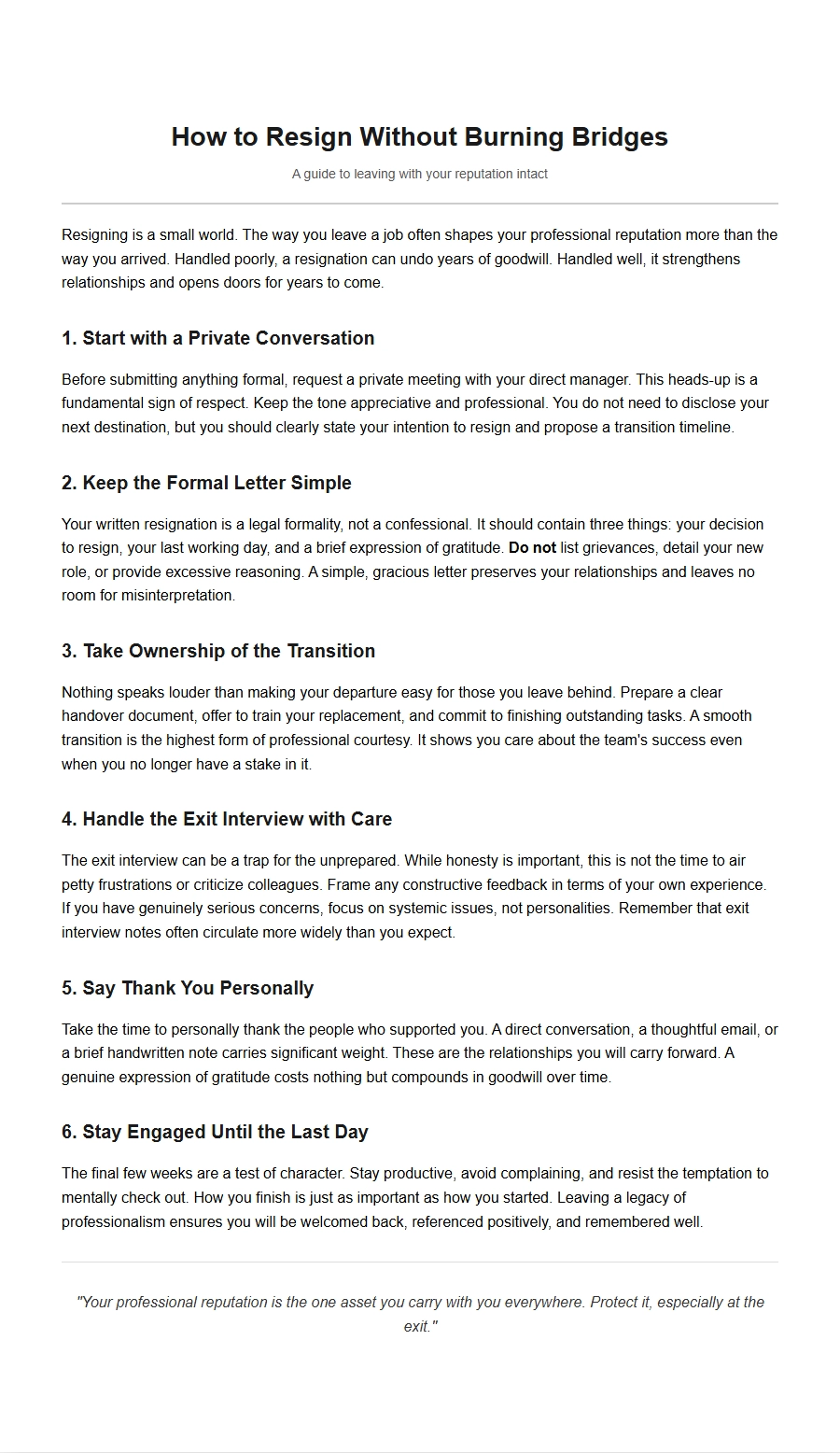 How to Resign Without Burning Bridges
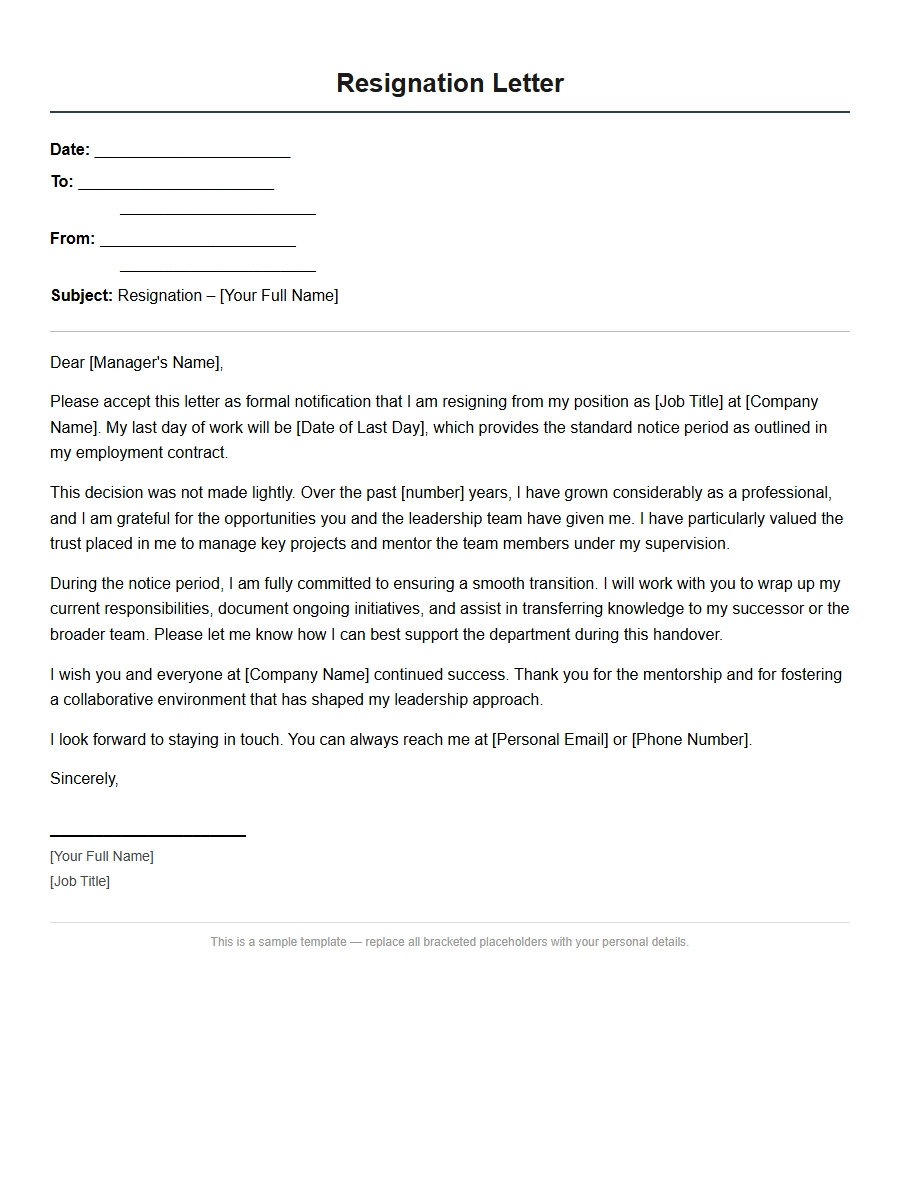 Formal Resignation Letter Sample for Manager
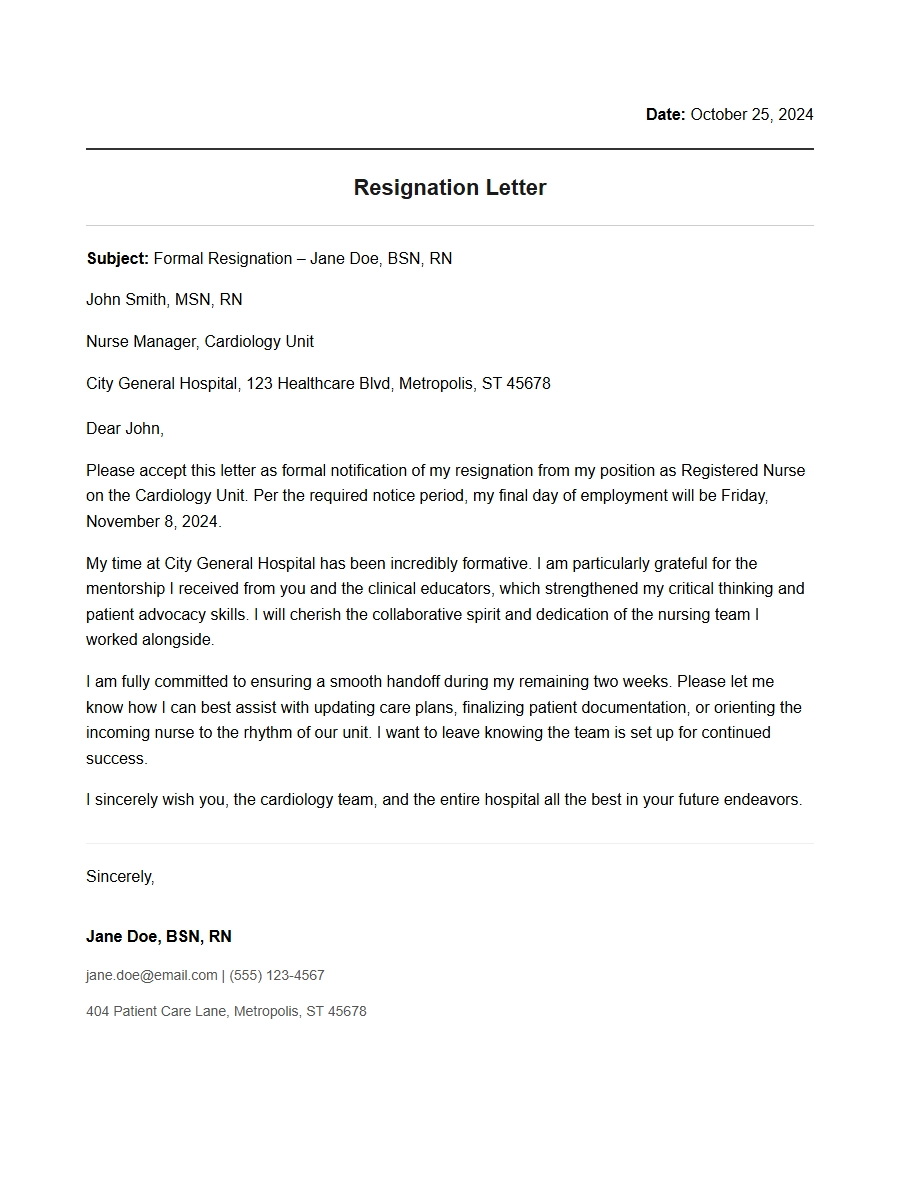 Nurse Resignation Letter with 2 Weeks Notice