plumber pipe installation contract cover letter - Cover Letters
Why a plumber pipe installation contract cover letter matters more than you think
You’ve put together a solid bid for a pipe installation job. You know the work, you have the right tools, and your pricing is fair. But then comes the part that makes many plumbers groan: writing a cover letter to go with the contract proposal. Staring at a blank screen, you wonder what to say. Should it be short? Should you list every certification? The pressure to sound professional without sounding stiff is real.
The good news: you don’t have to start from scratch. A well-written plumber pipe installation contract cover letter doesn’t need to be complicated. It just needs to show the client you understand the job, you’re reliable, and you take their project seriously. Using a sample as a starting point isn’t cheating. It’s a smart way to get the structure right, then make it your own.
What a good sample gives you
A letter template for a pipe installation contract does more than save time. It gives you a proven business letter format that clients expect. It provides natural phrasing for the salutation and closing, helps you set the right tone in writing (confident but not pushy), and reminds you to include key details like scope of work, timeline, warranty, and licensing info. You can focus on customizing instead of figuring out how to structure a professional correspondence from scratch.
Think of a sample as a skeleton. You add the meat: your specific experience, the pipe materials you’ll use, your insurance coverage, and why you’re the best fit for this particular job. That’s what makes the letter feel personal and authoritative. Without a sample, it’s easy to forget something important — like mentioning that you handle both copper and PEX installations, or that you offer a one-year labor warranty.
Category: Construction Contract Cover Letters
How to adapt a sample without losing your voice
Start by reading through a few cover letter examples for plumbers or contractors. Notice how they open. A strong first paragraph grabs attention by directly addressing the client’s project. For example: “I understand you’re replacing the main water line in your commercial building. With ten years of experience in large-scale pipe installations, I’m confident I can complete the job on schedule and within your budget.” That’s better than a generic “I am writing to apply for the pipe installation contract.”
Next, adjust the tone. If you’re sending the letter via email, use a digital letter format — no need for a letterhead, but include your logo and contact info at the top. If you’re printing and mailing it, use a clean letterhead design with your company name and license number. Avoid outdated salutations like “To Whom It May Concern.” Use the client’s name if you have it. If not, “Dear Project Manager” or “Dear Building Owner” works fine.
One common mistake is copying the sample’s language exactly. Clients can tell. Instead, rewrite the key points in your own words. If the sample says “we pride ourselves on quality workmanship,” say “I take the time to make sure every joint is sealed properly — no shortcuts.” That’s more specific and honest.
Real details that make the letter stand out
Include specifics that show you understand the job. Mention the type of pipe (e.g., PVC, copper, PEX), the expected duration of the installation, and any unique challenges like working in a crawlspace or coordinating with other trades. This demonstrates formal writing tips in action: concrete details build credibility.
Also, don’t forget proofreading letter before sending. A typo in a contract cover letter can make you look careless. Read it out loud, or ask a colleague to check it. And if you include a letter of recommendation from a previous client (attached or referenced), that adds extra trust.
The same structure used in a digital advertising campaign manager cover letter applies here: introduction, body, closing. But your body needs to focus on technical skills, safety record, and project-specific experience, not marketing metrics.
Common pitfalls to avoid
Don’t make the letter too long. One page is plenty. Don’t list every job you’ve ever done — pick the most relevant ones. And don’t use a resignation letter sample style (that’s for quitting a job, not winning a contract). Keep the tone positive and forward-looking.
If you’re emailing the letter, use a clear subject line like “Pipe Installation Proposal – 123 Main Street.” Attach your contract, but paste the cover letter in the body of the email. That lets the client read it immediately. This is a simple formal writing tip that increases the chance your proposal gets read.
Use the sample as a springboard
Writing a cover letter for a pipe installation contract doesn’t have to feel awkward. Once you’ve done it a few times, you’ll get faster and more natural. The first time, use a sample. The second time, tweak it. By the third time, you’ll have your own template that sounds like you. That’s the goal: professional, personal, and persuasive — without the stress.
Whether you’re a solo plumber or running a crew, taking a few minutes to write a thoughtful cover letter can set you apart from other bidders. And when you win the contract, that letter will be the first step of a successful job. So go ahead, grab a sample, and make it yours.
Simple Examples
plumber pipe installation contract cover letter - Cover Letters
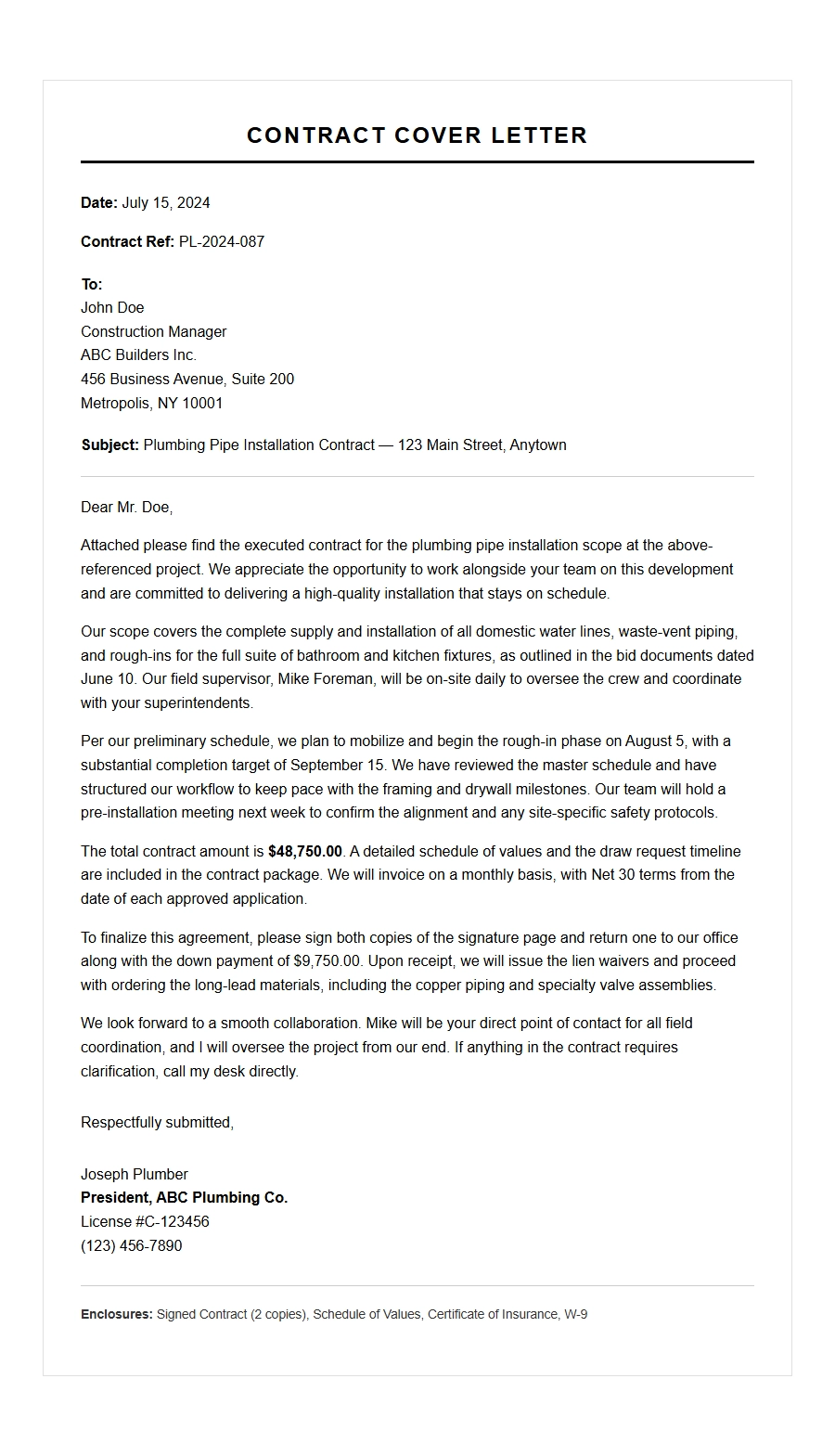
Standard Residential Plumbing Contract Cover Letter
Date: October 12, 2023
To: Mr. Jonathan Clark 123 Oak Avenue, Springfield, IL 62704
Re: Cover Letter for Pipe Installation Contract – 45 Oak Avenue
Dear Mr. Clark,
Please find enclosed the contract for the complete replacement of the main water supply line and copper piping in your basement. We have prepared the agreement based on the inspection conducted on October 5, 2023.
The contract outlines the scope of work, materials to be used, and the payment schedule. Below is a summary of the key terms for your convenience:
Item
Description
Amount
Labor
Pipe installation, trenching, and cleanup
$2,400.00
Materials
1" copper pipe, fittings, shutoff valve
$680.00
Permits
City plumbing permit (approved)
$120.00
Total
$3,200.00
Payment is due as follows: 50% upon signing ($1,600), 25% at rough-in inspection ($800), and the final 25% after successful pressure test ($800). We are scheduled to begin on October 23, 2023, and anticipate completion within five working days.
Please review the terms carefully. If you have any questions or wish to adjust the timeline, do not hesitate to call our office at (217) 555-0198. Sign both copies and return one to us before the start date.
Thank you for choosing Springfield Pro Plumbing.
Sincerely, Daniel Reyes Licensed Master Plumber # 4572
Commercial Pipe Installation - Multi-Unit Building
Date: October 12, 2023
To: Patricia Nguyen, Property Manager Sunrise Apartments, 1500 Lake Drive, Suite 200, Chicago, IL 60614
Re: Cover Letter for Pipe Installation Contract – Building B Risers
Dear Patricia,
Attached is the signed contract for the installation of new CPVC risers and branch piping in Building B of Sunrise Apartments. We appreciate the opportunity to work with your team.
The contract covers all 12 units on floors 2 through 4. Our scope includes:
Removal of old galvanized risers
Installation of 2-inch CPVC main risers with isolation valves
Connection to each unit’s existing copper lines
Pressure testing and chlorination
The total contract amount is $18,500.00, with a payment schedule of 30% upfront ($5,550), 40% after rough-in ($7,400), and 30% upon final inspection ($5,550). All work will be performed Monday through Friday, 8:00 AM to 4:30 PM, with minimal disruption to tenants.
We will coordinate with your maintenance crew to schedule unit access. A preliminary site meeting is set for October 18 at 10:00 AM. Please confirm attendance.
We look forward to a successful partnership. If any revisions are needed, please call me at (312) 555-0147.
Best regards, Marcus Chen Project Manager, Windy City Plumbing & Heating
New Construction - Pipe Rough-In Cover Letter
Date: October 12, 2023
To: Harbor Builders LLC Attn: Mr. Steven O’Brien 789 Industrial Way, Milwaukee, WI 53202
Re: Cover Letter – Plumbing Contract for Lot 17, Riverbend Estates
Dear Steve,
Enclosed please find our executed contract for the plumbing rough-in of the new single-family home at 42 Riverbend Drive. This letter serves as a cover to the agreement and provides a quick reference of key deliverables.
Our scope includes all below-slab and above-slab rough-in work as per the approved plans dated September 25, 2023. Materials will be Viega PEX for supply lines and PVC for DWV, with cast iron at the main stack for noise reduction.
Phase
Description
Completion Date
1
Underslab drainage and water lines
Oct 30
2
Above-slab supply and vent piping
Nov 10
3
Rough-in inspection and test
Nov 14
The total lump sum is $12,800.00, payable in two installments: $6,400 at phase 1 completion and $6,400 upon passing rough-in inspection. We have included a 5% early completion bonus clause as requested.
Please sign and return the attached contract by October 16. We are ready to mobilize as soon as the foundation is cured.
Thank you, Elena Vasquez Plumbing Estimator, Great Lakes Plumbing Services
Emergency Pipe Repair & Replacement Contract Letter
Date: October 12, 2023
To: Homeowner – David Greene 88 Maple Court, Madison, WI 53703
Re: Emergency Pipe Replacement Contract (Water Main Break)
Dear Mr. Greene,
Following our emergency service call on October 11, we have prepared this contract for the immediate replacement of the burst water main pipe under your front yard. This cover letter outlines the urgent scope and payment terms.
Scope of Work: Excavate and replace approx. 12 feet of 1-inch Type K copper water service line from the meter to the house foundation. Includes new ball valve, pressure regulator, and backfill/compaction. Work to begin October 13 at 7:00 AM.
Emergency service fee: $350
Pipe and fittings: $420
Labor (4 hours + 2 crew): $800
Total due on completion: $1,570
Due to the emergency nature, full payment is required upon job completion before we leave the site. We accept cash, credit card, or certified check. A 10% discount is available if paid by wire transfer (same day).
We have included a one-year warranty on materials and labor, as noted in the contract’s warranty clause. Please read the terms carefully and initial each page. Sign both copies; keep one and return the other when we start work.
We understand this is stressful, and we will work quickly to restore your water supply.
Sincerely, Tom Kowalski Emergency Response Lead, Madison 24/7 Plumbing
Renovation - Bathroom Pipe Installation Cover Letter
Date: October 12, 2023
To: Laura and Mark Benson 210 Pine Street, Ann Arbor, MI 48104
Re: Contract Cover Letter – Bathroom Renovation Pipe Installation
Dear Laura and Mark,
Thank you for choosing Ann Arbor Pipe Pros for your master bathroom renovation. Attached is the contract for all new plumbing installation within the remodeled space.
The contract includes rough-in and finish work for the shower, dual vanity, and water closet. Materials specified are uponor PEX for supply lines and Schedule 40 PVC for drains. You have selected the brushed nickel faucet and shower trim package.
Key milestones and payments:
Milestone
Amount Due
Due Date
Contract signing
$1,500
Oct 12
Rough-in completion
$2,500
Oct 24 (est.)
Final connection and test
$1,000
Nov 2 (est.)
Total contract amount: $5,000.00. Any changes to the scope will be reflected in a change order signed by both parties. The schedule allows for one week of rough-in, followed by tile and fixtures, then our final visit to connect and test.
Please initial the change order clause on page 3. We are ready to start on October 16 as planned. If you have any last-minute questions, call our office.
Best regards, Jennifer Hayes Plumbing Designer, Pipe Pros LLC
Irrigation System - Underground Pipe Installation
Date: October 12, 2023
To: Green Acres Landscaping Attn: Bob Whitman 55 Meadow Lane, Denver, CO 80210
Re: Cover Letter – Subcontract for Irrigation Piping at City Park Project
Dear Bob,
This letter accompanies the contract for the installation of all underground PVC mainlines and lateral pipes for the new irrigation system at East City Park. We are excited to contribute to this community project.
Our scope as a subcontractor includes trenching, laying 2-inch and 1-inch Class 200 PVC, installing isolation valves, and pressure testing. We will not handle the controller or sprinkler heads; that is your scope.
Contract breakdown:
Item
Unit
Quantity
Unit Price
Total
2" PVC mainline
linear ft
850
$2.40
$2,040
1" PVC lateral
linear ft
1,200
$1.50
$1,800
Valve boxes & fittings
lump sum
1
$740
$740
Labor & equipment
lump sum
1
$3,420
$3,420
Total
$8,000
Payment terms: 40% deposit ($3,200) with signed contract, 30% at 50% pipe completion ($2,400), final 30% after successful pressure test ($2,400). Work begins October 23, weather permitting.
Please review the insurance requirements on page 5. We carry the required liability and worker’s comp. Sign and return.
Sincerely, Ryan Patel Irrigation Division Manager, Mile High Plumbing
Fire Sprinkler Pipe Installation Contract
Date: October 12, 2023
To: Summit Industrial Corp. Attn: Jennifer Wu 2000 Commerce Drive, Suite 300, Portland, OR 97201
Re: Cover Letter – Fire Sprinkler Piping Contract for Warehouse 7
Dear Jennifer,
We are pleased to submit the enclosed contract for the installation of the wet-pipe fire sprinkler system in your new warehouse at 1801 Industrial Blvd. This cover letter highlights the critical details.
The work includes all black steel pipe from the city water connection to the branch lines, risers, and hangers, sized per NFPA 13. We will supply and install system components up to the sprinkler heads (heads installed by others as per your prime contract).
Key terms:
Contract amount: $47,200.00 (fixed price)
Schedule: Start November 1, 2023; substantial completion by December 15, 2023
Payment: 30% at signing ($14,160), 40% after rough-in ($18,880), 30% after hydrostatic test ($14,160)
Liquidated damages: $500 per day after December 15
We have included a list of our recent commercial fire protection projects for your reference. Our licensed pipefitters will coordinate with your general contractor’s schedule.
Please sign the contract and the attached scope acknowledgement. Return one copy to us by October 20. We will then issue a Notice to Proceed.
We look forward to a safe and efficient project.
Thank you, Angela Reed Project Director, Pacific Northwest Fire Protection
Mobile Home Park - Water Line Replacement Contract
Date: October 12, 2023
To: Mr. Dale Harding, Park Manager Sunset Mobile Home Park, 5000 Highway 9, Boise, ID 83702
Re: Cover Letter – Contract for PVC Water Line Replacement, Lots 12-18
Dear Mr. Harding,
Attached is the signed contract for replacing the undersized and aging water supply lines servicing Lots 12 through 18 at Sunset Mobile Home Park. This letter provides a summary of the agreement.
We will replace existing 3/4-inch polyethylene lines with new 1-inch CTS PEX buried at a minimum depth of 36 inches. Each lot will receive a new curb stop and meter connection. The work corridor will be restored with sod.
Project cost:
Item
Description
Cost
Mobilization & layout
Site prep, marking utilities
$750
Trenching & pipe laying (7 lots)
~320 ft each lot, total 2,240 ft
$5,600
Meter boxes & connections
7 units
$1,050
Restoration & cleanup
Sod, gravel, compaction
$800
Total
$8,200
Payment: $2,050 deposit, $4,100 at midpoint (after lots 12-15 are done), final $2,050 upon completion and inspection. Start date: October 23. Duration: 8 working days.
Please check the schedule conflicts for your notice to tenants. We will provide temporary water supply during the tie-in to each lot. Contact me directly at (208) 555-0192 if you have questions.
Sincerely, Grace Kim Plumbing Superintendent, Treasure Valley Pipe Works
Factory Direct - PTMT Pipe Installation Agreement
Date: October 12, 2023
To: Global Manufacturing Inc. Attn: Purchasing Department 1010 Industrial Drive, Building 4, Fort Wayne, IN 46805
Re: Cover Letter – Contract for PTMT Pipe Installation (Production Line Expansion)
Dear Team,
Enclosed is the fully executed contract for the installation of Polyethylene Terephthalate Modified (PTMT) piping system for the new chemical transfer line in Building 4. This material was selected for its chemical resistance and temperature tolerance.
Our scope: supply and install 150 feet of 3-inch PTMT pipe with fusion-welded joints, including all supports, isolation valves, and tie-ins to existing stainless steel lines. We will perform pressure testing per ASME B31.3.
Contract value: $21,300.00 – breakdown as follows:
Material procurement (pipe, fittings, fusion tools): $8,700
Payment terms: Net 30 after invoicing each milestone (50% after pipe delivered, 50% after successful test). We expect to complete within 10 working days after receipt of materials. A pre-installation meeting is scheduled for October 17 at 2:00 PM in your conference room.
Please verify the insurance certificate attached. We are fully compliant with your contractor requirements.
We look forward to a smooth installation.
Best regards, Carlos Mendez Industrial Piping Specialist, Fort Wayne Industrial Services
Residential Service Line Insurance Claim Contract Letter
Date: October 12, 2023
To: Claim Adjuster – Linda Brooks SafeGuard Insurance, PO Box 2000, Albany, NY 12212
Re: Cover Letter – Property Owner: Mr. Richard Hart, 55 Elm Street, Troy, NY – Pipe Installation Contract for Insurance Claim
Dear Ms. Brooks,
Attached is the contract for the replacement of the cast iron sewer line at the property insured under policy #SG-447892. This cover letter summarizes the scope for your claim review.
The line collapsed due to tree root intrusion and was deemed in need of full replacement by our inspection on October 10. The contract proposes:
Excavation of the existing 4-inch cast iron line (approx. 40 ft)
Installation of new 4-inch Schedule 40 PVC with cleanouts at the house and at the property line
Connection to the city sewer main (permit included)
Backfill and restoration of lawn
Cost breakdown:
Description
Amount
Excavation & old pipe removal
$2,100
PVC pipe & fittings
$560
Permit & inspection fee
$240
Labor (2 crew, 2 days)
$2,800
Restoration & cleanup
$300
Total
$6,000
We offer a 2-year warranty on workmanship. The job can begin as early as October 18. We have attached the signed contract from Mr. Hart authorizing the work pending your approval. Please advise if you need any additional documentation.
Thank you for your prompt attention.
Sincerely, Andrea Stokes Claims Coordinator, Capital District Plumbing & Drain
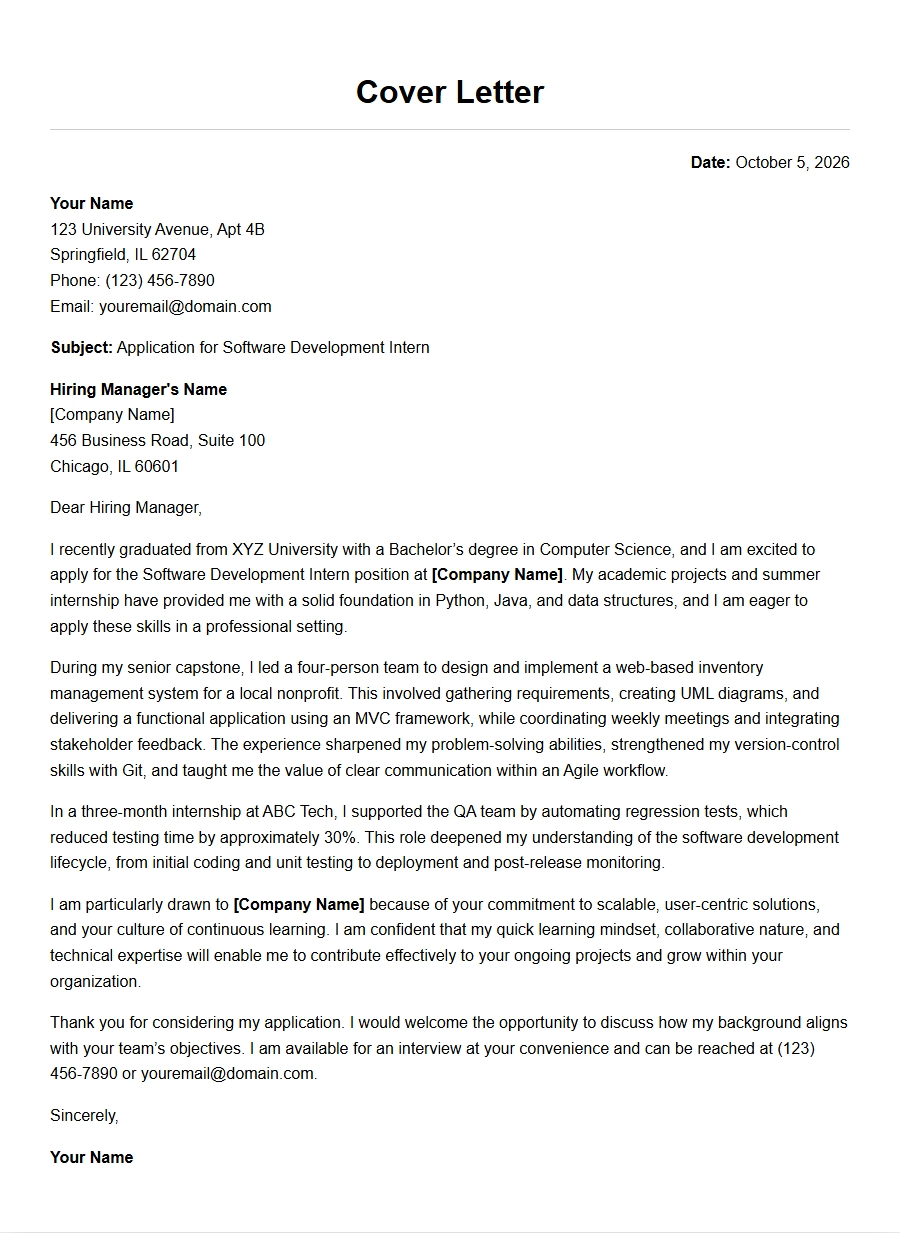 Recent College Student Cover Letter for Internship
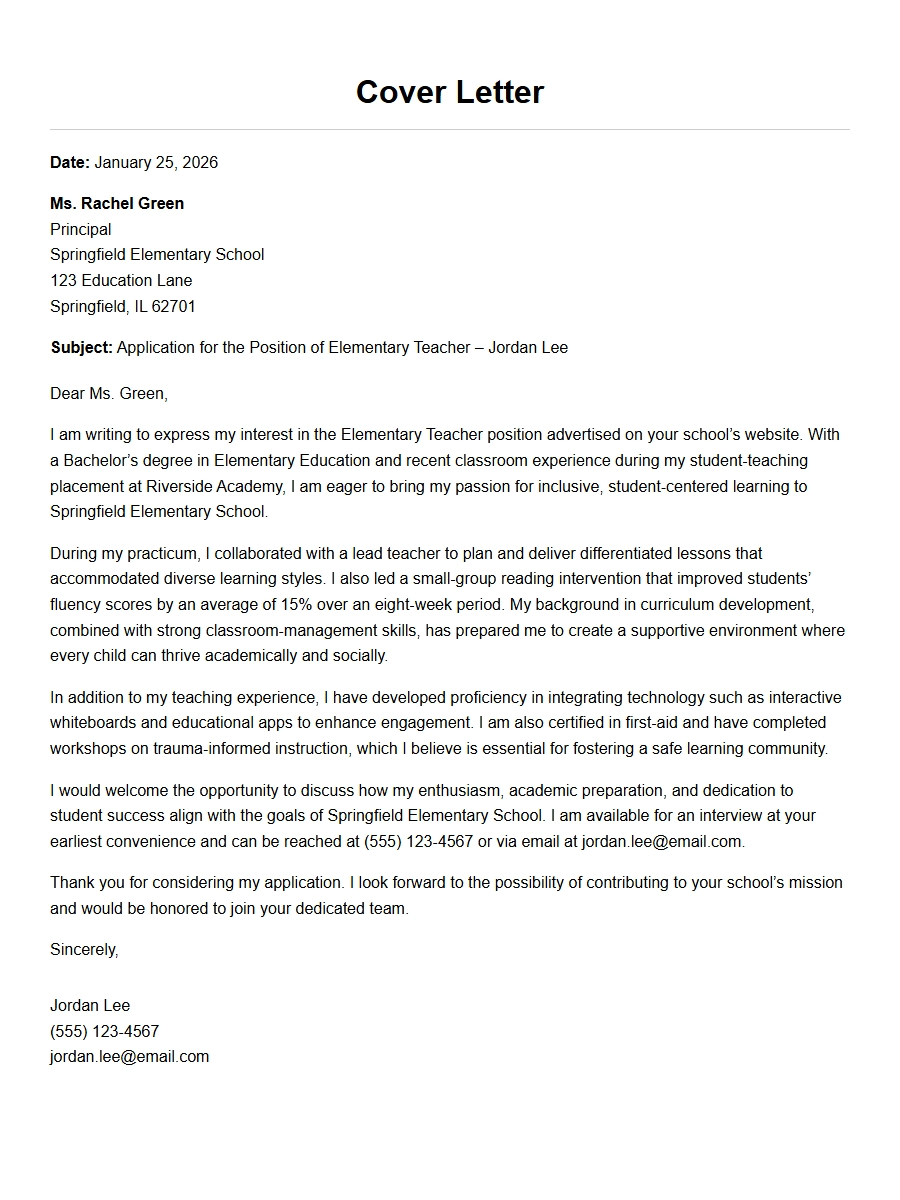 Entry Level Teacher Cover Letter Examples
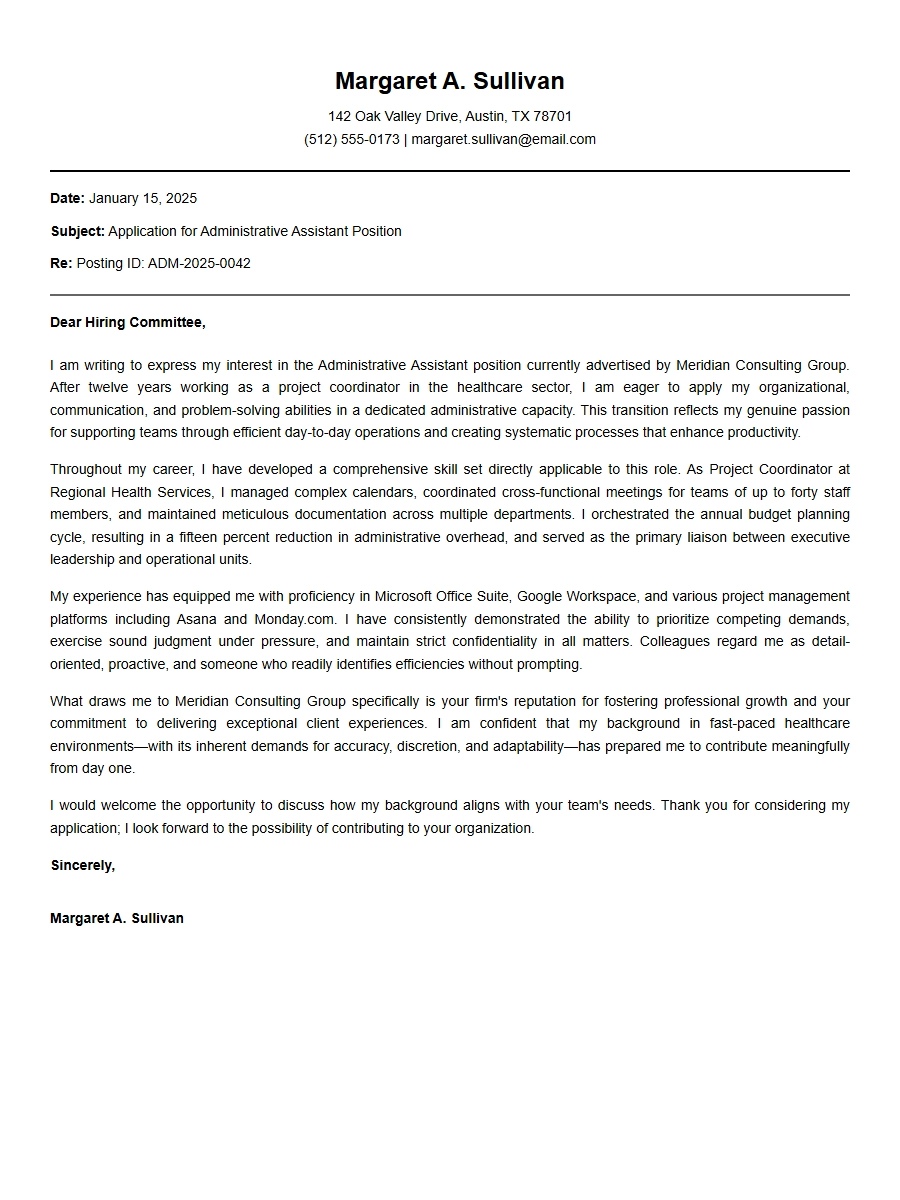 Career Changer Administrative Assistant Cover Letter
 High School Student Part Time Job Cover Letter
 Fresh Graduate Nursing Application Letter
 University Alumni Referral Email Cover Letter