You’ve been checking your affiliate dashboard for weeks. The sales are there. The commission total looks right. But the payout date came and went—and your bank account is still empty. That frustration is real, and it’s exactly why a well-written letter for affiliate commission payout delay can be your best tool for getting paid without burning a partnership.
Using a sample for this kind of professional correspondence isn’t a shortcut. It’s a smart way to start. A good template gives you the right salutation and closing, the proper business letter format, and a tone that’s firm but not aggressive. You just fill in the specifics of your situation. That saves time and reduces the risk of sending something that sounds angry or sloppy.
Why a sample works for this specific problem
A commission delay letter is different from a general complaint. You need to refer to your agreement, mention specific dates and amounts, and request a clear next step. A generic letter template for late payments often misses these details. The right sample for an affiliate situation gives you the letter structure that affiliates actually use—like referencing the affiliate program terms, the expected payout schedule, and your previous communication.
Category: Freelance & Partner Communications
How to pick and personalize your letter
Not every affiliate program is the same. Some are run through networks like ShareASale or Impact, while others are direct partnerships. Your letter should match that context. If it’s a direct relationship, use a semi-formal tone—still professional, but less stiff. If it’s through a large network, stick to formal tone in writing that mirrors their support documentation.
When you adapt a sample, start by changing the opening paragraph. State your affiliate ID, the period in question, and the unpaid amount. This grabs attention immediately. Then adjust the middle section to explain the impact on your business. You don’t need to overshare, but a sentence like “I rely on these payouts to manage my content production costs” is honest and effective.
Common mistakes to avoid
One big mistake is using a salutation like “To Whom It May Concern” when you have a contact name. It makes the letter feel copied. Another is ignoring the digital letter format—if you’re sending an email, don’t paste a printed letter layout. Use a clear subject line, a simple greeting, and your signature block at the bottom. Also, avoid writing in all caps or using too many exclamation points. It looks unprofessional and can hurt your case.
Always proofread your letter before sending. A typo in your payment amount or a missing date makes you look careless. Read it out loud. If a sentence sounds too aggressive, soften it. You want to be taken seriously, not ignored.
Practical tips for your opening and closing
Your first sentence should state the problem directly. Something like: “I am writing regarding a delay in my affiliate commission payout for [month/year] under program ID [number].” No fluff. No apology for asking. For the closing, ask for a specific action—“Please confirm the expected payment date by Friday” works better than “I look forward to your response.”
If you’re unsure about the tone, err on the side of polite professionalism. You can always escalate later. But starting with a clear, respectful request often gets results faster. For related advice on handling difficult professional correspondence, you might find this documentation on performance review feedback letters useful for structuring tough messages.
Also, keep a copy of every letter you send. If the delay continues, you’ll need a record of your communication. That documentation makes future follow-ups easier and shows you’ve been proactive.
Use the sample as a starting point
The best letter for an affiliate commission payout delay is one that feels like it came from you—not a robot. A sample gives you the foundation. Your personal details and honest tone make it effective. Don’t be afraid to adjust the language until it sounds natural. If you’re also dealing with other partner communication issues, this sample email for file sharing permission denials might help with related scenarios.
After you send the letter, give it a few days. If you don’t hear back, follow up with a short email referencing your original letter. Persistence is part of the process. Over time, writing these letters gets easier, and you’ll get faster at turning a sample into something that works for you.
Samples to Guide You
Apology for Affiliate Payout Letter Due to Delay
Apology for Delayed Monthly Payout Due to System Glitch
Date: August 15, 2024
Affiliate ID: AFF-2034 Affiliate Name: Digital Marketing Pro
Dear Mark,
We sincerely apologize for the delay in processing your commission payout for July 2024. A system glitch during our latest update affected the automatic payout module, causing a hold on all standard monthly payments. Our technical team identified the issue on August 12 and has since deployed a fix.
The corrected payout schedule is as follows:
Item
Details
Original Payout Date
August 10, 2024
Revised Payout Date
August 20, 2024
Commission Amount
$1,245.80
Payment Method
PayPal (registered email)
We have already credited a 5% compensation bonus to your account as a gesture of goodwill. The full payout will reach your PayPal by end of day August 20. We deeply regret any inconvenience caused and thank you for your patience.
Best regards, Sarah Jenkins Affiliate Operations Manager
Late Payout Due to Bank Verification Update
Date: September 5, 2024
Affiliate ID: AFF-8712 Affiliate Name: James Carter
Dear James,
We owe you an apology for the recent delay in your commission payout. Our records show that your bank account details were updated on August 28, requiring a mandatory 5‑business‑day verification process. Unfortunately, this verification was not completed until September 3, which pushed the payout past the standard 15th of the month.
Here is a summary of your pending payout:
Earned Commission (August): $3,210.00
Verification Completed: September 3, 2024
Expected Transfer: September 9, 2024 (ACH)
Transaction Reference: PAY-409-2024
We understand that waiting is frustrating. To prevent future delays, we recommend keeping your banking details unchanged for at least 30 days before the payout date. As an apology, we have added a $50 credit to your affiliate dashboard.
We appreciate your understanding and continued partnership.
Sincerely, Emily Tran Affiliate Support Lead
Apology for Delayed Q3 Bonus Commission
Date: October 12, 2024
Affiliate ID: AFF-5509 Affiliate Name: TechGadgets Blog
Dear Alex,
We are writing to apologize for the delay in disbursing your Q3 2024 bonus commission of $2,750.00. The delay stems from an internal reconciliation error where sales from three separate programs were incorrectly merged. Our finance team has corrected the data, and your bonus is now queued for payment.
Below is the corrected payment breakdown:
Program
Sales
Commission
Widget Pro
47 units
$1,880.00
Gadget X
12 units
$600.00
Service Plan
9 subscriptions
$270.00
Total Bonus
$2,750.00
The revised payout date is October 18, 2024. We will also send a confirmation email once the transfer is initiated. We regret this oversight and have added a $75 bonus to your account as a token of apology.
Thank you for your ongoing support.
Warmly, David Kim Senior Affiliate Manager
Personalized Apology for Missing Payout Window
Date: November 2, 2024
Affiliate ID: AFF-2241 Affiliate Name: Healthy Living Coach
Dear Rachel,
We sincerely apologize for missing the October payout window for your affiliate commissions. Due to an administrative oversight, your earnings totaling $890.50 were not included in the batch processed on October 30. We understand how important timely payments are for your business, and we take full responsibility for this error.
To resolve the issue immediately:
Payment Amount: $890.50
New Payment Date: November 5, 2024
Method: Direct Deposit (account ending 4321)
Confirmation Number: 4762-APL
We have also credited your account with a 7% late‑payment compensation ($62.34) as a sign of our regret. This amount will be included in the November 5 transfer.
We value your trust and are implementing new validation checks to ensure this does not recur. Please accept our heartfelt apologies.
Yours truly, Michael Chen Affiliate Payment Coordinator
Delayed Payout Due to Account Reapplication
Date: December 18, 2024
Affiliate ID: AFF-9973 Affiliate Name: Laura Stevens
Dear Laura,
We apologize for the delay in your November commission payout. Earlier this month, our compliance team requested a re‑verification of your account because of updated KYC regulations. This process took longer than anticipated, which caused the payout to be held.
Your account has now been fully verified, and payment is being processed:
Item
Details
Commission Period
November 1–30, 2024
Gross Commission
$1,200.00
Verification Fee (waived)
$0.00
Net Amount Payable
$1,200.00
Expected Payment
December 22, 2024
We have also added a $25 credit to your account for the inconvenience. Moving forward, we will send advance notifications when verification is needed.
Thank you for your cooperation and patience.
Best regards, Nina Patel Compliance & Payments Specialist
Apology for Late Payout During Platform Migration
Date: January 9, 2025
Affiliate ID: AFF-1128 Affiliate Name: Fashion Forward Blog
Dear Isabella,
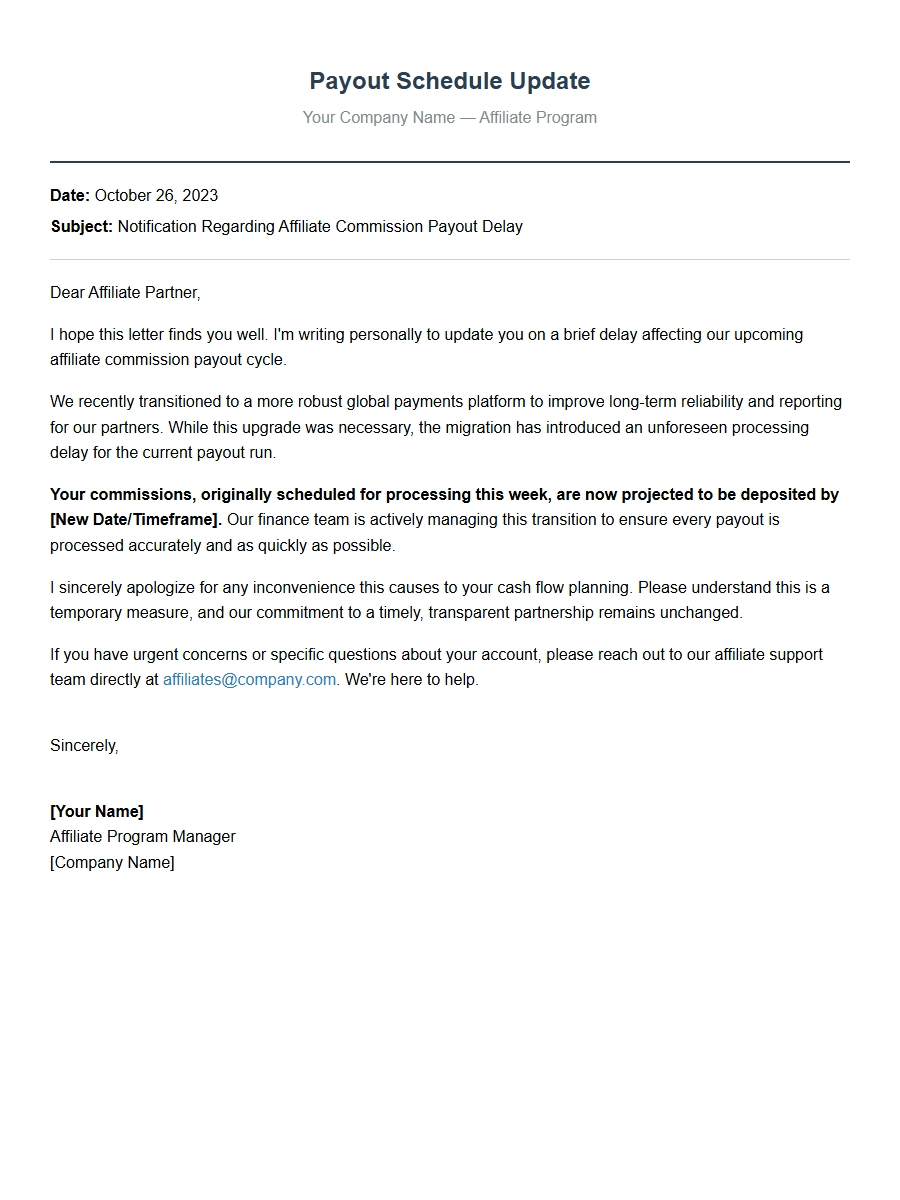
We are writing to apologize for the delay in your December 2024 commission payout. During the first week of January, our payment platform underwent a scheduled migration to a new provider. This transition caused a temporary pause in all outgoing transfers.
The migration is now complete, and payments are resuming. Your details are as follows:
Original Payout Date: January 5, 2025
Revised Payout Date: January 14, 2025
Commission Amount: $1,875.00
New Transaction ID: MIG‑2025‑0047
We have added a 10% late bonus ($187.50) to your account as a goodwill gesture. This bonus will be deposited together with your regular commission.
We appreciate your understanding as we work to improve our systems. Please do not hesitate to contact us if you have any questions.
Sincerely, Omar Hassan Affiliate Program Director
Formal Apology for Repeated Payout Delays
Date: February 20, 2025
Affiliate ID: AFF-4556 Affiliate Name: Digital Solutions Inc.
Dear Mr. Thompson,
We extend our sincerest apologies for the repeated delays in your affiliate commission payouts over the past two months. We recognize that this has been a recurring issue, and we take full responsibility. Internal audits have revealed a flaw in our payment approval workflow that caused your invoices to be stuck at a validation stage.
We have taken corrective actions:
Updated workflow – Added automated escalation if payment approval exceeds 3 business days.
Dedicated contact – You will now be assigned a personal payment coordinator, Elena Ruiz (e.ruiz@company.com).
Compensation – A lump sum of $200 has been added to your account for the inconvenience.
Here is the status of your pending funds:
Period
Amount
Status
January 2025
$2,100.00
Paid Feb 15 (late)
February 2025
$2,450.00
Processing – payout by Feb 25
We are committed to restoring your trust. Thank you for your patience.
Respectfully, Angela Rossi VP of Affiliate Operations
Apology for Delayed International Wire Transfer
Date: March 3, 2025
Affiliate ID: AFF-6789 Affiliate Name: Laura Schmidt (Germany)
Dear Laura,
Please accept our apologies for the delay in your February 2025 commission payout sent via international wire transfer. The transfer was initiated on February 28, but due to an incorrect SWIFT BIC code in our system, it was rejected by the intermediary bank.
We have corrected the code and resent the payment. Details of the corrected transaction:
Commission Amount: €1,530.00
Bank Transfer Fee: €25 (absorbed by us)
New Transfer Date: March 4, 2025
Expected Arrival: 1–3 business days
New Reference: WIRE‑2025‑031
As a compensation, we have refunded the bank fee and added a €50 bonus to your next payout. We are sorry for the frustration caused by this error.
Thank you for your understanding.
Mit freundlichen Grüßen, Hannah Weber International Payments Team
We apologize for the unusual delay in your March commission payout. Our fraud detection system flagged several transactions from your account as potential duplicates, triggering an automatic review. The review took longer than expected due to a high volume of cases, but we have now confirmed that all sales were legitimate.
Your payout details:
Item
Value
Commission Amount
$3,420.00
Flagged Transactions
7 (all cleared)
Review Completion
April 9, 2025
Payment Release
April 11, 2025
We deeply regret the inconvenience and have credited your account with a $100 courtesy bonus. We are also upgrading your account to a priority review status to prevent future delays.
We value your partnership and thank you for your patience.
Warmly, James Lee Affiliate Security Team
Apology for Late Payout Caused by Incomplete Tax Information
Date: May 22, 2025
Affiliate ID: AFF-2001 Affiliate Name: Jake Williams
Dear Jake,
We apologize for the delay in processing your April 2025 commissions. Our records indicate that your tax information (W‑9 form) is incomplete, which is required for payouts over $600. Without this, we are unable to release the payment.
To resolve this, please upload the completed W‑9 through your affiliate dashboard by May 30. Once received, we will release the payment within 3 business days.
Your pending commission breakdown:
Period
Amount
Status
April 2025
$2,850.00
Pending – tax form required
We understand that this is an additional step, but it is required by tax regulations. As a token of appreciation for your prompt cooperation, we will apply a $25 bonus to your account once the form is submitted.
Thank you for your understanding.
Best regards, Maria Gonzalez Tax Compliance Officer
 Personal Apology Letter for Boyfriend Relationship Strain
 Apology Correspondence for Parent-Child Disagreements
 Apology Message for Girlfriend After Argument
 note for friend stealing item - Apology Letters
 Apology to Boss for Micromanagement Complaint
 Apology Document for Vendor Supply Chain Issue