Resigning while on sick leave is a tough spot. You're already dealing with your health, and now you have to write a professional resignation letter on top of it. It feels awkward. Maybe even unfair. But it's more common than you think, and you can handle it without making things worse. The key is to keep the letter simple, neutral, and focused on the future, not on your illness.
Before you write anything, check your employment contract and company sick leave policy. Some employers require a notice period to be served, even when you're on leave. Others might let you negotiate a shorter notice or waive it entirely. Knowing your rights and obligations upfront saves you from legal headaches later.
What this situation means
Resigning while on sick leave isn't about admitting failure. It's about choosing your health over a situation that isn't working. The letter itself is just a formal notification. It doesn't need to explain your medical history or justify your decision. A short, clear statement is enough.
Think of it this way: you're giving your employer a professional courtesy notice. The less drama in the letter, the smoother the transition.
When you'd use this kind of resignation letter
You might resign during sick leave for many reasons. Maybe your health issue is long-term and you can't see yourself returning to the same role. Maybe the job itself contributed to your stress or illness. Or maybe you simply realized life is too short to stay in a job that doesn't fit. Whatever your reason, the letter should treat the resignation as a decision made, not a negotiation.
How to write your letter step by step
Keep the tone professional and neutral
You're not looking for sympathy or reaction. You're just informing your manager of your decision. Use a standard business letter format even if you're sending it by email. That means a clear subject line, a proper salutation, and a respectful closing.
If you're unsure about the correct opening, "Dear [Manager's Name]" is always safe. Avoid "To Whom It May Concern" unless you have no other name. For the closing, "Sincerely" or "Best regards" works perfectly. These are standard salutation and closing choices that keep things professional.
State your resignation clearly in the first sentence
Don't bury the lead. Start with: "Please accept this letter as formal notification that I am resigning from my position as [Job Title], effective [Date]." This is direct, clean, and impossible to misinterpret.
Mention your sick leave briefly, if at all
You don't need to say "due to my illness." A simple mention is fine: "I am currently on sick leave and have decided that resigning is the best step for my recovery." That's it. No details about symptoms, treatments, or doctor visits. The goal is to wrap up professionally, not to explain yourself.
Offer a transition, but don't overpromise
You can say you're available for calls or emails to help hand over your responsibilities, but only if you actually can do that. If you need full rest, don't offer anything. Your health comes first.
For example: "I am willing to assist with the transition remotely as my condition allows." This phrase keeps the door open without guilt.
A resignation letter sample for sick leave
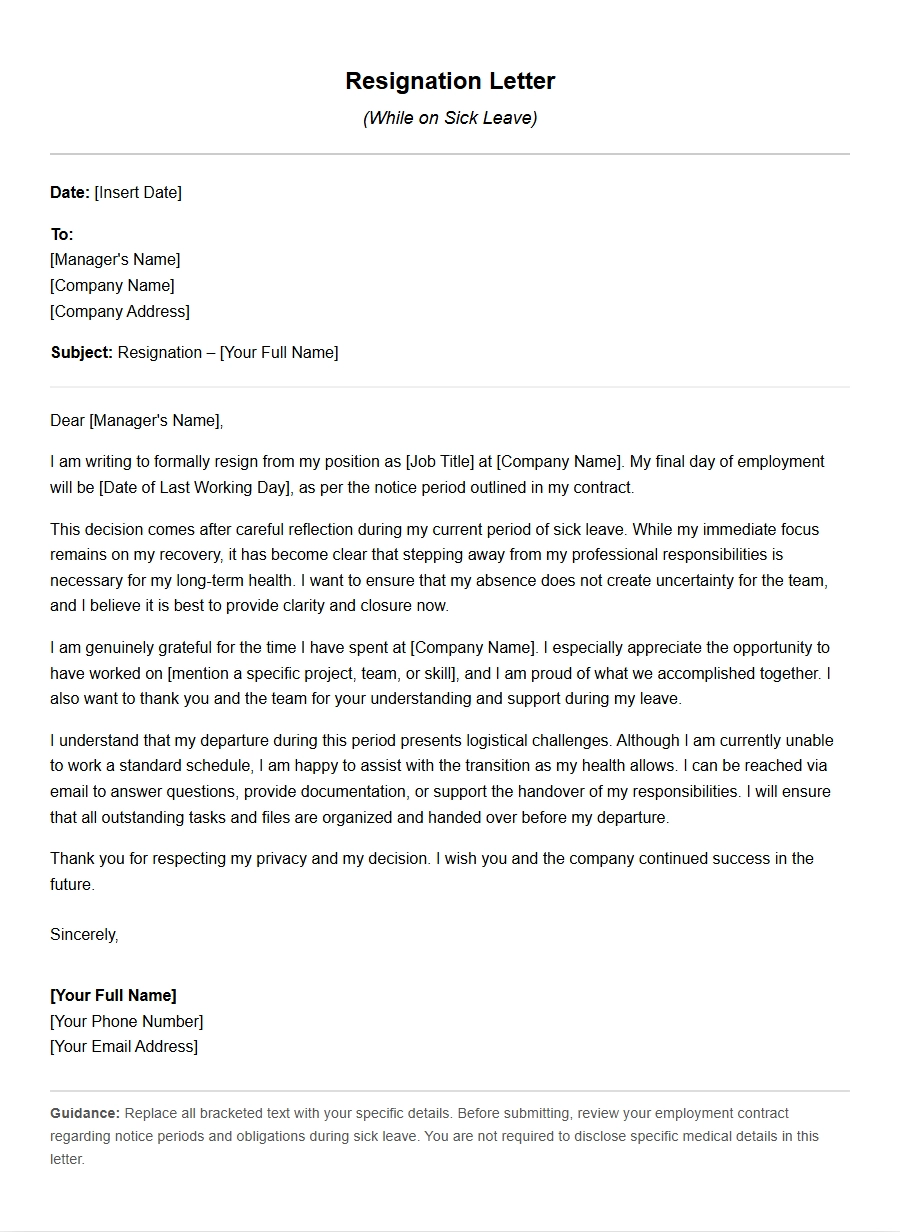
Here's a resignation letter sample that covers the basics without over-explaining:
Dear [Manager's Name],
Please accept this letter as formal notification that I am resigning from my position as [Job Title] at [Company Name]. My last working day will be [Date].
I am currently on sick leave and have decided that resigning is the best decision for my health at this time. I appreciate the opportunity to have worked with the team and am grateful for your support during my leave.
I will do my best to assist with the transition remotely if needed. Please let me know what information or documents you require from me.
Thank you for your understanding.
Sincerely,
[Your Name]
This customizable letter format works for email or printed letter. If you're sending it by email, use a clear subject line like "Resignation – [Your Name]" and paste the content directly into the body. For printed letters, include your contact information at the top and use a standard digital letter format or letterhead design if your company provides one.
Mistakes to avoid
The biggest mistake is over-explaining. Don't write three paragraphs about why you're sick or how hard the decision was. That invites questions and opinions from your manager. Keep it factual and final.
Another common error is ignoring letter writing etiquette. Even on sick leave, you're still a professional. Use proper grammar, avoid casual language, and proofread your letter before sending. Small typos can make the situation feel rushed or disrespectful.
Also, don't mention future job plans or vent about the company. This isn't the time for criticism or career announcements. The letter is a clean break.
Adapting the sample to your voice
The sample above is a starting point. If you have a close relationship with your manager, you can add a personal sentence like "I'll miss working with the team." But if your relationship is formal or strained, stick to the neutral version. The tone in writing should match your workplace culture without sacrificing your boundaries.
If you need more context on handling the exit professionally, read our guide on how to resign without burning bridges. It covers exit interviews, handovers, and final messages.
Once the letter is sent, give yourself permission to rest. You don't need to check email constantly or feel guilty. Your manager will likely reply to acknowledge receipt and discuss next steps. If they ask for details about your health, politely decline. You can say: "I prefer to keep my medical information private. Thank you for understanding."
If your sick leave was related to workplace stress or safety, you might also find it helpful to read examples of resignation due to safety concerns to see how others handled similar situations. And if you're leaving for a better opportunity once you're healthy, our article on resignation citing better compensation can help you frame that positively when the time comes.
Resigning while sick is never easy. But a clear, respectful letter lets you move on without looking back. Your focus now is recovery. Everything else waits.
Realistic Samples
How to Resign While on Sick Leave: A Guide
Formal Resignation Letter While on Sick Leave
Subject: Resignation from Position of [Job Title] – [Your Name]
Date: [Current Date]
To: [Manager’s Name], [Company Name]
I am writing to formally resign from my position as [Job Title] at [Company Name], effective [Last Working Day, e.g., 4 weeks from date]. As I am currently on sick leave, I wish to confirm that this decision is my own and made with careful thought about my health and future.
I am grateful for the support I have received during my illness. I am attaching a medical certificate to this letter and will ensure a smooth handover. My final date of employment will be [Date], which aligns with my notice period. I am prepared to discuss any transition details via email or phone if my health permits.
Please let me know the process for returning company property and settling any outstanding leave payments.
Thank you for the opportunities I have had at [Company]. I wish the team all the best.
Yours sincerely,
[Your Full Name] [Your Employee ID, if applicable]
Short Email Resignation During Medical Leave
To: [Manager’s Email]
Subject: Resignation – [Your Name] – [Job Title]
Dear [Manager’s Name],
I am writing to resign from my role as [Job Title], effective [Resignation Date – usually 2 weeks from email date]. As I am currently on medical leave due to [brief reason, e.g., recovery from surgery], I want to inform you of my decision as soon as possible.
I understand that my notice period is [X days/weeks] as per my contract. Given my health situation, I would appreciate if we could agree on an earlier end date if needed. I can provide any necessary documentation from my doctor.
I will begin the handover process remotely as soon as I am able. Please let me know how to proceed with returning my laptop and access cards.
Thank you for your understanding.
Best regards, [Your Full Name]
Resignation Letter Due to Health Issues
Subject: Resignation Due to Health Reasons – [Your Name]
Date: [Date]
To: The HR Department, [Company Name]
I am writing to formally resign from my position of [Job Title], effective [Date]. My current sick leave is due to a prolonged health condition, and after consulting with my doctor, I have decided that my recovery requires me to step away from my role completely.
I would like to thank you for the flexibility and support during my leave. Please find attached my resignation letter and a medical note from my physician. I am willing to cooperate in any handover process that can be done without compromising my health.
I request that my final salary and any accrued but unused annual leave be paid into my account as per company policy. Please also advise on the return of company property.
I hope this resignation does not inconvenience the team, and I wish the company continued success.
Sincerely, [Your Full Name] [Employee ID]
Resignation with Handover Instructions from Sick Leave
To: [Manager’s Name]
Subject: Resignation and Handover Plan – [Your Name]
Dear [Manager],
I am resigning from my position of [Job Title] with effect from [Resignation Date]. Because I am currently on sick leave, I have prepared a handover document to minimize disruption. Below is a summary of my current tasks and their status.
Task
Status
Person to Transfer To
Project Alpha weekly report
Up to date
Jane Doe
Client onboarding for XYZ
In progress
John Smith
Outstanding emails in shared inbox
Filed
Team Lead
I have also uploaded my files to the shared drive. If you need any clarification, please email me and I will respond as soon as my health allows. My last working day will be [Date].
Thank you for your understanding and support during this difficult time.
Best regards, [Your Full Name]
Letter to HR Regarding Resignation During Extended Sick Leave
I hope this letter finds you well. I am writing to formally resign from my role as [Job Title], effective [Final Date]. I have been on extended sick leave since [Start Date] due to [condition]. After several medical reviews, it is clear that I will not be able to return to work in the foreseeable future.
Therefore, I consider it best to resign. I confirm that I have received the company’s sick pay benefits and I am not disputing any payments. Please process my resignation as per standard procedures. I have attached the necessary medical documentation.
Could you please provide me with information on the following?
Final salary and any accrued holiday pay
Company pension plan details
Return of company equipment (laptop, phone, etc.)
I appreciate your assistance during my employment and hope to leave on good terms.
Yours faithfully, [Your Full Name] [Employee Number]
Polite Resignation While on Stress Leave
To: [Manager’s Name]
Subject: Resignation – [Your Name] – Stress Leave
Dear [Manager],
I am writing to resign from my position of [Job Title], effective [Date]. As you are aware, I am currently on stress leave. After careful reflection and with my doctor’s advice, I have decided that stepping back from work entirely is essential for my mental wellbeing.
I want to express my sincere gratitude for the support and understanding you and the team have shown me. This decision was not easy, but I believe it is the right one for my health. I am prepared to assist with a transition as much as I am able, whether through email or a brief call.
I kindly ask that you respect my need for privacy during this period. Please let me know the next steps for processing my resignation, returning company items, and settling any outstanding payments.
Thank you for everything. I wish the company continued success.
Warm regards, [Your Full Name]
Resignation Letter with Notice Period Adjustment
Subject: Resignation and Request for Reduced Notice Period – [Your Name]
Date: [Date]
To: [Manager’s Name], [Company Name]
I am writing to announce my resignation from the role of [Job Title]. My contract requires a notice period of [standard length, e.g., 4 weeks]. However, given that I am currently on sick leave and unable to perform my duties, I request that we reduce the notice period to [proposed length, e.g., 2 weeks] in mutual agreement.
I believe this is fair because:
I cannot actively work or train a replacement during my leave.
I have already prepared handover documentation.
An earlier end date would allow me to focus on recovery.
I am willing to sign a formal agreement to this effect if needed. Please find attached my resignation letter and a medical certificate. My proposed last day is [Date].
I appreciate your consideration and hope for a smooth process.
Yours sincerely, [Your Full Name]
Resignation via Email While on Sick Leave – Quick Notice
To: [Manager’s Email]
Subject: Resignation – [Your Name] – Immediate effect due to health
Dear [Manager’s Name],
I am resigning from my position as [Job Title] with immediate effect. I am currently on sick leave and my health has deteriorated further, making it impossible for me to continue working or provide notice.
I apologize for the short notice. Please be assured that I have left my key files in the shared folder and my password list with [colleague's name]. I have also updated my out-of-office message with alternative contacts.
I request that my final salary and any accrued leave be processed as per company policy. I will arrange for the return of my company laptop and ID badge as soon as possible.
Thank you for your understanding.
Regards, [Your Full Name]
Resignation Letter Requesting Early Release Due to Health
Subject: Request for Early Release – Resignation – [Your Name]
Date: [Date]
To: [Manager’s Name] / HR Department
I hereby resign from my position of [Job Title], effective [Date]. I am currently on medical leave and my doctor has strongly advised me to avoid any work-related activities for at least [time period]. Therefore, I request that my resignation be effective immediately, waiving the remainder of my notice period.
I have attached a doctor’s note supporting this request. I understand that this may affect any accrued annual leave pay or other benefits, and I am willing to discuss that separately.
I suggest the following quick handover:
Forward all pending emails to [colleague’s name]
Share a list of ongoing tasks with the team lead
Return company laptop and phone via courier (I will cover the cost)
I appreciate your understanding and hope to leave the company under amicable terms. Thank you for the opportunities you have given me.
Sincerely, [Your Full Name]
Acknowledgement of Resignation While on Sick Leave (from Employer – sample reply)
Subject: Acknowledgement of Resignation – [Employee Name]
Date: [Date]
To: [Employee Name]
Dear [First Name],
We have received your resignation letter dated [Date]. We understand that you are currently on sick leave and we respect your decision to resign due to health reasons. Your resignation will take effect on [Final Working Date] as per your letter.
As per company policy, we will process your final settlement as follows:
Item
Details
Final salary
Up to and including [date]
Accrued annual leave
[Number] days – to be paid
Outstanding sick pay
Already processed per policy
Please arrange to return your company equipment within 7 days. We will send you a return label. If you need any assistance with your handover, please contact [HR contact].
We wish you a speedy recovery and success in your future endeavors.
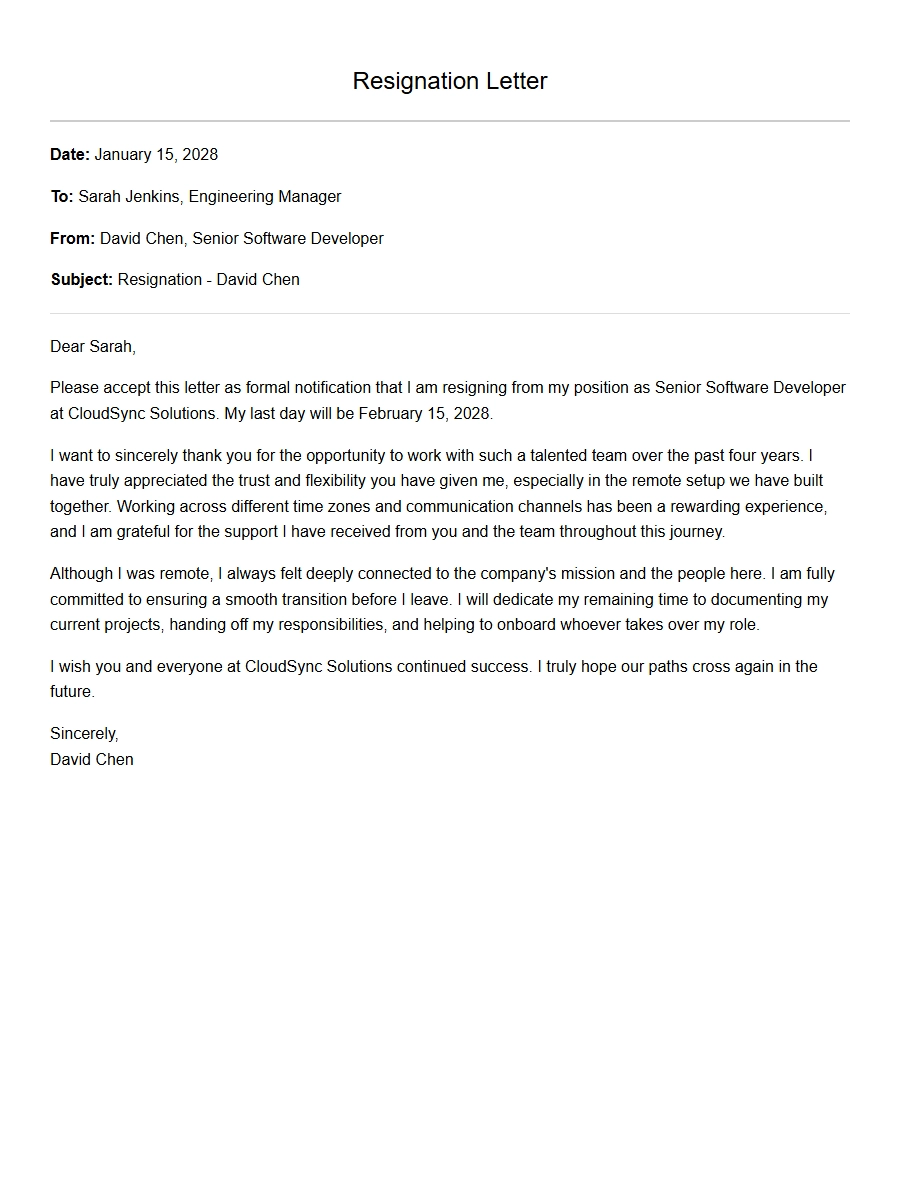 Polite Resignation Email for Remote Employees
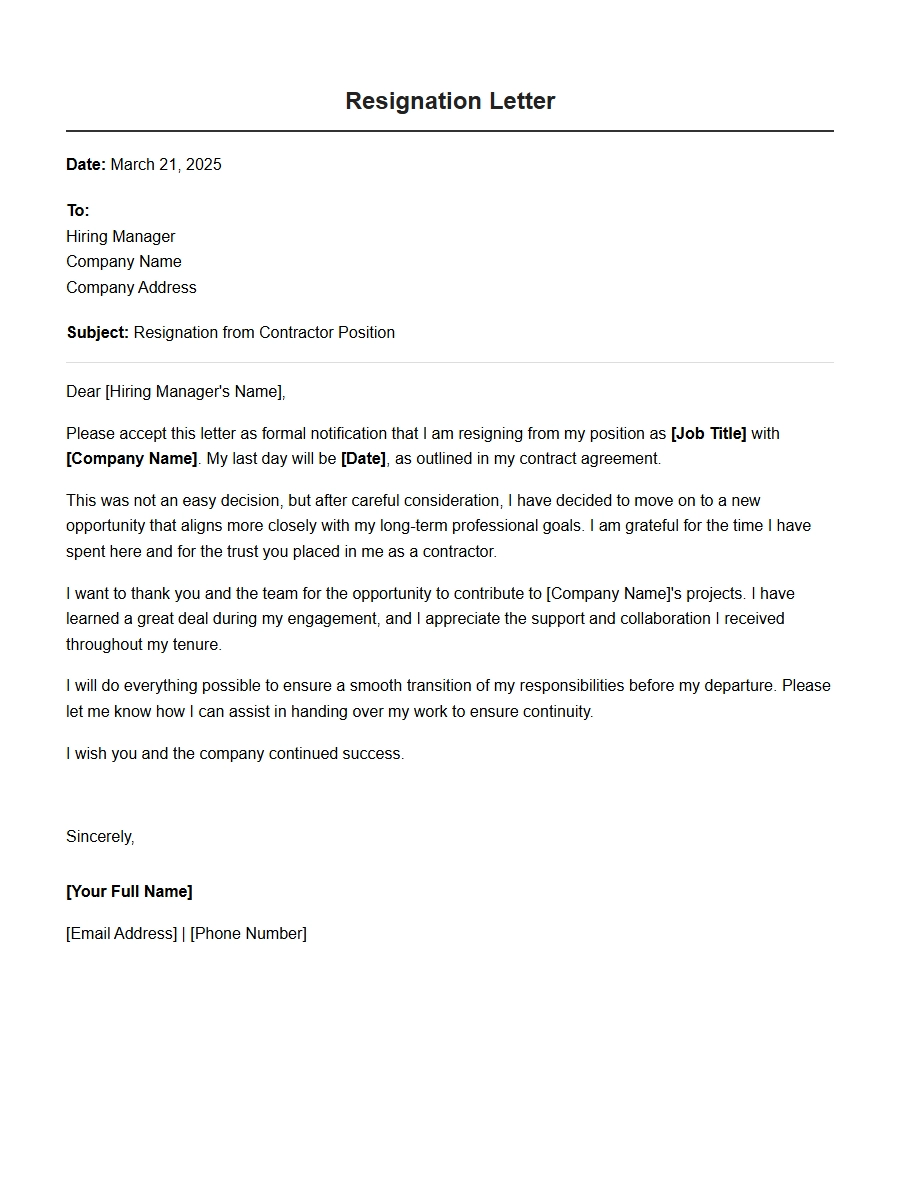 Short Resignation Letter for Contractor Position
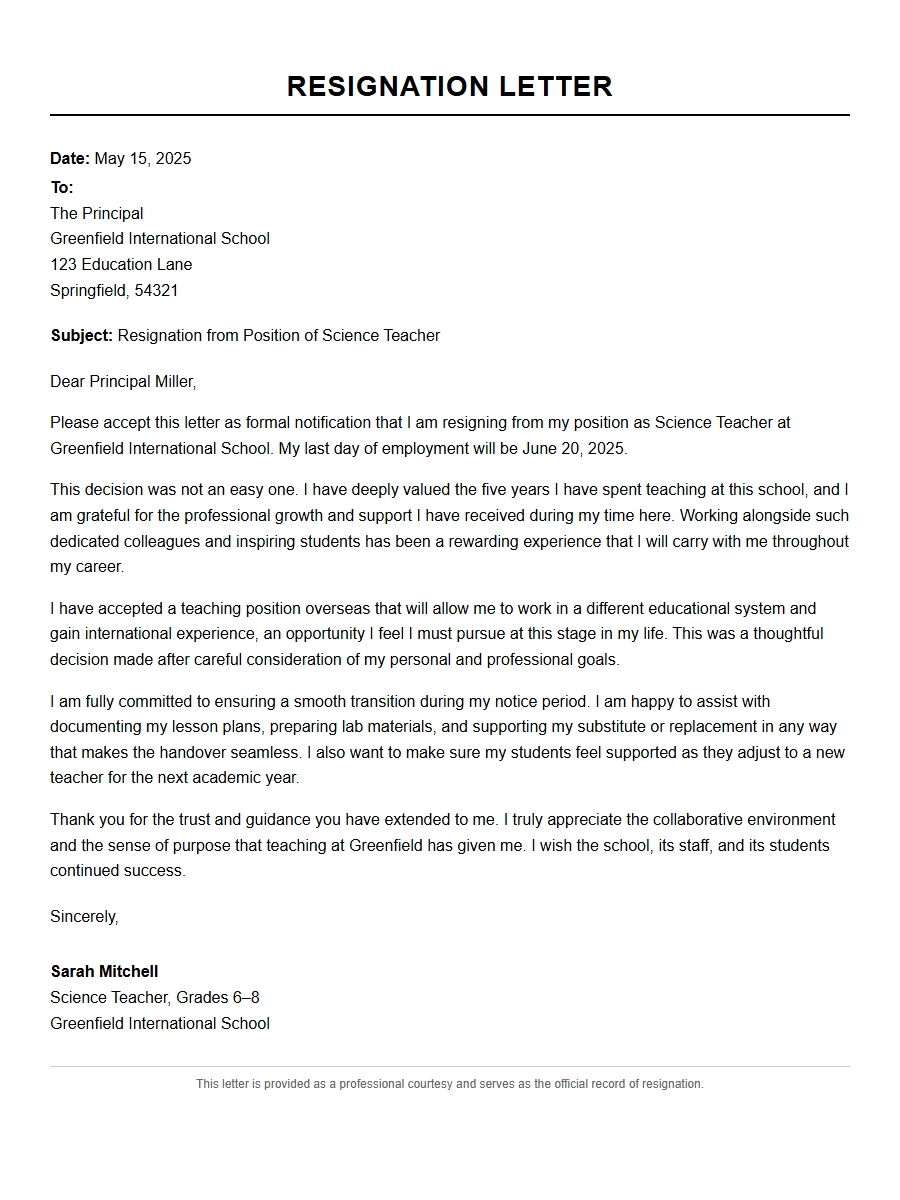 Teacher Resignation Letter Example
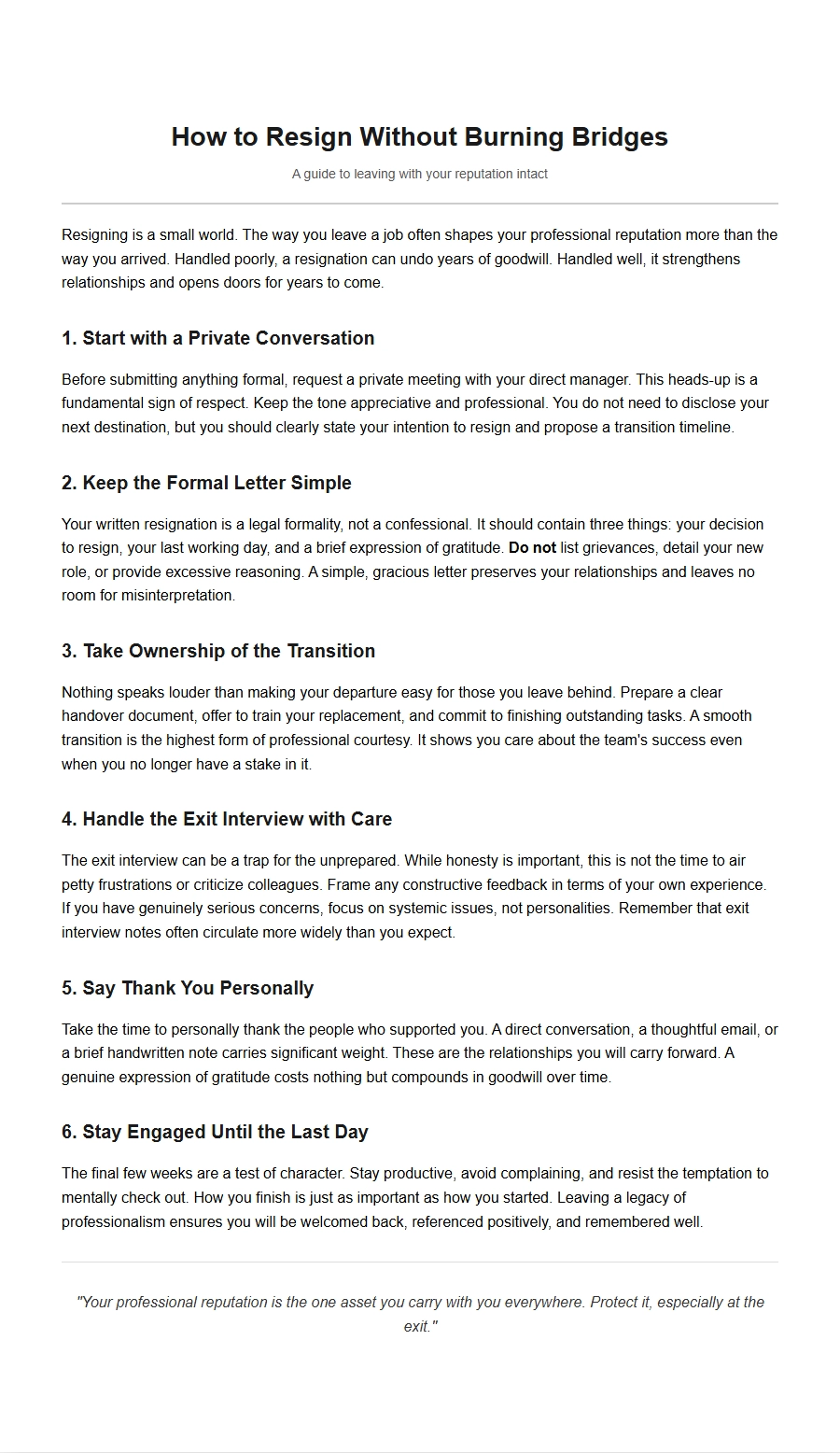 How to Resign Without Burning Bridges
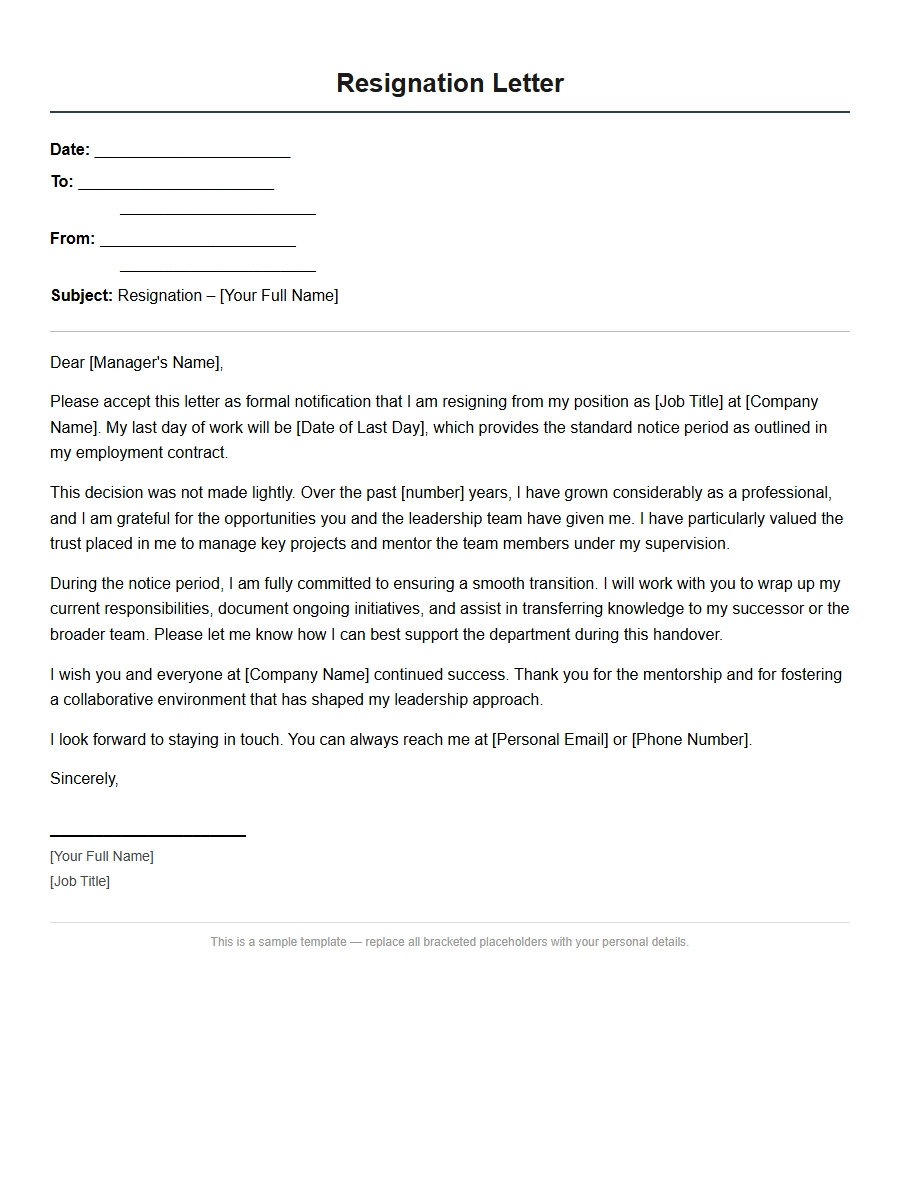 Formal Resignation Letter Sample for Manager
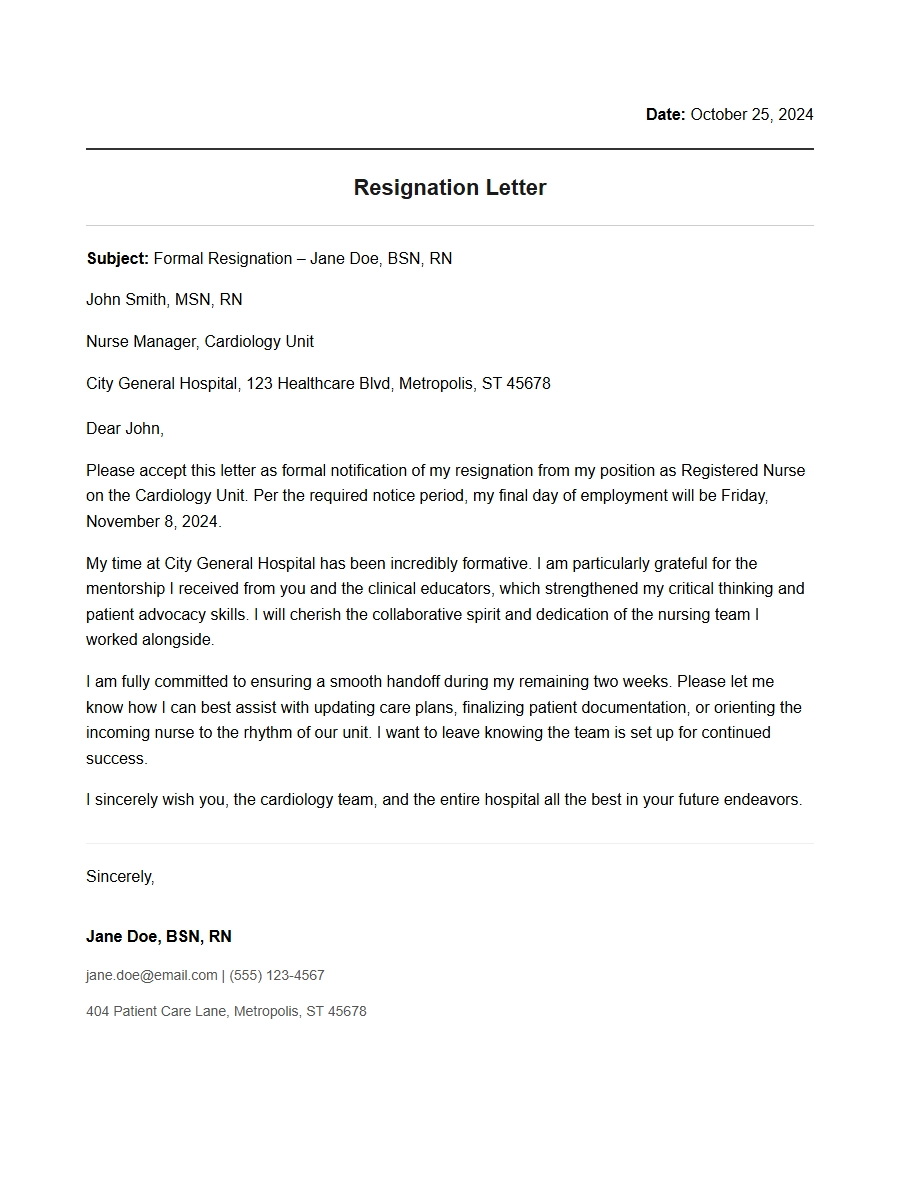 Nurse Resignation Letter with 2 Weeks Notice