You’re not being dramatic if you feel stuck. Resigning when a critical project is still underway—whether it’s a product launch, a quarterly report, or a client deliverable—can feel like you’re letting people down. And the blank page doesn’t help. But a well-chosen resignation letter sample can turn that anxiety into a clear, professional message. Using a sample isn’t cheating; it’s working smarter. A good template gives you structure, proper tone, and the right phrases, so you can focus on being honest and helpful rather than fumbling for words.
You need a letter that balances courtesy with clarity. You want to leave without burning bridges, but you also need to be direct about your last day. The right resignation letter sample helps you nail that balance. It shows you how to open politely, state your intentions clearly, and offer a transition plan—all without guessing the letter structure or worrying about salutation and closing etiquette.
Category: Resignation Letters
Why Resigning Before a Project Feels Tricky
Most resignation advice assumes you’re leaving at a clean break. But real work rarely lines up that way. Maybe you’re in supply chain and the quarterly inventory isn’t done, or you’re a team lead and the product roadmap is half-baked. The fear of looking irresponsible can keep you from writing anything at all. But staying out of guilt hurts everyone. A thoughtful resignation during a project actually shows you care—because you’re giving notice early enough for a smooth handover.
That’s where a resignation letter sample tailored to your situation helps. It lets you focus on what matters: the timing, the transition, and the tone.
Choosing the Right Sample for Your Situation
Not every sample fits. A standard business letter format might look too cold if you work in a casual startup. And a very informal email might feel disrespectful in a corporate setting. Look for samples that match your industry and culture. For example, if you’re a supply chain manager stepping away mid-project, our sample resignation for a supply chain manager offers language that acknowledges deadlines without overpromising. If you’re stepping down from a leadership role, you’ll need a different approach—more focus on delegation and handover, which you’ll find in our example of stepping down from a leadership role.
The sample you pick should also match the digital letter format you’ll use. For email, keep the salutation and closing short but respectful. For a printed letter, include a professional letterhead design if you have one, or just your contact info at the top.
Adapting a Template Without Losing Your Voice
A letter template is a starting point, not a script to copy verbatim. Your reader—your manager or HR—knows your voice. If your letter sounds like someone else, it feels fake. The goal is to make the template your own. Start by rewriting the opening paragraph. Instead of “Please accept this letter as my resignation,” try “I’m writing to formally give notice, though I know it’s not ideal timing.” That honesty builds trust.
When you’re resigning during a project, the most important part is the transition offer. Use the sample’s letter structure to separate your resignation announcement from your handover plan. Keep paragraphs short. Say something like: “I want to make sure the Q3 report is handed off cleanly. I can document my steps and spend the last two weeks training [colleague’s name].” That’s concrete and helpful.
Common Mistakes When Resigning Mid-Project
The biggest error is apologizing too much. A brief “I’m sorry for the timing” is fine, but pages of guilt sound unprofessional. Another mistake is ignoring the medium. An email resignation for a remote team? Fine. But if you normally print memos, a paper letter still works. Always double-check your professional correspondence format.
Also pay attention to tone in writing. In a formal letter, avoid casual phrases like “just letting you know” but also avoid stiff legalese like “hereby give notice.” Aim for warm professionalism. And after you send it, make time for proofreading letter—a typo in a resignation leaves a poor last impression.
If you’re dealing with a busy season or a heavy workload, you might feel extra pressure. That’s why we have specific guidance for giving notice during busy season. It covers how to phrase your availability and set realistic expectations for handovers.
How to Personalize Your Resignation Letter
Start by picking a customizable letter that matches your exact need. Then rewrite the middle section to reflect your project. Mention the specific deliverables you’ll help transition. If you’re leaving before a project completes, offer to create a handover document, schedule a knowledge-transfer session, or be available by email for two weeks after your last day. That shows responsibility.
For cover letter examples, the same principle applies—but in reverse. When resigning, you’re not selling yourself; you’re closing professionally. Still, a good source of letter writing etiquette comes from reviewing how others handled similar transitions. Our standard notice of withdrawal from position is a reliable starting point, especially if you need a neutral, factual tone.
Final Thought: Make It Personal, Not Perfect
Nobody expects a perfect resignation letter—they expect a sincere one. Use the sample as a springboard, not a crutch. The best letters feel both professional and personal. They acknowledge the awkward timing without overexplaining, and they offer real help for the transition. After you write your first draft, read it aloud. If it sounds like you, you’re ready. Over time, writing these letters becomes easier. And if you’re still unsure, our guide on how to resign before project completion has more examples and step-by-step advice to walk you through the process.
Samples You Can Use
How to Resign Before Project Completion: A Guide
Standard Resignation Letter for Project Handover
Dear [Manager's Name],
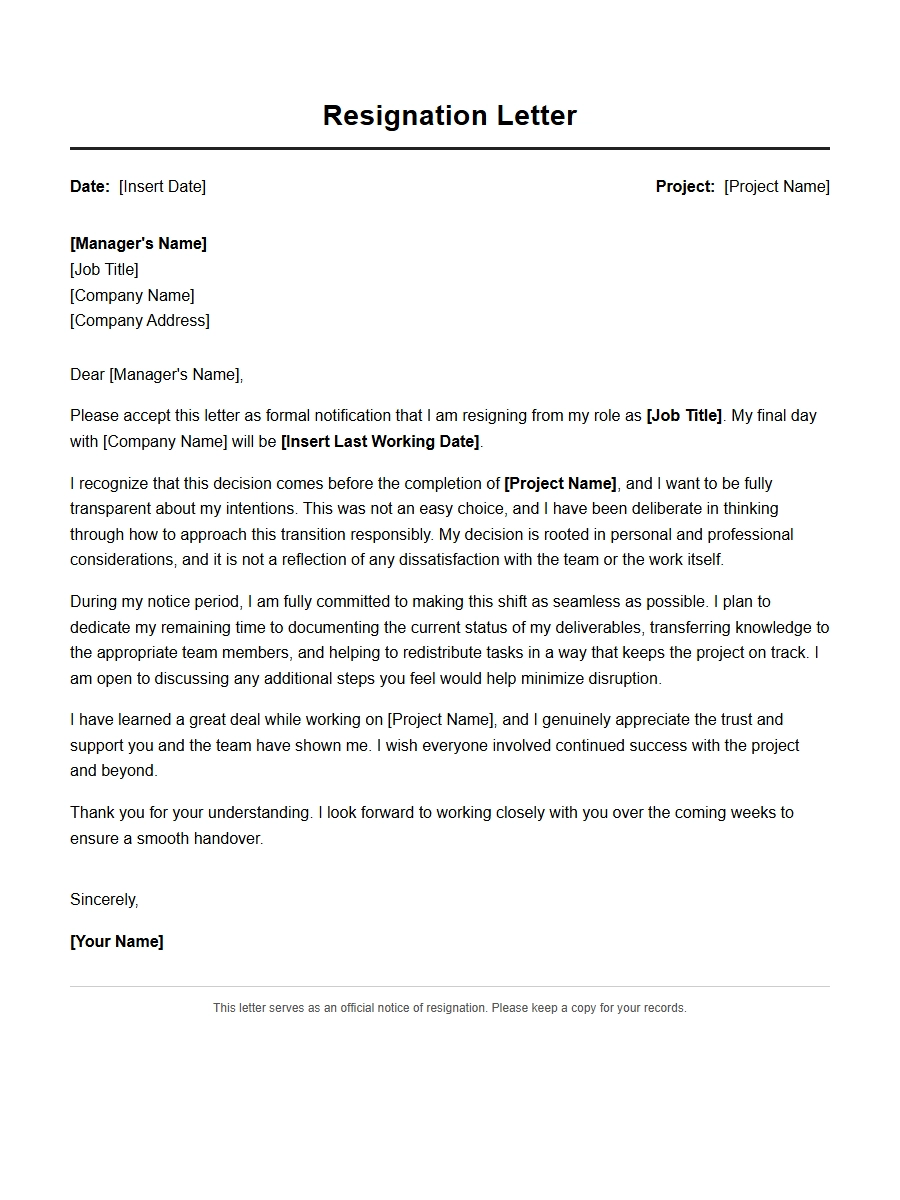
Please accept this letter as formal notification that I will be resigning from my position as [Job Title] at [Company Name], effective [Last Working Day]. Although I am leaving before the completion of the [Project Name] project, I am fully committed to ensuring a smooth transition.
To minimize disruption, I have prepared a detailed handover document covering all pending tasks, key milestones, and technical documentation. I am available for the next two weeks to assist with knowledge transfer and answer any questions.
Key handover items include:
Completed deliverables and their status
List of open tasks and dependencies
Contact information for external stakeholders
Access credentials and repository locations
I want to express my sincere appreciation for the opportunity to work on this project. I regret not seeing it through to the end, but I trust that my handover will allow the team to continue smoothly.
Sincerely, [Your Name]
Resignation Request Due to Health Reasons Before Project Completion
Dear [Manager's Name],
It is with a heavy heart that I submit my resignation, effective [Date]. Due to ongoing health issues, I am unable to continue working on the [Project Name] project until its completion. I have consulted my doctor, and they have advised a period of rest and recovery.
I have compiled a summary of my progress and unfinished work to facilitate a smooth handover:
Task
Status
Remaining work
Requirement analysis
Completed
-
Wireframe design
In progress
Feedback pending
Code module A
90% done
Unit testing
I am willing to assist remotely during my notice period if my health permits. I deeply appreciate the team’s understanding and support during this difficult time.
Best regards, [Your Name]
Short Notice Resignation During Project (Email Format)
I am writing to resign from my role at [Company Name], effective immediately. This decision is driven by a personal emergency that requires my full attention. I understand that I am leaving the [Project Name] project mid-stream, and I sincerely apologize for any inconvenience.
Please find attached a quick handoff note summarizing:
Files location and naming conventions
Current sprint board state
Outstanding pull requests
Next steps for each deliverable
I have also briefed [Colleague's Name] on my pending tasks. I hope the team can continue with minimal disruption. I value the time I’ve spent here and wish everyone the best.
Regards, [Your Name]
Formal Resignation with Transition Plan for Ongoing Project
Dear [Manager's Name],
Please accept this letter as my formal resignation from the position of [Job Title]. My last day will be [Date]. I recognize that my departure comes before the completion of the [Project Name] project, and I have developed a comprehensive transition plan to ensure continuity.
The transition plan includes:
Knowledge transfer sessions – Two half-day workshops covering architecture, decisions, and known issues.
Shadowing period – I will work side-by-side with [Replacement Name] for the final week.
I am grateful for the growth opportunities I received here and hope to maintain a positive relationship. Please let me know if any adjustments to the plan are needed.
Yours sincerely, [Your Name]
Resignation Letter for Career Change Affecting Project
Dear [Manager's Name],
After much reflection, I have decided to resign from my position to pursue a new career direction. This decision was not easy, especially because I am currently involved in the [Project Name] project which is not yet complete.
I have prepared a summary of my contributions and the remaining tasks:
Stage
My contributions
Remaining items
Planning
Full project roadmap
Risk mitigation plan
Development
Core backend modules
Integration tests
Testing
Unit tests for 3 modules
User acceptance testing
I have already spoken with [Colleague's Name] who has agreed to take over my tasks. I will ensure a seamless handover during my two-week notice period. Thank you for understanding my need to grow in a different direction.
Respectfully, [Your Name]
Resignation with Recommendation of Replacement for Project
Dear [Manager's Name],
I am writing to formally resign from [Company Name], effective [Date]. I realize that my departure is not ideal given the [Project Name] project’s timeline. To mitigate this, I recommend [Colleague's Name] as a suitable replacement to take over my responsibilities.
Why [Colleague's Name] is a good fit:
Already familiar with the project’s tech stack and domain
Has expressed interest in stepping into a lead role
Has shadowed my work for the past two weeks
I have already briefed [Colleague's Name] on the following critical items:
Current sprint goals and blockers
Stakeholder expectations and communications
Outstanding deliverables and deadlines
I am committed to making this transition as smooth as possible. Thank you for the trust you placed in me.
Best regards, [Your Name]
Polite Resignation While Acknowledging Unfinished Work
Dear [Manager's Name],
With mixed emotions, I submit my resignation, effective [Date]. I am aware that the [Project Name] project is still in progress, and I deeply regret leaving before its completion. I have done my best to document everything clearly.
Here is a snapshot of what remains:
Deliverables handed over:
Frontend code (80% complete)
API documentation
Database schema
Outstanding items:
Finalizing user dashboard
Performance optimization
Deployment script
I have created a step-by-step handover guide and will be available via email for clarification even after my last day. Thank you for the wonderful experience and support.
Sincerely, [Your Name]
Resignation from Project Lead Role Before Go-Live
Dear [Manager's Name],
Please accept this letter as my resignation from the position of Project Lead for the [Project Name] initiative. My last day will be [Date]. I understand that we are only two weeks away from the scheduled go-live, and I take full responsibility for any disruption my departure may cause.
To ensure a successful launch, I have outlined a quick transition plan:
Area
Current status
Action needed
UAT feedback
50% resolved
Assign to QA team
Go‐live checklist
70% done
Person to consolidate: [Name]
Stakeholder approval
Pending sign‐off
Schedule meeting with [Stakeholder]
I have already briefed the team and prepared a runbook for the first week post-launch. I hope this minimizes the impact. Thank you for trusting me to lead this project.
Yours truly, [Your Name]
Resignation Letter with Detailed Handover Checklist
Dear [Manager's Name],
I am resigning from my role as [Job Title], effective [Last Working Day]. Because the [Project Name] project is not yet complete, I have created a detailed handover checklist to assist the incoming team member.
Critical handover items:
Task board access and current sprint status
Shared drive with all project files
List of external vendors and contacts
Project calendar with upcoming milestones
Risk register with unresolved issues
Additionally, I have set up three review sessions scheduled for next week to walk through the codebase and architecture. After my departure, I can be reached at [email] for urgent clarifications.
I thank you for the opportunities and for making my time here rewarding.
Warmly, [Your Name]
Mutual Agreement to Resign with Project Completion Waiver
Dear [Manager's Name],
I am writing to confirm our mutual agreement regarding my resignation from [Company Name], effective [Date]. As discussed, due to unforeseen personal circumstances, I am unable to see the [Project Name] project through to completion. We have agreed that my notice period will be two weeks, during which I will focus solely on knowledge transfer.
Per our conversation, the following conditions apply:
Item
Agreed action
Project completion
Waived – no penalties for unfinished work
Handover documentation
To be delivered by [Date]
Exit interview
Scheduled for [Date]
I appreciate your understanding and willingness to release me from the completion obligation. I wish the project and the company continued success.
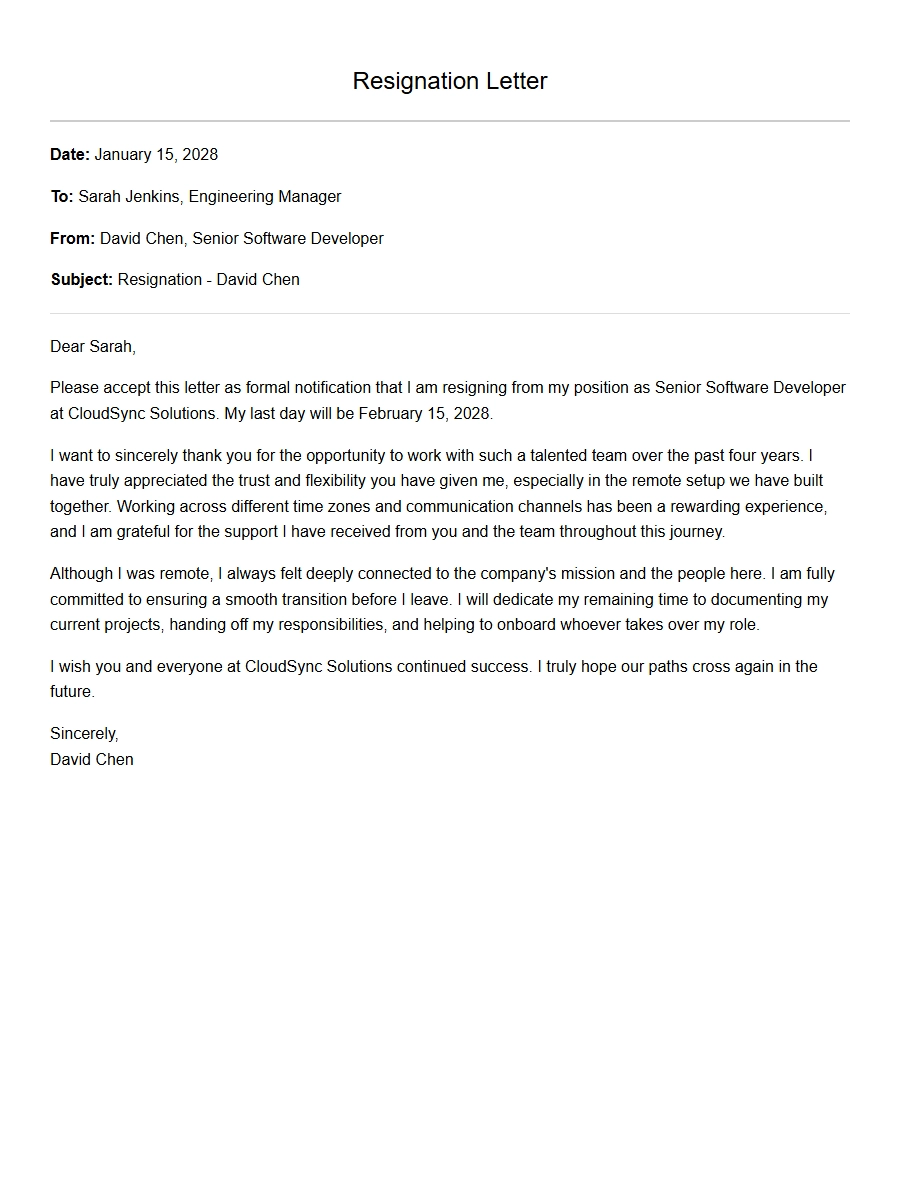 Polite Resignation Email for Remote Employees
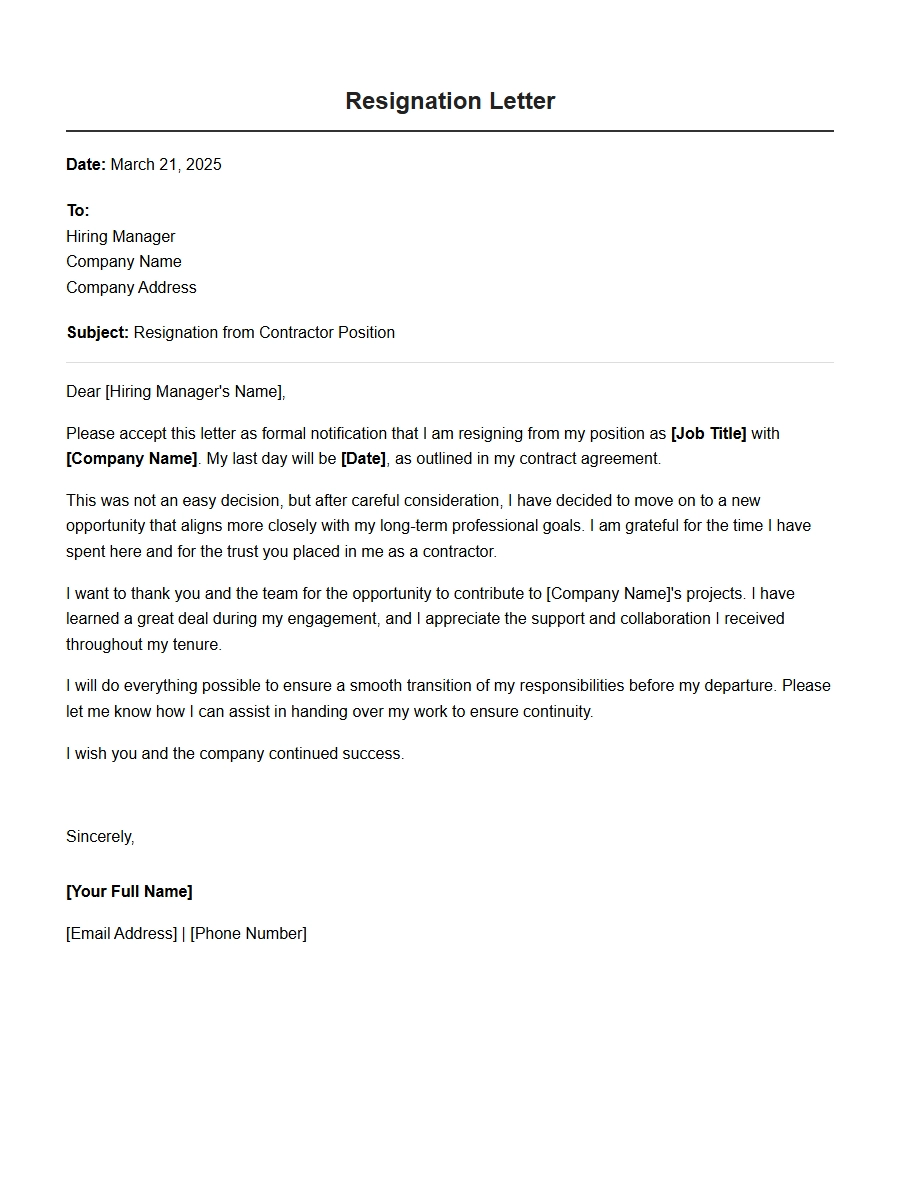 Short Resignation Letter for Contractor Position
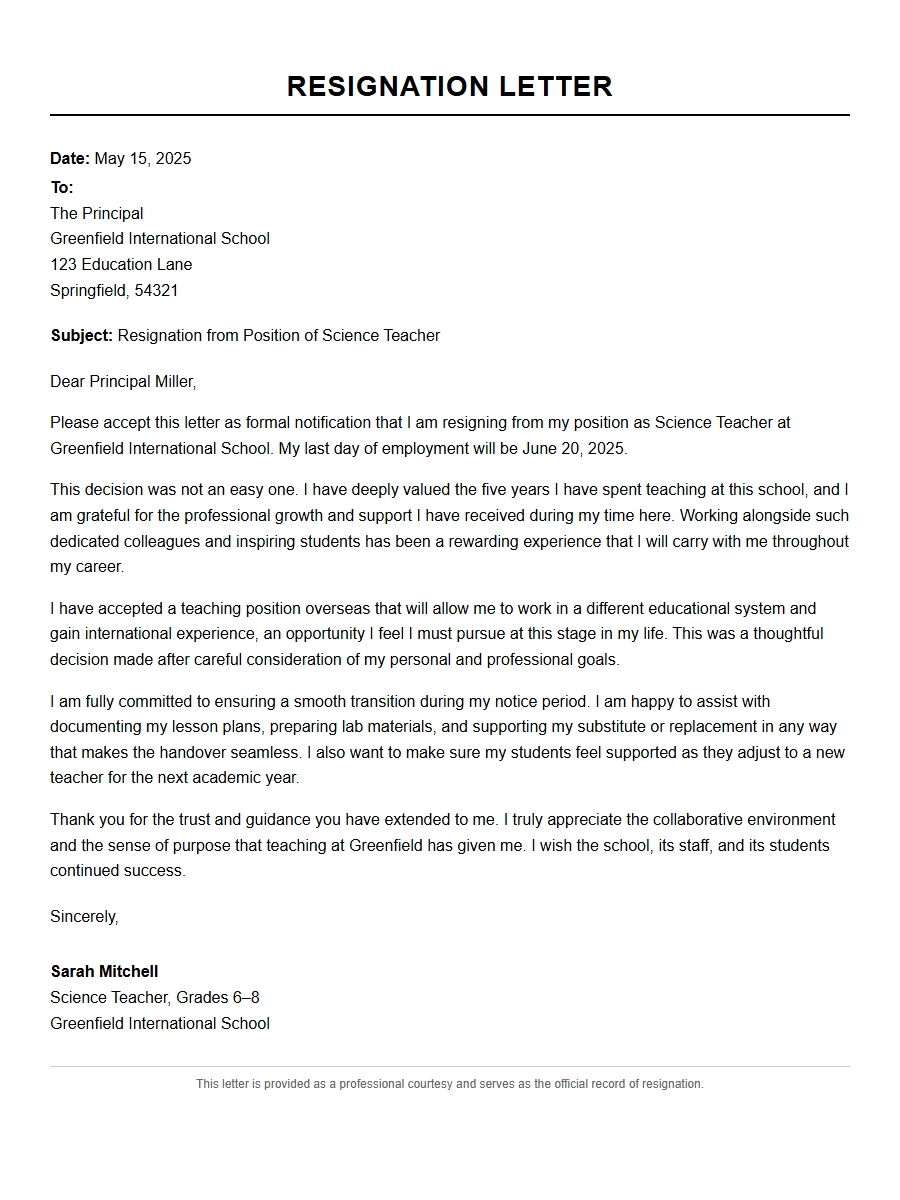 Teacher Resignation Letter Example
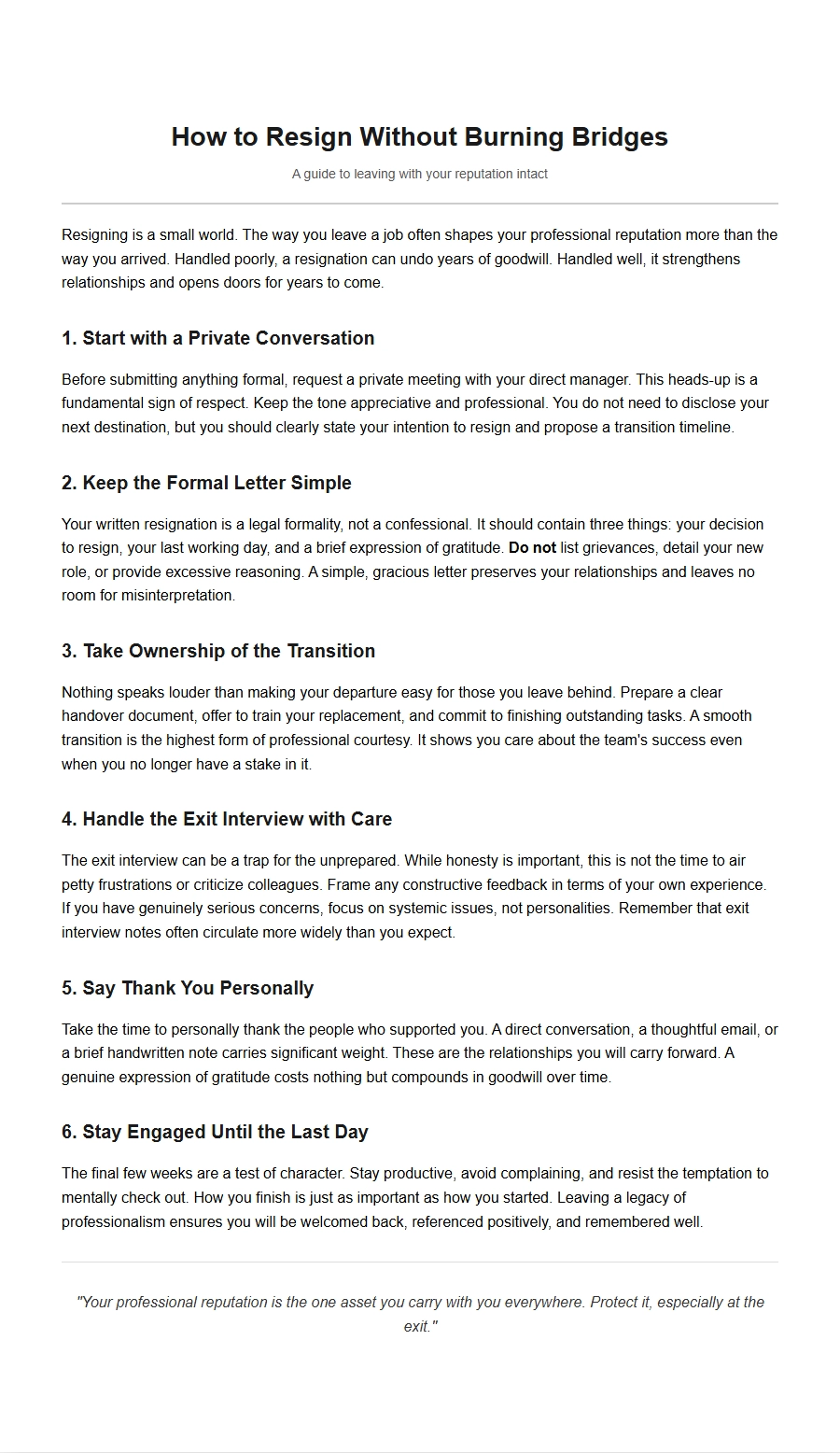 How to Resign Without Burning Bridges
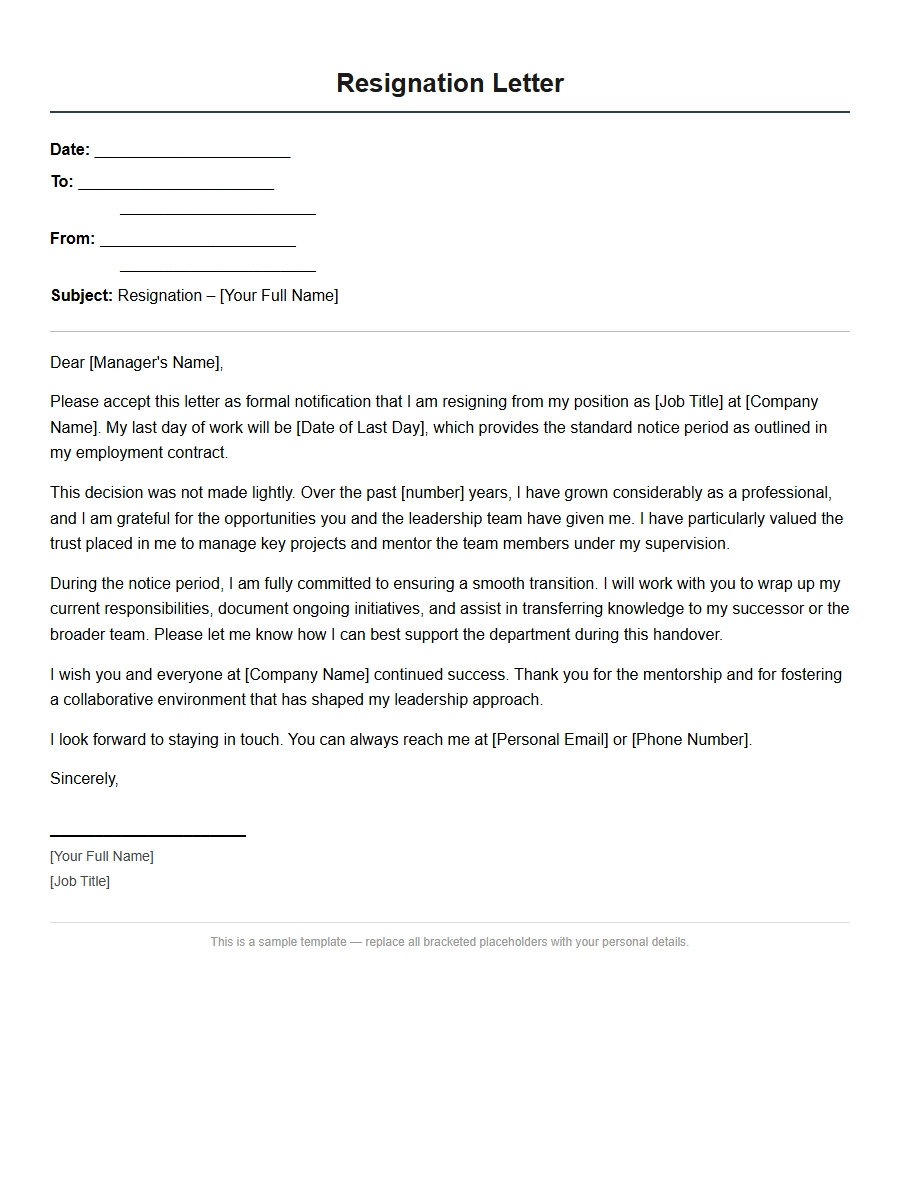 Formal Resignation Letter Sample for Manager
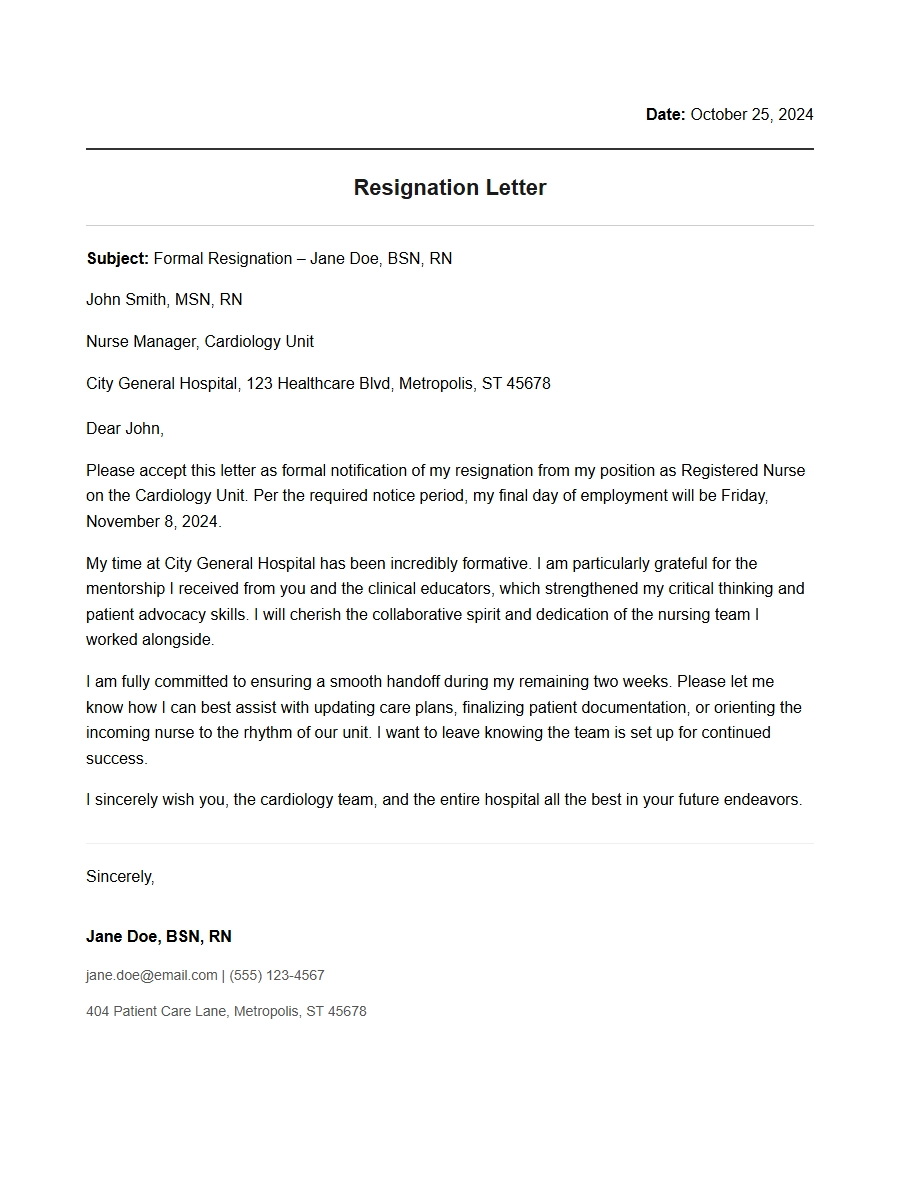 Nurse Resignation Letter with 2 Weeks Notice