You’re sitting down to write a formal thank-you letter to a charity supporter—maybe a major donor, a corporate sponsor, or a volunteer who helped fund a critical project. The pressure is real. You want the letter to feel warm and personal, but it also needs to be professional enough to represent your organization well. Blank page, blinking cursor, nervous energy. That’s exactly where a good sample can help you move from anxiety to a confident, polished draft in minutes.
Why using a letter sample isn’t cheating
Professional correspondence is built on proven patterns. A well-designed letter template gives you a clear structure, a tone that works, and key phrases you can adapt. It saves you from reinventing the wheel every time you need to send a thank-you. The best part? Samples leave plenty of room for personalization. You’re not copying—you’re customizing. That’s a smart, time-saving strategy, especially when you’re juggling multiple stewardship tasks.
Category: Charity Thank-You Letters
What should a formal gratitude letter for charity support include?
Start with a standard business letter format: your organization’s letterhead, the date, the supporter’s name and address, a respectful salutation, the body, a sincere closing, and your signature block. If you’re sending it digitally, a clean digital letter format (PDF or well-formatted email) is fine—just keep the same professional tone. A good sample will show you exactly how to arrange these elements.
The body is where your voice comes through. Open with a direct expression of thanks for the specific support. “On behalf of everyone at [Organization], I want to thank you for your generous gift of $5,000 to our after-school program.” Then explain the impact their contribution made—use concrete details. Many formal writing tips suggest avoiding vague language like “your support is greatly appreciated” without context. Instead, say “Your donation allowed us to buy supplies for 50 students this semester.” That kind of specificity turns a routine thank-you into a meaningful relationship builder.
How to adapt a sample without losing your authentic voice
Choose a sample that matches your situation. A formal gratitude letter for a corporate sponsor will sound different from one written to a long-time individual donor. Look for a customizable letter that has a warm but respectful tone. Once you have it, read through and change the details—names, amounts, specifics about the project. Keep the sentence structure but rewrite phrases that feel stiff. For example, if the sample says “we are deeply grateful for your unwavering support,” and that sounds too formal for your style, try “we’re so grateful you stood by us this year.”
A quick tip: tailor your opening paragraph to grab attention. Instead of a generic “Thank you for your donation,” lead with something like “Your check arrived just as we were finalizing plans for the new community garden—thank you for making it happen.” That immediate connection makes the letter feel personal and timely.
Common mistakes to avoid in formal charity thank-you letters
One frequent error is using outdated salutations like “Dear Sir or Madam” when you know the supporter’s name. Always address them personally. Another misstep is ignoring the difference between a printed letter and an email. For a printed letter, include a letterhead design and your physical signature. For email, keep the subject line clear (e.g., “Thank you for your support of our youth program”) and avoid lengthy attachments. Also, don’t forget proofreading letter—a small typo in a thank-you can feel dismissive. Read it aloud or ask a colleague to check it.
And remember letter writing etiquette: respond promptly, keep it to one page, and end with a forward-looking note (“We’ll keep you updated on the garden’s progress”). A well-crafted letter strengthens the supporter’s connection to your cause and sets the stage for future engagement.
When the letter sample isn't enough
Sometimes you need more than a template because the situation is unique—perhaps you’re thanking someone who also gave a recommendation for your grant, or you’re acknowledging a social media shout-out that boosted your campaign. In those cases, borrow the structure from a charity thank-you sample but adapt the tone to match the context. For example, a thank-you after a recommendation letter might be slightly more informal, while a professional thank-you after an interview appointment scheduling would stick to a formal tone. The core principles remain: be specific, be sincere, and show impact.
Use the sample as a springboard, not a crutch
The best thank-you letters feel both professional and personal. A sample gets you started, but your genuine gratitude makes it memorable. After you’ve written two or three by adapting a template, the process will feel natural—you’ll know what to say and how to say it. Practice turns that initial blank-page anxiety into confidence. So grab a sample, make it yours, and send that letter. Your supporters will feel the difference.
Browse Sample Ideas
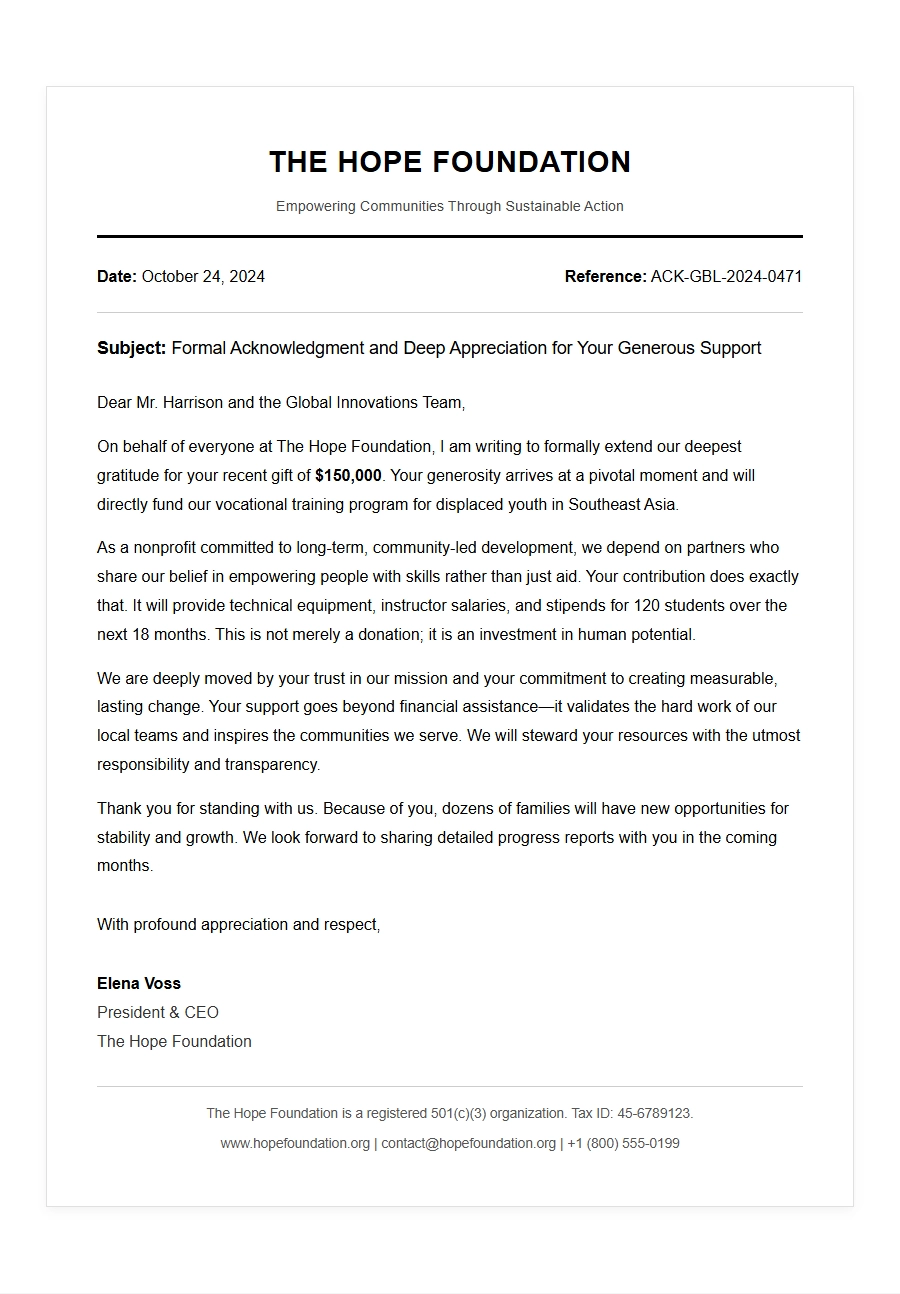
Formal Gratitude Letter for Charity Support
Standard Donation Thank-You
Dear Mr. and Mrs. Thompson,
On behalf of everyone at Hope for Tomorrow, I extend our sincere gratitude for your generous gift of $500 received on March 15, 2025. Your continued support makes it possible for us to provide nutritious meals and educational programs to over 200 children in our community each month.
As a token of appreciation, we have included a summary of how your donation will be allocated:
Program
Allocation
After-school tutoring
$250
Healthy meal kits
$200
Administrative support
$50
Thank you for being a vital part of our mission. You will receive an official tax receipt via post within two weeks.
With deepest appreciation, Jennifer Alvarez Director of Development
Corporate Sponsor Recognition
Dear Ms. Rivera,
We are writing to formally thank GreenTech Industries for your generous sponsorship of $10,000 toward our annual Community Health Fair. Your commitment to corporate social responsibility truly sets a standard for our community.
Your contribution directly supported the following services:
Free blood pressure and glucose screenings for 350 residents
Health education workshops for local families
Distribution of 500 first-aid kits
As part of our recognition package, your company logo will appear on all event signage, our website, and in the post-event report. We would also be delighted to arrange a brief thank-you presentation at your next team meeting if that interests you.
We look forward to a lasting partnership. Please feel free to contact me directly with any questions.
Warmly, Dr. Samuel Lee Executive Director
Volunteer Group Appreciation
Dear Maplewood Neighborhood Association,
I am writing to express our deepest gratitude for the incredible volunteer effort your team provided during our annual River Clean-Up Day on April 12, 2025. The 45 volunteers from your association contributed over 180 hours of service, resulting in the removal of more than 2 tons of trash from the riverbanks and surrounding parks.
Your dedication had a measurable impact:
Item
Quantity Collected
Plastic bottles
850
Metal cans
400
Misc. debris (bags)
150
Because of your work, local wildlife habitats have been restored, and our community has a cleaner, safer environment. We have already reserved a date for next year’s event and hope you will join us again.
Thank you for being the hands and heart of this project.
Sincerely, Maria Chen Community Outreach Coordinator
Annual Pledge Fulfillment Letter
Dear Dr. and Mrs. Patel,
Thank you for your faithful annual pledge of $2,500 to the Children’s Literacy Fund. We received your most recent payment of $1,250 on June 1, 2025, bringing your year-to-date contributions to the full pledge amount.
Your multi-year commitment allows us to plan confidently. Here is a snapshot of what your donation supports:
Books for 60 underserved children in our summer reading program
Training for 15 volunteer tutors who work one-on-one with struggling readers
Digital literacy workshops for parents
We are inspired by your generosity. As a token of our appreciation, you will receive our annual donor recognition publication highlighting the stories of children whose lives have been transformed by literate.
Thank you for making literacy a priority.
With gratitude, Susan Kim President, Board of Directors
Tax Receipt Acknowledgment
Dear Mr. Jackson,
This letter serves as both a thank-you and an official tax receipt for your donation to City Hope Shelter. We are deeply grateful for your gift of $350 made on July 20, 2025. Your support directly provides emergency housing and meals for families in crisis.
Per IRS guidelines, no goods or services were provided in exchange for this contribution. Below are the details for your records:
Field
Details
Donation Date
July 20, 2025
Amount
$350.00
Form of Contribution
Check #1042
Nonprofit EIN
XX-XXXXXXXX
Please retain this letter for tax purposes. If you have any questions about your receipt, contact our finance office at (555) 123-4567.
Thank you for sharing our vision of a community where everyone has a place to call home.
Blessings, Reverend Thomas Grant Executive Director
In-Kind Donation Thank-You
Dear Ms. Okafor,
Thank you so much for your generous in-kind donation of 35 backpacks and school supplies delivered to our office on August 10, 2025. Your thoughtful contribution will directly benefit students in our after-school program who otherwise might start the school year without essential supplies.
We have inventoried the items as follows:
Item
Quantity
Backpacks (assorted colors)
35
Notebooks (spiral, 70-sheet)
100
Pencil cases
35
Crayons (24-packs)
70
Every child will receive a complete kit before the first day of school. On behalf of our staff and the families we serve, please accept our heartfelt thanks.
We would be happy to provide a formal receipt acknowledging the fair market value of your donation for tax purposes. Please reply to this letter if you need one.
With appreciation, Yolanda Brooks Program Director
Fundraising Event Supporter
Dear Bayside Restaurant Group,
I am writing to thank you for your generous sponsorship of our Annual Charity Gala held on September 15, 2025. Your contribution of $5,000 as a Platinum Sponsor helped make the evening a tremendous success, raising over $120,000 for teen mental health services.
Highlights of the event include:
Over 400 guests attended
Live auction raised $45,000
Keynote speaker inspired many to take action
As pledged, your company was recognized in all gala materials, on stage during the evening, and in our post-event newsletter. We would also like to feature your support in our upcoming annual report if you are agreeable.
Thank you for partnering with us to break the stigma around mental health. We look forward to continuing this vital work together.
Gratefully, Lisa Henderson Special Events Manager
Monthly Donor Program Recognition
Dear Mr. O’Brien,
Words cannot express how much we value your monthly commitment of $50 to the Animal Rescue League. Your steadfast support over the past 18 months has provided vital resources for abandoned pets waiting for their forever homes.
Because of donors like you, we have been able to achieve the following in 2025 (year to date):
Metric
Number
Animals rescued
340
Adoptions completed
215
Spay/neuter surgeries
180
Your monthly gift covers food, medical care, and enrichment for an entire wing of our shelter. To express our appreciation, we are enrolling you in our Paw Patrol Donor Circle, which includes a quarterly digital update from our adoption coordinator and a special behind-the-scenes tour invitation.
Thank you for being a reliable partner in saving lives.
Warmly, Dr. Karen Hall Director, Animal Rescue League
Legacy Planned Gift Thank-You
Dear Ms. Whitfield,
It is with immense gratitude that I acknowledge your decision to include the Sunrise Community Foundation in your estate plan. Your generous planned gift of 10% of your residuary estate will ensure that our programs for senior citizens continue for decades to come.
We understand that this is a deeply personal commitment, and we honor your trust. Becoming a member of our Legacy Circle comes with the following benefits:
Annual invitations to donor appreciation events
Recognition in our Legacy Circle donor wall (anonymity respected if desired)
Regular updates on how your future gift will make an impact
If you have not already done so, you may wish to share the following information with your estate planner to ensure your intent is fulfilled:
Legal Name: Sunrise Community Foundation Tax ID: XX-XXXXXXXX Address: 123 Main St, City, State ZIP
Thank you for leaving a legacy of compassion. We will steward your vision with the utmost care.
With deep respect, James McCarthy VP of Development
General Charity Support Acknowledgement
Dear Friends at Maplewood Food Bank,
On behalf of everyone at Feeding Hands, thank you for your recent donation of 500 canned goods and non-perishable items collected during your community food drive. This generous support comes at a critical time as demand for our services has increased by 25% over the past year.
Your donation will be distributed through our network of partner agencies, serving families in five counties. Below is a summary of the items received:
Category
Number of Items
Canned vegetables
200
Canned fruit
80
Pasta and rice
120
Other (soup, beans, etc.)
100
Your teamwork and generosity are an inspiration. We also appreciate that you took the time to sort items by expiration date, which greatly reduces our volunteer workload. Please extend our thanks to everyone who contributed.
Together, we are building a hunger-free community.
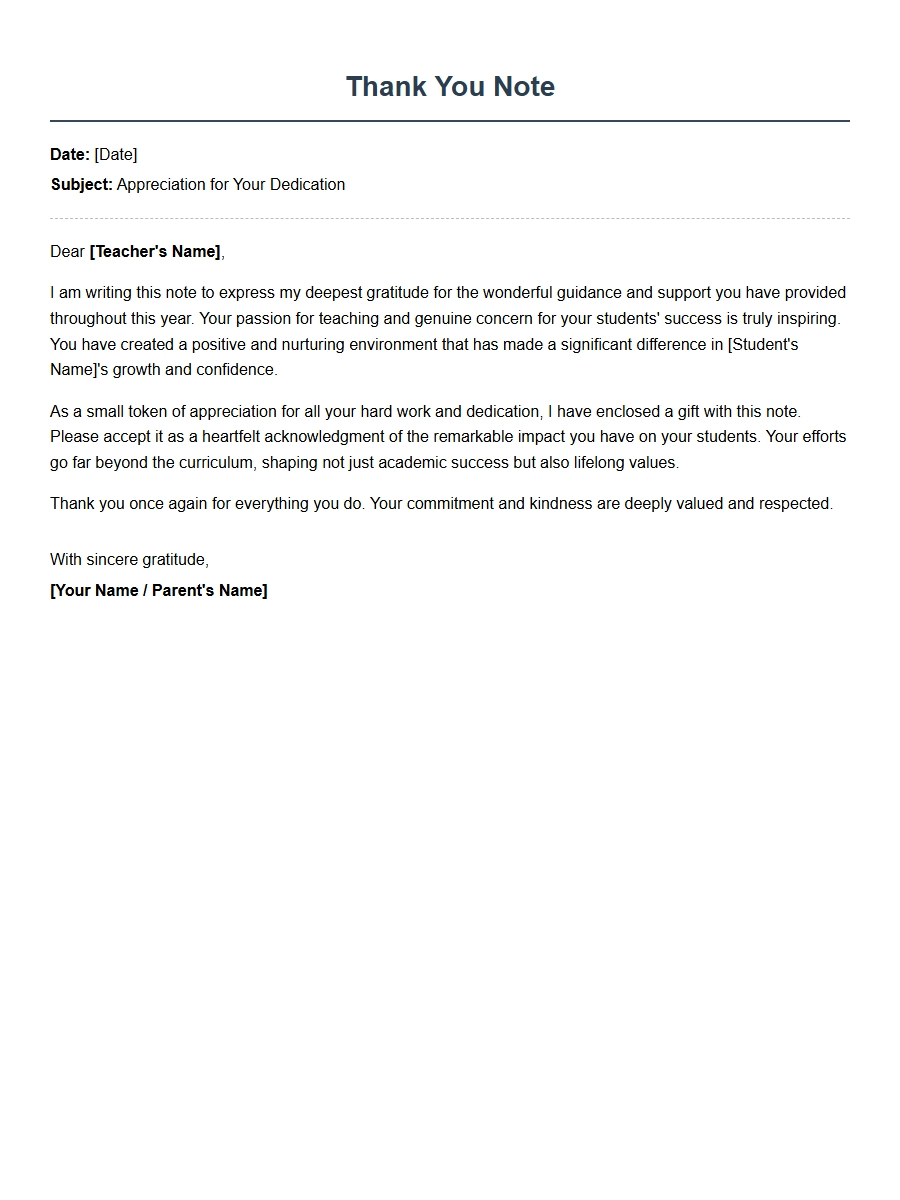 Sample Thank You Note for Teacher Gift
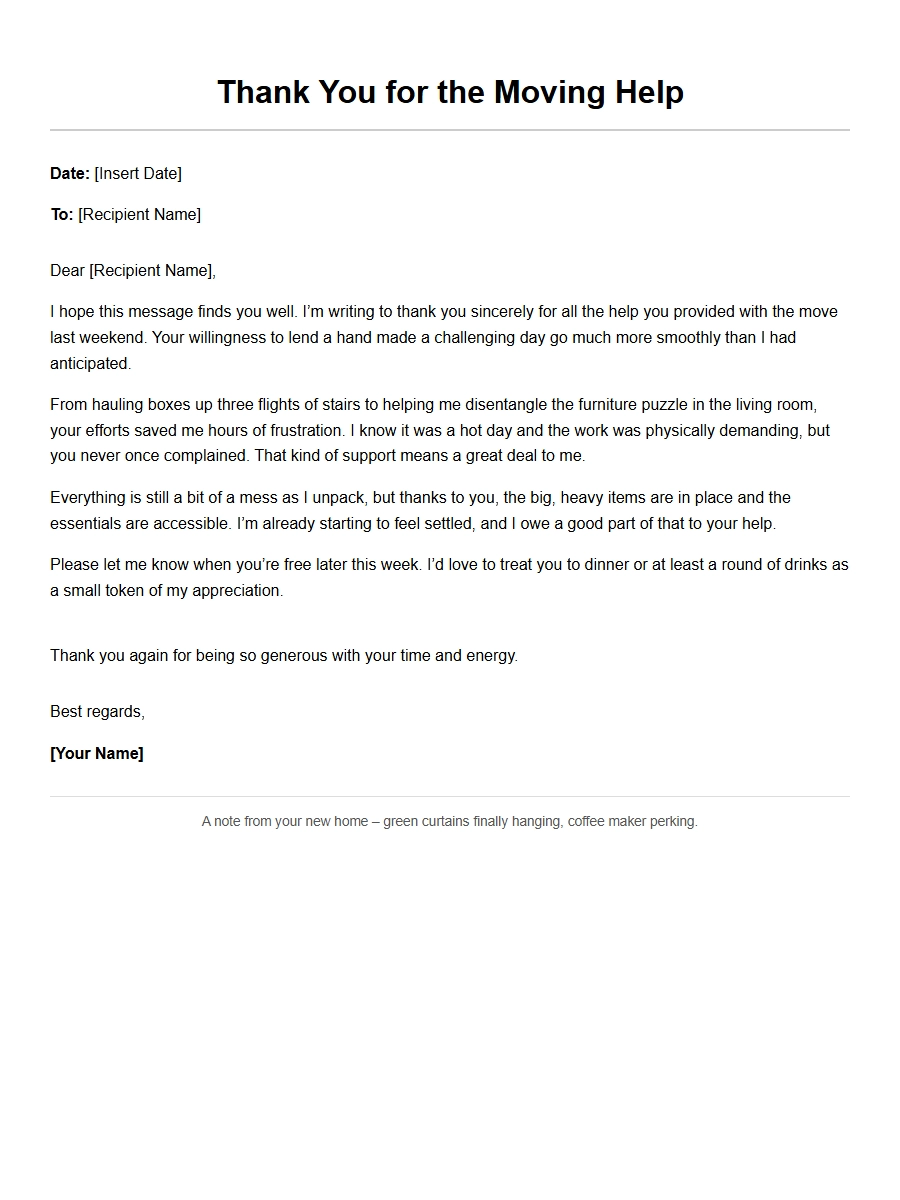 Thank-You Letter for Help with Moving
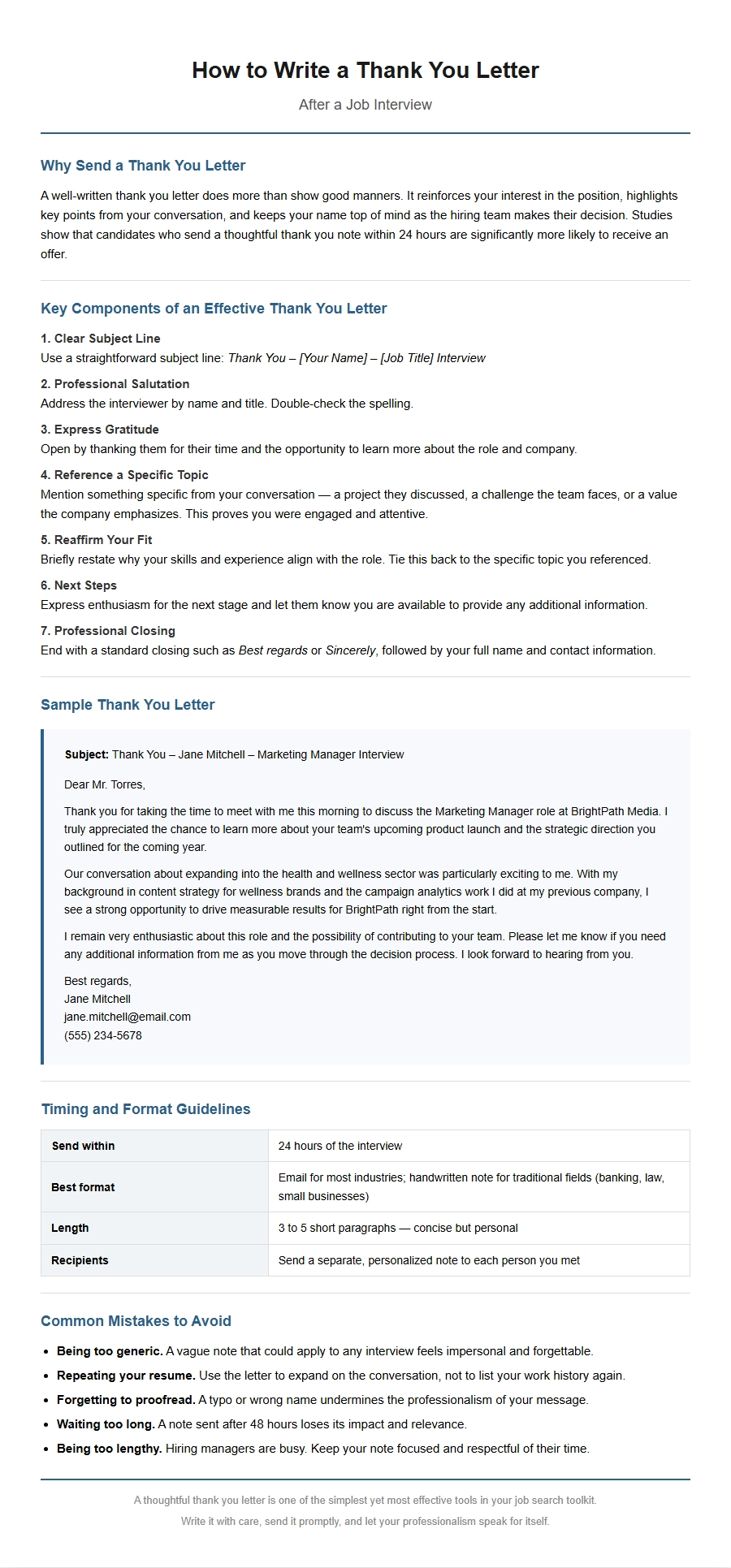 How to Write a Thank You Letter After an Interview
 professional thank you email example for client - Thank-You Letters
 Business Mentor Thank-You Letter Guide
 Thank You Letter for Sponsor Donation