You need to send a resignation message today, but the blank page stares back at you. Maybe your notice period is ending, or you’ve accepted a new role and have to put it in writing. Digital format only adds another layer: Should you paste it in an email body? Attach a PDF? Use a formal business letter format or something more casual? The anxiety is real.
Here’s the thing: using a sample isn’t cheating. It’s a smart shortcut. A good resignation letter sample gives you the structure, the right tone, and the key phrases you need. Then you personalize it. Think of it as a skeleton—you add the muscle and skin. You’ll save time and avoid awkward phrasing.
Category: Resignation Letters
The first step is picking the right template for your situation. Not all quit messages are the same. If you work in a corporate environment, you’ll want a more formal business letter format with proper salutation and closing. For a small startup or a remote team, a polite email with a clear subject line might be enough. Check the industry norms. If you’re in a formal field like finance or law, stick to the classic letter structure. For creative or tech roles, a friendly but professional tone works well.
Once you’ve chosen a sample, adapt it without losing your voice. The best professional correspondence sounds like you—just more polished. Start by rewriting the opening paragraph to mention your specific role, manager’s name, and last working day. That grabs attention and shows you’ve thought about it. Avoid copying the sample word for word; change a few sentences to match how you normally speak. That keeps the letter authentic.
Common mistakes are easy to dodge if you’re aware of them. First, check your salutation. “To Whom It May Concern” feels outdated unless you truly don’t know who receives the letter. Use your manager’s name instead. Second, remember that digital letters have different rules than printed ones. If you’re sending a resignation via email, you don’t need a full letterhead design—just your name and contact info at the bottom. But if you attach a PDF, a simple letterhead adds professionalism. Third, always proofread. A typo in a resignation letter can undermine your tone in writing. Read it aloud or ask a friend to scan it.
Quick tip on formatting: use a standard font like Arial or Times New Roman, size 11 or 12. Keep margins normal. For email, keep the message concise—three to four short paragraphs. For a PDF, follow classic business letter alignment (left-aligned, single-spaced). Customizable letter templates are everywhere, but make sure you adjust the placeholders. Don’t leave “[Date]” or “[Your Name]” as is. Fill them in.
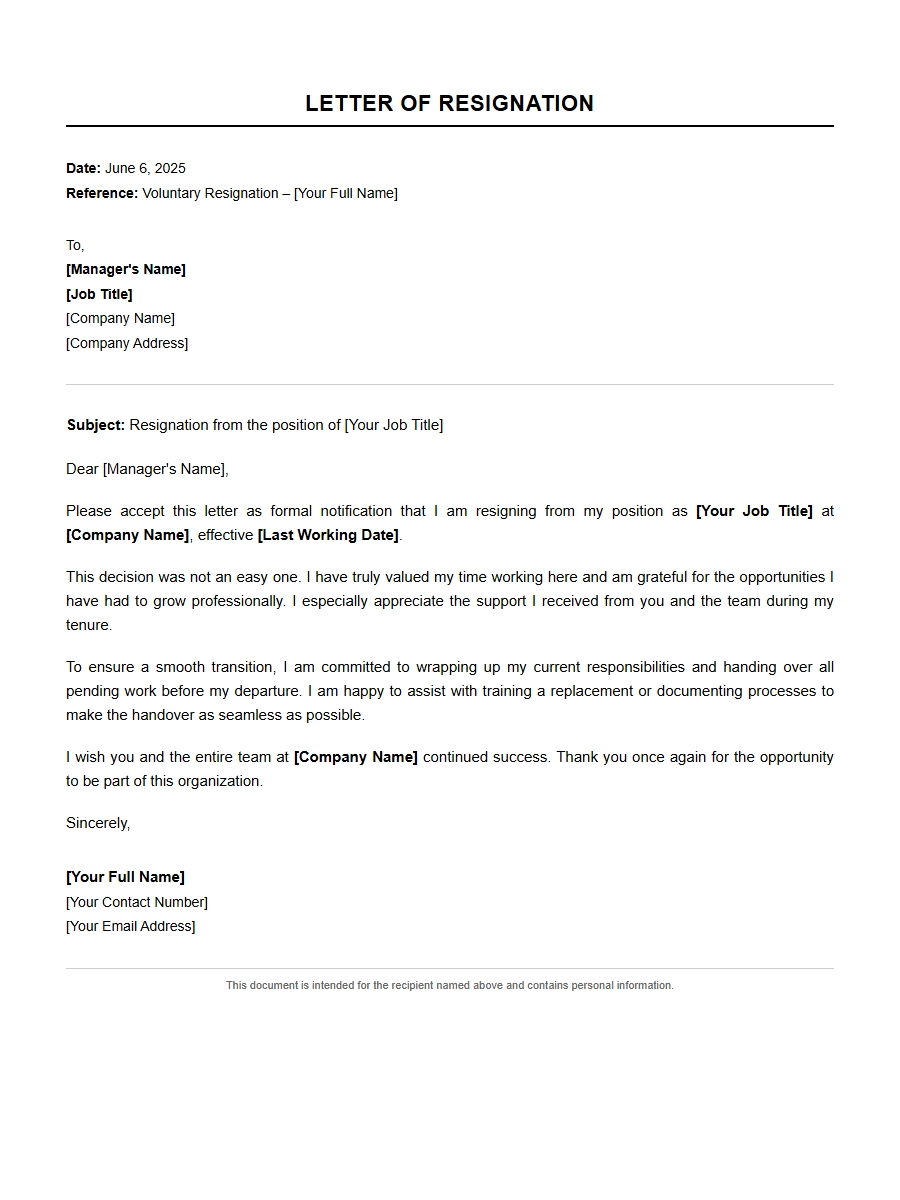
If you’re dealing with a shift work schedule change or a non-standard employment arrangement, you’ll want a sample that addresses those specifics. This resignation letter for shift work schedule change can guide you on handling irregular hours in your notice. For more formal situations like a formal declaration of intent to stop working, this template covers the legal tone you might need. If you’re updating your manager about a change in employment status, this professional notice keeps things clear. For a short and polite note, this upcoming departure note works well. And if you’re a remote employee, this polite resignation email for remote employee respects the digital-first workflow.
The goal is to make your letter feel both professional and personal. Use the sample as a springboard, not a crutch. Fill in your reasons briefly (you don’t owe a novel), express gratitude, and keep the door open for future contact. The more you write these letters, the faster you’ll get. Next time you stare at a blank page, you’ll know exactly where to start.
Templates and Samples
Sending a Resignation Letter in Digital Format
Formal Email Resignation
Subject: Resignation – [Your Full Name]
Dear [Manager's Name],
Please accept this message as my formal resignation from the position of [Job Title] at [Company Name]. My final day of employment will be [Last Working Day], which fulfills the required notice period of two weeks.
Below is a summary of my transition plan:
Task
Status
Handover To
Project documentation update
In progress
[Colleague Name]
Client introductions
Pending
[Colleague Name]
Access credentials transfer
Completed
IT Admin
I am grateful for the opportunities I’ve had here and will ensure a smooth transition. Please advise on any additional steps needed for my departure.
Best regards, [Your Name]
Slack Direct Message Resignation
/resign
Hey [Manager's Name],
I’m writing to let you know I’ve decided to leave [Company Name]. My last day will be [Date]. I wanted to keep this informal since we chat here regularly.
I’ve enjoyed working with the team, but I’ve accepted a role that aligns more with my long-term goals. I’ve attached a brief handover list below:
Current sprint tasks – shared in Trello board
Client onboarding docs – in Drive folder Handover
Weekly report template – saved in team wiki
Happy to jump on a call tomorrow to discuss anything. Thanks for everything!
I hereby submit my resignation from the position of [Job Title]. My intended last working day is [Last Day]. The reason for leaving is: Personal career advancement.
Additionally, I have completed the exit checklist:
Item
Completed
Return laptop
✔ Yes
Clear desk
✔ Yes
Final timesheet
✔ Submitted
Please process my final pay and relieve me on the date mentioned. I appreciate the support during my tenure.
Signature: [Digital Signature]
Text Message Resignation Notice
SMS Resignation
Hi [Manager's Name], this is [Your Name]. I need to inform you that I’m resigning from my position at [Company Name] effective immediately due to a family emergency. I apologize for the short notice.
I’ve already emailed a formal letter with details. Please let me know how to return my company phone and badge. Thank you for understanding.
Best, [Your Name]
Professional Email with Transition Table
To: HR, Manager Subject: Resignation – [Name] – Transition Details
Dear Team,
As discussed, this serves as my formal resignation. My last day will be [Date]. To ensure a seamless handover, I’ve outlined my pending tasks and suggested owners:
Task
Priority
Suggested Owner
Q2 budget report
High
[Name A]
Vendor contract renewals
Medium
[Name B]
Training manual review
Low
[Name C]
I can be reached at [Personal Email] for any follow-ups. Thank you for the growth opportunities here. Wishing the company continued success.
Sincerely, [Your Name]
LinkedIn Message Resignation
To: [Manager's Name] via LinkedIn Messenger
Hi [Manager's Name],
I’m writing to let you know I’ve resigned from [Company Name] effective [Date]. I wanted to inform you personally through this channel, as we connected here professionally.
My formal resignation letter has been submitted to HR. I’m grateful for your mentorship and the projects we worked on together. I’ve prepared a brief transition document, which I’ll share via email.
Let’s stay in touch – I’d love to connect on LinkedIn long-term. Thank you again.
Best, [Your Name]
Two-Week Notice with Handover List
Subject: Two Weeks’ Notice – [Your Name]
Dear [Manager's Name],
This letter serves as my official resignation, providing two weeks’ notice as per company policy. My final day will be [Date].
Here is my handover plan:
Client A: All files transferred to [Colleague] – status complete.
Weekly reports: Draft template saved in Shared Drive.
Access: Request IT to disable my accounts on last day.
Additionally, I have scheduled a knowledge transfer session for [Date]. Please confirm if there are any other tasks I should prioritize before leaving.
Thank you for the wonderful experience here.
Regards, [Your Name]
Health-Related Resignation via Email
Subject: Resignation due to health reasons – [Your Name]
Dear [Manager's Name] and HR Team,
It is with regret that I tender my resignation from [Company Name], effective [Date]. Unfortunately, ongoing health issues prevent me from continuing in my role.
I have attached a doctor’s note for your records. I will ensure all my current tasks are documented and handed over by mid-next week. Please let me know the procedure for submitting my equipment.
Below is a list of my unfinished projects and their current status:
Project
Status
Notes
Marketing campaign
60%
Brief ready, need designer
Vendor onboarding
Completed
All documents signed
I appreciate your understanding and flexibility during this difficult time. Thank you for the support.
Yours sincerely, [Your Name]
Resignation via Performance Review System
Submitted via: Employee Feedback Module
Review Period: Q2 Resignation Notice: Yes
I am using this platform to formally notify the company of my resignation as [Job Title]. My last working day will be [Date].
Reason for leaving (optional): I have accepted an offer that better suits my career path.
I have completed the self-evaluation for this quarter and noted that my transition plan is attached. Key handover items:
Code repository access – revoke after [Date]
Current pull requests – assign to [Name]
Documentation – updated in Confluence
I hope this digital submission serves as sufficient notice. Please contact me if additional information is required.
– [Your Name]
Instant Message (Teams) Resignation Brief
Chat with: [Manager's Name] @company.com
[Your Name]: Hello, I’d like to inform you that I’m resigning from my position. My last day will be [Date]. This message serves as my written notice.
[Manager]: Can you please send a formal email as well?
[Your Name]: Yes, I have already drafted it. I’ll send it now. For quick reference, here’s what I’m handing off:
Report X – final version in Drive
Meeting Y – rescheduled for next week
Password list – shared via secure link
[Your Name]: Thank you for the guidance. I’ll ensure a smooth exit.
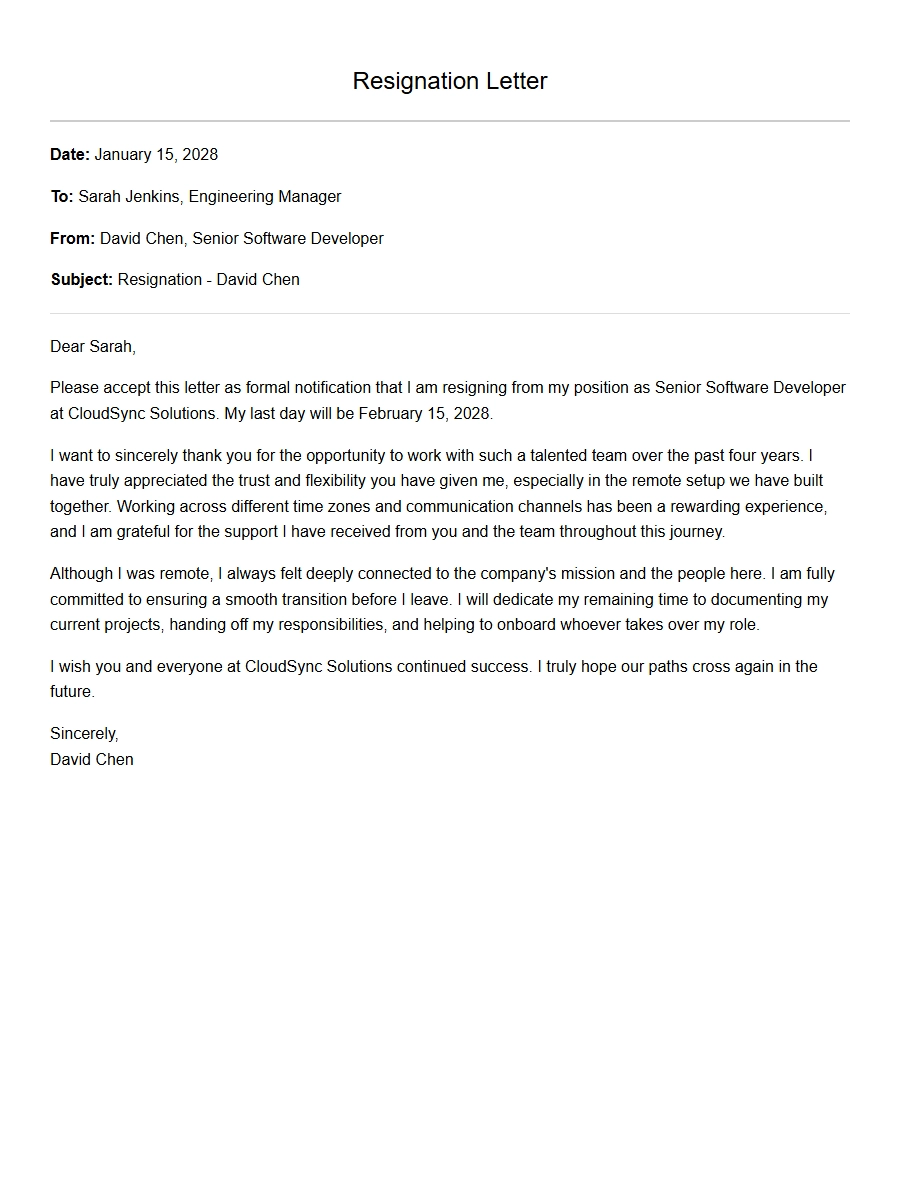 Polite Resignation Email for Remote Employees
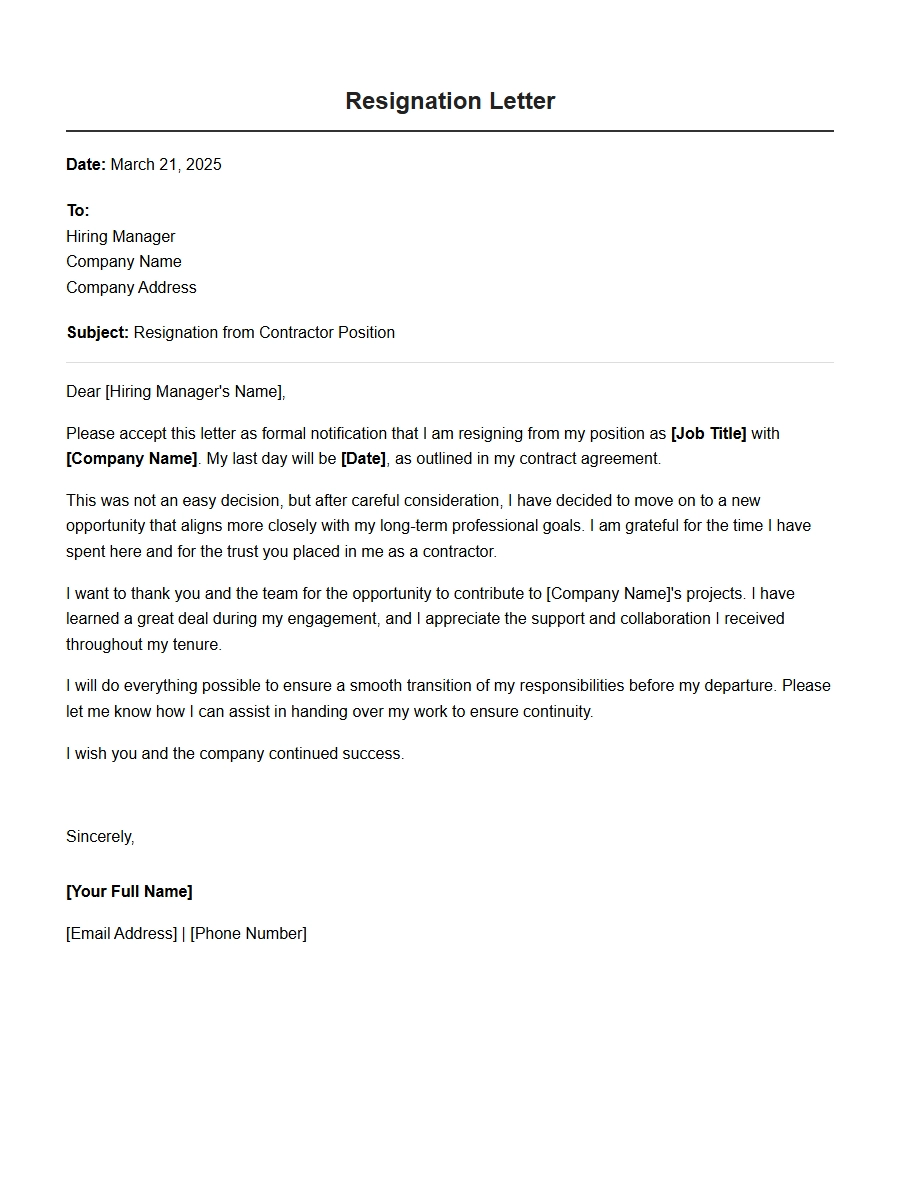 Short Resignation Letter for Contractor Position
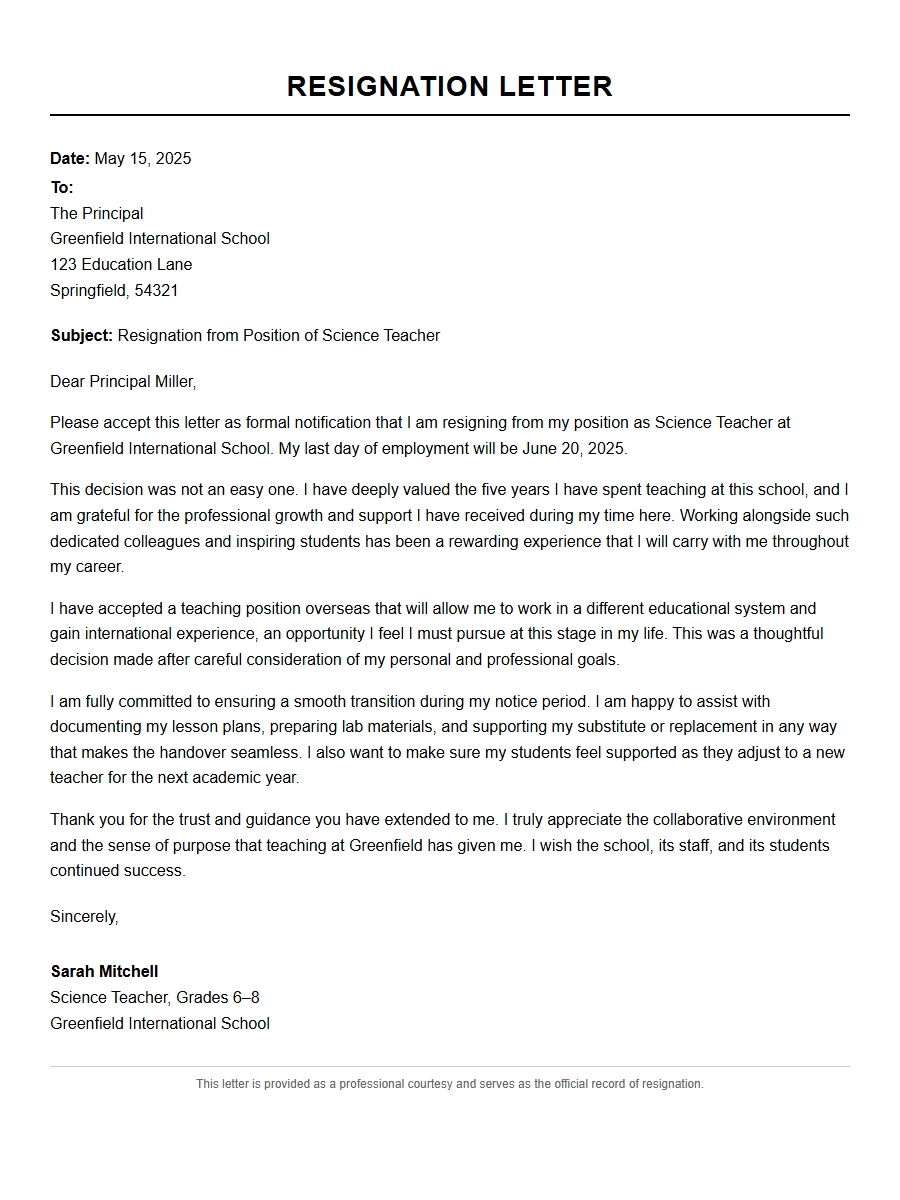 Teacher Resignation Letter Example
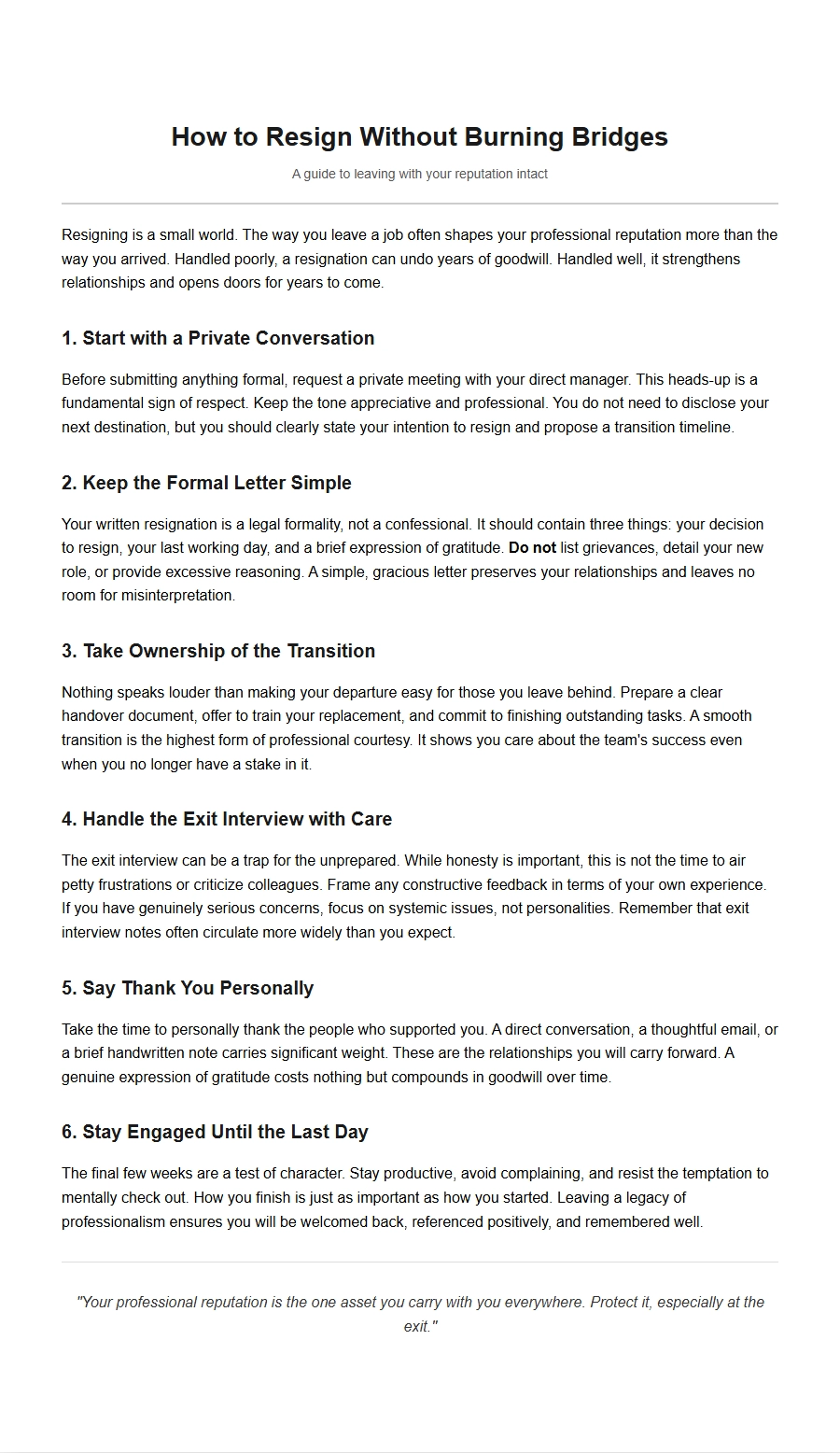 How to Resign Without Burning Bridges
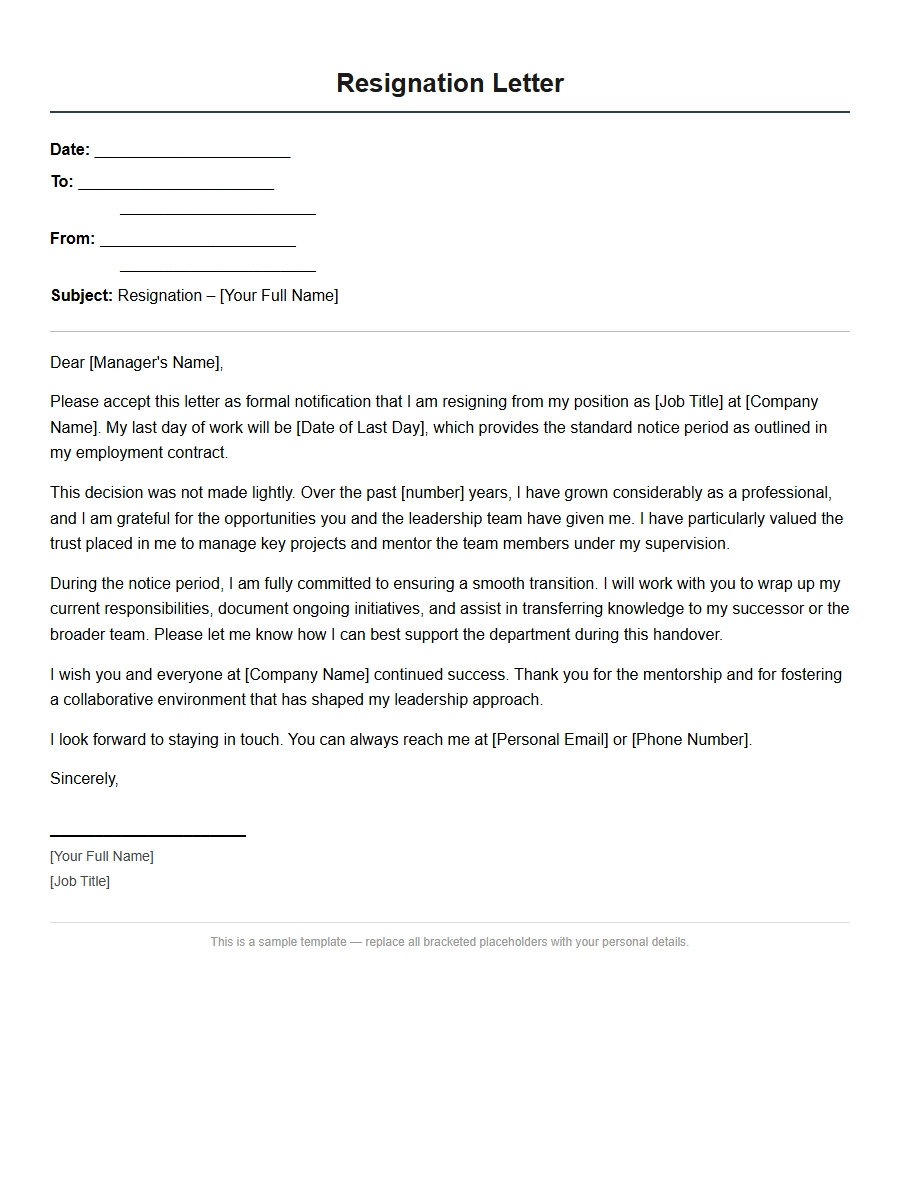 Formal Resignation Letter Sample for Manager
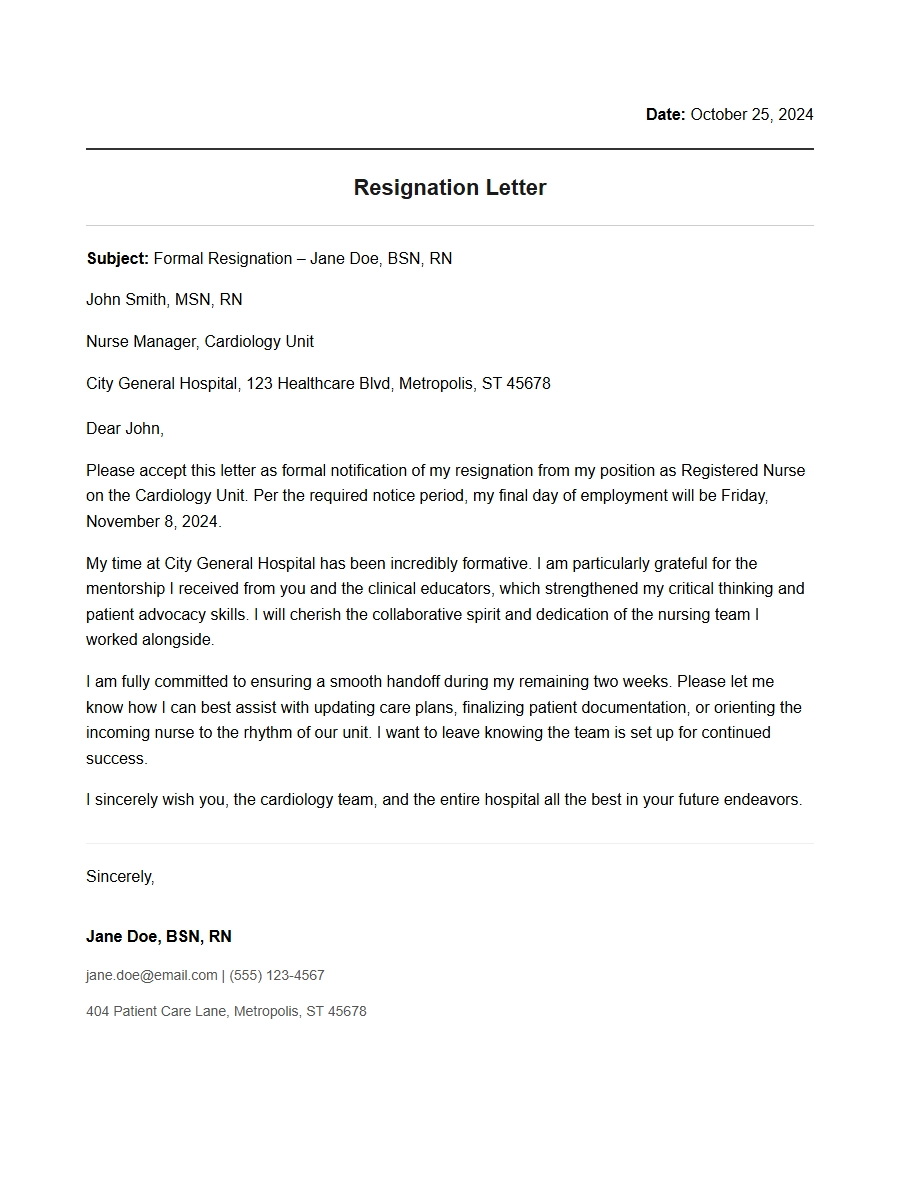 Nurse Resignation Letter with 2 Weeks Notice