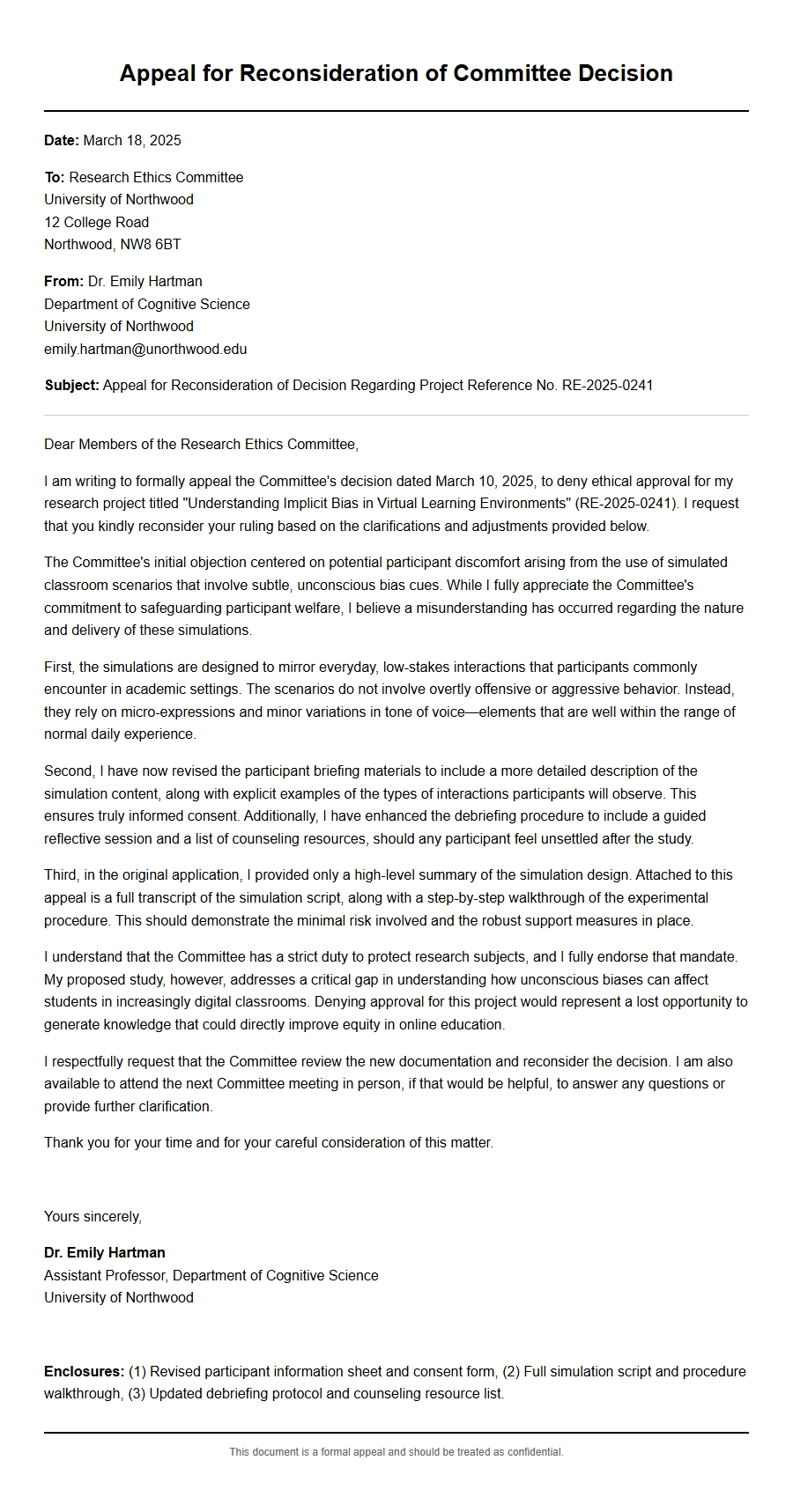
You open an email from the committee. The decision is not what you hoped for. Now you need to write an appeal letter, and that blank document feels like a wall. You’re not alone—this is one of the most stressful pieces of professional correspondence because it asks you to push back respectfully while keeping your cool. A good sample can turn that anxiety into a clear, persuasive draft in minutes.
Using a letter template isn’t cheating. It’s a smart move. A solid sample gives you the structure, tone, and key phrases that work in formal appeals. But you can’t just copy-paste. The best appeals sound like you wrote them, not like you filled in the blanks. The trick is to use the sample as a scaffold—then build your own case on top of it.
Category: Official Appeal Letters
Start with the right sample
Not all letter templates are useful for a committee decision appeal. You need one that follows formal business letter format: sender info, date, recipient, subject line, salutation, body, closing. Look for samples that acknowledge the decision without being confrontational. A typical opening might say, “I am writing to respectfully request reconsideration of the committee’s decision regarding…” That’s a safe base. But if your situation is less formal—say, an internal committee at work—you can soften the tone slightly. Always match the sample to the context.
Pay attention to the salutation and closing. “Dear Committee Members” is fine if you don’t have individual names. Avoid “To Whom It May Concern” when possible. For the closing, “Sincerely” or “Respectfully” work best. These small details in letter writing etiquette tell the reader you understand the norms.
Adapt without losing your voice
Once you have a sample that fits, it’s time to make it yours. Start by rewriting the opening paragraph to grab attention. Instead of a generic “I am writing to appeal,” add one sentence that shows you understand the committee’s perspective. For example: “I appreciate the time your committee took to review my application, but I believe new information may change your assessment.” That shows respect while making your point. Then follow the sample’s structure for the middle paragraphs—present your evidence, explain why the decision should be reconsidered, and mention any errors or missing facts.
Don’t forget the tone in writing. An appeal must be firm but not aggressive. Think of it as a conversation with a reasonable person. Avoid words like “unfair” or “wrong” unless you can back them up with facts. Instead, use neutral language: “I would like to clarify a point that was not fully addressed during the initial review.” That keeps the door open for reconsideration.
Common pitfalls to avoid
One mistake is using outdated language like “I am writing to respectfully request that you revisit your previous ruling.” That’s fine, but it can feel stiff. Modern digital letter format allows a slightly more direct approach. If you’re emailing the appeal, skip the letterhead design—just put a clear subject line and use a polite greeting. If you’re printing and mailing, include your contact info and a date.
Another error: not tailoring the sample to your specific case. I once saw someone use a resignation letter sample to write an appeal—it was too passive and didn’t ask for what they needed. Treat the sample like a set of Legos. You can swap out blocks, but keep the overall shape. Also, always proofread your letter. A small typo can make you look careless, which weakens your credibility.
Think about the human element. Just as a sincere apology letter for a hotel room cleanliness issue needs to acknowledge the guest’s frustration, your appeal must acknowledge the committee’s effort. Respect goes both ways. Similarly, if you’re acknowledging a mistake on your part—like missing a deadline—follow the structure of an apology for a late assignment submission. Be honest, explain why it happened, and show you’ve fixed the issue.
When you need to point out a factual error in the committee’s reasoning, be concise. Don’t bury the key point in a long paragraph. Follow the model of a software bug fix release apology—state the problem, offer the correction, and move on. If you’re referring to new documentation or evidence, treat it like a documentation revision: clearly state what changed and why it matters. And if your appeal references user feedback or process changes, consider how a platform navigation changes feedback apology handles criticism—acknowledge the issue without being defensive.
Turn the sample into a springboard
The best appeal letters feel both professional and personal. They use a sample’s structure but fill it with your own words, your own story, your own evidence. Don’t expect your first draft to be perfect. Write it, set it aside, then read it aloud. If any sentence sounds like a robot wrote it, rewrite it. Over time, you’ll get faster at adapting templates without losing your authentic voice. The goal is not to avoid using samples—it’s to use them so well that no one can tell you used one.
Browse Sample Ideas
Apology for Committee Decision Reconsideration
Academic Grade Appeal - Missed Final Submission
Date: March 10, 2025 To: Academic Appeals Committee Re: Appeal for Reconsideration of Grade F in ENGL 301
Dear Committee Members,
I am writing to sincerely apologize for my failure to submit the final research paper on time, which resulted in a failing grade for ENGL 301. I take full responsibility for my oversight and deeply regret any inconvenience this may have caused.
However, I humbly request the committee to reconsider this decision. Due to an unexpected medical emergency that required hospitalization during the final week, I was unable to complete the assignment. I have attached supporting documentation from my physician and a timeline of events:
Date
Event
Feb 28, 2025
Admitted to City Hospital
Mar 2, 2025
Discharged, but advised bed rest
Mar 5, 2025
Attempted to submit paper: system closed
I have completed the paper and can provide it for review. I apologize again for the late submission and ask for an opportunity to demonstrate my understanding of the course material. Thank you for your compassion and understanding.
Date: April 2, 2025 To: Employee Conduct Committee Re: Appeal of Termination Decision – Case #EMP-4521
Dear Members of the Committee,
I am writing to express my deepest apologies for my unprofessional behavior during the team meeting on March 15, 2025. My outburst was unacceptable, and I understand the seriousness of my actions. I have reflected on this incident and am committed to improving my conduct.
I respectfully request the committee to reconsider the termination decision. I have been with the company for eight years with an otherwise clean record. Attached are letters of support from three colleagues who have witnessed my positive contributions. Below is a summary of my corrective actions:
Enrolled in a conflict resolution workshop (starting April 10)
Scheduled monthly check-ins with HR for six months
Willing to accept a final written warning instead of termination
I apologize to everyone affected by my actions. Please give me one more chance to prove I can be a respectful team member. Thank you for your time.
Respectfully, John Smith Employee ID: E-8872
Neighborhood Fine Appeal - Unauthorized Structure
Date: January 22, 2025 To: Community Association Appeals Board Re: Appeal for Reconsideration of Fine for Shed Violation – Lot 14B
Dear Board Members,
I am writing to apologize for constructing a small garden shed without prior approval from the association. I was unaware of the specific permit requirement and take full responsibility for the oversight. I sincerely regret any frustration this may have caused the committee and my neighbors.
I respectfully ask the board to reconsider the $500 fine and allow me to either relocate the shed or submit a retroactive application. To date, I have taken the following steps:
Stopped all construction pending resolution
Measured the shed (8x10 ft, within size limits)
Consulted a contractor about structural compliance
I have also prepared a formal variance request and would be happy to attend a hearing. I apologize again for my mistake and appreciate your consideration.
Thank you, Maria Garcia Unit 14B, Oakwood HOA
Professional License Suspension Appeal
Date: May 5, 2025 To: State Medical Board Review Committee Re: Appeal for Reconsideration of License Suspension – License #MD78654
Dear Committee Members,
I am writing to offer my sincere apology for failing to complete the mandatory continuing education credits within the designated timeframe. I understand that this oversight is a serious violation of board regulations, and I deeply regret any concern it may raise about my commitment to professional standards.
Nonetheless, I humbly request the committee to reconsider the six-month suspension. The delay was due to an administrative error: my CME provider did not report my credits correctly. I have since completed all outstanding credits and submitted proof. Below is a summary of the situation:
Requirement
Status
20 credits – Ethics (2024)
Completed March 2025
10 credits – Pain Management
Completed April 2025
Proof of completion sent
Yes – attached
I apologize for the inconvenience and ask that my license be reinstated with a probationary period. I value my ability to serve patients and will ensure full compliance going forward. Thank you for your fairness.
Respectfully yours, Dr. Robert Chen, MD
Grant Funding Denial Appeal - Late Report
Date: June 14, 2025 To: Community Grants Review Committee Re: Appeal for Reconsideration of 2025 Grant Denial – Project Harmony
Dear Committee Members,
On behalf of the Harmony Youth Center, I apologize for the late submission of our mid-year progress report, which led to the denial of our follow-up grant. We take full responsibility for this error and regret any inconvenience it has caused the review process.
We respectfully request the committee to reconsider this decision. Our organization has a strong track record of delivering impactful programs, and the late report was due to a staffing transition. We have since corrected the issue and submitted the report. Below are key project metrics from the past six months:
Metric
Target
Achieved
Youth served
150
162
Workshops held
20
22
Volunteer hours
500
540
We are committed to timely reporting moving forward. Please consider reinstating our grant with a probationary period. Thank you for your understanding.
Sincerely, Anna Lee, Executive Director Harmony Youth Center
Sports Doping Ban Appeal - Apology for Medication
Date: July 20, 2025 To: National Athletics Arbitration Committee Re: Appeal for Reconsideration of Two-Year Ban – Case D-8852
Dear Committee Members,
I write to apologize wholeheartedly for the presence of a prohibited substance in my sample. I understand the gravity of anti-doping rules and accept that I am responsible for everything I ingest. There is no excuse for my lack of vigilance.
However, I humbly request the committee to reconsider the two-year suspension. The substance entered my system through an over-the-counter cold medication I took without consulting the team doctor. I was unaware it contained a banned ingredient. I have since attended a doping education workshop and provide the following documentation:
Doctor’s note confirming the medical condition
Copy of the medication label with ingredient list
Certificate of completion of anti-doping training (attached)
I apologize to my team, my country, and the sport. I ask for a reduced ban or a period of ineligibility with regular testing. Thank you for your compassionate review.
Respectfully, Lucas Mendes Athlete ID: BRA-3021
Insurance Claim Denial Appeal - Incomplete Information
Date: August 30, 2025 To: Insurance Appeals Committee Re: Appeal for Reconsideration of Homeowners Claim Denial – Policy #HO-771234
Dear Committee Members,
I am writing to apologize for submitting an incomplete claim packet after my basement flood in June. I failed to include the required photographs and receipts, which rightfully led to the denial. I accept the error and regret any administrative burden this caused.
I respectfully ask the committee to reconsider. I have now compiled all missing documentation and present it below:
Required Document
Status
Photos of flood damage
Attached (8 photos)
Receipts for temporary repairs
Attached (3 receipts, $1,200 total)
Contractor estimate for restoration
Attached ($4,500 estimate)
The flood was sudden and caused significant stress, leading to my oversight. I have learned to double‑check all submissions. I kindly request the claim be re‑evaluated. Thank you for your patience and understanding.
Sincerely, Karen White 123 Oak Street, Apartment 4B
Eviction Notice Appeal - Lease Breach Apology
Date: September 18, 2025 To: Housing Authority Appeals Board Re: Appeal for Reconsideration of Eviction for Unauthorized Pet – File #HUD‑4409
Dear Board Members,
I am writing to apologize for violating my lease by keeping a small dog without prior written approval. I understand that this is a breach of the housing agreement, and I fully accept responsibility. I am deeply sorry for any inconvenience to the management and neighbors.
I humbly ask the committee to reconsider the eviction notice and allow me to either remove the pet or pay a reasonable fine. Since receiving the notice, I have:
Registered the dog as an emotional support animal with a licensed therapist
Obtained a letter from my doctor explaining the benefit (attached)
Spoken to the property manager about a pet deposit
I have been a tenant for three years with on‑time rent and no prior violations. Eviction would cause me significant hardship. Please allow me this one chance to rectify my mistake. Thank you for your understanding.
Respectfully, David Kim Unit 7C, 450 River Road
Scholarship Retention Appeal - Academic Integrity
Date: October 12, 2025 To: Scholarship Review Committee Re: Appeal for Reconsideration of President’s Scholarship Revocation – ID 8873B
Dear Committee Members,
I am writing to offer my deepest apology for the plagiarism found in my History 201 term paper. There is no excuse for submitting someone else’s work as my own. I fully accept the academic integrity violation and the resulting consequences. I am ashamed of my lapse in judgment and the disappointment it has caused.
I respectfully appeal for reconsideration of the scholarship revocation. This scholarship is essential for me to complete my degree. I have already taken corrective actions:
Completed an online academic integrity course (certificate attached)
Met with the writing center for tutoring on proper citation
Voluntarily rewrote the term paper from scratch
I am committed to upholding the highest academic standards going forward. Please allow me to retain the scholarship under a probationary period with mandatory ethics workshops. Thank you for your mercy and trust.
Humbly, Sophia Martinez Freshman, Class of 2028
Ethics Committee Censure Appeal - Conflict of Interest
Date: November 8, 2025 To: Professional Ethics Committee Re: Appeal for Reconsideration of Public Censure – Case EC‑301
Dear Members of the Committee,
I am writing to apologize unreservedly for my failure to disclose a financial interest in a vendor that submitted a bid to my department. I understand that this constituted a clear conflict of interest and violated our code of ethics. I take full responsibility for my negligence and the harm it has done to the organization’s reputation.
I respectfully ask the committee to reconsider the public censure. While I accept that some disciplinary action is warranted, I believe a less severe sanction would still serve as an effective deterrent. Below I outline the steps I have taken to ensure this never recurs:
Action
Completion Date
Disclosed all existing vendor relationships to HR
Oct 20, 2025
Attended an ethics seminar
Oct 28, 2025
Implemented a quarterly disclosure review for my team
Nov 1, 2025
I apologize again to the committee and to my colleagues. I request a private reprimand instead of a public censure, to allow me to work toward rebuilding trust. Thank you for your thoughtful consideration.
Respectfully, James Okafor Director, Procurement Division
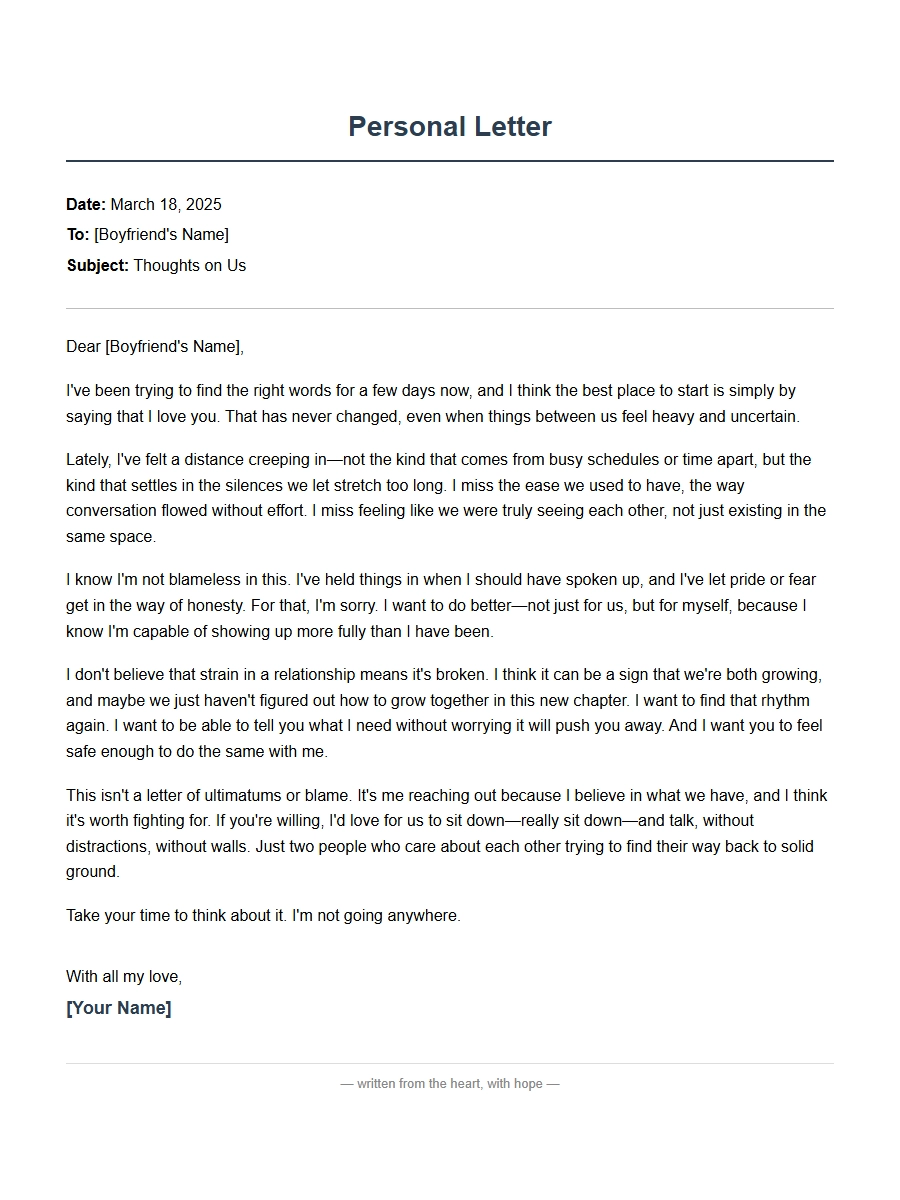 Personal Apology Letter for Boyfriend Relationship Strain
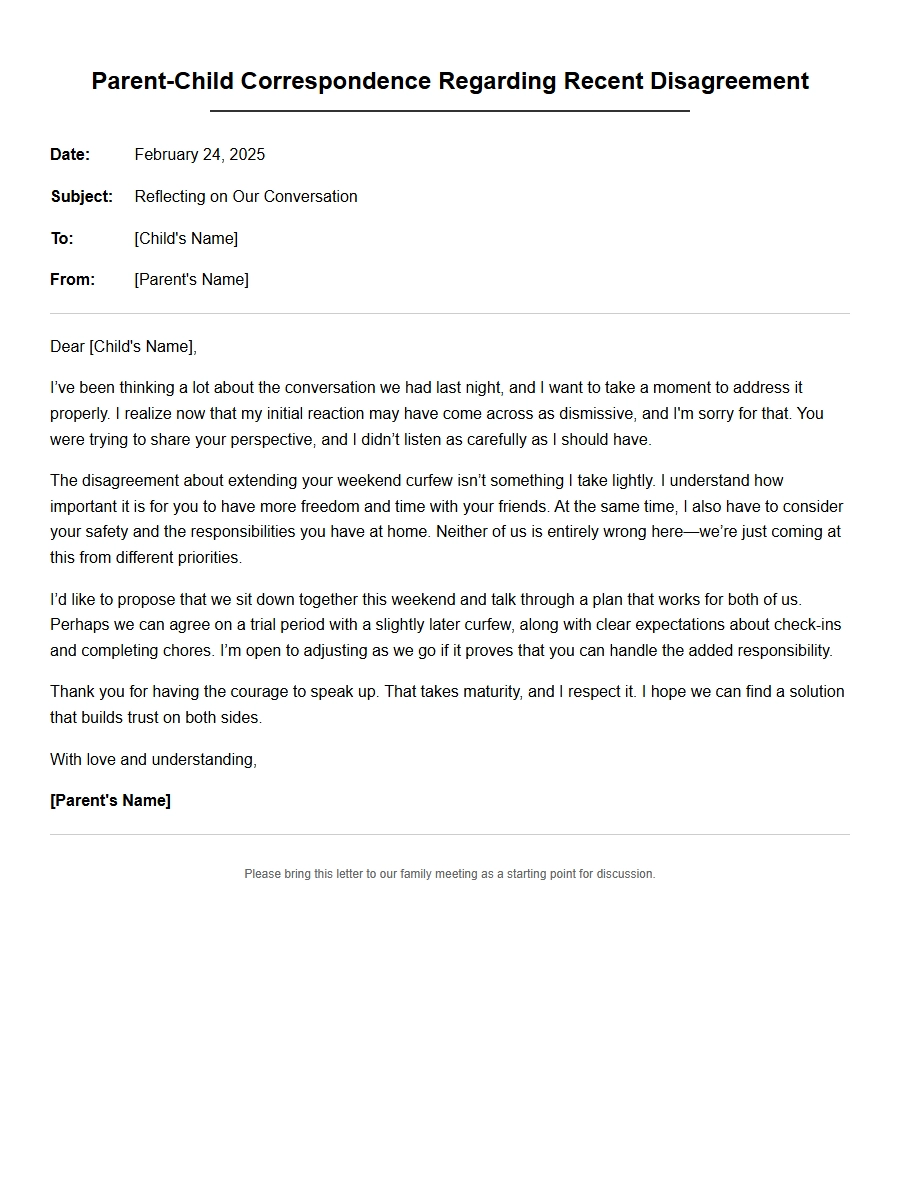 Apology Correspondence for Parent-Child Disagreements
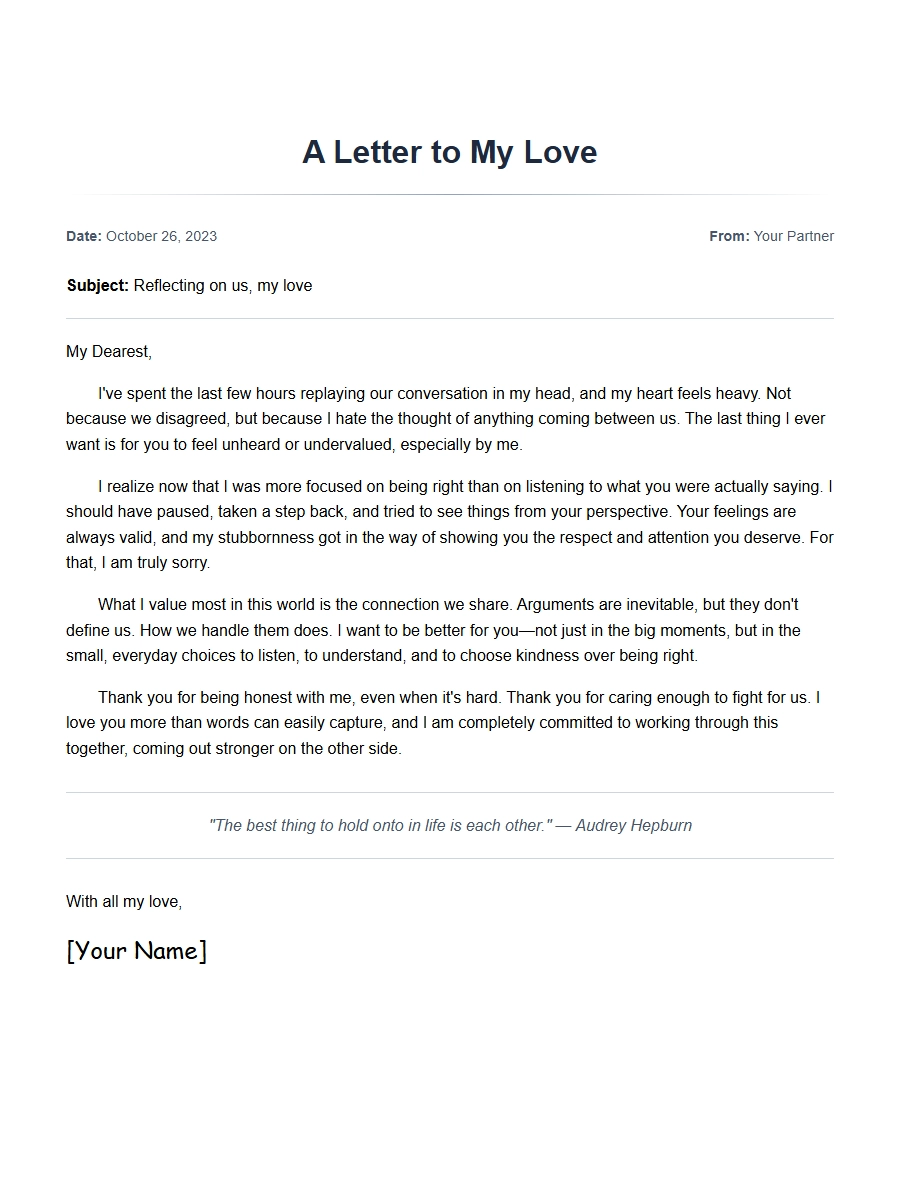 Apology Message for Girlfriend After Argument
 note for friend stealing item - Apology Letters
 Apology to Boss for Micromanagement Complaint
 Apology Document for Vendor Supply Chain Issue