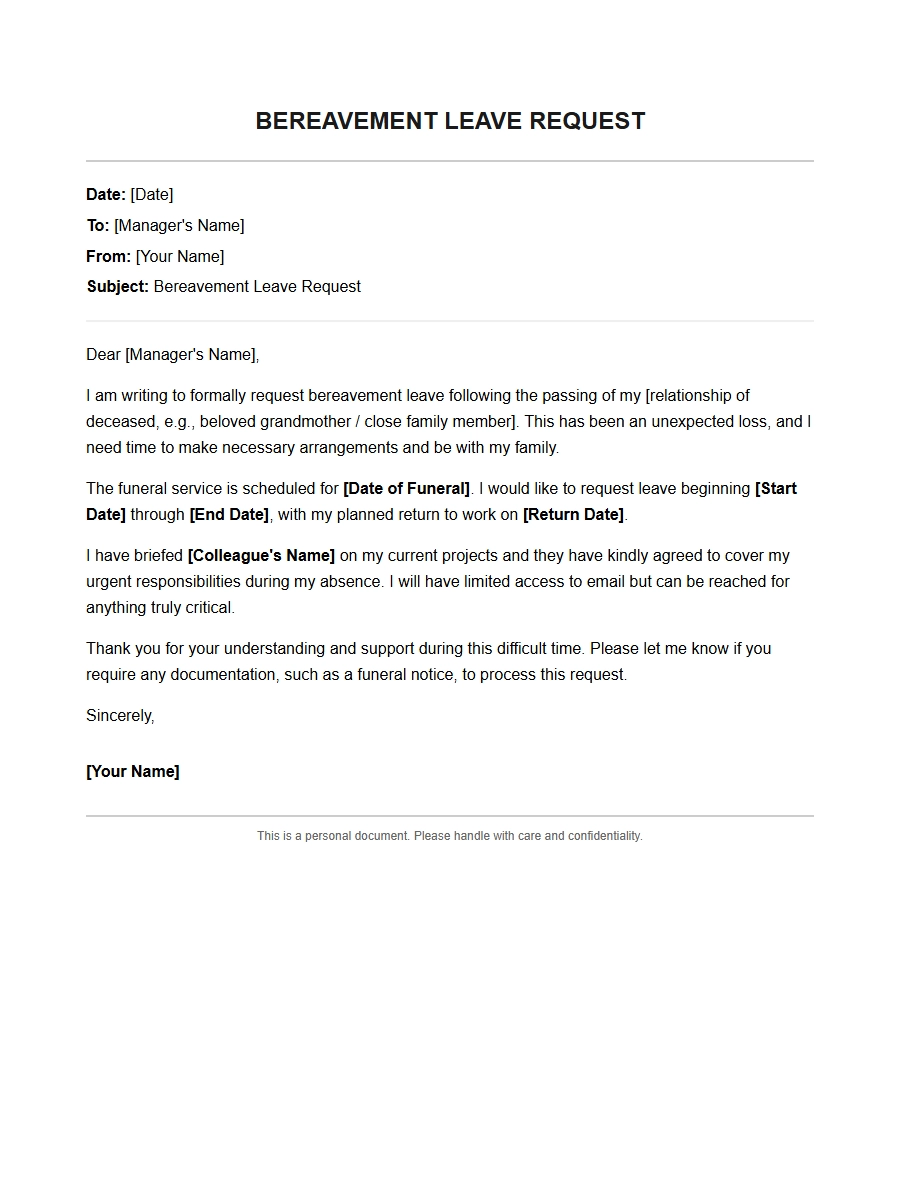
Staring at a blank page when you need to write a bereavement leave request can feel paralyzing. You're already dealing with grief, and now you have to explain your situation to a manager or HR—in the right words, with the right tone, without sounding too stiff or too casual. The good news is that a solid sample turns that anxiety into a confident, polished draft in minutes.
Using a message for bereavement leave request isn't cheating. It's a smart time-saver. A good sample gives you the structure you need—the proper salutation, the respectful opening, the clear request for time off, and a gracious closing. It also helps you avoid accidentally saying something that could be misinterpreted when emotions are raw. You keep your authentic voice by tweaking the sample to match your relationship with your boss and your workplace culture.
Category: Bereavement Leave Request Messages
Every workplace is different, so the first step is choosing the right sample. If you work in a formal office—think law firms, banks, or corporate HQs—you'll want a letter that follows standard business letter format. That means a clear subject line, a formal salutation like "Dear [Manager's Name]," and a closing like "Sincerely" or "With regards." If your workplace is more casual—a startup, a creative agency, a small team—you can adapt the sample to a shorter email format. The key is matching the tone to what your manager expects from everyday professional correspondence.
Once you pick a sample, adapt it without losing your own voice. Start by replacing the generic placeholder name and dates. Then read the opening paragraph aloud. Does it sound like you? If it's too wordy, trim it. If it's too blunt, add a brief personal sentence about your loss—just enough to be human, not a full story. A quick tip: keep the opening paragraph short and direct. Say something like, "I'm writing to request bereavement leave following the death of my [relation]." That grabs attention immediately and shows respect for your manager's time.
Common mistakes can trip you up. One is using outdated salutations like "To Whom It May Concern" in an email when you know your boss's name. Another is ignoring whether you're sending a printed letter or a digital format. In most cases today, a well-formatted email is fine—just remember to include a clear subject line (e.g., "Bereavement Leave Request – [Your Name]"). Don't forget to proofread. Grief can make typos more likely, so read the message twice before hitting send. Consider asking a trusted colleague to glance at it if you're unsure. Good proofreading habits matter in all professional writing, from cover letter examples to resignation letter samples.
Tone is everything in sensitive messages. You want to be professional but not robotic. Avoid overly formal phrases like "I hereby request" unless that's genuinely how your company communicates. At the same time, don't be too casual—using "hey" or emojis in a bereavement request can come across as insensitive. A safe middle ground: polite, clear, and brief. If you're unsure, look at how your manager writes to you in official communications, and mirror that level of formality. Similar principles apply to other sensitive correspondence, such as a message for guest speaker transport delay apology letters or a note for friend stealing item apology letters—the right tone avoids misunderstandings.
Don't overthink the structure. A basic bereavement leave request usually includes: your name, the reason for the request, the dates you'll be away, and an offer to help with handover if needed. If you want to see how professional correspondence handles difficult topics, you might also reference a report for identity theft confirmation fraud apology letters for its formal but calm tone. For more personal touch, a message for girlfriend after argument apology letters can show how tone shifts when the relationship is closer.
Remember, you're not writing a novel. Your manager needs the facts and a clear request. The sample is a springboard, not a crutch. The best bereavement leave messages feel both professional and personal—they show you care about your work and your team, even while you take needed time off. Practice makes this process faster, and next time (though you hope there isn't a next time) you'll know exactly what to write.
Templates and Samples
Apology for Bereavement Leave Request
Late Request Apology
Dear HR Manager,
I am writing to sincerely apologize for submitting my bereavement leave request after the required deadline. The emotional shock of losing my grandmother left me unable to focus on administrative tasks. I now realize that my delay may have caused scheduling difficulties for the team.
Below is a corrected timeline of my request:
Item
Original Date
Corrected Date
Incident date
March 10
March 10
Request submitted
March 12 (late)
March 10 (required)
Leave start
March 11
March 11
I take full responsibility for this oversight and have updated my personal system to prevent future delays. I kindly request that you still process my leave retroactively. Thank you for your understanding.
Sincerely, Jane Doe
Missing Documentation Apology
Dear Leave Coordinator,
Please accept my sincere apology for failing to attach the required proof of relationship and death certificate to my bereavement leave request. I was in a hurry to submit the form between funeral arrangements and accidentally skipped the attachment step.
Here is a checklist of the missing documents I am now providing:
Certified copy of death certificate (attached)
Letter from funeral home confirming service date
Family tree excerpt showing relationship
I have re-submitted the full application via the portal and also emailed a copy to you directly. I understand that incomplete submissions cause extra work for your team, and I will double-check all attachments in the future.
Thank you for your patience in this matter. Best regards, John Smith
Extension Request Apology
Dear Manager,
I need to apologize for the last-minute request to extend my bereavement leave by an additional three days. Unexpected legal matters regarding my father’s estate have arisen, and I cannot return to work as originally planned.
My updated leave schedule is as follows:
Original End Date
Proposed New End Date
Reason for Extension
April 5
April 8
Estate attorney meeting on April 7
I know this disrupts the team’s workflow, and I deeply regret the inconvenience. I will promptly resume my duties upon return and work extra hours to catch up on any missed deadlines.
Please let me know if you need further documentation to approve this extension. Thank you for your compassion during this difficult time.
Respectfully, Emily Chen
Clerical Error Apology
To the Payroll Department,
I am writing to apologize for the clerical error in my bereavement leave request form. I mistakenly entered the leave start date as March 15 instead of March 14. This oversight may have caused confusion in your records and possibly affected my pay calculation.
Here is the corrected information:
Correct start date: March 14, 2025
Original erroneous date: March 15, 2025
End date: March 19, 2025 (unchanged)
I have attached an updated signed form for your files. I apologize for any extra steps this creates for you. I will be more careful when filling out future forms, especially under emotional stress.
Thank you for correcting this on your end. Yours truly, Michael Rivera
Procedure Noncompliance Apology
Dear HR,
I am sorry for not following the standard bereavement leave request procedure. I emailed my manager directly instead of using the leave management system, and I did not copy the HR team. I understand that bypassing the official channel creates record-keeping problems.
To rectify this, I have now submitted the request through the portal with the following details:
Field
Value
Request ID
BL-2025-042
Submission method
Online portal (correct)
Previous method
Direct email (incorrect)
I assure you that I will adhere to the prescribed process for all future leave requests. Thank you for your understanding and for helping me resolve this oversight.
With apologies, Sarah Johnson
Email Subject Typo Apology
Dear Leave Team,
Please accept my apologies for the typo in the subject line of my bereavement leave request email. I typed “Bereavement Leave Request (Urgent)” when the correct subject should have been “Bereavement Leave Request - Immediate Family” as per the guidelines. This may have caused your automated filters to misroute the message.
To clarify, here is the accurate request information:
Employee: David Kim
Relationship: Brother (immediate family)
Leave period: May 10 - May 14, 2025
I have resent the email with the correct subject line and attached the original PDF. I am sorry for any confusion this error caused and will carefully review subject lines in the future.
Thank you for your assistance. Best, David Kim
Emergency Leave Without Approval Apology
Dear Manager,
I am writing to apologize for taking bereavement leave without prior approval. My mother’s sudden passing left me in a state of shock, and I left the office immediately without submitting a formal request. I realize this was unprofessional and disrupted team planning.
I have now completed the necessary paperwork. Below is a summary of the leave:
Date
Action
June 5
Left work abruptly (no approval)
June 6
Submitted emergency leave request
June 7
Attended funeral
June 10
Returned to work
I deeply regret not following protocol. I will ensure that in any future emergency, I at least send a brief notification through the proper channel. Thank you for your generosity in granting retroactive approval.
Sincerely, Amanda Lee
Privacy Detail Refusal Apology
Dear HR Representative,
I apologize for not providing the specific cause of death or detailed personal information about the deceased in my bereavement leave request. I understand that certain documentation is required to validate the absence, but I feel uncomfortable disclosing private medical details.
However, I am able to supply the following verifiable documents without compromising privacy:
Obituary notice (confirming name and date of death)
Signed letter from my pastor confirming the funeral service
Medical certificate with cause of death redacted (if acceptable)
I hope these alternatives satisfy the policy requirements. If you need additional verification, please let me know what options are available that respect family privacy. Thank you for your understanding.
With respect, Robert Thompson
Missed Deadline Apology
To the Benefits Office,
I sincerely apologize for missing the 30-day deadline to submit my bereavement leave paperwork. The combination of grief and travel for the funeral caused me to overlook this requirement. I am now submitting the completed forms, though they are two weeks late.
Enclosed documentation includes:
Document
Status
Leave request form
Completed
Death certificate
Attached
Supervisor approval
Signed (dated today)
I understand that late submissions may result in unpaid leave or other penalties. I accept responsibility for my delay and kindly request you consider any exceptions. I will set calendar reminders to avoid this in the future.
Thank you for your grace during this difficult period. Yours, Patricia Adams
Canceled Meeting Apology
Dear Team,
I must apologize for canceling yesterday’s project meeting at the last minute due to a sudden bereavement. I understand that my absence caused rescheduling challenges and disrupted your workflow. The meeting was important, and I regret not being able to attend.
To make amends, I have taken the following steps:
Rescheduled the meeting for next Tuesday at 10 AM
Shared my notes and agenda ahead of time
Assigned a temporary lead in my absence
I also want to assure you that my bereavement leave request has been properly filed with HR. I will keep you updated on my return date. Thank you for your flexibility and compassion during this loss.
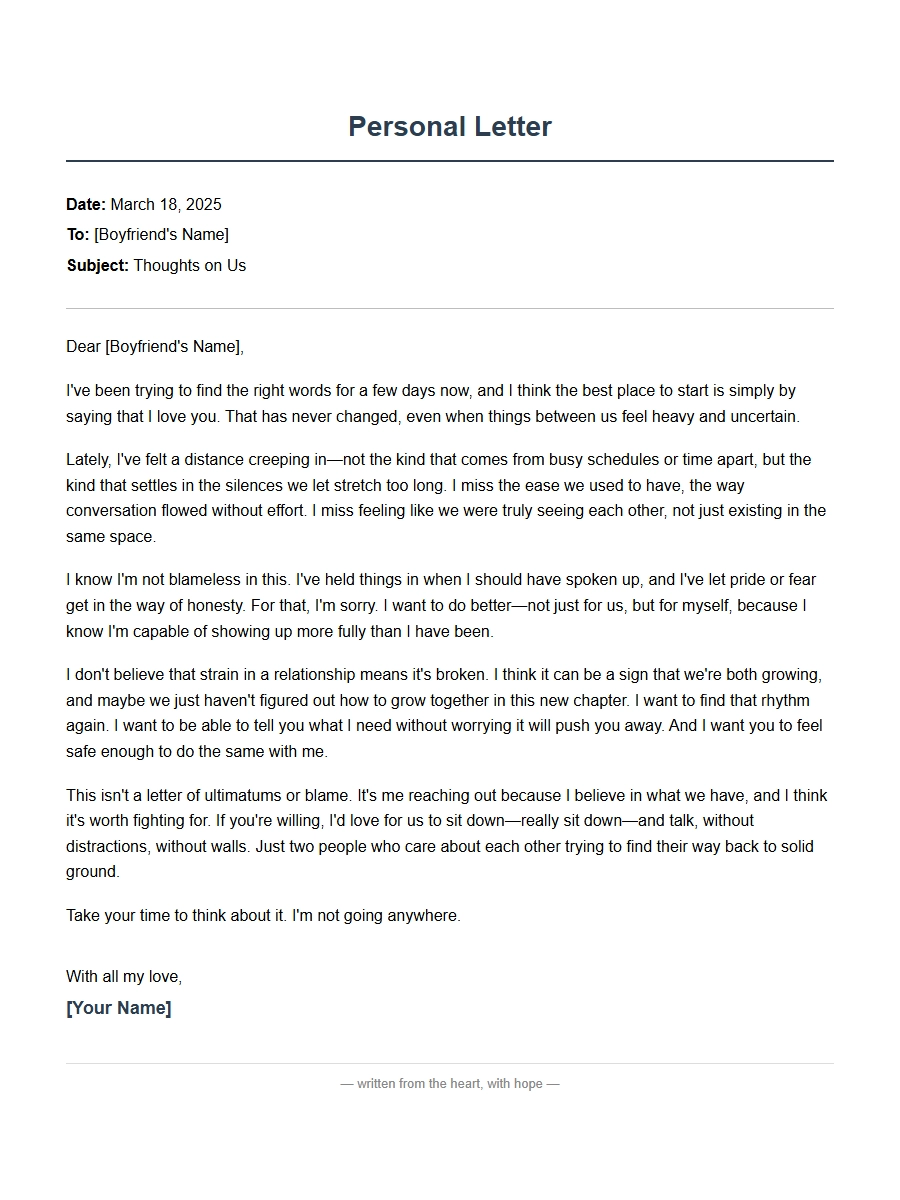 Personal Apology Letter for Boyfriend Relationship Strain
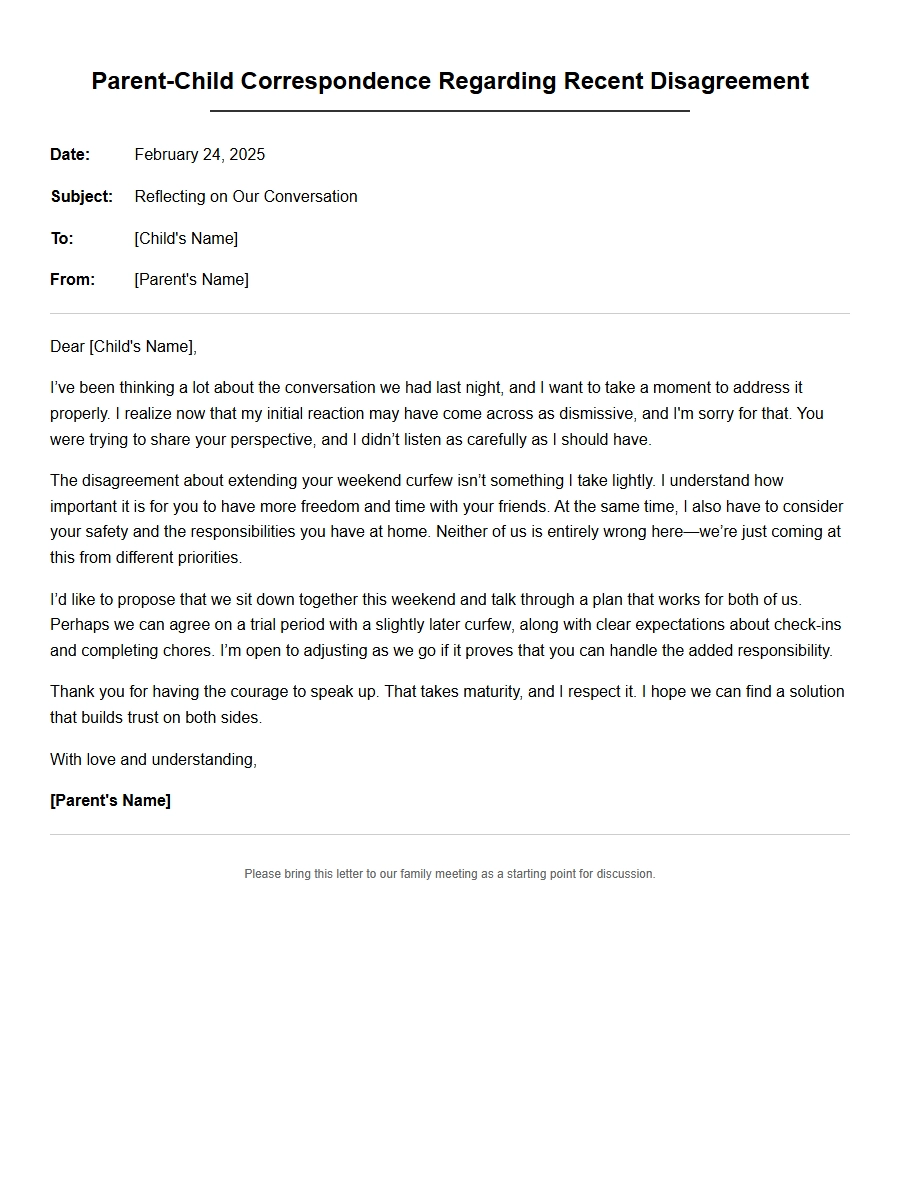 Apology Correspondence for Parent-Child Disagreements
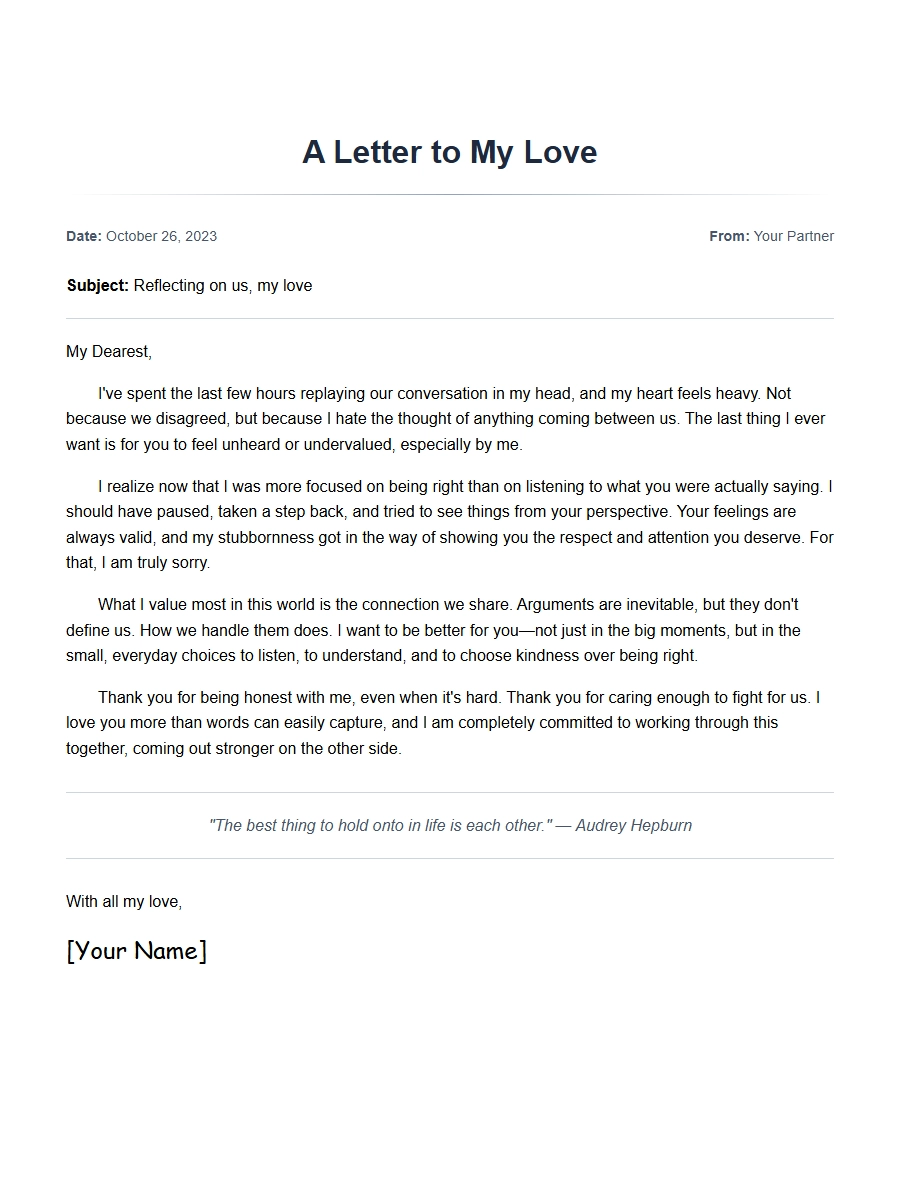 Apology Message for Girlfriend After Argument
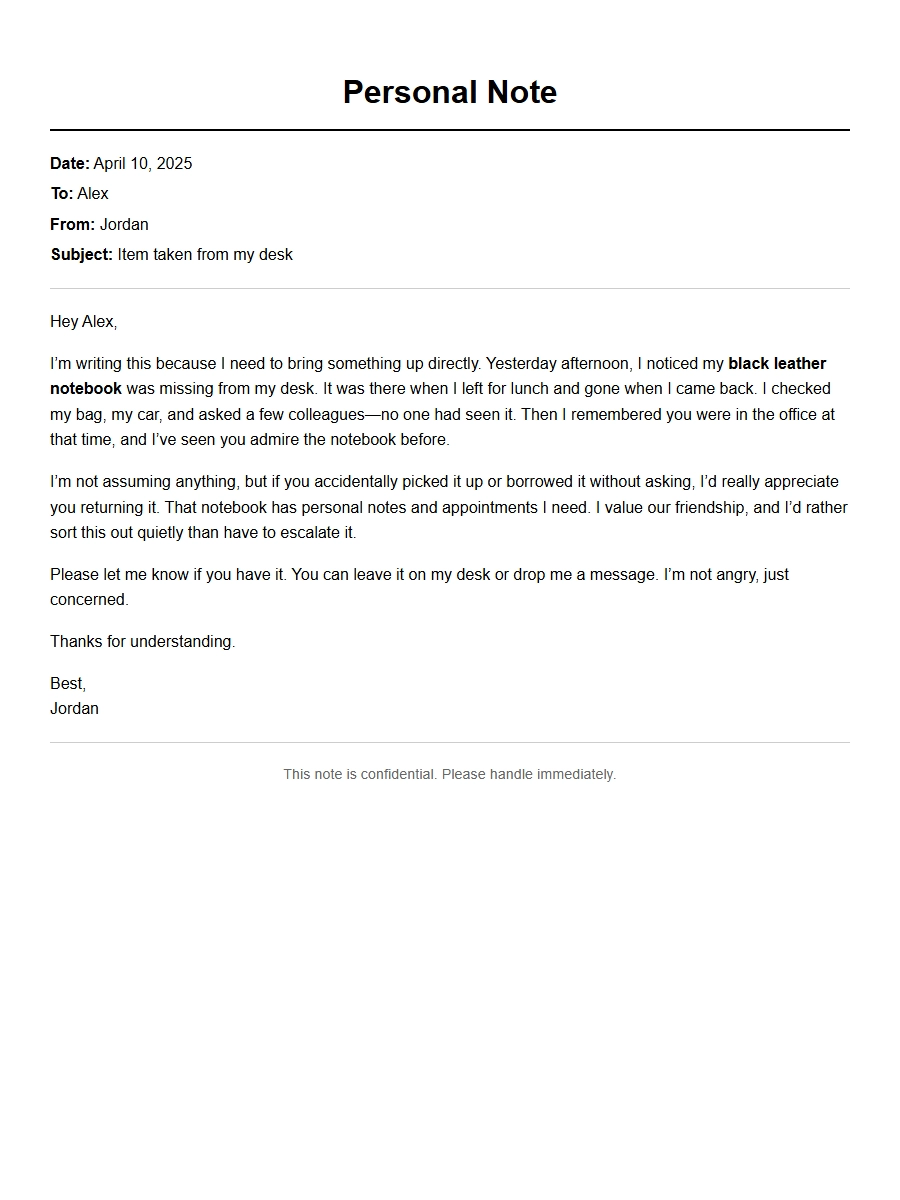 note for friend stealing item - Apology Letters
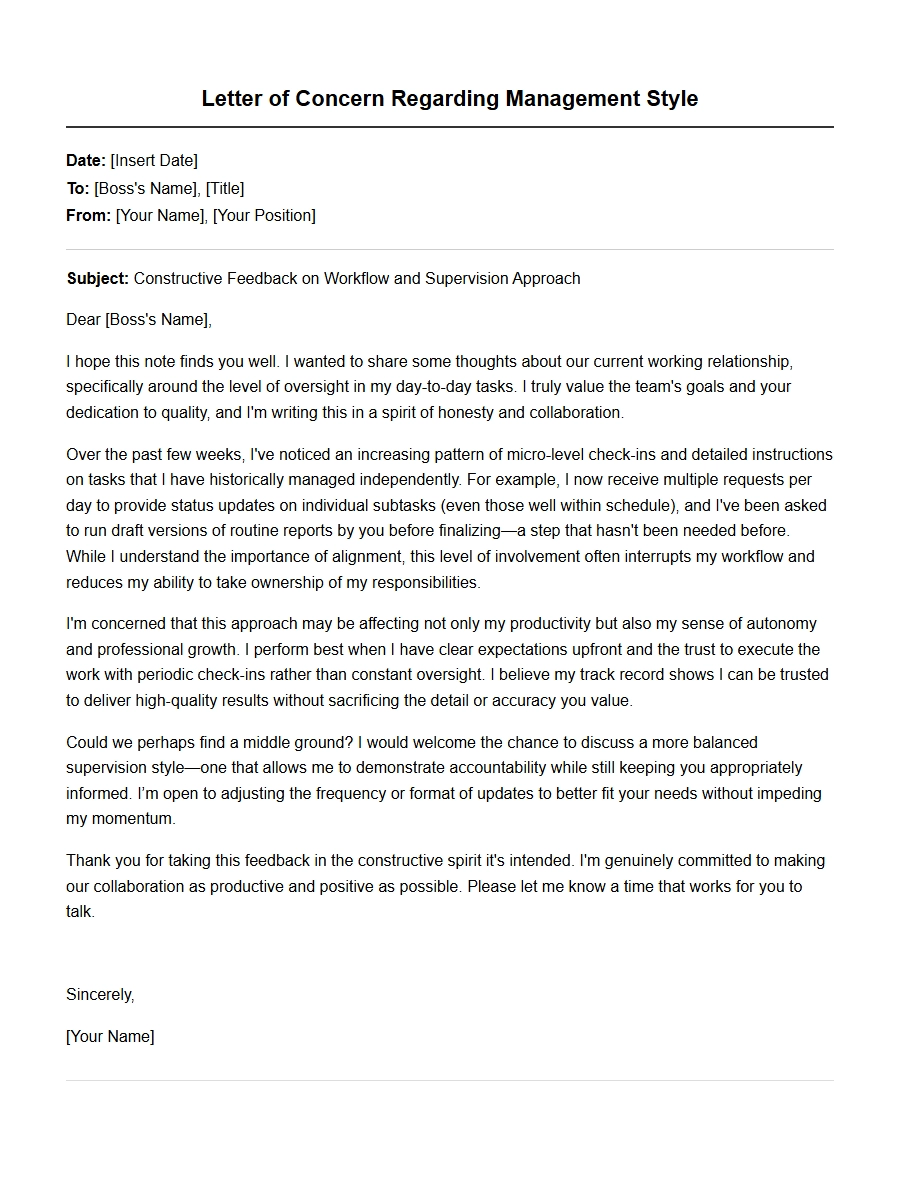 Apology to Boss for Micromanagement Complaint
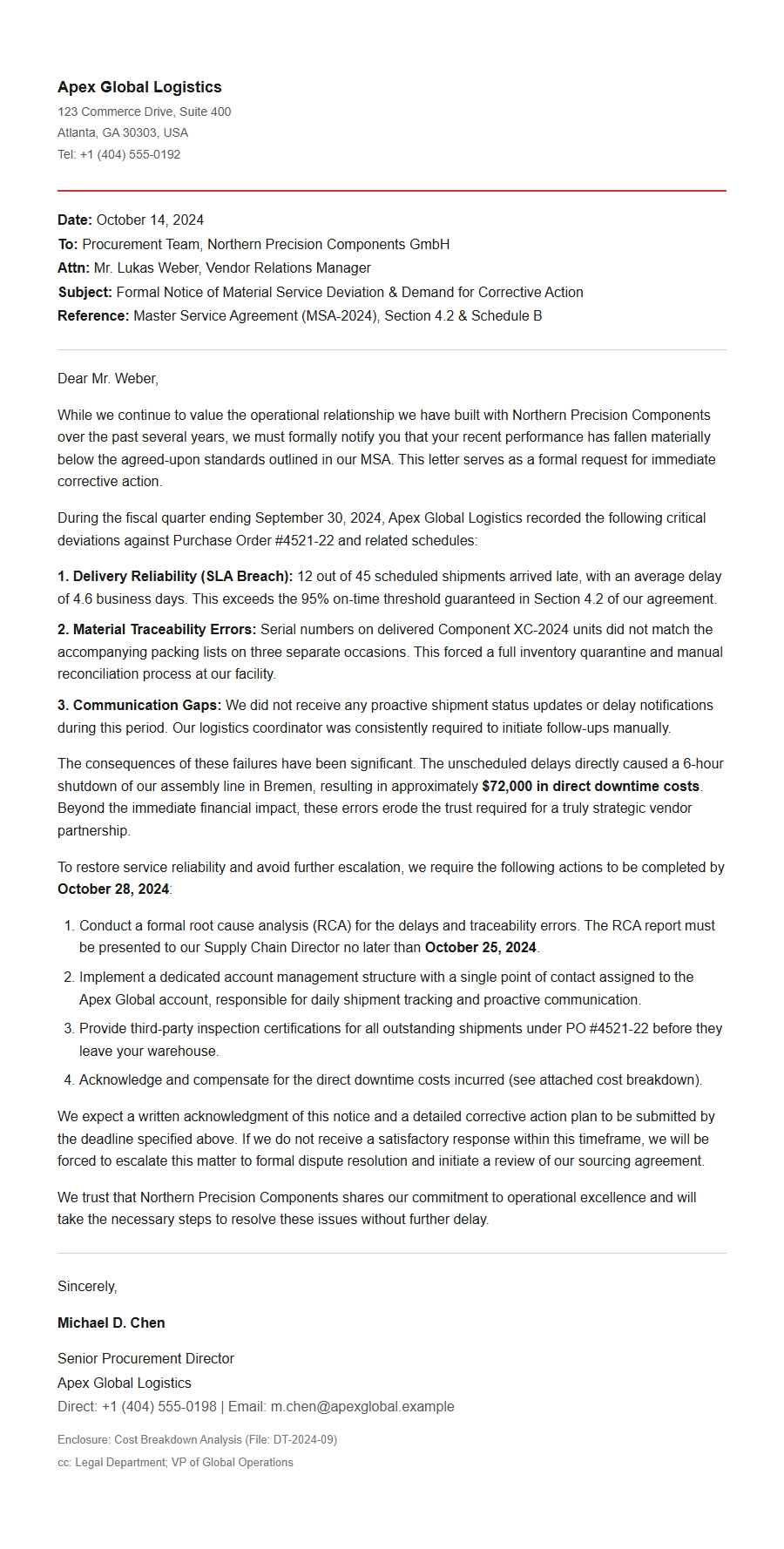 Apology Document for Vendor Supply Chain Issue