You were just in a ride share accident. Maybe your driver hit someone, or another car hit you while you were in an Uber. Now you’re staring at a blank screen, trying to write a letter about liability. Who do you send it to? What do you say? The pressure is real because one wrong phrase could affect your claim.
Let’s be honest: writing this kind of letter is stressful, and most people don’t do it every day. That’s exactly why using a letter template isn’t cheating—it’s a smart way to get the structure right. A good sample gives you the proper tone, the necessary legal phrases, and the correct format. You just personalize it with your details. It saves time and cuts down mistakes.
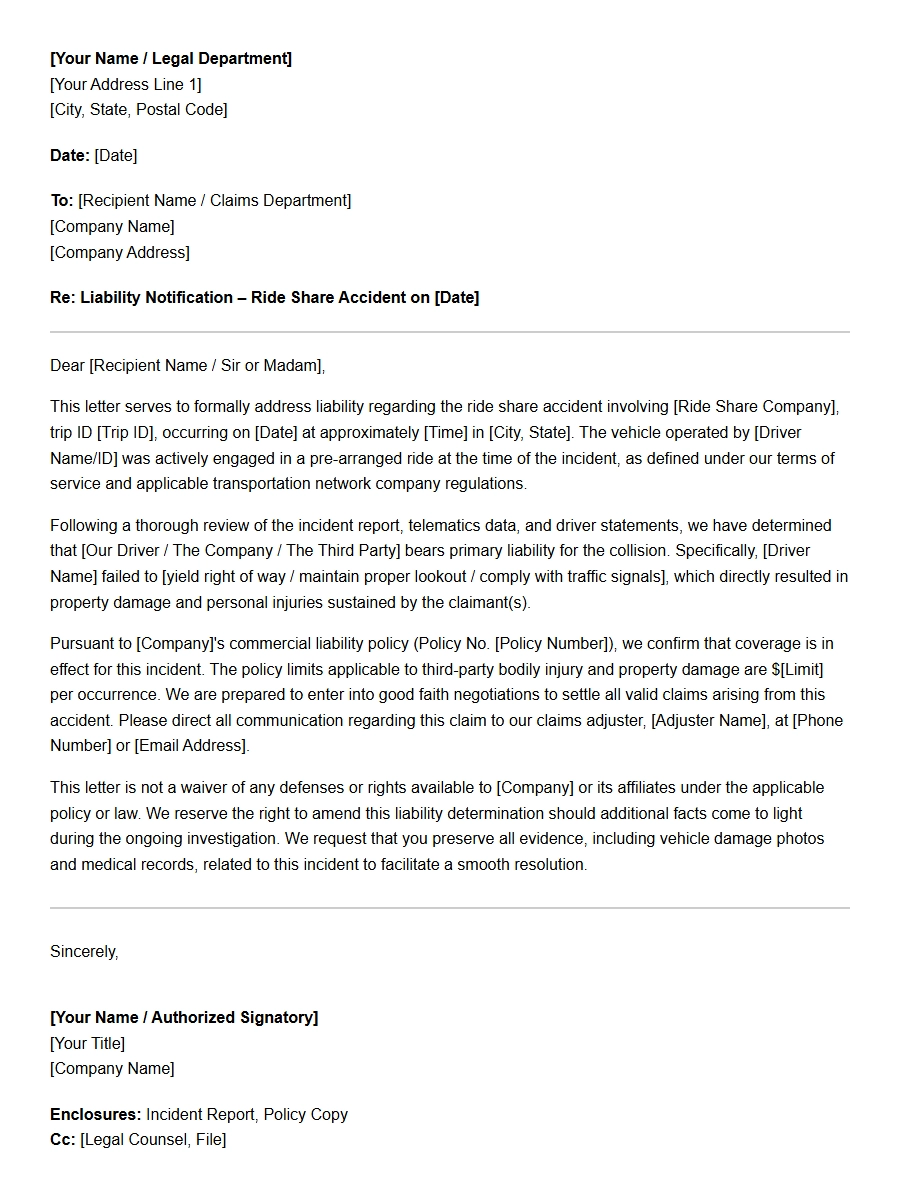
This type of letter falls under the broader category of legal correspondence, but ride share accidents have unique rules because both the driver’s personal insurance and the company’s policy may apply. Let’s walk through how to write a letter for ride share accident liability that actually works.
What is a ride share accident liability letter?
It’s a formal letter you send to the ride share company (Uber, Lyft, etc.), the driver’s insurance, or the other party’s insurance after a crash. The letter explains what happened, states who you believe is at fault, and sometimes demands compensation or denies liability. You might also need one to clarify that you were a passenger and not responsible. The goal is to create a clear, professional record.
Whether you’re a passenger, a driver, or a third party, your letter needs to be precise. Vague language like “I think the other driver was speeding” won’t help—you need facts: time, location, police report number, and any dashcam footage. That’s where a sample becomes your guide.
How to choose the right sample for your situation
Not all ride share accident letters are the same. If you were a passenger injured by your driver’s negligence, your letter should focus on the driver’s duty of care. If you were the ride share driver and you hit someone, your letter may admit partial fault or explain why you weren’t to blame. Look for a professional correspondence sample that matches your role. Avoid generic “car accident letter” templates that ignore ride share policies—they often use outdated business letter format rules that don’t fit an email or digital submission.
Pay attention to the salutation and closing. For a formal letter to an insurance adjuster, use “Dear [Name]” and “Sincerely.” For an email to ride share support, a simpler “Hello” works, but keep the closing professional. Many people mess up by addressing “To Whom It May Concern” when they could easily find the claims department name online.
Adapt the sample without losing your voice
Take the sample’s structure—opening, facts, demand, closing—and rewrite it in your own words. Change phrases like “the incident occurred on” to “the accident happened on” if that sounds more natural. The key is to keep the tone in writing consistent: factual, polite, and direct. Don’t copy jargon you don’t understand. If the sample says “I hereby notify you of my intent to pursue a claim,” and you’re just reporting an incident, simplify it: “I am writing to notify you of my claim.”
A quick tip: tailor your opening paragraph to grab attention. Instead of “I am writing regarding an accident,” say “On March 12, I was a passenger in your driver’s vehicle when it was hit by another car on I-95.” That tells them immediately who you are and why you’re writing.
Common mistakes to avoid
One big error is ignoring whether the letter will be printed or sent digitally. If you’re sending it via email, skip letterhead design—use a clear subject line and include your contact info in the signature. If you print it, use a standard digital letter format (PDF) to keep the formatting intact. Another mistake is forgetting to proofread. Even a small typo in a date or police report number can cause delays. Always read it aloud before sending.
Don’t forget to keep a copy for yourself. After you send the letter, follow up with a phone call or email to confirm receipt. For example, if you’re writing to clarify a policy waiver related to the accident, you’ll want proof that the company received your letter.
When and why you’d use this letter
You might need to write one right after the accident to protect your rights. Insurance companies move fast, and if you delay, they may deny coverage. A well-written letter establishes a timeline and shows you’re serious. For instance, if the other driver claims you were at fault, your letter can explain why the ride share driver was liable—like running a red light.
A sample letter won’t do the work for you, but it gives you a solid foundation. The best letters feel both professional and personal—they show you know the facts and you’re prepared. Write your draft, set it aside for an hour, then come back and revise once. You’ll catch awkward sentences and missing details.
Over time, writing these letters gets faster. You’ll learn what works and what doesn’t. For now, start with a trusted template, adapt it to your voice, and send it with confidence. One letter is all it takes to get the process moving.
Practical Writing Samples
Apology Letter for Ride Share Accident Liability
Driver's Apology to Passenger for Injury
Date: October 15, 2024
To: Mr. James Carter
From: Sarah Mitchell, Rideshare Driver
Re: Apology for Accident on October 12, 2024
Dear Mr. Carter,
I am writing to sincerely apologize for the accident that occurred during your ride on October 12. I understand that you sustained injuries and were taken to the hospital. I deeply regret that my failure to check the intersection properly caused this unfortunate event.
Please find below my insurance and contact details:
Item
Details
Insurance Provider
SafeRide Insurance Co.
Policy Number
POL-8743-XYZ
Claim Number
CL-2024-112
My Phone
(555) 123-4567
I have already reported the incident to my insurance company, and they will be contacting you shortly to cover your medical expenses. I am also available to provide any further information needed. Please accept my heartfelt apologies. I am committed to making sure your recovery is supported.
Sincerely, Sarah Mitchell
Driver's Apology to Other Driver for Accident
Date: November 2, 2024
To: Mr. Robert Lee
From: Emily Tran, Rideshare Driver
Re: Apology for Collision at 5th and Main on October 30
Dear Mr. Lee,
I am writing to express my deepest apologies for the accident on October 30 when my vehicle struck yours at the intersection of 5th and Main. I fully accept liability for the incident, as I failed to yield the right of way. I understand the inconvenience and damage this has caused you.
Below is a summary of the damage to your vehicle as noted in the police report:
Left rear bumper: cracked and detached
Tail light assembly: shattered
Rear quarter panel: dented
My insurance, National Auto Shield (Policy #NAS-7621), has been notified and will handle your repair costs. I have also attached a copy of the police report (Case #1024-3301). Please contact me if you need any additional documentation. I hope you are doing well, and again, I am truly sorry for my mistake.
Respectfully, Emily Tran
Rideshare Company Apology to Injured Passenger
Date: December 5, 2024
To: Ms. Linda Garcia
From: RidePlus Customer Relations
Re: Apology for Accident on Trip #98923 on Nov 28, 2024
Dear Ms. Garcia,
On behalf of RidePlus, I want to sincerely apologize for the accident you experienced during your trip on November 28. Our driver, Mr. Davis, operated his vehicle in a manner that caused the collision, and we take full responsibility for the injuries and distress you suffered.
We have arranged for your medical bills to be covered through our corporate liability policy. Below are the relevant contact points:
Department
Contact
Reference
Claims Handling
claims@rideplus.com
Case CP-4002
Medical Coordinator
(800) 555-0199
Ext. 33
Ride Support
support@rideplus.com
Trip ID 98923
We have also suspended the driver pending investigation. Please do not hesitate to reach out if you have any further needs. We value your safety and are committed to preventing future incidents. Again, our sincerest apologies.
Warm regards, Jennifer Wong Customer Relations Supervisor
Driver's Apology for Property Damage to Homeowner
Date: January 10, 2025
To: Mr. and Mrs. Patterson
From: Dave Kim, Rideshare Driver
Re: Apology for Damage to Your Property on Jan 8, 2025
Dear Mr. and Mrs. Patterson,
I am writing to sincerely apologize for the damage caused to your front fence and gate when I lost control of my vehicle while dropping off a passenger on Oak Street. I understand that my car struck your property at approximately 9:30 PM on January 8. I fully accept liability.
Here is a list of the damages I observed:
Wooden fence panel: 3 sections broken
Metal gate: bent hinge and latch
Concrete pillar: cracked at base
My insurance information is as follows:
Provider
Policy #
Contact
Farmers Insurance
FARM-3309-AB
(555) 234-5678
Agent
Allison Reed
allison.reed@farmers.com
I have already filed a claim and will ensure that a contractor is sent to repair the damage. Please accept my apologies for the inconvenience. I am happy to cooperate fully and provide any additional documentation.
Sincerely, Dave Kim
Driver's Apology to Pedestrian
Date: February 20, 2025
To: Ms. Helen Torres
From: Michael Brown, Rideshare Driver
Re: Apology for Accident on Feb 18, 2025 at Market St.
Dear Ms. Torres,
I am writing to express my deepest regrets for the accident that occurred on February 18 when I struck you while crossing Market Street. I was distracted by the navigation screen and failed to see you in the crosswalk. I am fully aware that my negligence caused your injuries, and I am truly sorry.
I have taken the following steps to address this incident:
Reported to my insurance (Policy #RIDE-4521) claim #CL-2580
Provided a statement to the police (Report #2025-0321)
Arranged for an immediate medical assessment
Please find my contact details below:
Field
Information
Phone
(555) 789-0123
Email
mbrown.driver@email.com
Insurance Contact
(555) 876-5432
I intend to cover all your medical expenses and any lost wages. Please contact me so that we can discuss a fair compensation. Again, I am deeply sorry for the pain and fright I caused.
With remorse, Michael Brown
Driver's Apology to Employer for Using Personal Vehicle
I am writing to apologize for the accident that occurred on March 3 while I was driving my personal vehicle during work hours. I understand that I was logged into the rideshare app on a break, but the collision happened when I was not carrying a passenger. I realize this incident may reflect poorly on my professionalism and on the company.
The accident details are as follows:
Location: 42nd Ave and Broadway
Time: 2:15 PM
Damages: Minor rear-end collision
Police report: #2025-0450
I have attached the accident report and my insurance information. I assure you that I will take full responsibility for any liability that arises. I will also review company policies to ensure my driving habits align with expectations. Please consider this letter as an official apology. I hope to continue my association with the company and will take steps to avoid any recurrence.
Thank you for your understanding. Alicia Vargas
Driver's Apology to Customer for Delayed Trip
Date: April 12, 2025
To: Ms. Olivia Chen
From: James O'Neil, Rideshare Driver
Re: Apology for Accident-Caused Delay on April 10
Dear Ms. Chen,
I want to apologize for the significant delay you experienced during your ride on April 10. Due to an accident involving my vehicle while en route to pick you up, I was unable to arrive on time. I understand that you missed an important meeting because of this, and I am very sorry.
I have already contacted the rideshare company to waive your trip fee and provide a compensation credit. Below is a summary of the incident:
Item
Detail
Original Pickup
7:30 AM at 123 Elm St.
Accident Time
7:35 AM
Your Arrival Delay
45 minutes
Compensation Issued
$20 credit (Trip #4402)
I assure you that the accident was minor and no one was hurt, but it required police documentation. I have learned to better anticipate alternate routes. Again, please accept my sincere apologies for the inconvenience. I value your safety and punctuality.
Best regards, James O'Neil
Driver's Apology for Hit-and-Run Incident (After Discovery)
Date: May 1, 2025
To: Mr. David Park
From: Lisa Huang, Rideshare Driver
Re: Apology for Leaving Scene of Accident on April 25
Dear Mr. Park,
I am writing to sincerely apologize for my inexcusable actions on April 25. After reviewing dashcam footage and contacting the police, I have realized that I was the driver who struck your parked car and then left the scene. I was panicked and made a terrible decision. I take full responsibility for the hit-and-run.
I have reported this incident to my insurance (Policy #SAFE-6183) and to the police (Report #2025-0782). The damage to your vehicle includes:
Driver-side mirror: broken off
Front bumper: scraped and detached
Hood: dent near headlight
I am prepared to pay for all repairs out of pocket if your insurance does not cover it. Please contact me at (555) 234-8901 or lisa.h.driver@email.com to discuss compensation. I am ashamed of my behavior and promise to cooperate fully. I hope you can accept my apology.
With regret, Lisa Huang
Passenger's Apology for Causing Distraction
Date: May 20, 2025
To: Laura Simmons, Rideshare Driver
From: Mark Johnson
Re: Apology for My Role in Accident on May 18
Dear Ms. Simmons,
I am writing to apologize for my behavior during the ride on May 18, which I believe contributed to the accident. I was loudly on the phone and demanding that you take a shortcut, causing you to become distracted. I deeply regret my actions and the resulting collision with the median.
Although the damage was minor (scratched right side and a flat tire), I understand that my distraction could have led to a serious injury. I want to take responsibility for my part. Please find below my contact information and offer to cover any costs not handled by insurance.
My phone: (555) 342-1122
Insurance: I have no liability coverage as a passenger, but I am willing to pay up to $500 for damages.
I have spoken with the rideshare company and requested they not penalize you. I also promise to be more considerate in future rides. I hope you accept my apology and that you are doing well after the incident.
Sincerely, Mark Johnson
Driver's Apology for Accident Caused by Medical Episode
Date: June 8, 2025
To: Mr. Andrew Cruz (other driver)
From: Patricia Ng, Rideshare Driver
Re: Apology for Collision Due to Sudden Illness on June 6
Dear Mr. Cruz,
I am writing to apologize for the collision on June 6 at the intersection of Lake and Park. I suffered a sudden drop in blood sugar that caused me to lose consciousness for a few seconds, leading to my car crossing into your lane. I want to assure you that this was not intentional or due to negligence; I have since been medically evaluated and am now managing my condition.
I am fully cooperating with authorities and my insurance company (HealthFirst Auto, Policy HF-4591) to cover all damages to your vehicle. Below is a list of damages to your car as per the adjuster:
Part
Estimated Repair Cost
Left front fender
$1,200
Headlight assembly
$800
Bumper cover
$600
I am deeply sorry for the inconvenience and the sudden nature of this accident. I have attached a doctor's note and the police report (Case #2025-0911). Please feel free to contact me if you need anything further.
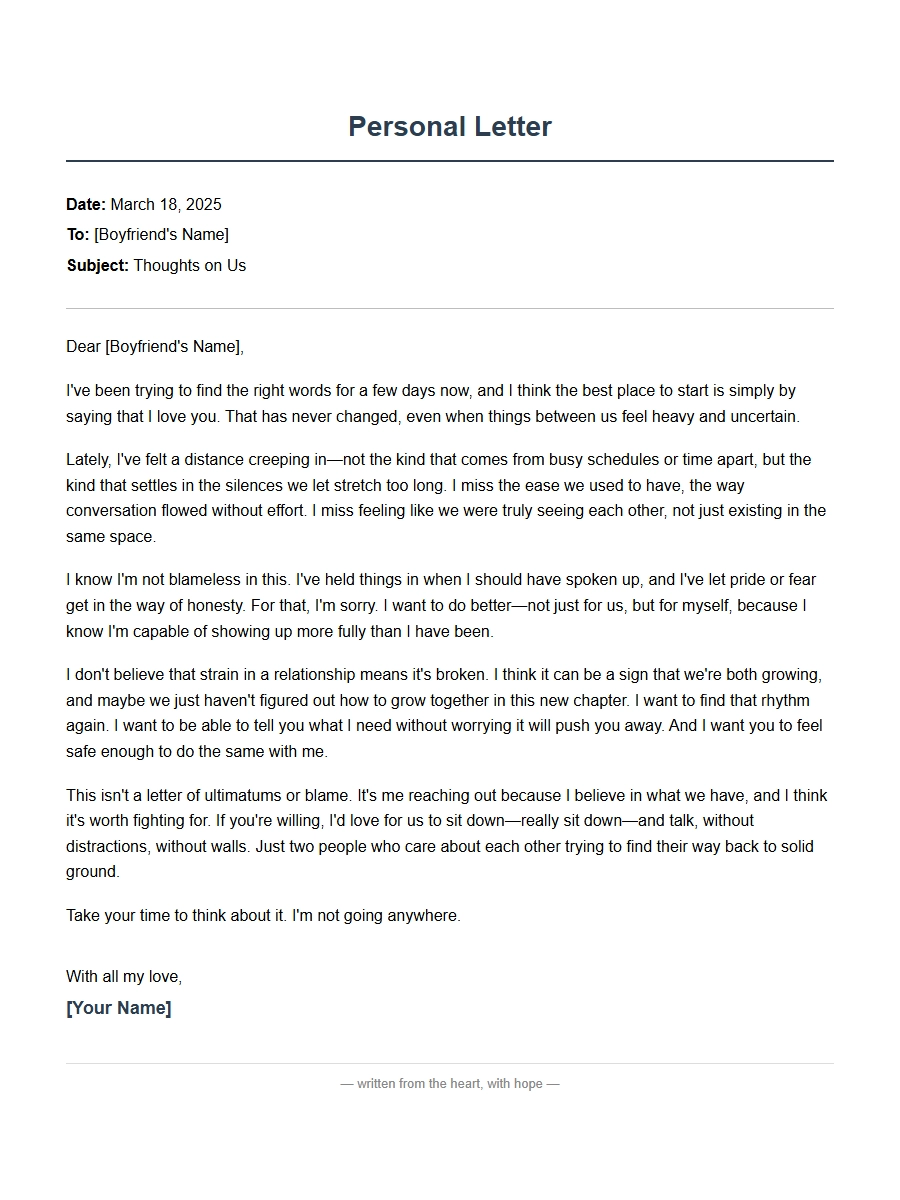 Personal Apology Letter for Boyfriend Relationship Strain
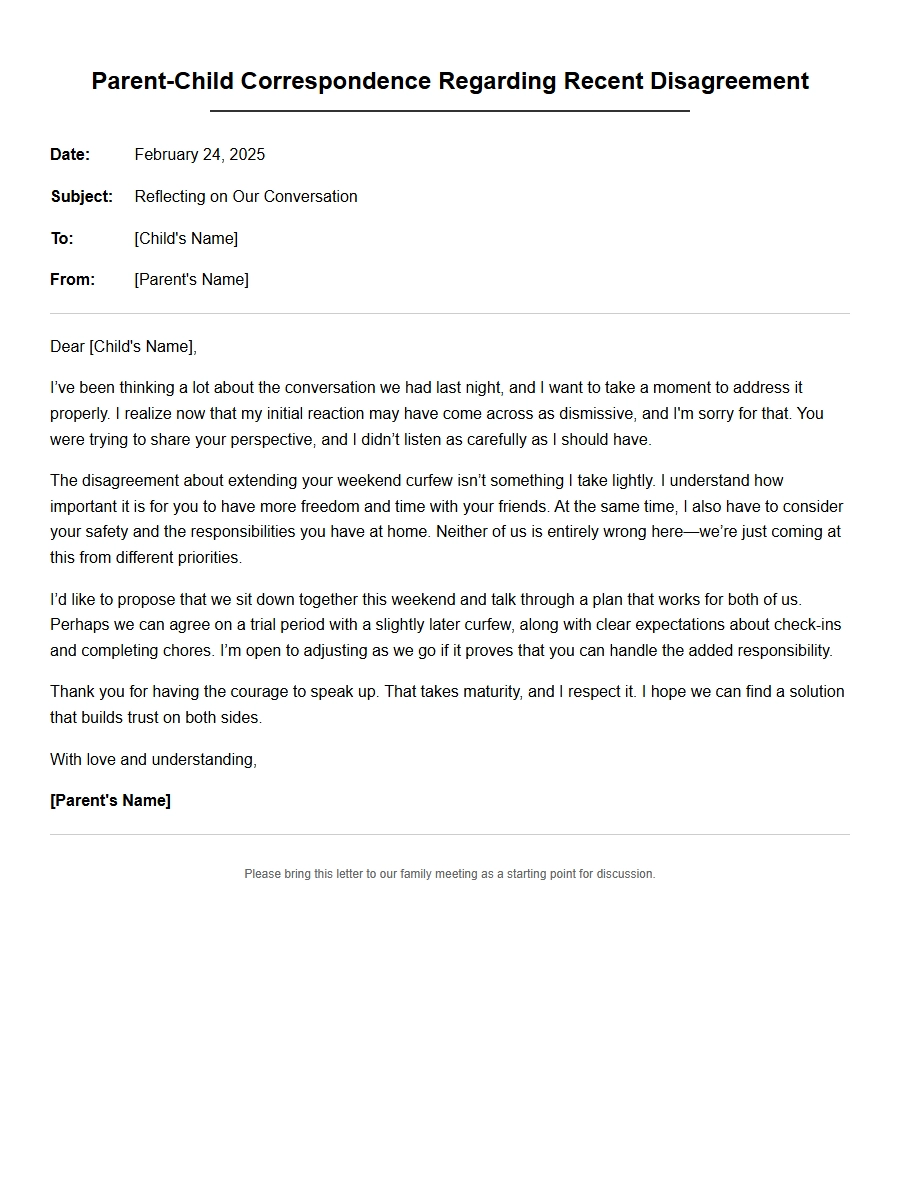 Apology Correspondence for Parent-Child Disagreements
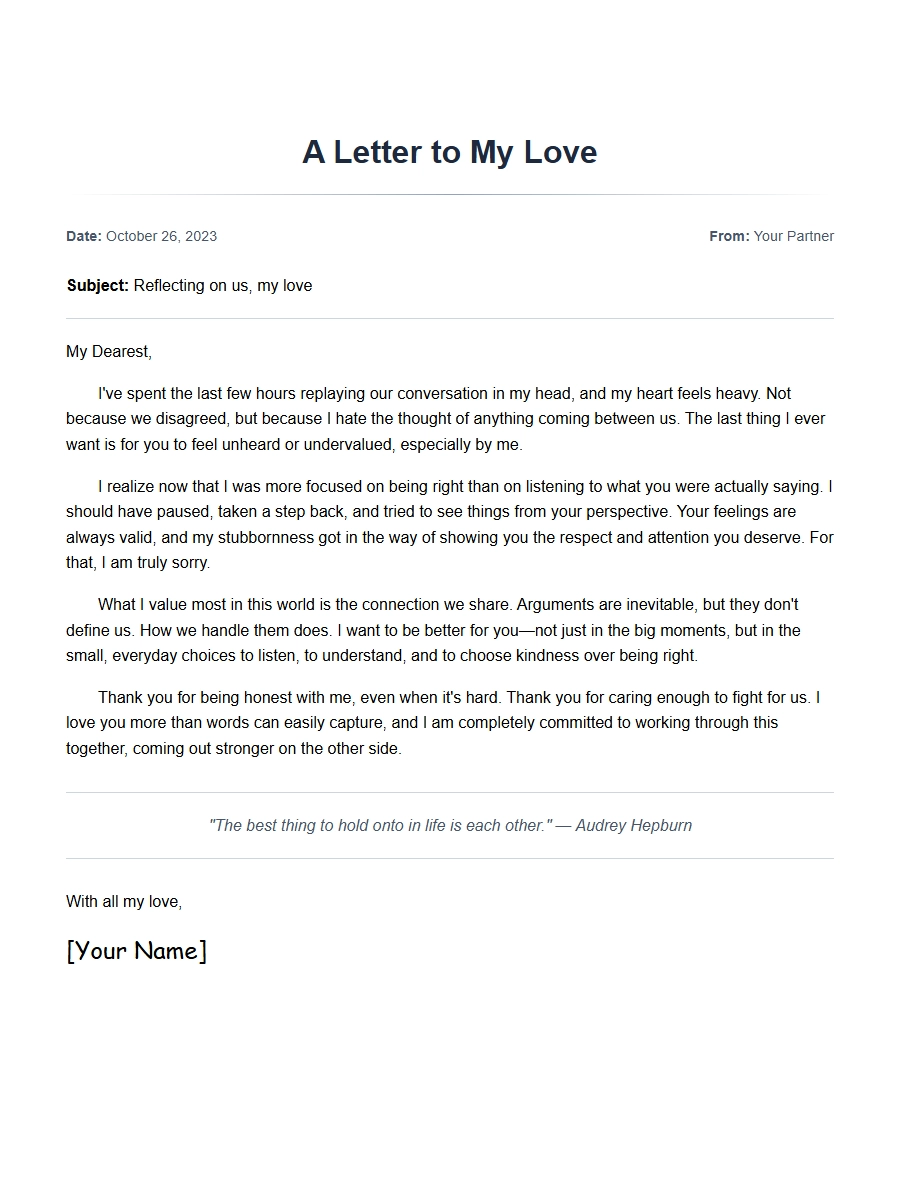 Apology Message for Girlfriend After Argument
 note for friend stealing item - Apology Letters
 Apology to Boss for Micromanagement Complaint
 Apology Document for Vendor Supply Chain Issue