You’ve identified a promising business partner, sketched out the shared goals, and even agreed on a rough split of responsibilities. But when it comes to putting that joint venture collaboration proposal letter into words, your cursor just blinks at a blank screen. It’s a familiar frustration—one that has little to do with your idea and everything to do with translating vision into professional correspondence.
Reaching for a well‑written sample isn’t cutting corners. It’s working smart. A solid letter template gives you the structure, tone, and key phrases that belong in any serious business proposal. The trick is knowing how to use it without losing your own voice—or the specific details that make your partnership unique.
Why a joint venture proposal letter needs more than a handshake
A joint venture isn’t a casual arrangement. It’s a formal alliance where both parties invest resources, share risk, and expect clear terms. Your proposal letter sets the tone for that relationship. It should show that you’ve thought through the logistics, understand each other’s strengths, and respect the formalities of business letter format. Too casual and you risk looking unprepared; too stiff and you sound like a legal document, not a collaborator.
Think of the sample as a framework you’ll fill with your own details. Use it to nail the salutation and closing, choose the right level of formality, and structure your argument so that the reader immediately grasps the mutual benefit.
How to adapt a sample without sounding like a robot
First, pick a sample that matches your situation. A joint venture proposal between two small agencies will sound different from one between a tech startup and a manufacturing firm. Look for examples that mirror your industry and the kind of partnership you’re building. If your venture involves legal services or professional consulting, a sample from a related field—like a legal services engagement proposal letter—can teach you the right level of specificity and contractual language.
Once you have a sample, read it through once for tone. Then rewrite the opening paragraph in your own words. That’s where you grab attention. Lead with your shared opportunity, not with a generic “We are pleased to propose.” Instead try: “Your team’s distribution network and our product development experience could double market reach within twelve months. Here’s how we see that working.” That kind of opening is both professional and personal, and it makes the reader feel like a partner, not a target.
Now go through the rest of the letter. Replace placeholder percentages and dates with real figures. Change the company names everywhere. Keep the structure—why this collaboration, what each party brings, proposed terms, next steps—but make every sentence yours. A good new client acquisition proposal letter follows a similar arc: establish need, present your solution, and ask for action. The same logic applies here, except the “solution” is a mutual venture.
Common mistakes that kill credibility
One of the fastest ways to undermine your proposal is using an outdated salutation. “To Whom It May Concern” suggests you didn’t bother to learn the recipient’s name. Always address the person who will actually review the proposal. If you’re sending the letter by email, keep the format digital—no header images that don’t render, no attachments that aren’t clearly labeled. If it’s a printed letter, use clean letterhead design that matches your brand.
Another mistake: ignoring the closing. A joint venture proposal should end with a clear call to action. “I’ll call your office next Tuesday to discuss next steps” is better than “We look forward to hearing from you.” It shows you’re serious and you have a timeline. Proofread the letter twice—once for spelling and grammar, once for tone. A small typo in a number or name can make you look careless.
And don’t forget the category. Formal writing tips suggest labeling your document clearly so it’s easy to file. For instance, you might include a line: Category: Business Proposal Letters at the top of the body or as a subject line. It helps both you and the recipient keep things organized.
Tone is a tool, not a trap
The best joint venture letters feel like two colleagues having a focused conversation. Use “you” and “us” naturally. Avoid over‑explaining concepts your partner already knows. If you’re both experienced in your fields, skip the background lessons. Instead, demonstrate your expertise by being concise and precise. If you’re writing to a larger firm that might be unfamiliar with your niche, add a short sentence of context—but keep it brief.
Ever received a letter that felt too stiff or too casual? You know how quickly it erodes trust. Aim for a tone that’s respectful but not robotic, confident but not arrogant. If you’re unsure, read the letter out loud. If you stumble over a sentence, rewrite it. And remember that a law firm hiring consultant proposal letter can show you how to balance legal precision with approachable language—a good model for any joint venture that involves formal agreements.
Your sample is a springboard, not a script
Once you’ve adapted the template, set it aside for a few hours. Come back with fresh eyes and ask yourself: Does this sound like me? Does it truly reflect the opportunity we’re building together? If the answer is yes, you’re ready to send it. If not, adjust until the personal details outweigh the boilerplate.
Writing a joint venture proposal letter gets easier every time you do it. The first one takes the most effort—but with a good sample and a clear idea of what you want to say, you’ll move from blank page to polished draft in minutes. And that draft, with its blend of professional structure and authentic voice, is what convinces the other party to say yes.
Samples You Can Use
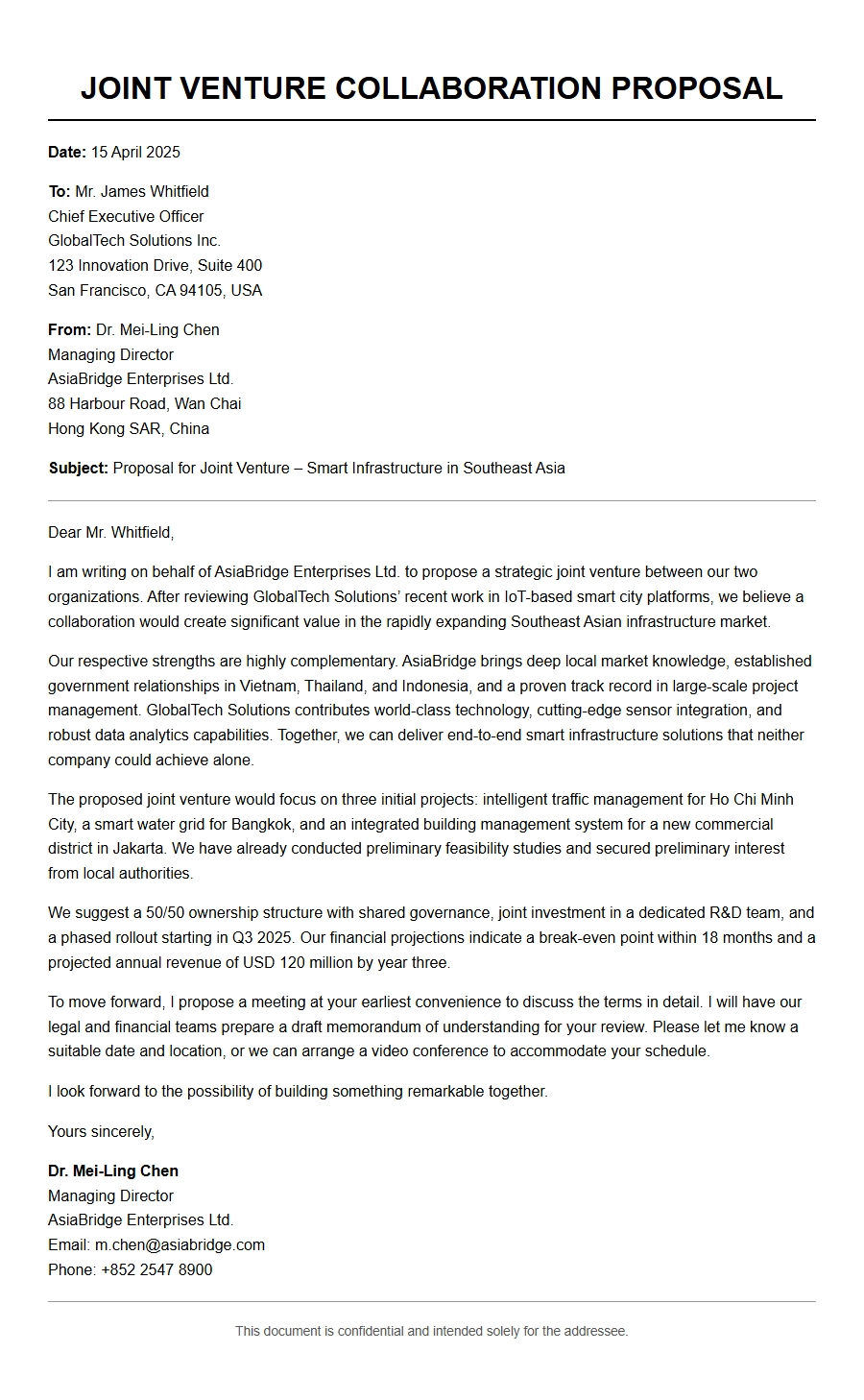
Joint Venture Collaboration Proposal Letter
Joint Venture for Tech Innovation
Proposal Date: 2025-06-15
To: Board of Directors, NovaTech Corp.
From: InnoSphere LLC
We propose a joint venture to combine NovaTech's enterprise software platform with InnoSphere's AI-driven analytics engine. This collaboration will deliver a next-generation customer intelligence suite.
Parameter
Details
Equity Split
50% NovaTech / 50% InnoSphere
Initial Investment
$2.5M (cash & IP contribution)
Revenue Sharing
Proportional to equity after operational costs
Management
Joint committee with rotating chair
Term: 5 years with renewal option.
Please review the attached term sheet. We welcome a discussion to refine the scope.
Real Estate Development Collaboration
Date: 2025-07-01
To: Greenfield Property Group
Subject: Mixed-Use Development JV Proposal
We propose a 50/50 joint venture to develop a 12-acre parcel in Austin, TX. Greenfield would contribute land and entitlements; our firm, UrbanCore Builders, would provide construction management and 60% of development capital.
Project Value: $48M (residential + retail)
Expected IRR: 18% over 4 years
Profit Distribution: Preferred return of 8% to capital contributor, then 50/50 split
Governance: Each partner appoints two directors. Major decisions require supermajority.
We have attached a preliminary pro forma. We look forward to scheduling a meeting to negotiate the definitive agreement.
International Market Entry Proposal
Date: 2025-07-10
To: PacificBridge Inc. (Tokyo)
From: MarketAccess Ltd. (London)
We propose a joint venture to introduce European organic skincare brands to the Japanese market. PacificBridge will manage local distribution, regulatory compliance, and retail relationships. MarketAccess will source brands and handle marketing strategy.
Component
PacificBridge
MarketAccess
Capital Contribution
$300,000
$200,000
Equity Share
60%
40%
Key Responsibilities
Logistics, sales force
Brand curation, promotion
Profit Split: After operating expenses, net profit distributed proportionally.
We have drafted a joint venture agreement outlining governance, dispute resolution, and exit terms. Awaiting your feedback.
Research & Development Partnership
Date: 2025-08-05
To: PharmaCore Laboratories
From: BioGenX Therapeutics
We invite PharmaCore to form a joint venture focused on developing a novel mRNA vaccine platform for autoimmune diseases.
Funding: Each party contributes $1.5M per year for three years.
Milestones: Preclinical proof-of-concept within 18 months; Phase I start at 30 months.
Revenue Sharing: 50/50 on global net sales, with a 2% royalty to a third-party licensor.
Term: Until first commercial launch or 7 years, whichever occurs first.
We propose a joint steering committee with equal representation. A draft collaboration agreement is available for your review.
Joint Venture for Renewable Energy Project
Date: 2025-08-20
To: SolarTech Energy
From: GreenGrid Infrastructure
We propose a 50/50 joint venture to develop a 200 MW solar farm in Nevada. SolarTech will supply photovoltaic modules and O&M services; GreenGrid will manage land acquisition, permitting, and grid interconnection.
Item
Details
Estimated Cost
$260M (debt & equity)
Debt Financing
70% via project finance (to be arranged)
Equity Contribution
$39M each
Annual Revenue Projection
$35M (PPA at $0.045/kWh)
Profit Distribution: Cash flows distributed quarterly after debt service and reserves. An 8% preferred return to equity partners before 50/50 split.
We have a term sheet ready for discussion. Please contact us to arrange the next steps.
Healthcare Services Alliance
Date: 2025-09-01
To: Regional Health Systems Inc.
From: PrimeCare Medical Network
We propose a joint venture to establish a network of ambulatory surgical centers in three midwestern states. PrimeCare will contribute clinical expertise and patient referrals; Regional Health will provide facilities management and administrative support.
Equity: PrimeCare 45%, Regional Health 55%
Initial Capital: $4M (split proportionally)
Governance: Board of six directors (3 from each)
Revenue Model: Fee-for-service and bundled payments. Net earnings distributed based on ownership percentage after 10% retained for reserve.
Duration: 10-year term with mutual renewal rights.
We have prepared a letter of intent. We anticipate closing within 90 days.
Logistics and Supply Chain Joint Venture
Date: 2025-09-15
To: CargoFleet Logistics
From: PortGlobal Terminal Operators
We propose forming a joint venture to operate an inland container depot and bonded warehouse near Chicago O'Hare. CargoFleet will contribute fleet management, last-mile delivery network, and a 40% equity share. PortGlobal will provide the terminal land, customs brokerage license, and 60% equity.
Factor
Value
Projected Annual Volume
50,000 TEUs
Revenue in Year 3
$12M
Profit Share
60% PortGlobal / 40% CargoFleet
Management Fee
3% of gross revenue to each for services
Exit: Right of first refusal for share transfer. Deadlock resolved by binding arbitration.
We look forward to your response.
Entertainment Media Co-Production
Date: 2025-10-01
To: StarLight Studios
From: Visionary Films Inc.
We propose a joint venture to co-produce and distribute a three-picture animated series for streaming platforms. Visionary Films will provide the creative team, script development, and 30% of funding. StarLight will contribute post-production facilities, global distribution network, and 70% funding.
Budget per Film: $8M
Revenue Sharing: 50/50 after recoupment of investment
IP Ownership: Jointly held; each can use characters with consent
Term: Covers concept through initial distribution window (18 months post-release). Subsequent works subject to renegotiation.
A prospectus with financial projections is attached. We welcome a creative partners meeting.
Joint Venture for Agricultural Farming
Date: 2025-10-10
To: AgriGreen Cooperative
From: FarmTech Solutions LLC
We propose a joint venture to convert 1,200 acres of farmland to high-efficiency drip-irrigated organic vegetable production. AgriGreen will provide the land and labor; FarmTech will supply precision agriculture technology, seeds, and a guaranteed purchase agreement.
Investment
AgriGreen
FarmTech
Land (value)
$1.2M
$0
Equipment & Tech
$0
$800K
Working Capital
$200K
$300K
Equity Share
55%
45%
Profit Distribution: Net profits distributed according to equity shares after harvest costs. Jointly managed by a board of four.
Duration: 7-year initial term. We have prepared a Memorandum of Understanding for your review.
Franchise Expansion Partnership
Date: 2025-10-20
To: QuickBite Restaurant Group
From: Urban Ventures Capital
We propose a joint venture to expand QuickBite's franchise network in the northeastern United States. Urban Ventures will provide real estate, construction financing, and site management. QuickBite will contribute the brand, operating system, and ongoing training.
JV Equity: Urban Ventures 60%, QuickBite 40%
Initial Unit Count: 10 new locations over 2 years
Royalty Fee: 4% of gross sales to QuickBite (before distribution)
Profit Sharing: Net cash flow split 60/40. A preferred return of 12% to Urban Ventures is provided from operating cash flows.
Governance: A management committee with two members from each party.
We have drafted a joint venture agreement and a development schedule. Let's schedule a call to finalize terms.
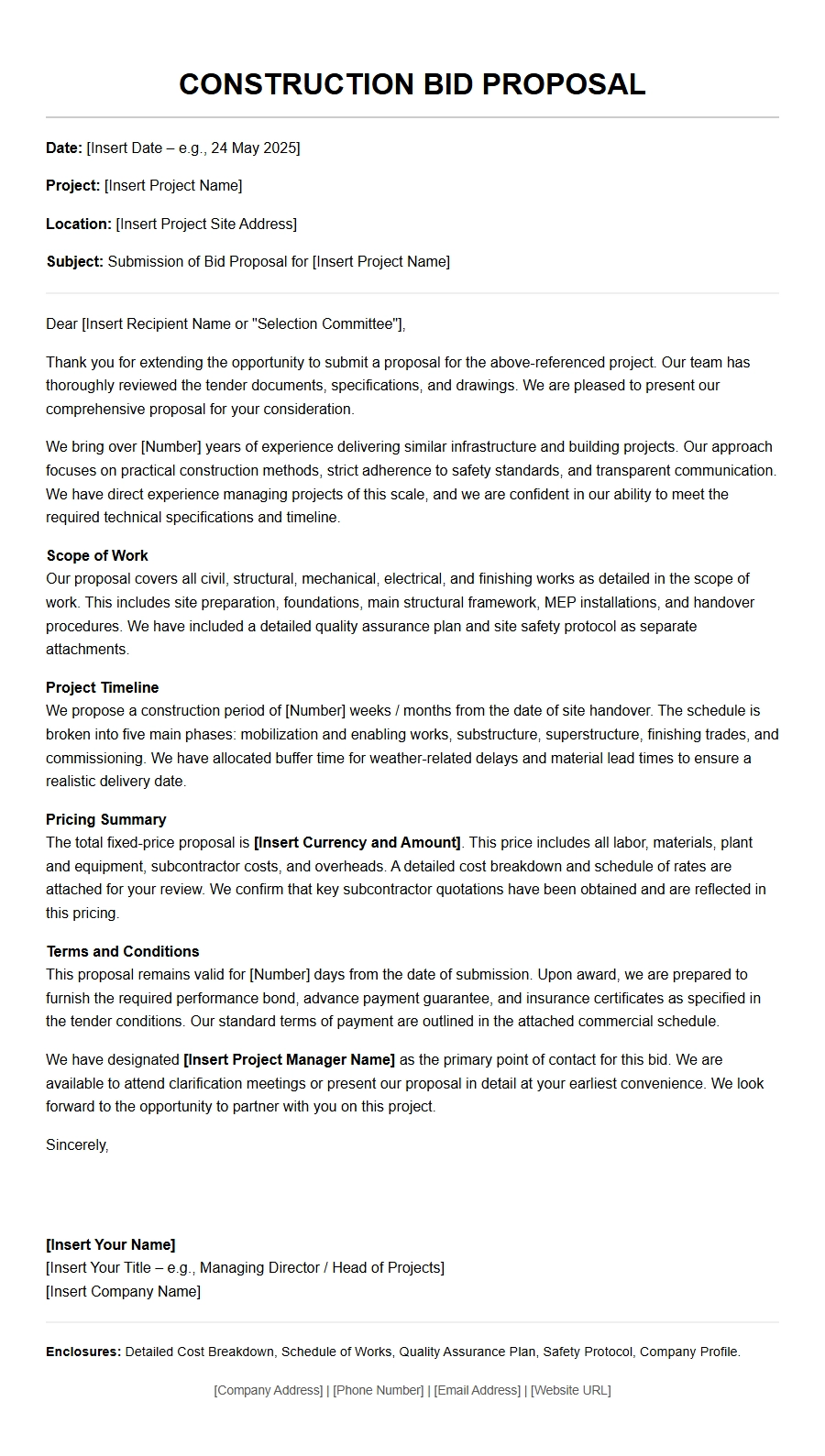 Sample Construction Bid Proposal Letter
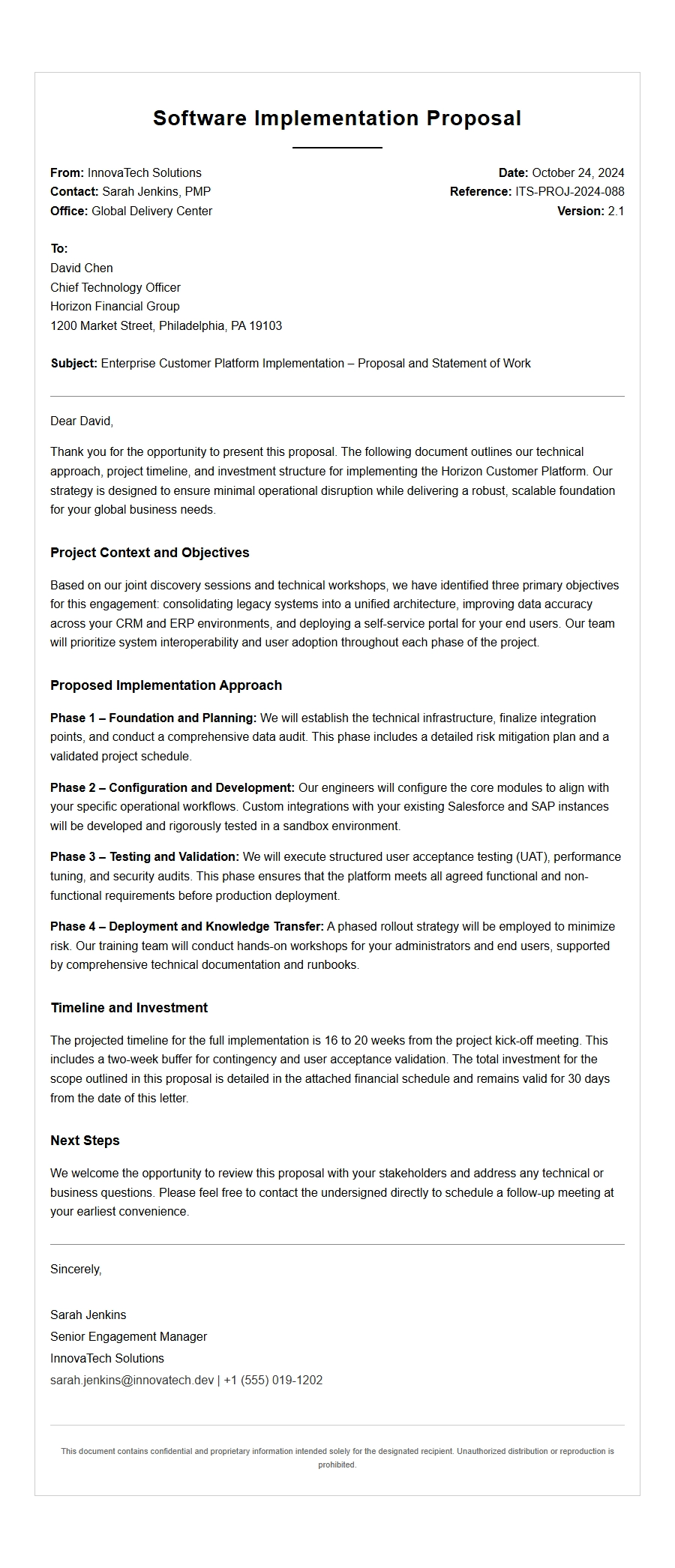 Enterprise Software Implementation Proposal Letter Example
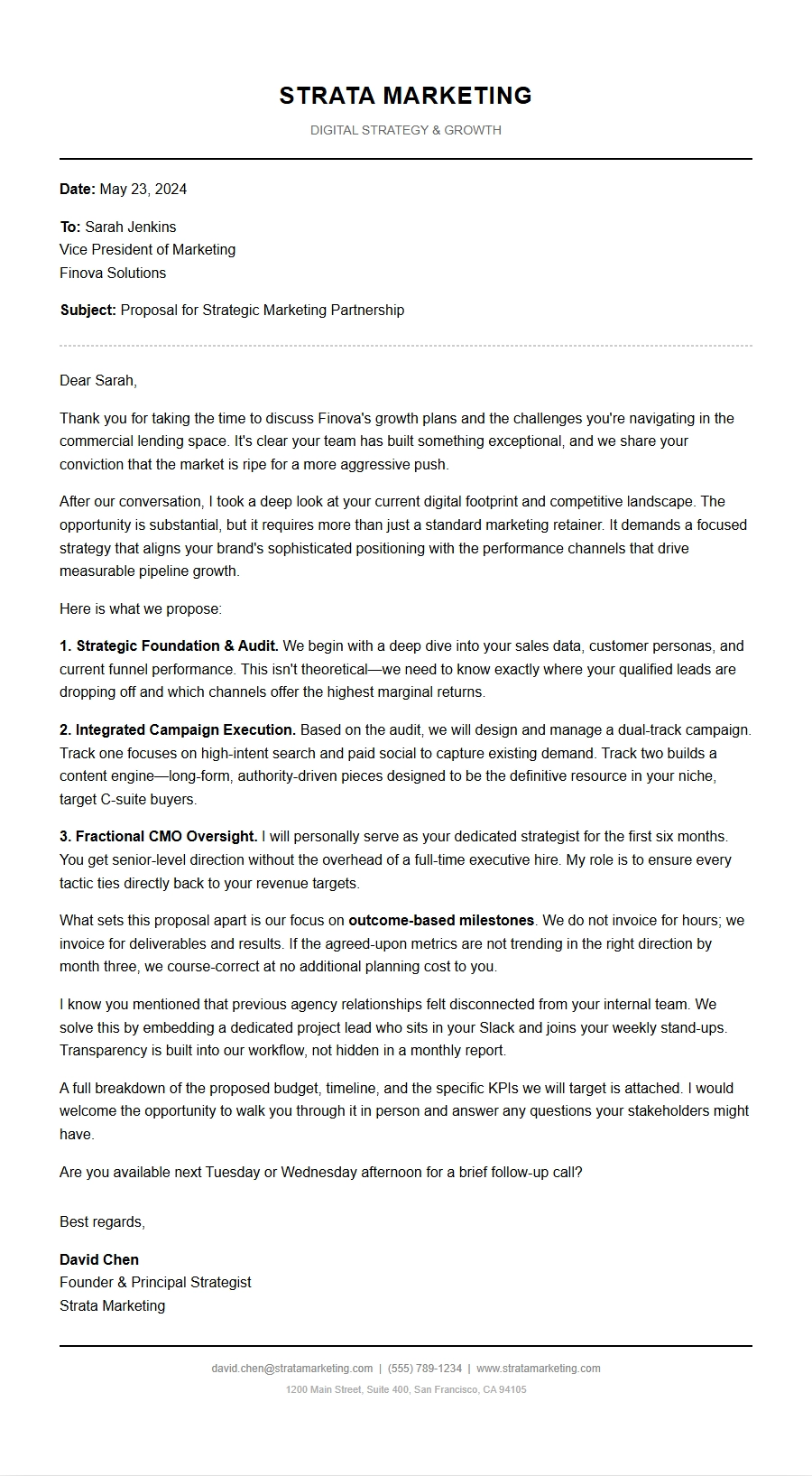 Marketing Agency Service Proposal Letter Template
 Creative Studio Project Proposal Letter
 Small Business Partnership Proposal Letter Template
 Startup Investment Proposal Letter Template