invitation letter for farewell gathering host - Invitation Letters
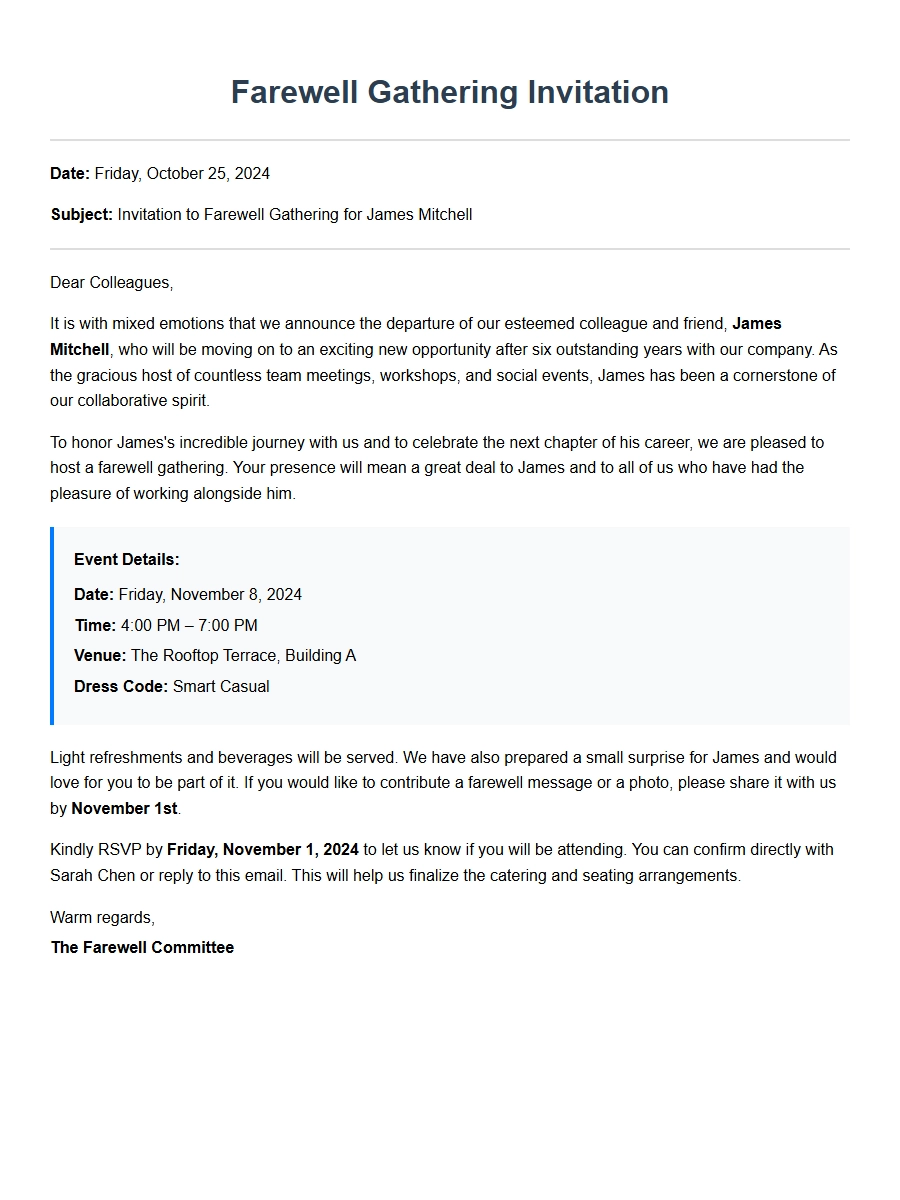
You’re the one organizing a farewell for a coworker, friend, or team member. The date is set, the venue is booked, but now you’re staring at a blank email or document, unsure how to phrase the invitation. You want it to feel warm, respectful, and clear—not awkward or overly formal. That’s where a solid invitation letter for a farewell gathering host can save you time and stress.
Why a sample isn’t cheating—it’s smart
Using a letter template for a farewell invitation is like having a road map. It gives you the structure—salutation, body, closing—so you don’t have to invent the wheel. You still decide the tone, the personal details, and the specific memories you want to include. A sample helps you avoid common pitfalls: forgetting the date, using a tone that’s too stiff, or leaving out the RSVP instructions. Think of it as a customizable letter that you shape to fit your group’s culture.
What makes a farewell invitation work?
Whether you’re drafting a formal corporate invitation or a casual get-together among close colleagues, the core need is the same: you want people to show up, feel included, and celebrate the person leaving. Professional correspondence for this scenario balances warmth with clarity. You’re not writing a resignation letter or a letter of recommendation—you’re inviting people to a social event. So the tone should be inviting, not bureaucratic.
Start with a short greeting like “Dear Team” or “Hi everyone,” then state the purpose clearly: “We’re gathering to say goodbye to Sarah on Friday, June 14.” Mention the time, location, and any details about food or gifts. Keep the paragraph readable—two or three sentences is usually enough. Then end with a polite request to RSVP and a friendly closing like “Best” or “See you there.”
Adapting a sample without losing your voice
When you find a good invitation letter for farewell gathering host sample, read it once. Then close it and write your own version using the same structure but your own words. For example, if the sample says “Please join us to celebrate Jane’s contributions,” and you’d rather say “Come raise a glass with Jane one last time,” go with your instinct. The sample gives you the business letter format and the key elements; you provide the personality.
A common mistake is copying the tone of the sample exactly. If your office is casual, use contractions (“you’ll,” “we’re”) and a light opening. If it’s a more traditional workplace, stick with “you are invited” and formal writing tips like using “Kindly RSVP” instead of “Let me know.” The best invitations feel like a natural conversation, not a form letter.
Formatting tips for email vs. printed letter
For a digital letter format (email), put the key details in the subject line: “Farewell Gathering for Tom – Friday 6pm.” In the body, keep it short—most people read emails on mobile. Use a simple font, no fancy letterhead design unless it’s a printed card. For printed invitations, include the event name, date, time, location, and RSVP info in a clean layout. Avoid cluttering the page with too much text.
Another tip: always proofread your letter. A typo in the date or venue can cause confusion. Read it aloud or ask a friend to check it. This step is part of good letter writing etiquette—it shows you care about the event and the guests.
Mistakes that turn people away
Ever received an invitation that felt too stiff or too casual? The biggest errors are using outdated salutations like “Dear Sir/Madam” for a group of friends, or forgetting to specify the dress code. Also, don’t assume everyone knows the person leaving. Add a line like “Many of you know Chris from the marketing team; we’ll miss his humor and late-night brainstorming.” This helps people who aren’t close to the colleague feel included.
Another slip: leaving no way to confirm attendance. Without an RSVP, you’ll have no idea how many people are coming. Include a simple “Please reply by Wednesday” with an email or a shared spreadsheet link. For larger events, consider using a free online tool.
The best farewell letters feel both professional and personal. They acknowledge the departure with respect but also with genuine warmth. Use the sample as a springboard—fill in the blanks with real memories, a specific story, or an inside joke. That’s what makes people want to come. Over time, writing these invitations becomes quicker. You’ll develop a feel for the right tone, the right length, and the right details. Until then, keep a few good samples handy, and don’t overthink it. Write it, check it, send it—then focus on making the event memorable.
Examples You Can Adapt
invitation letter for farewell gathering host - Invitation Letters
Formal Farewell Dinner Host Invitation
Dear Colleagues,
I am writing to formally invite you to a farewell dinner I am hosting in honor of our departing team member, John Smith.
Event Details:
Date: Friday, March 24, 2025
Time: 7:00 PM
Venue: The Grand Oak Restaurant, 123 Main Street
Menu Options (Please select one):
Option
Description
Option A
Grilled Salmon with vegetables
Option B
Chicken Alfredo Pasta
Option C
Vegetarian Lasagna
Please RSVP by March 17 and indicate your menu choice via the attached form. Your presence will mean a lot to John.
Warmly,
Jane Doe
Casual Farewell Party Host Invitation
Hey Team!
I’m hosting a little farewell gathering for our friend Alex, who’s moving on to new adventures. Let’s make it a relaxed evening with good food and great memories.
Details:
Date: Saturday, April 2, 2025
Time: 6:00 PM onwards
Location: My place, 45 Park Avenue, Apartment 3B
We’ll have pizza and drinks, but feel free to bring a snack to share if you’d like. Kindly let me know if you can make it by March 28 so I can order enough food.
Hope to see you there!
Cheers,
Mike
Virtual Farewell Meetup Host Invitation
Dear Team,
I am hosting a virtual farewell meetup for our colleague Sarah, who is leaving for a new role. Due to remote schedules, we’ll gather online to share some laughs and wish her well.
Meeting Link & Schedule:
Item
Details
Date
Wednesday, April 6, 2025
Time
5:00 PM - 6:00 PM EST
Platform
Zoom (link to be shared before event)
Agenda
Short speeches, trivia game, and farewell messages
Please confirm your attendance by April 1 so I can prepare the slides and trivia. Feel free to send me a favorite memory with Sarah to include in the presentation.
Best,
Kim
Farewell Brunch Host Invitation for Mentor
Dear Team,
I am delighted to host a farewell brunch to honor our mentor, Dr. Emily Carr, who is retiring after 25 years. Join me in celebrating her incredible journey.
Brunch Details:
Date: Sunday, April 10, 2025
Time: 10:30 AM - 1:00 PM
Venue: The Sunrise Café, 789 Elm Street
A short program will include a slideshow of her career highlights. If you have photos or stories to share, please send them to me by April 3. A small collection for a gift will also be organized; contributions are voluntary.
Please RSVP by April 5 so I can finalize the seating. Your warmth will make this day special.
With gratitude,
Mark
Farewell Gathering Host Invitation with RSVP Table
Dear Friends,
I’m hosting a farewell gathering for our dear friend Lisa, who is moving to another city. Let’s give her a proper send-off!
Event Info:
Date: Saturday, April 16, 2025
Time: 8:00 PM - 11:00 PM
Location: The Backyard Bistro, 456 Oak Avenue
RSVP List (Please fill your details):
Name
Number of Guests
Dietary Needs
Example: John
2
Vegetarian
____
____
____
____
____
____
Kindly reply by April 9 and include your info in the table. Looking forward to a memorable evening.
Best,
Anna
Farewell Picnic Host Invitation for Team
Hi Team,
I’m organizing a farewell picnic as the host for our colleague Tom, who is heading to a new job. Let’s enjoy an outdoor afternoon together.
Picnic Details:
Date: Saturday, April 23, 2025
Time: 12:00 PM - 4:00 PM
Location: Riverside Park, Shelter B
I’ll provide burgers and drinks. Please bring a side dish or dessert to share if possible. We’ll play some lawn games and share stories. Let me know if you can come by April 16.
Games Planned:
Frisbee
Cornhole
Badminton
Cheers,
Laura
Formal Farewell Luncheon Host Invitation for Executives
Dear Board Members,
I am hosting a farewell luncheon to honor our CEO, Richard Johnson, as he steps down after many years of leadership. Your presence will be greatly appreciated.
Luncheon Details:
Item
Information
Date
Friday, April 29, 2025
Time
12:30 PM - 2:00 PM
Venue
The Executive Club, 1000 Wealthy Lane
Dress Code
Business Attire
There will be a brief speaking program. If you would like to contribute a few words, please notify me by April 22. Kindly RSVP via email by April 25.
Respectfully,
Sarah Thompson
Farewell Party Host Invitation with Potluck List
Dear All,
I’m hosting a farewell party for our buddy Chris this month. It will be a potluck-style evening at my home.
Details:
Date: Saturday, May 7, 2025
Time: 7:00 PM
Address: 21 Maple Drive
Potluck Sign-Up (Please choose one):
Item
Person
Main Dish
____
Side Dish
____
Dessert
____
Drinks
____
Please reply by May 1 with your selection and number of guests. Let’s make this a night to remember!
Thanks,
Jen
Farewell Tea Party Host Invitation for Older Colleagues
Dear Colleagues,
I’m pleased to host a farewell tea party for our esteemed coworker, Mrs. Helen Grant, who is retiring next month. We’ll enjoy a cozy afternoon together.
Tea Party Schedule:
Date: Wednesday, May 11, 2025
Time: 3:00 PM - 5:00 PM
Location: The Willow Lounge, 50 Green Street
We will serve tea, coffee, and a variety of pastries. There will be a memory-sharing circle. If you wish to bring a small keepsake or card, please do so. Confirm your attendance by May 4.
Attendee List (Example):
Name
Guest Count
Helen Grant
1
____
____
Looking forward to a lovely afternoon.
Sincerely,
Patricia
Farewell Gathering Host Invitation with Contribution Table
Hi Everyone,
I am hosting a farewell gathering for our teammate Dave after work. Let’s celebrate his new journey!
Details:
Date: Thursday, May 19, 2025
Time: 6:30 PM onwards
Venue: The Tipsy Tap, 88 Harbor Road
I will reserve a table and cover appetizers. Drinks and additional food are on your own. However, if you want to contribute toward a group gift for Dave, please see the table below.
Gift Contribution:
Name
Amount (optional)
____
$____
____
$____
Total Goal
$150
Please RSVP by May 12 and let me know if you wish to contribute. Let’s show Dave our support!
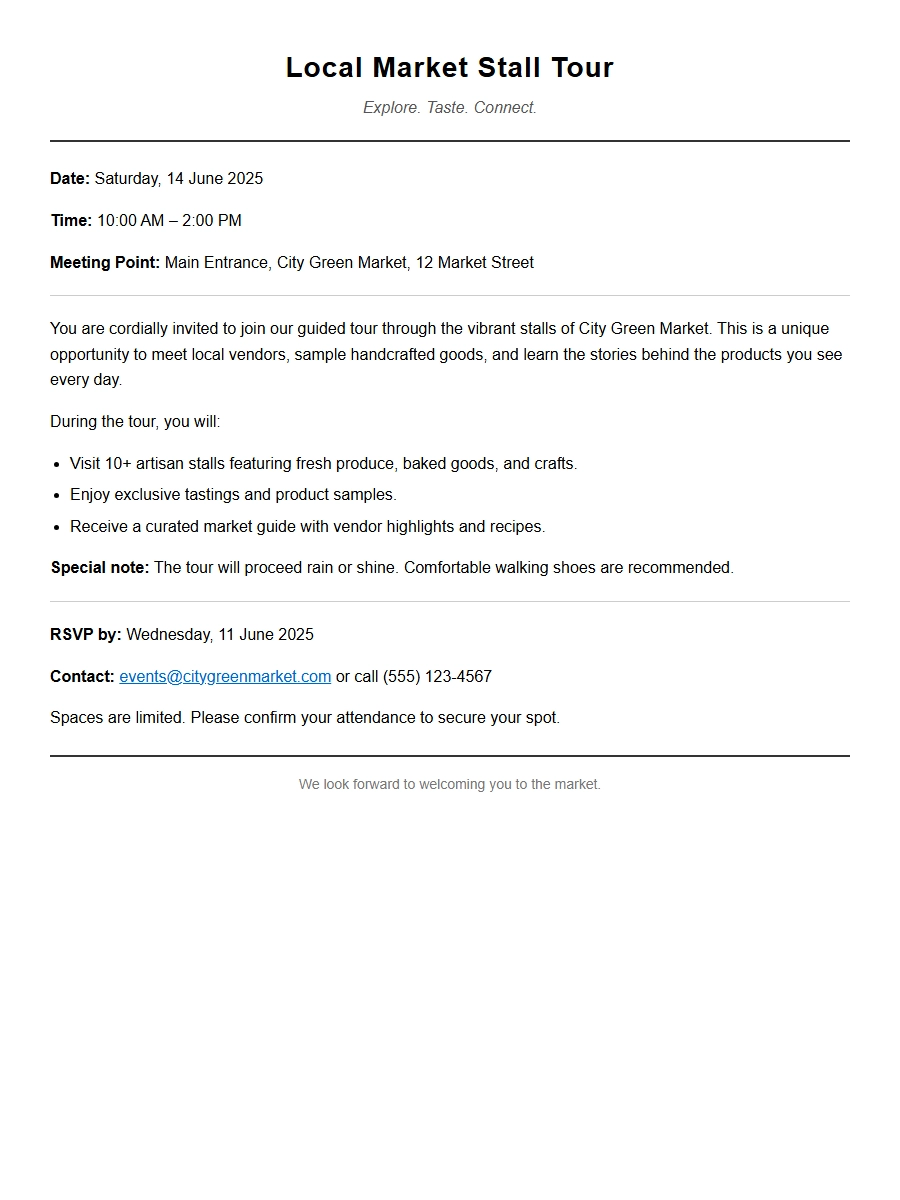 sample invitation for local market stall tour - Invitation Letters
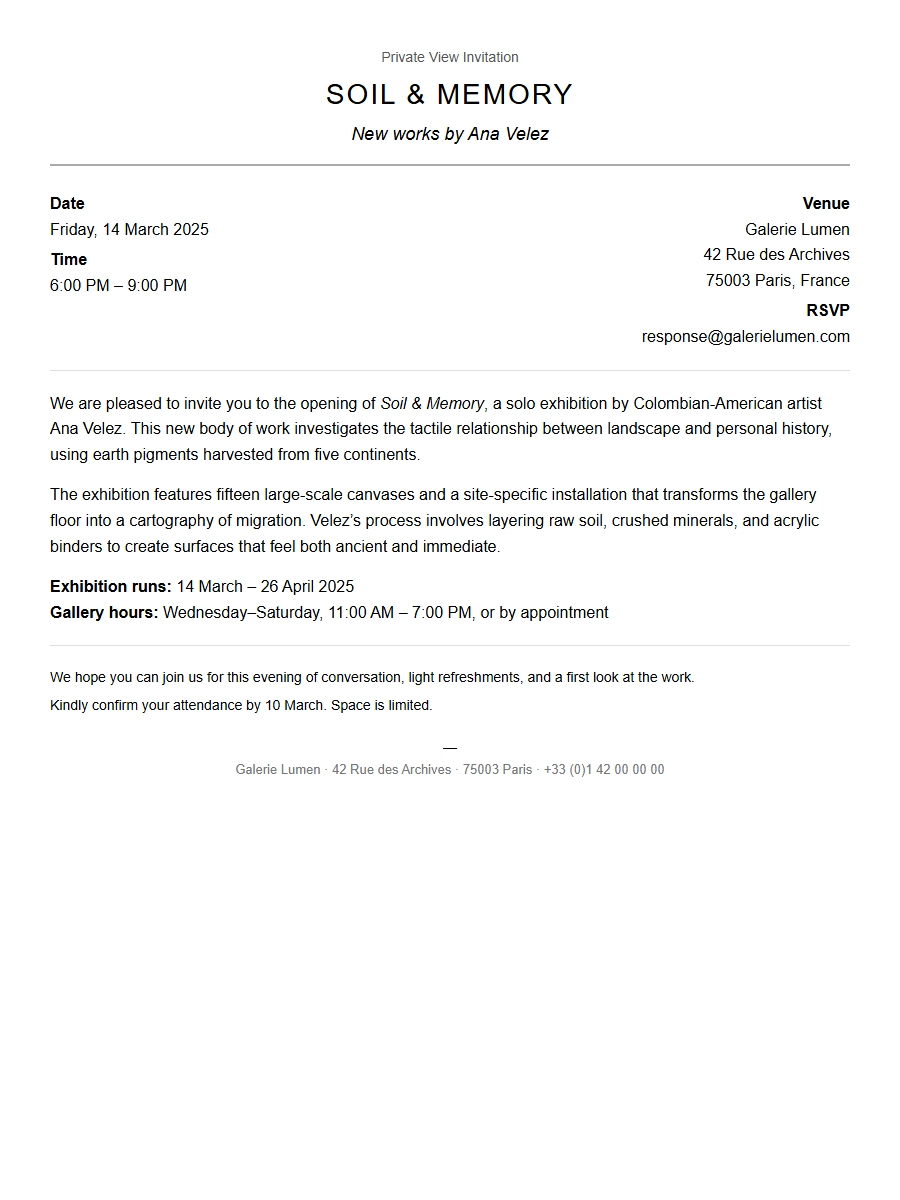 Art Exhibition Opening Invitation Wording Ideas
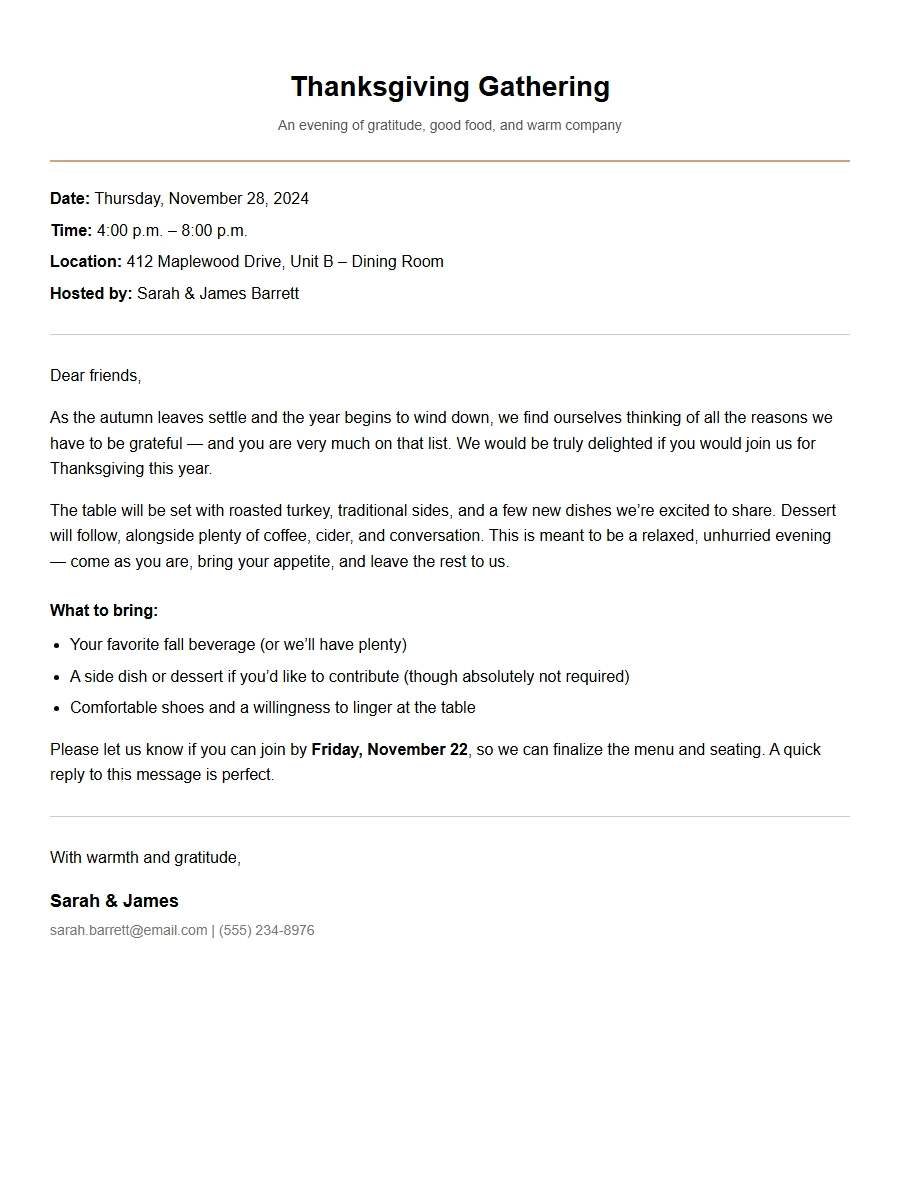 Thanksgiving Meal Gathering Invitation Text
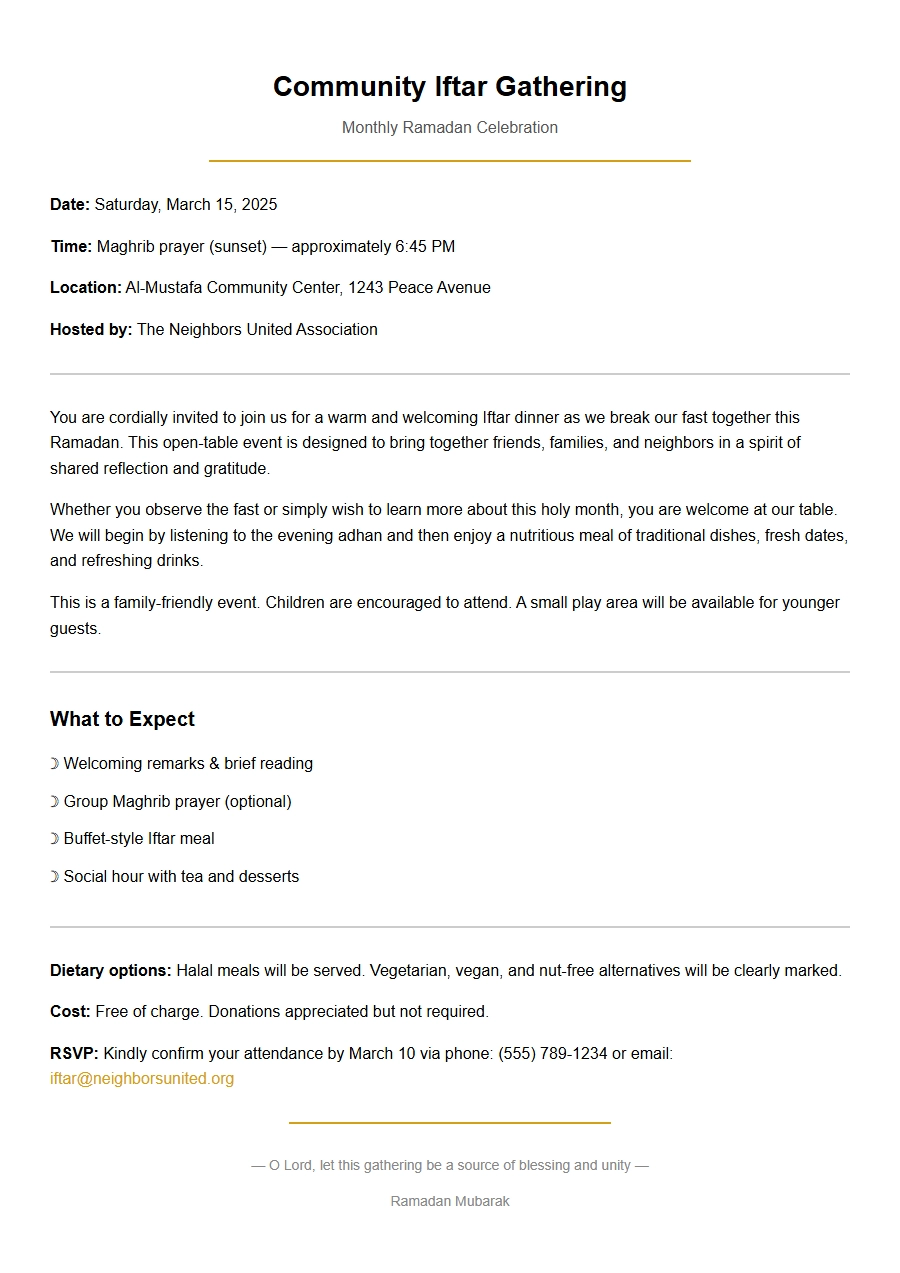 Ramadan Iftar Community Event Invitation
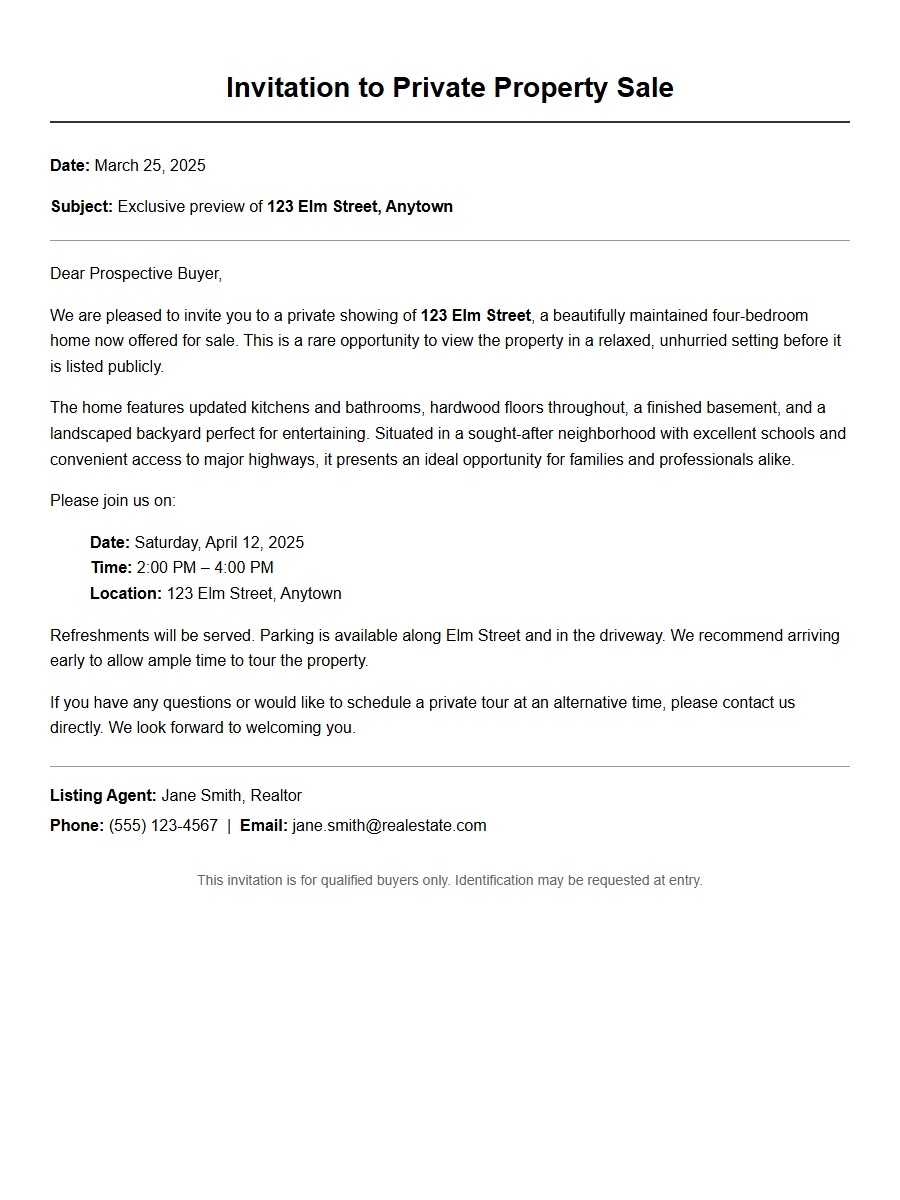 Sample Wording for Property Sale Invitations
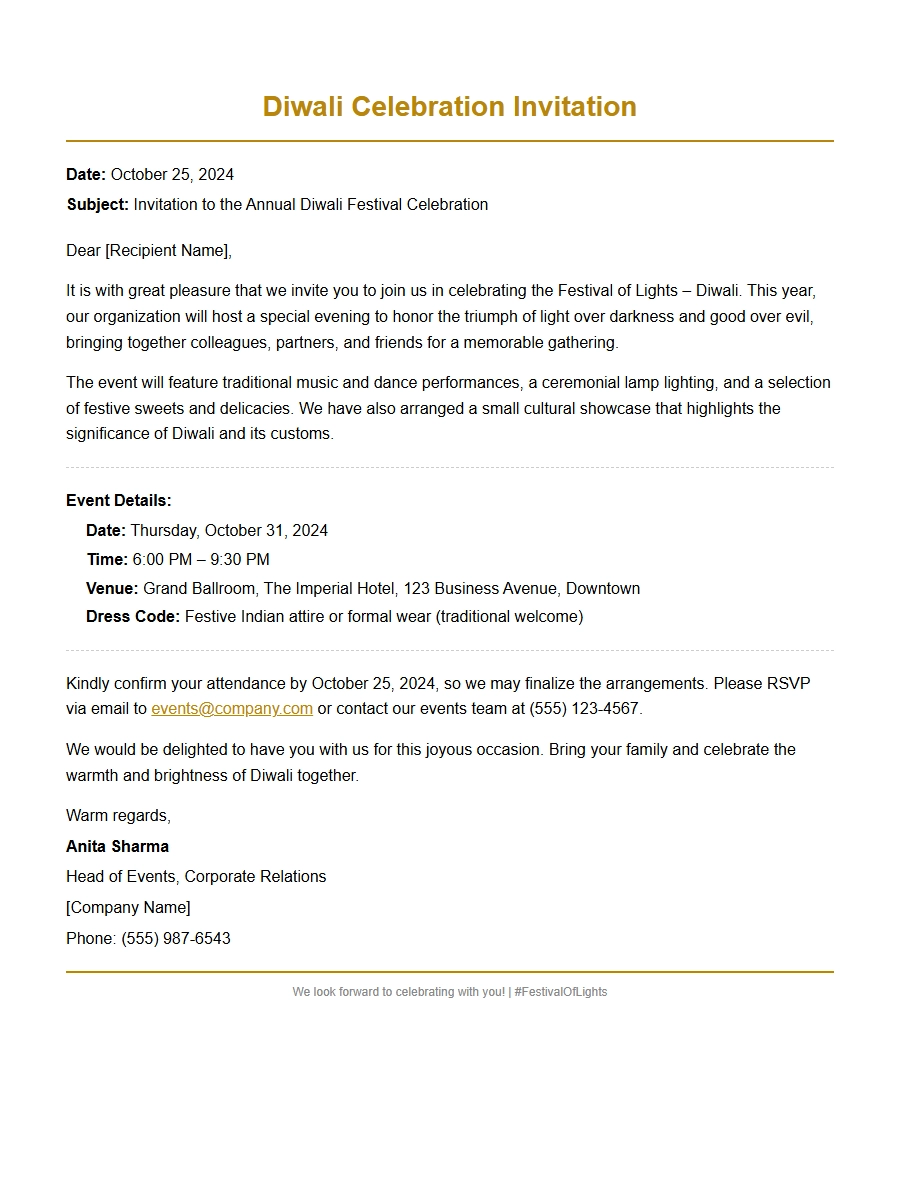 Diwali Festival Celebration Invitation Draft