Thank-You Letter for Financial Advisor Consultation
You’ve just had a productive consultation with a financial advisor. Maybe they helped you map out a retirement plan, clarified investment options, or gave you a clear path to tackle debt. Now you want to send a thank you note, but you’re stuck on how to say it without sounding stiff or overly salesy. It’s a common moment of hesitation—you want to show genuine appreciation, but the blank page makes you second-guess every word.
Why a gratitude letter for financial advisor consultation isn’t just polite—it’s smart
A thoughtful thank you does more than check a social nicety. It reinforces your relationship with the advisor and keeps the door open for future questions. It also shows you’re serious about following through on the plan you discussed. The best part is, you don’t need to invent the wheel. A good letter template gives you a framework so you can focus on personalizing the message rather than stressing over structure.
### Category: Professional Correspondence Templates
What makes a great gratitude letter for a financial advisor consultation
The key is matching your tone to the relationship. If you’ve worked with this advisor for years, a semi-formal tone that feels like a colleague-to-colleague thank you works perfectly. For a first meeting, keep it a bit more polished but still warm. Think “I appreciate your time and clarity” rather than “Your brilliance astounded me.” The latter can feel forced.
A solid business letter format usually works here. Include your contact info, the date, and a clear salutation like “Dear [Name].” Avoid overly stiff openings like “To Whom It May Concern.” That’s a quick way to undo the warmth you’re trying to build.
How to adapt a sample without losing your voice
Grab a sample that feels close to your situation, then rewrite the opening paragraph to reflect exactly what you took away from the consultation. For example, if the advisor helped you understand a complex tax strategy, say that explicitly: “Thank you for taking the time to explain how tax-loss harvesting might work for my portfolio.” That small detail makes the letter feel like it was written for this person, not copied from a book.
Common mistakes to avoid: using outdated salutations like “Dear Sir or Madam” or ignoring whether the letter will be sent as an email or a printed letter. If you’re sending it digitally, skip the letterhead design and just use a clean subject line and sign-off. If you’re printing it, a simple letterhead with your name and contact details is fine—no need for fancy graphics.
Quick tips for writing a letter that feels genuine
Keep the body short. Two or three paragraphs are plenty. Start with the specific thing you’re grateful for, then mention one concrete action you plan to take based on their advice. That shows you were listening and you intend to follow through. Close with a forward-looking line, like “Looking forward to our next check-in.”
For the salutation and closing, keep it simple. “Dear [First Name]” works in most cases. For a more formal relationship, use “Dear Mr./Ms. [Last Name].” End with “Sincerely” or “Best regards.” It’s safe and professional.
A real example to get you started
Let’s say you met with an advisor to discuss retirement planning. Here’s a short adaptation of a cover letter examples style but for a thank you:
“Dear Sarah,
Thank you for the consultation last Tuesday. I especially appreciated how you broke down the difference between Roth and traditional IRAs—something I’ve been confused about for years. I’ve already set up a recurring contribution to my Roth as you suggested.
I’m feeling much more confident about my retirement timeline now. Looking forward to our next session in March.
Best regards,
[Your Name]”
Proofreading matters more than you think
Even a short letter can contain typos or awkward phrasing. Read it out loud before you send it. If a sentence trips you up, rewrite it. Proofreading letter isn’t just about catching spelling errors—it’s about making sure your tone sounds like you, not like a template. If you’re emailing it, give it a once-over after you’ve inserted the email subject line. The subject should be simple, like “Thanks for the consultation” or “Appreciation for your advice.”
The goal isn’t to write a perfect letter on the first try. It’s to get comfortable expressing gratitude in a way that feels true to you. The more you do it, the faster it becomes. So pick a customizable letter sample, adjust the specifics, and send it. Your advisor will appreciate the gesture, and you’ll feel good knowing you closed the loop on a valuable conversation.
Writing Examples
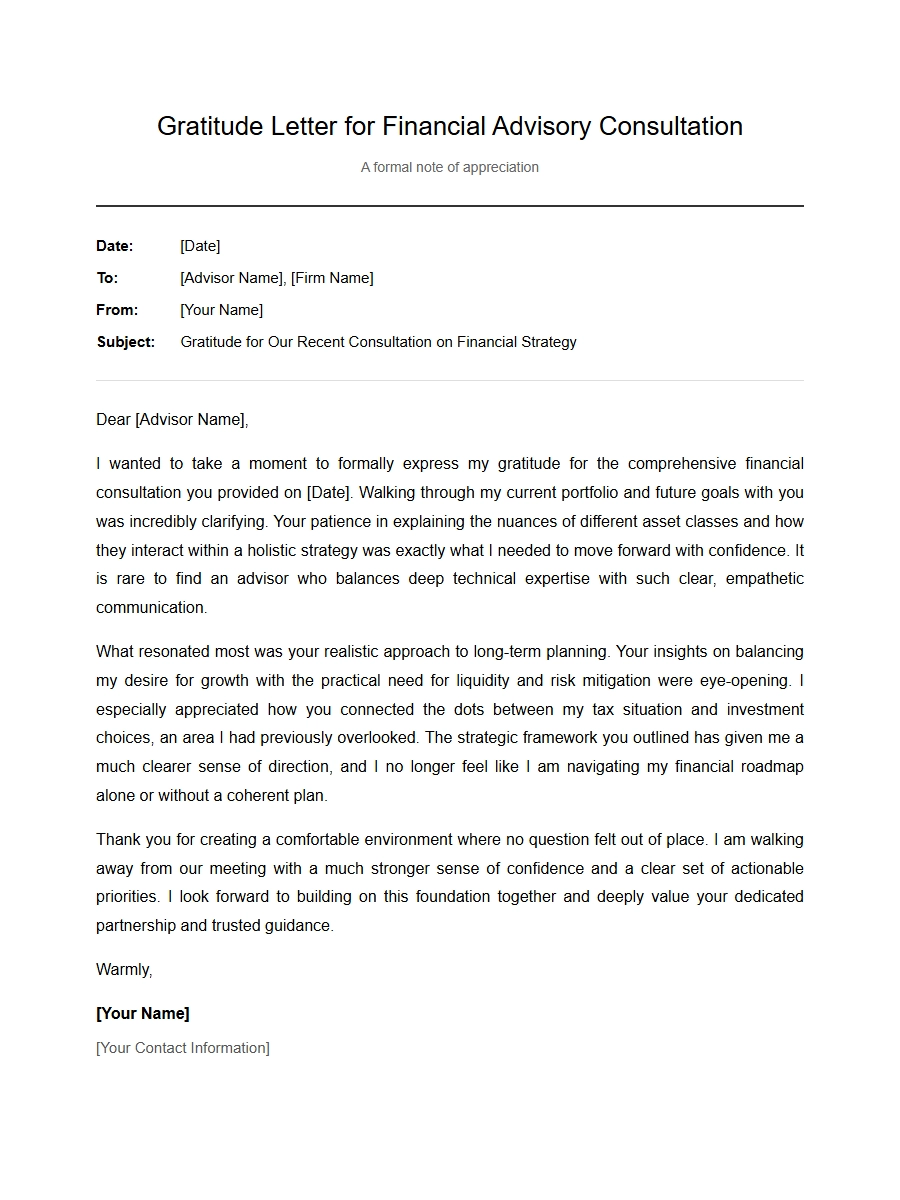
Thank-You Letter for Financial Advisor Consultation
Heartfelt Thanks for Your Financial Guidance
Dear [Financial Advisor],
I wanted to express my deepest gratitude for the time and expertise you shared during our recent consultation. Your clear explanation of my current financial situation and the steps we outlined together has given me a renewed sense of confidence. I especially appreciated how you took the time to answer every question, no matter how small.
Based on your recommendations, I have started implementing the following action items:
Priority
Action Item
Timeline
1
Increase emergency fund to 6 months of expenses
3 months
2
Adjust 401(k) contributions to maximize match
Next paycheck
3
Set up automatic transfers for Roth IRA
By end of month
Thank you again for helping me feel more in control of my financial future. I look forward to working with you going forward.
Sincerely, [Your Name]
Grateful for Your Retirement Planning Insights
Dear [Advisor Name],
Thank you so much for the invaluable retirement planning insights you shared during our meeting. I left feeling much more prepared for the years ahead. Your breakdown of different annuity options and the impact of Social Security timing was especially eye-opening.
Here are the key takeaways I plan to act on:
Reallocate my 401(k) to a more conservative mix as I approach retirement age
Consider a partial Roth conversion within the next two years
Delay Social Security benefits until age 70, if possible
I also appreciate the personalized retirement income projection you prepared. It made the numbers feel real and attainable. Your patience in explaining the pros and cons of each strategy helped me make decisions without feeling overwhelmed.
Thank you again for your expertise and kindness. I am truly grateful to have you as my advisor.
Warmly, [Your Name]
Appreciation for Tax Optimization Advice
Dear [Advisor Name],
I wanted to send a quick but sincere thank-you for the tax optimization strategies you outlined in our last consultation. Your advice on harvesting capital losses and timing my charitable donations was exactly what I needed to lower my tax bill this year.
Below is a summary of the tax-saving opportunities you recommended:
Strategy
Estimated Savings
Deadline
Max out HSA contribution
$1,000
April 15
Donate appreciated stock instead of cash
$500
December 31
Bundle medical expenses into one year
$800
By year-end
I have already begun implementing several of these, and I feel much more confident about tax season. Thank you for making such a complex topic easy to understand. I am glad I sought your guidance.
With appreciation, [Your Name]
Thank You for Investment Portfolio Review
Dear [Advisor Name],
Thank you for the thorough review of my investment portfolio. Your analysis helped me see where I was over-concentrated in tech stocks and how to better diversify across asset classes. I feel reassured knowing my risk level is now aligned with my long-term goals.
The specific changes we discussed include:
Reduce individual tech holdings from 30% to 15% of the portfolio
Increase allocation to international equities by 5%
Add a small position in real estate via a REIT ETF
Rebalance bonds to include more short-term Treasuries
I appreciate that you didn’t push any products and instead recommended low-cost, passive funds. Your transparent approach builds trust. I’m already seeing a more balanced performance, and I’m sleeping better at night.
Thank you again for your expertise and thoughtful advice.
Best regards, [Your Name]
Grateful for Your Education Savings Plan
Dear [Advisor Name],
I cannot thank you enough for the time you spent helping me create an education savings plan for my daughter. Your explanation of 529 plans, Coverdell ESAs, and the impact of financial aid formulas was incredibly clear. I now have a roadmap that feels both manageable and ambitious.
Here are the steps I committed to following:
Open a 529 plan with a target-date enrollment fund
Set up monthly automatic contributions of $300
Review the beneficiary designation each year
Look into state tax deductions for contributions
Your suggestion to involve grandparents in gifting to the 529 was brilliant. We are planning a family meeting to discuss this. I feel so much more prepared for the future, and my daughter is excited to know we are saving for her education.
With sincere gratitude, [Your Name]
Thanks for Estate Planning Consultation
Dear [Advisor Name],
Thank you for the comprehensive estate planning consultation. I had been putting this off for years, and your guidance made the process feel less daunting. You explained the roles of wills, trusts, and powers of attorney in a way that was easy to understand and apply to my family’s situation.
Below is a summary of the documents we discussed and my next steps:
Document
Purpose
Action Needed
Will
Distribute assets per my wishes
Draft with attorney
Revocable Living Trust
Avoid probate
Fund with property titles
Durable Power of Attorney
Manage finances if incapacitated
Sign and notarize
Healthcare Directive
Medical decisions
Complete form
I feel a huge weight lifted knowing that my family will be taken care of. Your referral to a trusted estate attorney was also much appreciated.
With thanks, [Your Name]
Appreciation for Risk Management Assessment
Dear [Advisor Name],
Thank you for the thorough risk management assessment you conducted during our meeting. I had no idea I was underinsured for disability and umbrella liability. Your step-by-step review of my insurance policies helped me identify critical gaps.
Here are the coverage types we reviewed and adjustments I plan to make:
Coverage Type
Current Status
Recommended Change
Auto Liability
$100,000
Increase to $300,000
Umbrella Policy
None
Add $1 million
Disability Insurance
None
Purchase own-occupation policy
Life Insurance
$250,000 term
Consider converting to permanent
I have already contacted my insurance agent to update my auto coverage. Your advice to buy disability insurance through a professional organization was very helpful. Thank you for protecting my financial future so thoroughly.
Gratefully, [Your Name]
Thank You for Debt Reduction Strategy
Dear [Advisor Name],
I wanted to thank you for the personalized debt reduction strategy you created for me. I was feeling overwhelmed by my credit card and student loan balances, but your plan gave me a clear path forward. The snowball method you recommended, starting with the smallest debt first, feels very motivating.
Here is the priority order we established:
Pay off credit card A ($2,500) in 3 months
Pay off credit card B ($4,200) in 5 months
Eliminate personal loan ($6,000) by year-end
Aggressively pay down student loan ($15,000) over 2 years
You also suggested I consolidate the two credit cards to get a lower interest rate. I applied and was approved, which will save me hundreds in interest. I feel so much more in control now, and I’m already sticking to the budget we outlined. Thank you for giving me hope and a practical plan.
With appreciation, [Your Name]
Grateful for Your Guidance on Business Finances
Dear [Advisor Name],
Thank you for the excellent business financial consultation. As a small business owner, I was struggling to separate my personal and company finances, and your advice was transformative. You helped me set up a proper accounting system and identify key performance indicators that matter most for growth.
Here are the metrics you recommended I track monthly:
Metric
Current Value
Target
Gross Profit Margin
55%
60%
Operating Expense Ratio
40%
35%
Cash Runway (months)
4
6
Customer Acquisition Cost
$150
$120
I have already implemented your suggestion to open a separate business credit card and set up automatic transfers for quarterly estimated taxes. The cash flow projection you prepared gave me the confidence to hire a part-time assistant. I’m truly grateful for your practical, no-nonsense approach.
Best, [Your Name]
Sincere Thanks for Your Comprehensive Financial Review
Dear [Advisor Name],
I wanted to express my sincere gratitude for the comprehensive financial review you completed for my family. Covering everything from budgeting to retirement projections, your holistic approach gave me a complete picture of where we stand and where we need to go. I especially valued how you included my spouse in the conversation and addressed both of our concerns.
The main benefits I gained from our consultation include:
A clear net worth statement with actionable improvement steps
An optimized asset allocation that reduces unnecessary fees
A realistic monthly budget that still allows for fun expenses
Peace of mind knowing our financial foundation is solid
Your suggestions to automate savings and review insurance annually were simple but powerful. I’ve already set up automatic transfers to our emergency fund. Thank you for your patience, expertise, and genuine care for our well-being. We look forward to a long partnership.
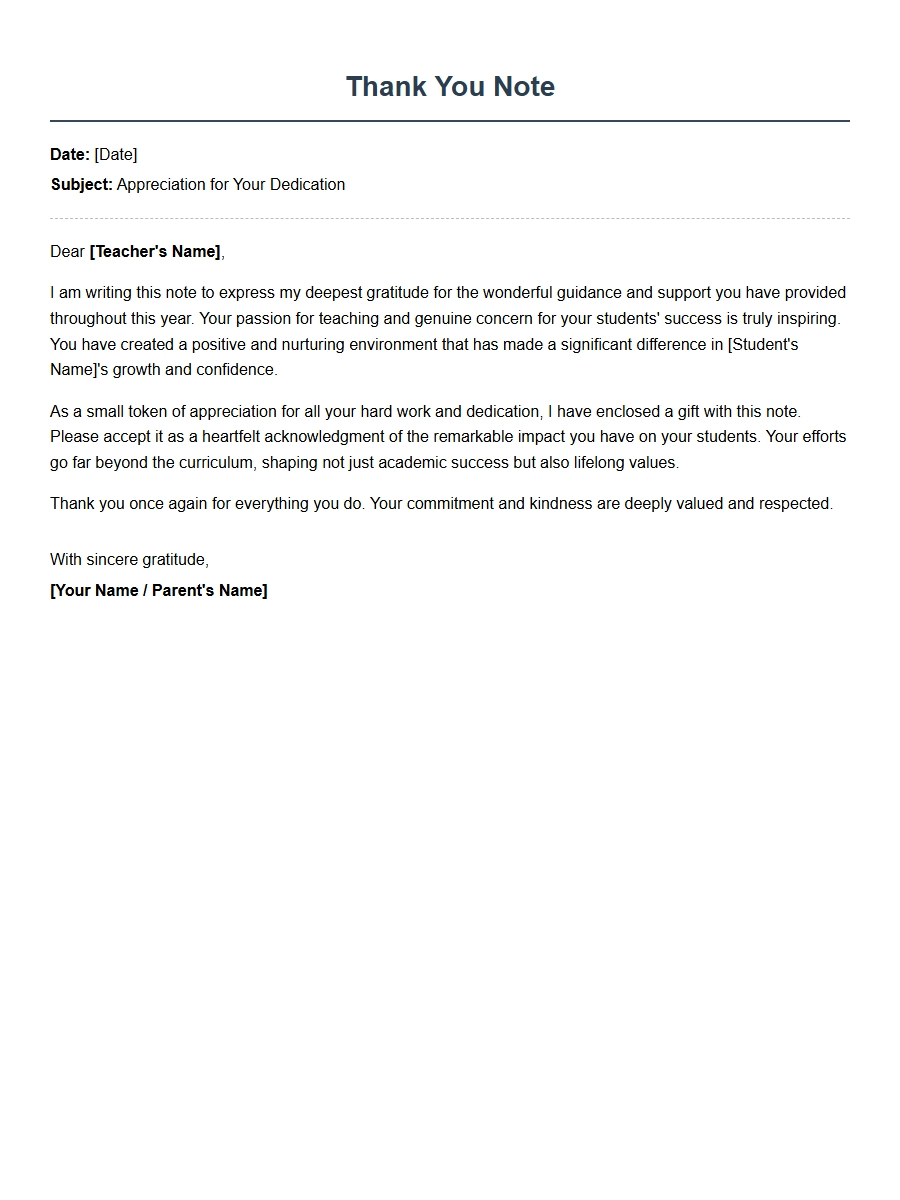 Sample Thank You Note for Teacher Gift
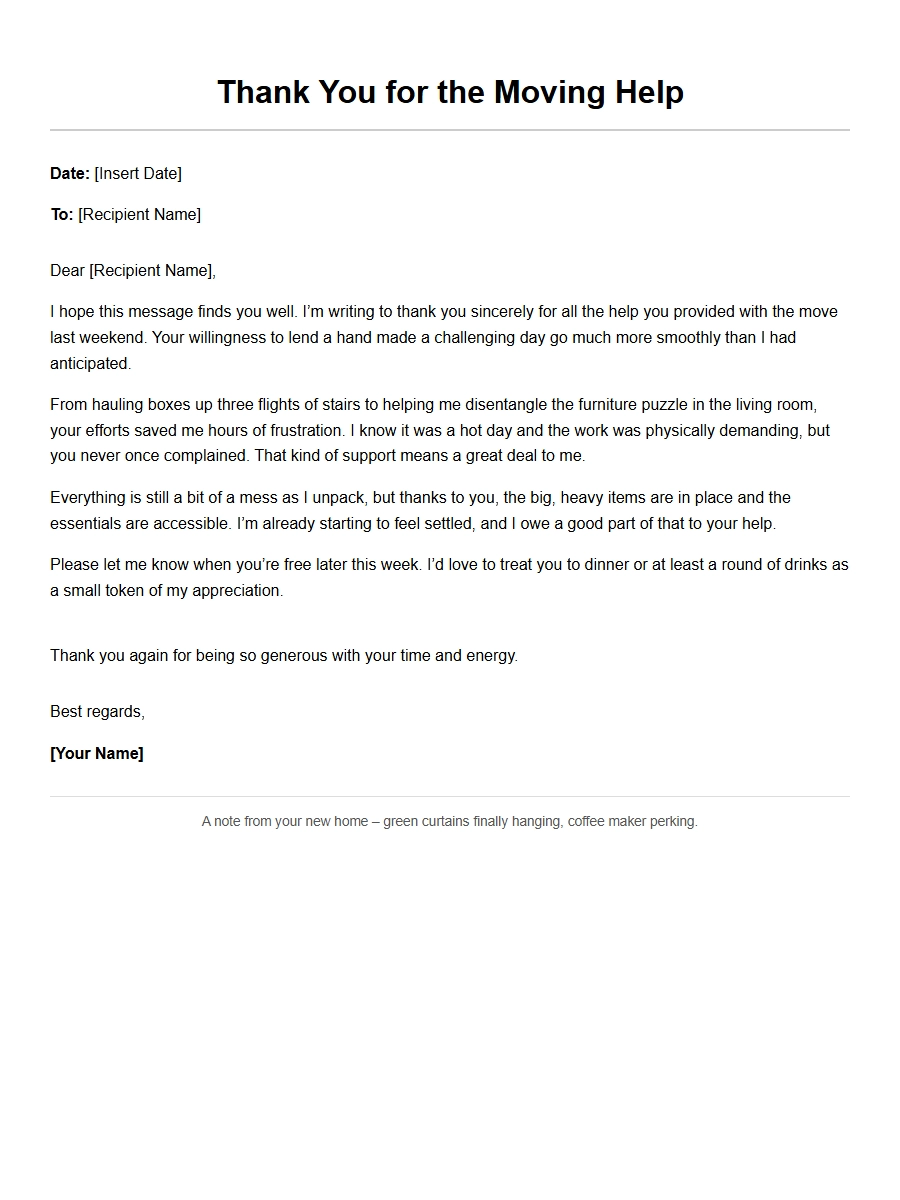 Thank-You Letter for Help with Moving
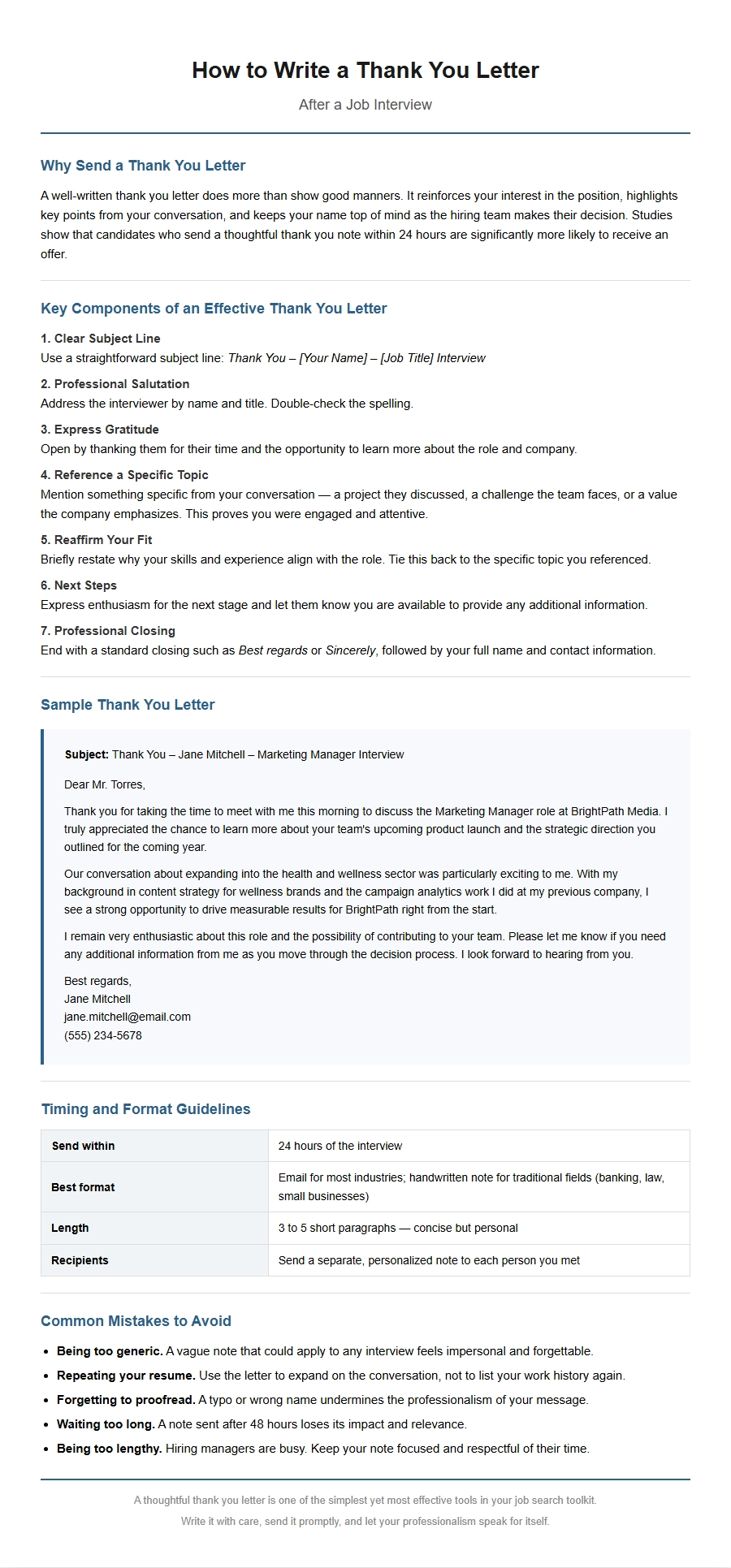 How to Write a Thank You Letter After an Interview
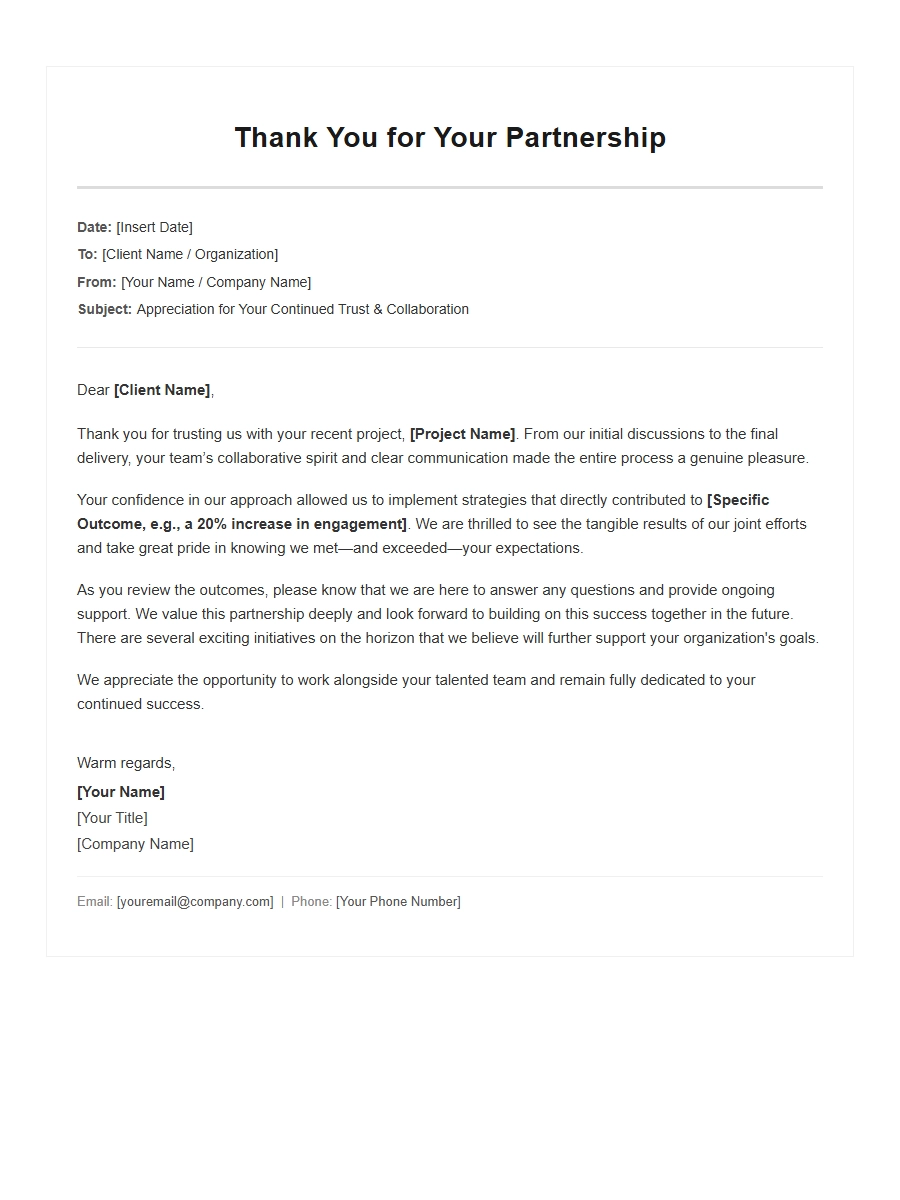 professional thank you email example for client - Thank-You Letters
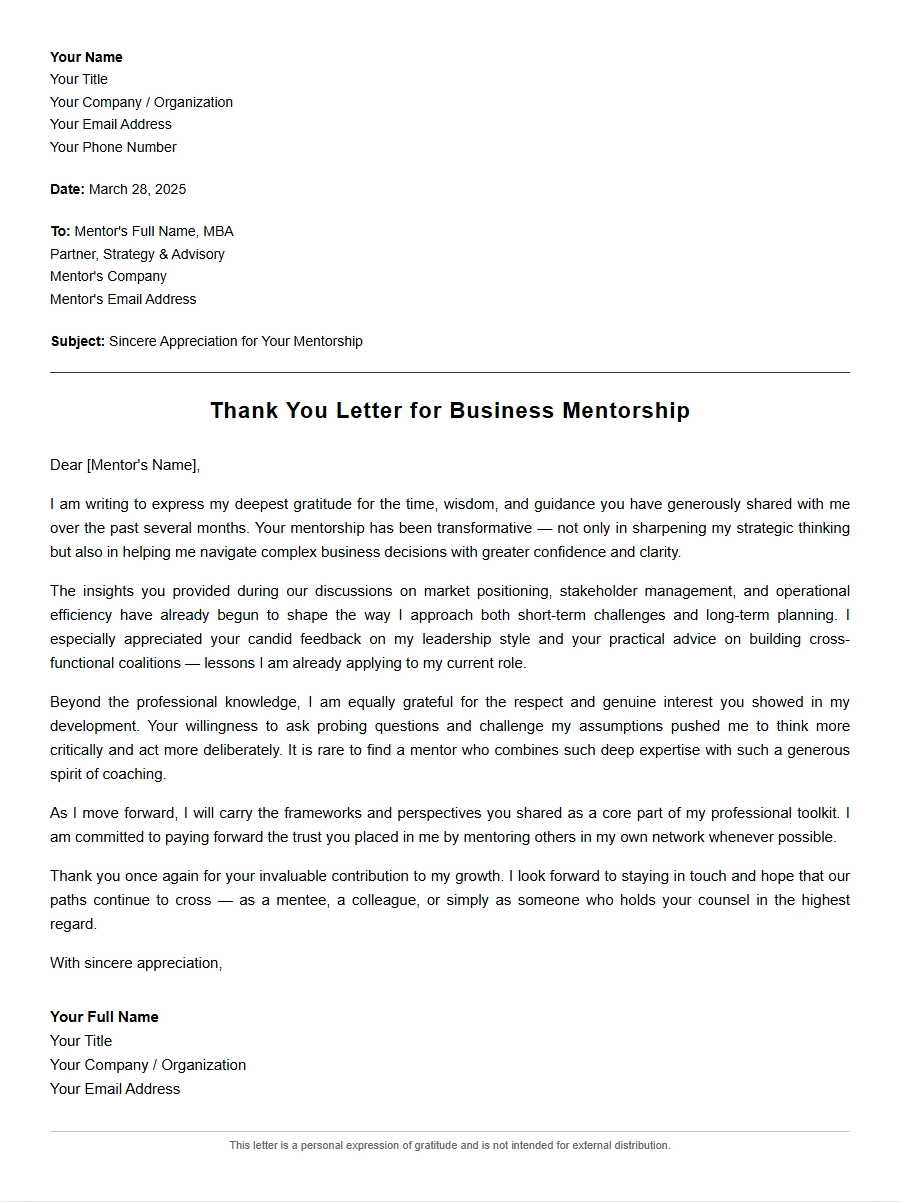 Business Mentor Thank-You Letter Guide
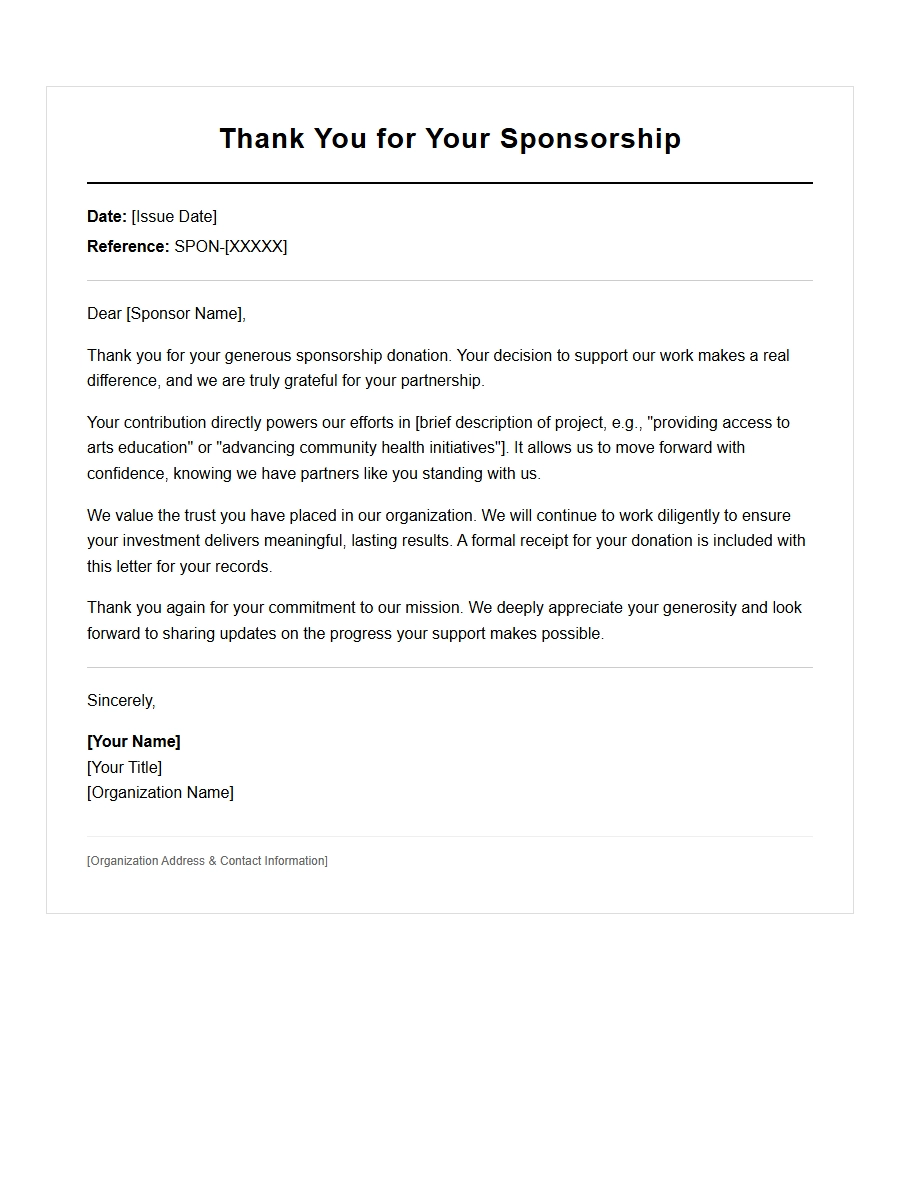 Thank You Letter for Sponsor Donation