You just got a notice about an exam result irregularity. Your heart sinks. Now you need to write an explanation that clears things up without making them worse. The blank page stares back. But with the right approach, you can turn that anxiety into a clear, professional letter in minutes.
Why using a sample isn’t cheating
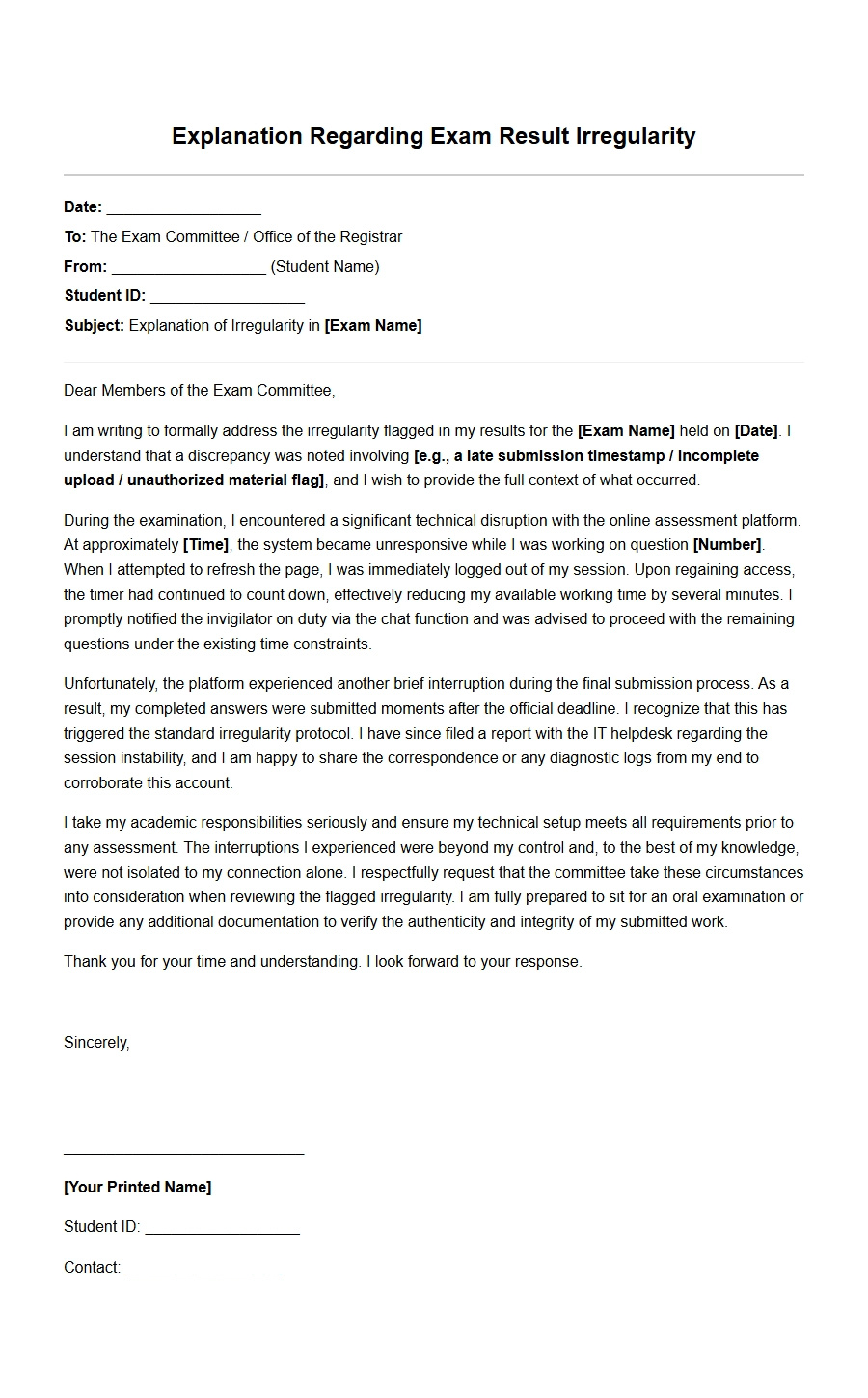
A good letter sample gives you the structure and tone you need while leaving room for your own story. It’s like having a road map. You still drive the car. When you’re explaining an exam irregularity—maybe a medical emergency, a misunderstanding about rules, or an honest mistake—you want to sound credible and calm. A sample helps you avoid common pitfalls like sounding defensive or too vague.
Category: Academic Correspondence
Choosing the right sample for your situation
Not all irregularities are the same. If you were sick, your explanation will focus on medical documentation. If you misread the instructions, you’ll need to show that you understand your error without making excuses. Look for a sample that matches the formality level of your institution. University committees often expect a formal business letter format with a clear salutation and closing. A high school teacher might accept a more personal note.
Think about the tone in writing. Formal doesn’t mean robotic. You can still be human. For example, start with “I am writing to explain the circumstances surrounding my exam on [date].” That’s direct and respectful.
How to adapt a sample without losing your voice
Take the sample’s structure—header, date, greeting, body, closing—but rewrite the details in your own words. Don’t copy phrases you wouldn’t normally say. If the sample says “due to unforeseen circumstances” but you’d rather say “because my child was suddenly hospitalized,” use that. Authenticity matters more than fancy language.
A quick tip: tailor your opening paragraph to grab attention. State the irregularity upfront and your intent to provide a full explanation. Committees read many letters. Yours should be easy to follow.
Common mistakes to avoid
Ever received a letter that felt too stiff or too casual? That happens when people ignore the context. For an exam irregularity, avoid outdated salutations like “To Whom It May Concern” if you know the committee chair’s name. Use “Dear Dr. Smith” instead. Also, if you’re sending this via email, skip the letterhead design unless it’s a printed letter. A simple subject line like “Explanation for Exam Result Irregularity – [Your Name]” works better.
Another mistake: leaving out key evidence. You can mention that you’ve attached a doctor’s note or a report. But don’t go overboard with emotion. State facts, then explain how they affected your exam performance.
If your situation involves a disciplinary hearing, you might also find helpful guidance in our sample for a school principal disciplinary action letter. Or, if it’s a simple grading mistake, our note to a teacher regarding grading mistake can offer a different perspective.
Making the letter work for digital or print
Consider how the recipient will read it. For a formal submission, use standard business letter format with your contact info, date, and recipient’s address. For an email, keep it shorter and put your explanation in the body. Digital letter format should be scannable: short paragraphs, no huge blocks of text.
Once you’ve drafted, proofread carefully. A typo can undermine your credibility. Read it aloud to catch awkward phrasing. Ask a friend to check for tone. Is it honest? Respectful? Clear? Good.
One last thought
Use the sample as a springboard, not a crutch. The best letters feel both professional and personal. They show that you’ve reflected on what happened and that you’re taking responsibility. Every time you write one of these, it gets easier. Eventually, you won’t need the sample at all—but it’s nice to have when the clock is ticking.
Start with a template, make it yours, and send it off with confidence. You’ve got this.
Samples for Inspiration
Apology Letter for Exam Result Irregularity
Student Apology for Similar Answer Scripts
Dear Examination Committee,
I am writing to express my sincere regret regarding the irregularity flagged in my recent final exam results. My answer script was noted to have striking similarities with the paper of another student. I acknowledge that I failed to maintain the required level of independence and inadvertently discussed a few key points before the exam, which led to overlapping phrasing. I take full responsibility for my lack of judgment.
To prevent such incidents, I propose the following corrective measures:
I will re-sit the exam under strict invigilation.
I will attend an academic integrity workshop.
I will sign a declaration of original work for all future assessments.
I sincerely apologize to the faculty and my peers for this lapse. I kindly request the committee to consider my explanation and allow me to rectify my mistake. Thank you for your understanding.
Yours respectfully, Jordan Lee Student ID: 2024CS047
Teacher Apology for Marking Error
To the Exam Board,
I, Dr. Sarah Mitchell, wish to formally apologize for the irregularity discovered in the grading of the Advanced Physics paper (Course Code PHY301). During the review, it was found that I mistakenly applied an outdated scoring rubric to question 5, resulting in a 12-point discrepancy for 15 students. This error was entirely due to my oversight.
Below is a summary of the affected students and the corrected marks:
Student ID
Original Score
Corrected Score
2022PHY01
68
80
2022PHY02
71
83
2022PHY03
65
77
(Full list attached separately)
I deeply regret the confusion this may have caused. I have already submitted the corrected results to the Records Office and will personally ensure that all future grading follows the approved rubric. My sincere apologies to the students and the institution.
Sincerely, Dr. Sarah Mitchell Department of Physics
Institution Apology for Data Entry Error
Dear Students and Parents,
On behalf of Greenfield University, I must apologize for the result irregularity that occurred during the publication of semester final grades. Due to a technical glitch in our grade management system, several students were assigned incorrect grades. Specifically, a batch of 23 transcripts showed higher scores in Humanities electives than actually earned.
We have taken immediate steps to rectify this:
Cross-verified all results manually with answer scripts.
Updated the online portal with correct grades.
Initiated an audit of our data entry protocols.
Affected students will receive an official corrected transcript free of charge by February 20, 2025. We sincerely regret any inconvenience or anxiety caused. The integrity of our examination process is paramount, and we are committed to preventing such errors in the future.
Thank you for your patience and understanding.
Yours sincerely, Prof. Alan Turner Registrar, Greenfield University
Student Apology for Unauthorized Materials
Dear Examination Officer,
I am writing this letter to apologize for the discovery of unauthorized notes during my Mathematics exam on January 15, 2025. I candidly admit I brought a small sheet of formulas into the hall, which is against the university's strict policy. I acted out of desperation and poor judgment, and I deeply regret my action.
I acknowledge that this constitutes an academic misconduct. I am prepared to accept the consequences, including:
Nullification of my math exam grade
Mandatory academic integrity training
A formal warning on my record
I also want to clarify that the notes were for my own recall and that I did not share them with other students. I take full responsibility and humbly request the committee to consider my otherwise clean academic record. I assure you this will never be repeated.
Sincerely, Emily Wright Student ID: 2023ENG45
Exam Board Apology for Grade Calculation Flaw
To All Stakeholders,
The National Examination Board formally apologizes for the irregularity in the December 2024 grade calculations. An internal audit revealed that for the subject of Chemistry (Paper II), the weighted average formula was incorrectly programmed, causing an overstatement of final marks for 78 candidates.
The error affected the following scores:
Grade Band
Actual Marks
Erroneous Marks
Number of Students
A
85-100
90-100
12
B
70-84
75-89
34
C
55-69
60-74
32
We have now published the correct results and notified all schools. Students can request recalculated transcripts via our portal. We deeply regret this oversight and have upgraded our verification system to prevent recurrence. Please accept our sincere apologies.
With regret, Dr. Helen Cho Chairperson, NEB
Student Apology for Mobile Phone Possession
Dear Exam Committee,
I am writing to explain the irregularity reported against me during the final English Literature exam. A mobile phone was found in my possession while I entered the examination hall. I admit that I forgot to switch it off and leave it in my bag outside, as per instructions. I did not use it during the test, nor did I intend to.
To prove my sincerity, I request the committee to review the invigilator's log – the phone was taken from my pocket as I walked in, not during the exam. I understand that the rule is absolute and my forgetfulness does not excuse the violation. I apologize sincerely to the faculty and staff.
I propose the following restitution:
I will submit a written affidavit of no phone use.
I will accept a zero-grade penalty on this exam if deemed necessary.
I will attend a seminar on exam conduct.
Thank you for considering my explanation. I promise to be more vigilant.
Your student, Michael Torres Roll No. 1012
Proctor Apology for Lax Invigilation
To the Examination Board,
I, Mr. David Chen, proctor of Hall B during the March 2025 examinations, offer my sincere apology for the irregularity reported in Section 3 of the Economics paper. I failed to strictly enforce the rule that students must keep their desks clear of any electronic devices, which resulted in three students accessing unauthorized materials.
I accept full responsibility for my negligence. I should have conducted a thorough pre-exam check. The following measures are now implemented in my assigned halls:
Pre-exam bag checks for every student
Random walk-throughs every 15 minutes
Immediate confiscation of any prohibited items
I understand the gravity of this lapse and the damage it does to the integrity of the examination process. I have voluntarily requested a one-month suspension from invigilation duties to reflect on this error. Again, my deepest apologies.
Sincerely, David Chen Proctor ID: PR-2047
Student Apology for Copying During Online Exam
Dear Professor Harris,
I am deeply sorry for the irregularity in my online calculus exam. The system flagged unexpected screen-sharing activity for 3 minutes during the test. I honestly explain that my younger sibling accidentally opened a video call in the same room, and I minimized it immediately. I did not cheat or receive any help.
However, I understand that the university's proctoring policy holds me responsible for the testing environment. I should have ensured a completely quiet, contained room. I humbly request you to review the proctoring log – the flagged time window shows I continued working on the problem without external input.
I am willing to prove my knowledge by taking an alternate version of the exam in the presence of a proctor. Below are my current grades in this course:
Assessment
Score
Midterm
94%
Homework Average
91%
Quiz Average
88%
I hope this demonstrates my consistent performance. I apologize for any inconvenience and promise a distraction-free environment in the future.
We at Riverside High School must apologize for the seating arrangement error during the Grade 10 Science exam on February 12, 2025. Due to a scheduling oversight, four students who had studied together were seated in adjacent desks, leading to allegations of collusion and a subsequent invalidation of their papers.
Our investigation found that the seating plan was prepared by an inexperienced staff member without proper cross-checking. The affected students have now been given a separate re-test. We have taken corrective actions:
Implemented a randomized seating algorithm.
Assigned a senior invigilator to approve all seating charts.
Conducted a staff training session on exam protocol.
We sincerely regret the stress this caused to the students and their families. Their original scores from the regular exam have been preserved but flagged for review. We assure you that such an error will not recur. Thank you for your understanding.
Yours in apology, Ms. Linda Grant Principal, Riverside High School
Student Apology for Unauthorized Calculator Use
Dear Examination Officer,
I am writing this letter to apologize for the breach of rules regarding calculator usage in the Statistics exam. I was found using a graphing calculator model (TI-84 Plus) that is not permitted for this test, as only basic scientific calculators are allowed. It was an honest mistake – I packed my older model by habit.
I did not use any pre-loaded programs or graph functions; I only performed basic addition. However, I understand that the rule is strict to ensure fair competition. I have already submitted a written statement to the invigilator. I request the committee to consider my clean record of three years and allow me to retake the exam under supervised conditions.
Please find my proposed resolution:
Surrender the unauthorized calculator to the department.
Attend a workshop on exam regulations.
Accept a 10% grade penalty if necessary.
I promise to read all exam instructions carefully in the future. I am truly sorry for this oversight.
Yours apologetically, Alex Kim Student ID: STA2023044
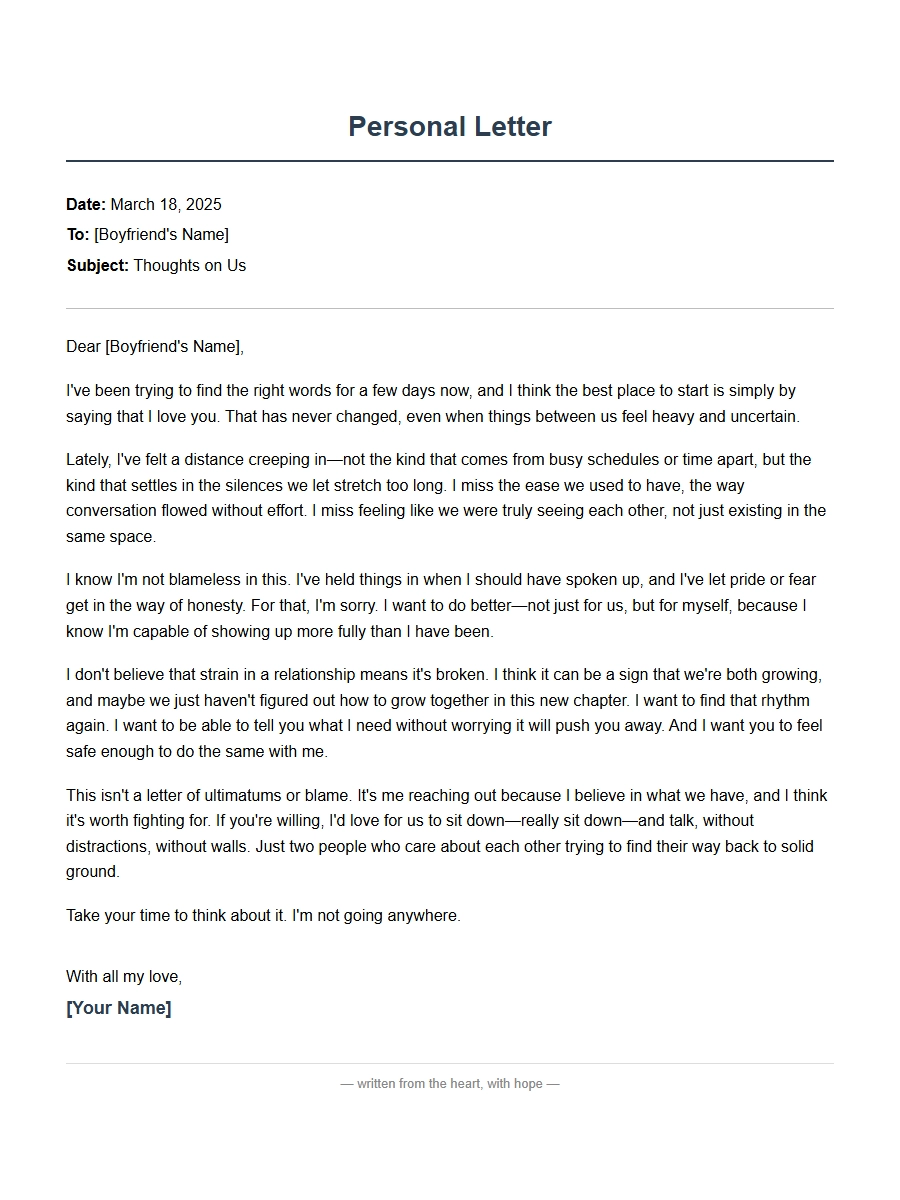 Personal Apology Letter for Boyfriend Relationship Strain
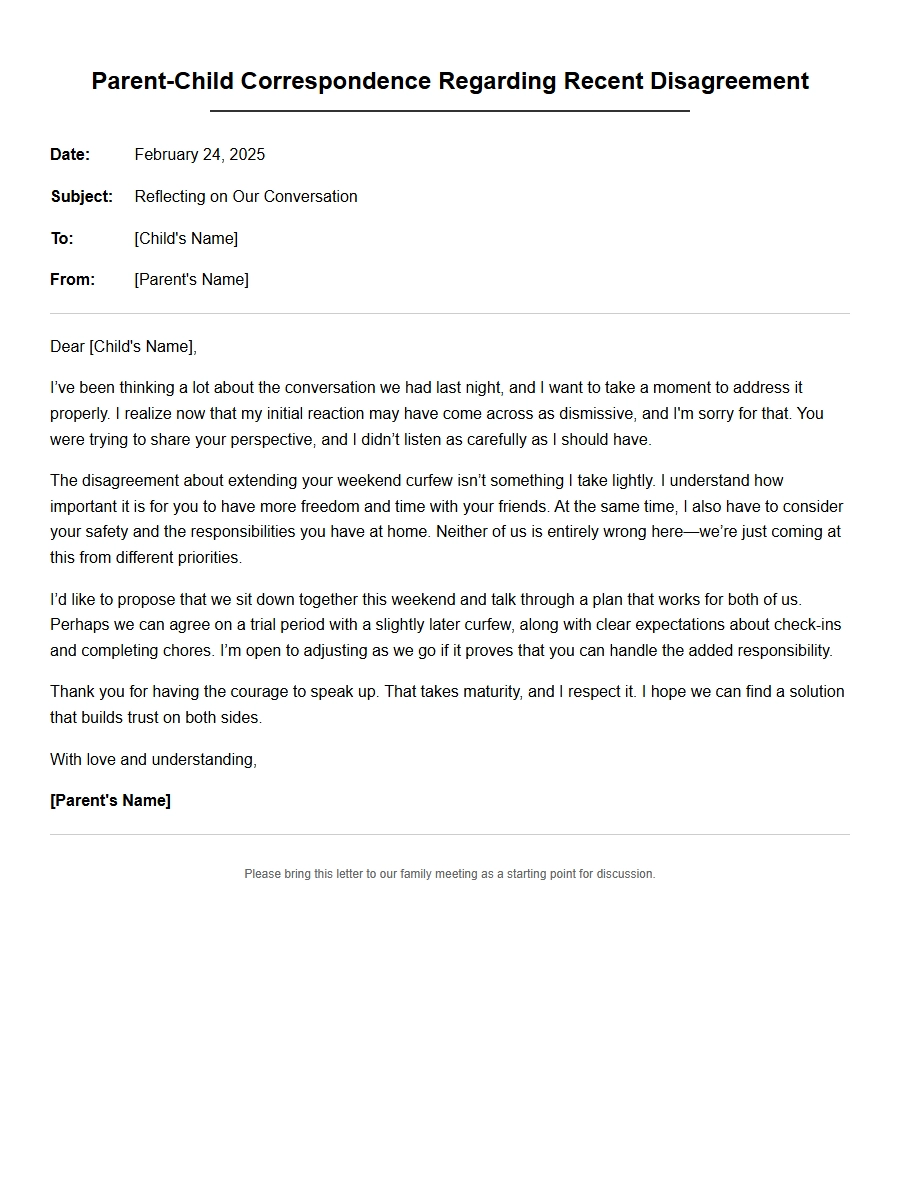 Apology Correspondence for Parent-Child Disagreements
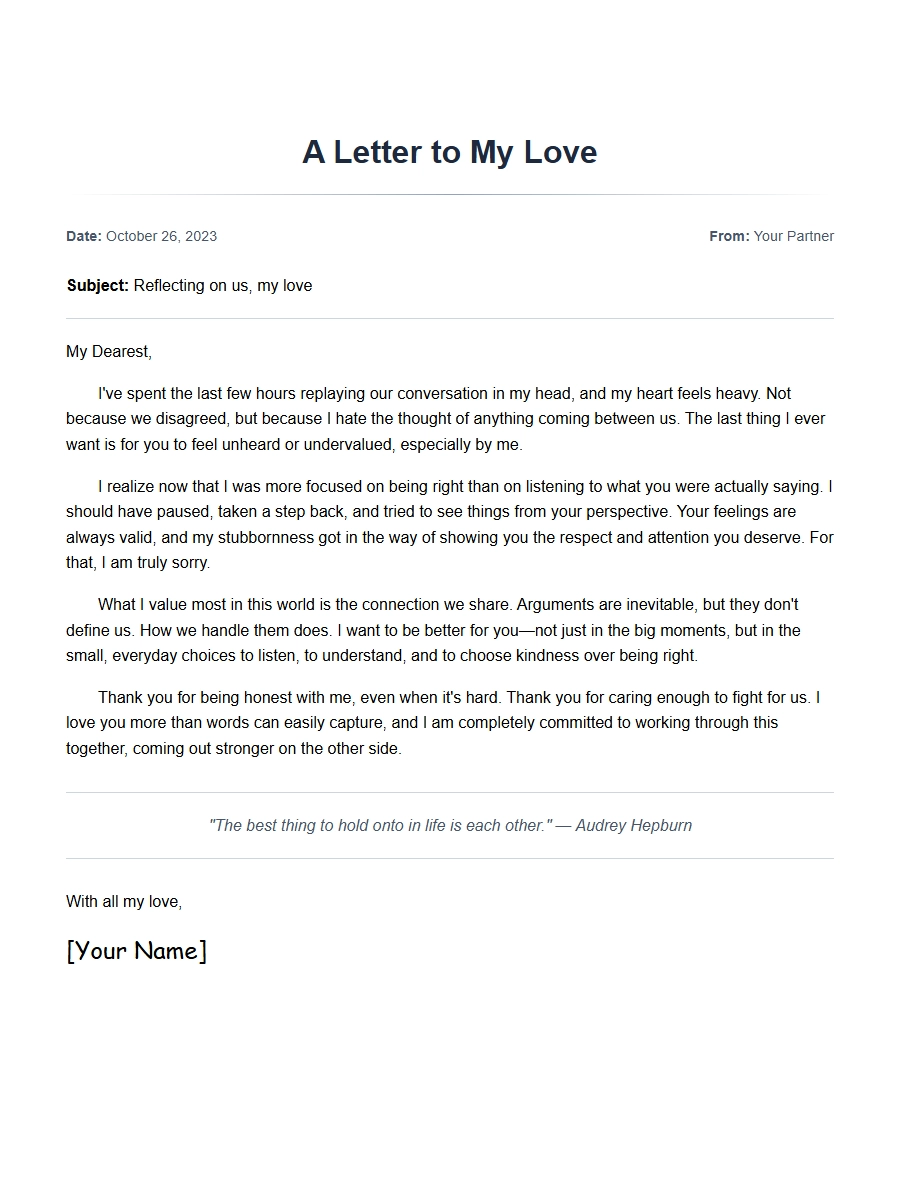 Apology Message for Girlfriend After Argument
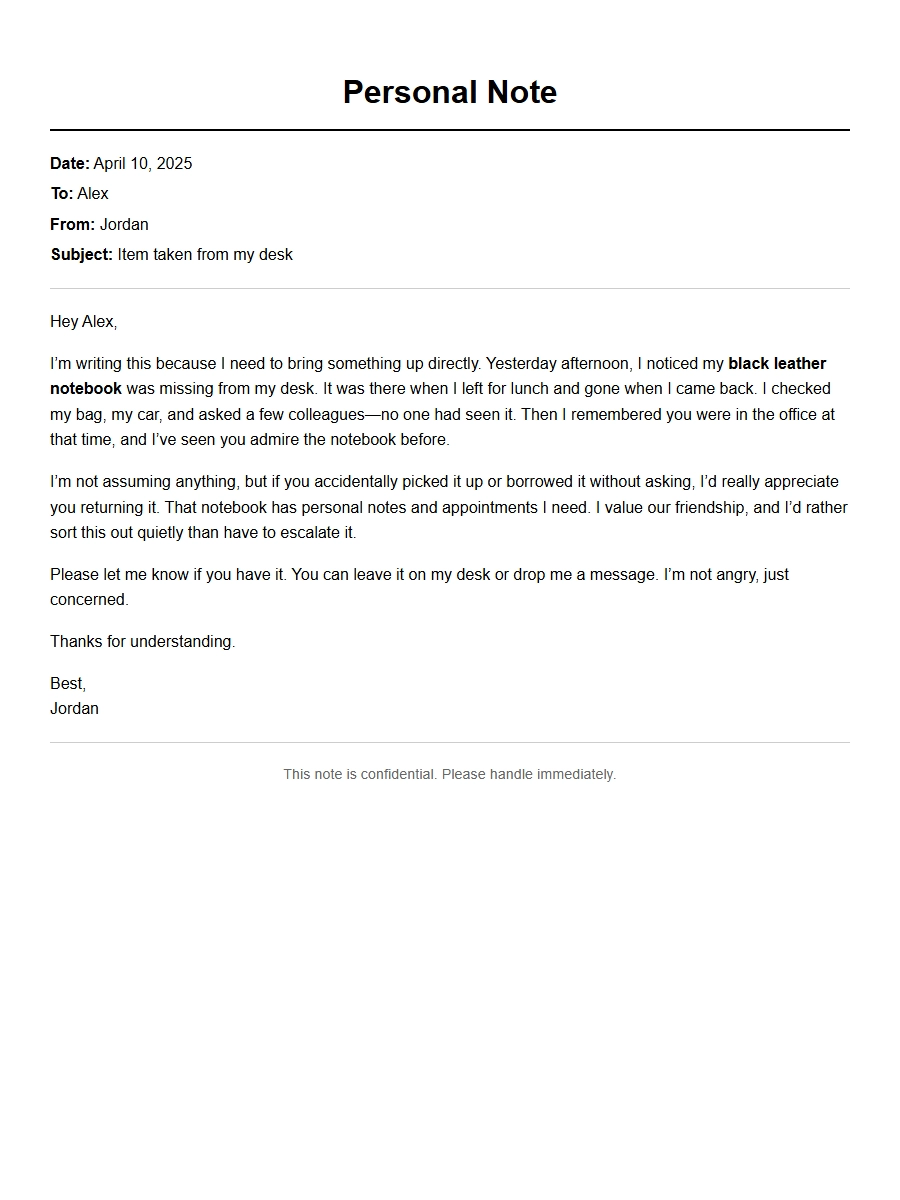 note for friend stealing item - Apology Letters
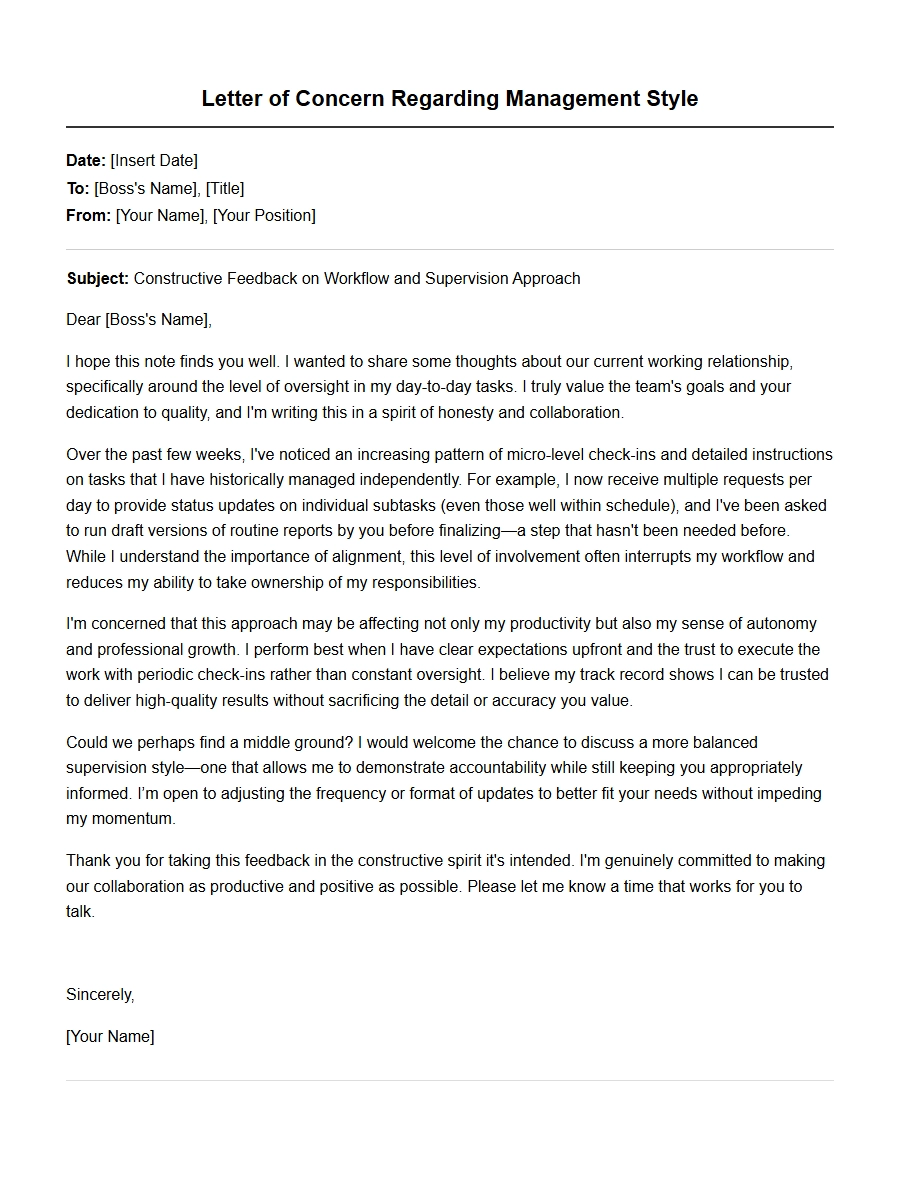 Apology to Boss for Micromanagement Complaint
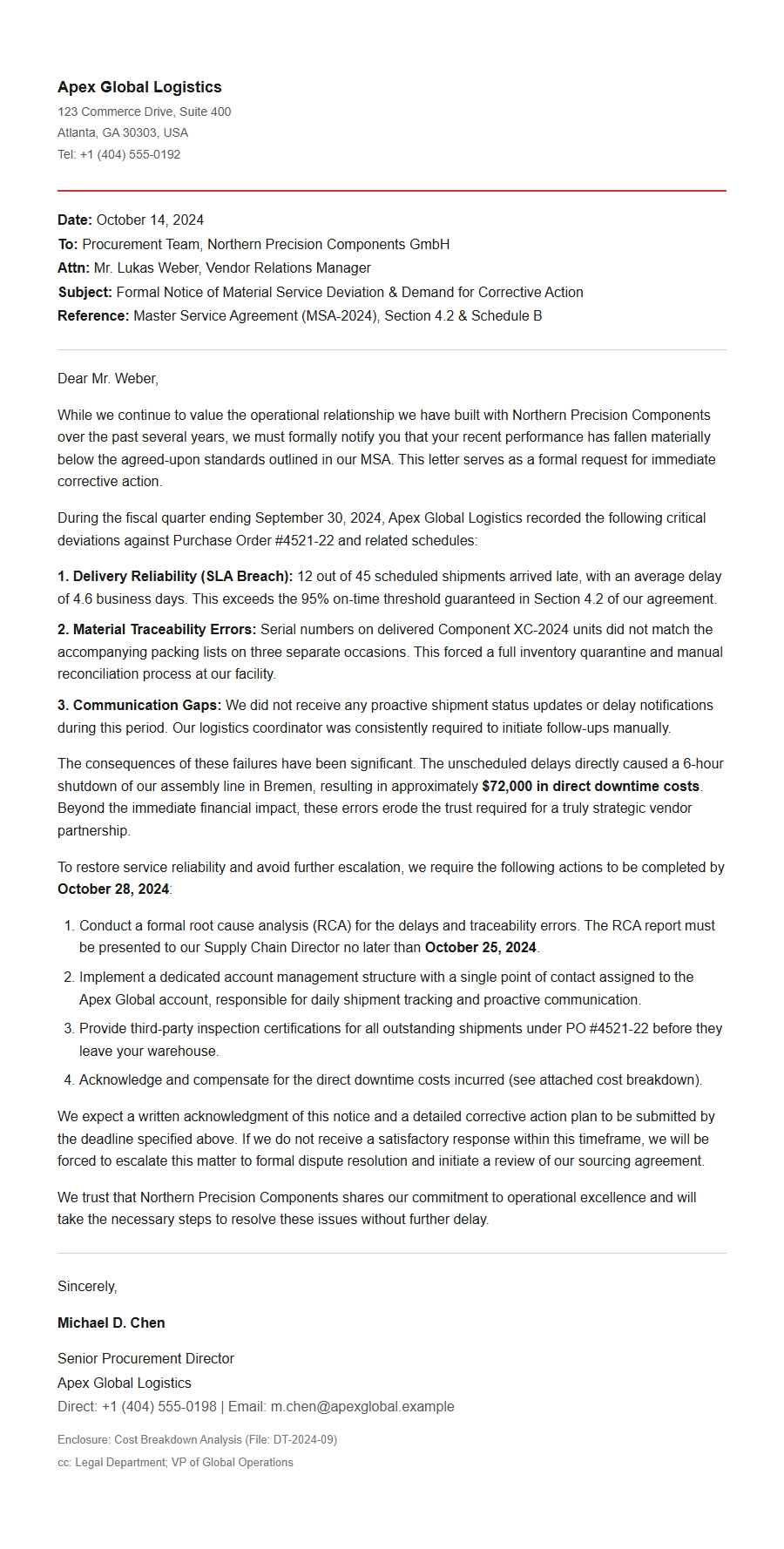 Apology Document for Vendor Supply Chain Issue