Example Note for Insurance Claim Settlement Approval
You’ve waited weeks for the insurance adjuster’s decision. Finally, the claim settlement approval lands in your inbox—but now you need to write a note confirming it, and suddenly the blank cursor stares back at you. It’s a small task, but one that can feel surprisingly high-stakes. A messy or unclear reply might slow things down, while a crisp, professional note keeps the process moving.
Using an example note for insurance claim settlement approval isn’t cheating—it’s a smart shortcut. Good samples give you the structure, the right tone, and the key phrases you need, while leaving plenty of room for your own details. Think of a letter template as a runway: you still have to steer the plane.
Category: Insurance Correspondence
Why a sample saves you time and trouble
A well-crafted sample covers the basics you might forget under pressure: the policy number, claim reference, settlement amount, and next steps. It also shows you how to sound confident without being pushy. Most people aren’t writing professional correspondence every day, so having a go-to format removes the guesswork. You can focus on the facts instead of worrying about letter structure.
But the real win is tone. A sample helps you strike the balance between “thank you for approving this” and “please don’t delay the payment.” It gives you a starting point that already feels trustworthy.
How to adapt a sample without sounding robotic
Start by choosing the right style. If you’ve been emailing back and forth with the same adjuster, a semi-formal note works. If this is your first contact after the approval, stick to a standard business letter format. Look at the sample’s salutation and closing—“Dear [Name]” is fine for most situations; “To Whom It May Concern” feels dated unless you truly don’t know who you’re writing to.
Next, personalize the opening. Instead of copying “I am writing to acknowledge receipt of your settlement approval,” try “Thanks for approving my claim—I appreciate the update.” That small shift makes the note feel like a real conversation. You’re still using the sample’s flow, but your voice comes through.
One quick tip: grab attention in the first sentence by confirming the exact approval date or claim number. It reassures the reader you’re on the same page. For example: “Thanks for your letter dated April 10 approving claim #12345.”
Common mistakes that slow down the process
Using an outdated salutation and closing like “Dear Sir” or “Sincerely yours” can feel stiff. If you’re sending an email, a simple “Best regards” works. Ignoring the difference between digital and printed formats is another trap—if you’re emailing, skip the letterhead design and put your details at the bottom. Printed letters still benefit from a clean header, but keep it simple.
Don’t forget to proofread. A typo in the settlement amount or policy number can cause delays. Treat this like any other formal writing tips exercise: read it aloud, check numbers twice, and ask someone else to glance at it if you’re uncertain. Proofreading letter might take an extra two minutes, but it saves hours of follow-up calls.
Making the note feel both professional and personal
The best settlement approval notes acknowledge the good news, confirm the details, and express appreciation without overdoing it. If you’ve worked with the same adjuster for months, a quick thank-you goes a long way. Think about the tone in writing: friendly but not casual, grateful but not groveling. You’re not writing a letter of recommendation—you’re closing a transaction with clarity.
A good example note for insurance claim settlement approval gives you the confidence to write a clear, professional response—but the best letters still feel like they came from you. Use the sample to get the format right, then swap in your own words. Practice a few times, and soon you’ll be able to dash off a settlement note in under five minutes.
The process isn’t complicated: pick a sample, adapt the tone, double-check the numbers, and send. That blank page won’t look so scary next time.
Practical Writing Samples
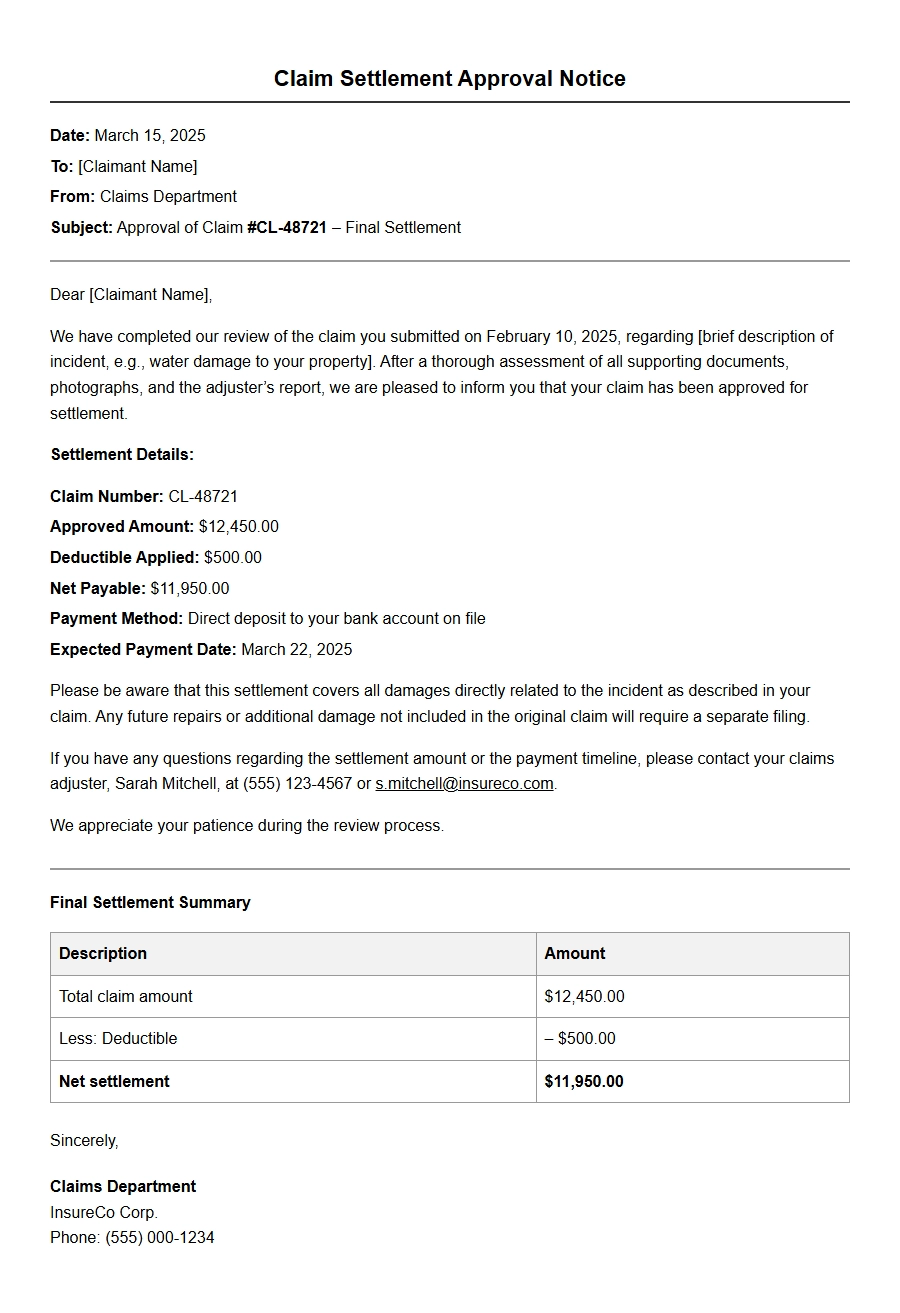
Example Note for Insurance Claim Settlement Approval
Standard Approval Acknowledgement
Dear [Recipient Name],
Thank you for your letter regarding the approval of insurance claim settlement for policy number POL-2025-7843. We acknowledge receipt and appreciate your prompt notification.
The settlement details are as follows:
Item
Details
Claim Number
CLM-98765
Date of Loss
March 12, 2025
Settlement Amount
$12,450.00
Payment Method
Direct Deposit
We confirm that the funds will be transferred to your account within five business days. Should you require further assistance, please contact our claims department at 1-800-555-0199.
Thank you for your cooperation throughout this process.
Sincerely, Claims Adjustment Team
Gratitude for Expedited Processing
Dear Claims Department,
On behalf of our family, I want to express our sincere gratitude for the swift approval of our insurance claim regarding the recent storm damage at our property.
We were particularly impressed with the efficiency shown by your team:
Immediate assignment of an adjuster within 24 hours
Thorough yet timely inspection of damages
Clear communication regarding required documents
Fast turnaround on settlement approval
The approved settlement of $8,700.00 (claim # CLM-45231) will greatly assist in repairing our roof and replacing damaged siding. Your exceptional service made a stressful situation much easier to handle.
Thank you again for your professionalism and support.
Warm regards, Margaret Thompson
Professional Appreciation to Adjuster
Dear Mr. Harrison,
I am writing to thank you personally for your dedicated work in securing the approval of my insurance claim settlement (claim number: CLM-334567).
Your meticulous attention to detail and transparent approach throughout the evaluation process were commendable. You patiently explained each step, from the initial assessment to the final approval, ensuring I understood all decisions made.
The settlement breakdown is as follows:
Component
Amount
Structural Damage
$15,200.00
Content Loss
$3,450.00
Additional Living Expenses
$2,100.00
Total Approved
$20,750.00
Your professionalism and empathy have restored my faith in the claims process. Please accept my heartfelt thanks.
Best regards, David Chen
Thanks for Prompt Payment Release
Dear Finance Department,
I am pleased to acknowledge receipt of the settlement payment for my auto insurance claim (# CLM-66789), and I thank you for the prompt approval and release of funds.
The payment was credited to my account on April 5, 2025, exactly as per your confirmation. The amount of $6,230.75 matches the agreed settlement for the repair of my vehicle.
Key milestones in this process were:
Claim filed: March 20, 2025
Approval date: March 28, 2025
Payment issued: April 2, 2025
Your efficiency in handling this matter from approval to payment is highly appreciated. I will now proceed with the repairs as planned.
Thank you once again for your excellent service.
Sincerely, James Okafor
Gratitude During Difficult Time
Dear Customer Service Team,
I am writing to thank you for the compassionate handling of my health insurance claim (claim # MED-2025-8912) following my recent surgery.
The approval of the settlement for $34,500.00 came at a critical time, and your team’s sensitivity to my situation was deeply appreciated. You kept me informed at every stage, answered all my questions patiently, and ensured that the paperwork was completed without unnecessary delays.
Your support included:
Pre-approval verification conducted quickly
Clear explanation of coverage limits
Assistance with submitting medical records
Timely approval notification
This allowed me to focus on my recovery without financial worry. Thank you for making a difficult time more manageable.
With gratitude, Sarah Mitchell
Acknowledgment with Feedback
Dear Claims Manager,
I am writing to express my thanks for the approval of my property insurance claim (# PROP-2025-4451) and also to provide positive feedback on your service.
Settlement highlights:
Category
Details
Claim Filed
January 15, 2025
Damage Type
Water Damage from Burst Pipe
Adjusted Amount
$9,875.00
Approved Amount
$9,875.00
Payment Date
February 2, 2025
The adjuster, Ms. Rivera, was exceptionally helpful. She made site visits on weekends to accommodate my schedule and provided a clear report that facilitated the swift approval. I also appreciate that the settlement matched the initial estimate, which speaks to the fairness of your assessment.
Thank you for restoring my trust in insurance processes.
Best wishes, Linda Grayson
Thanks for Supporting Documentation
Dear Documentation Team,
Thank you for your assistance in the approval of my travel insurance claim (# TRAV-7834) related to my canceled trip to Japan. Your guidance on the required supporting documents was invaluable.
Following your advice, I submitted:
Original flight cancellation notice
Medical certificate for the emergency
Hotel cancellation receipts
Completed claim forms
Within two weeks, I received approval for a settlement of $2,340.00, covering all non-refundable expenses. The clarity of your instructions and the responsiveness of your team made a frustrating situation much simpler.
I am particularly grateful for the email alerts that kept me updated on the status of my claim. Your efficient processing is a model of excellence.
Thank you once again.
Sincerely, Patrick Nguyen
Corporate Client Appreciation
Dear Business Claims Division,
On behalf of ABC Enterprises, I extend our sincere thanks for the approval of our commercial property claim (# COM-2025-1122) following the fire incident at our warehouse.
The settlement of $127,500.00 has been instrumental in allowing us to resume operations quickly. We appreciate the priority treatment given to our case, given the business disruption.
Summary of the approved settlement:
Loss Type
Approved Amount
Building Structure
$85,000.00
Inventory Damage
$32,500.00
Business Interruption
$10,000.00
We value the partnership with your company and look forward to continuing our relationship. Your professionalism during this crisis was outstanding.
Thank you again.
Yours faithfully, Robert Kim, CFO
Personal Note to Claims Officer
Dear Ms. Patel,
I wanted to send a personal note of thanks for your role in approving my life insurance claim settlement (policy # LIFE-4590) after my father’s passing.
Your kindness and patience during this emotional time meant a great deal to me. You made sure I understood every document I signed and expedited the approval process without any pressure. The settlement amount of $250,000.00 was processed within three weeks of submission, which is remarkable.
Key services you provided:
Helped compile the death certificate and policy documents
Guided me through beneficiary forms
Liaised with the legal department for quick approval
Followed up personally to confirm payment
Your dedication to your work has made a lasting impression on our family. Please accept our deepest gratitude.
Warmly, Anita Sharma
Final Resolution Thank You
Dear Settlement Team,
I am writing to thank you for the final approval and closure of my homeowners claim (# HOME-2025-9987) related to the hailstorm damage in March.
After a thorough review, the settlement was approved at $14,200.00, and I have now received the full payment. I appreciate that all disputes regarding the roof estimate were resolved amicably, thanks to your mediation.
Claim timeline for reference:
Event
Date
Claim Filed
March 18, 2025
Inspection Completed
March 22, 2025
Adjustment Dispute Resolved
April 5, 2025
Approval Notification
April 10, 2025
Payment Received
April 15, 2025
Thank you for your patience and professionalism throughout this process. I am satisfied with the outcome and grateful for your support.
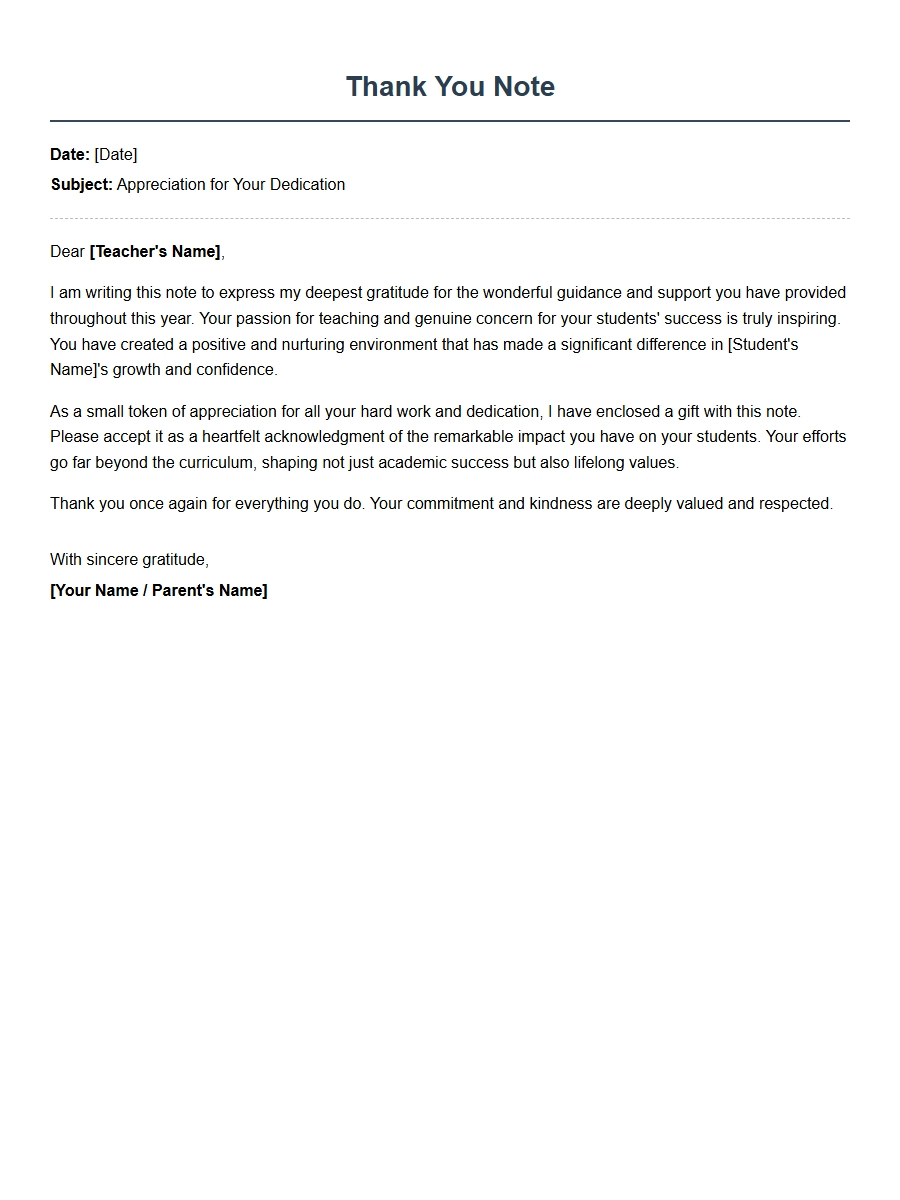 Sample Thank You Note for Teacher Gift
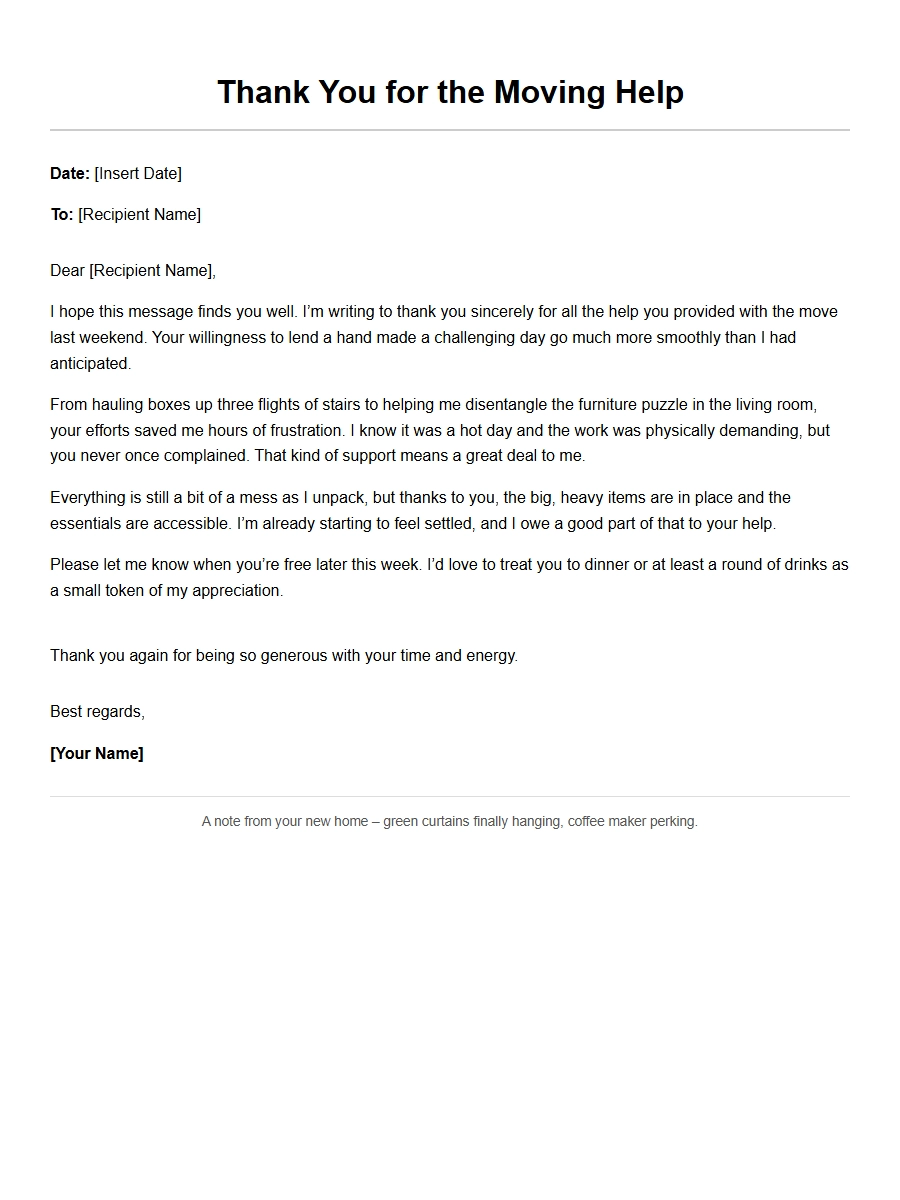 Thank-You Letter for Help with Moving
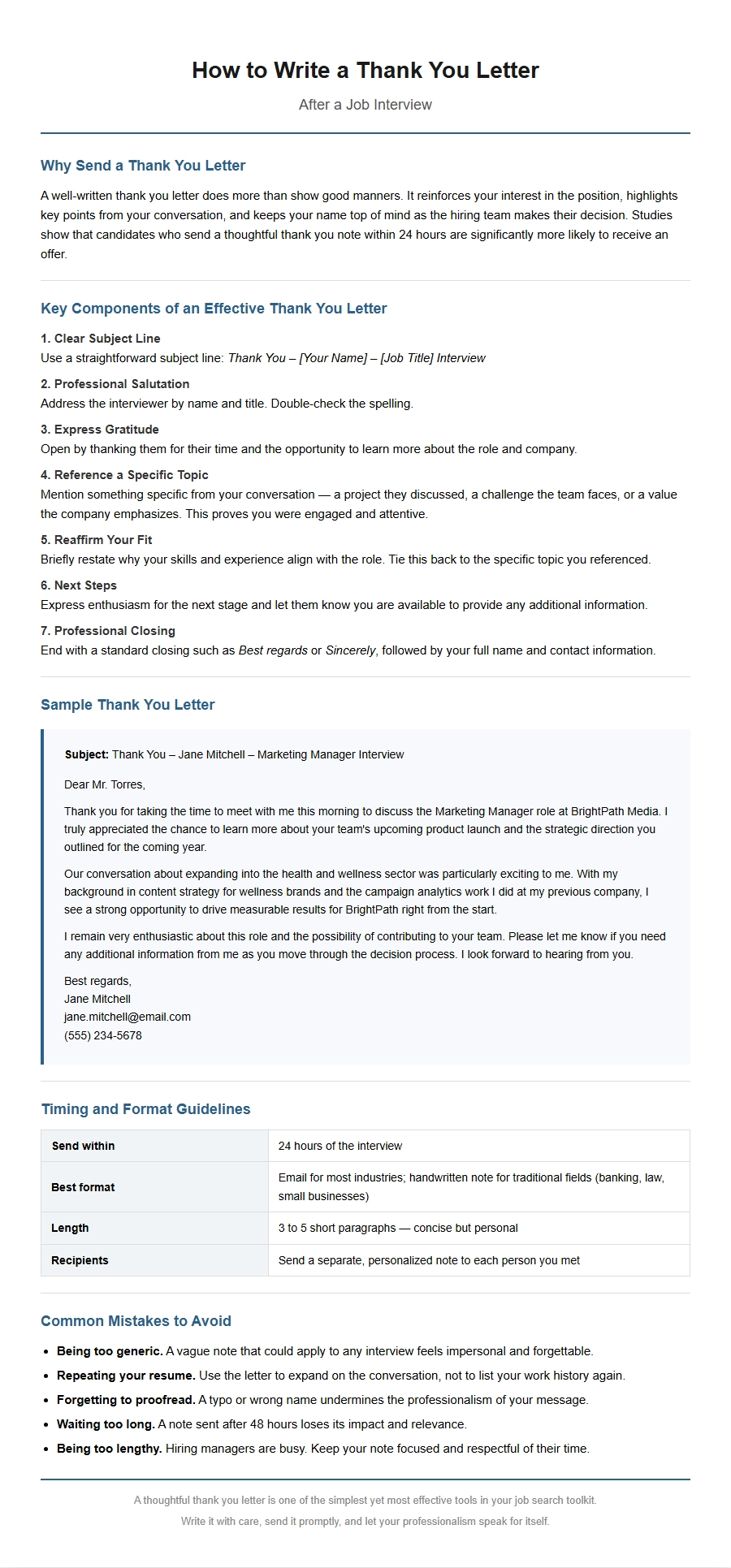 How to Write a Thank You Letter After an Interview
 professional thank you email example for client - Thank-You Letters
 Business Mentor Thank-You Letter Guide
 Thank You Letter for Sponsor Donation