Copywriter Cover Letter for Direct Response Marketing
You’ve got a direct response marketing copywriter cover letter to write, and the blank page is staring back at you. Maybe you’re switching jobs, or maybe this is your first time applying for a role that demands sales-driven writing. Either way, you don’t need a lecture—you need a starting point.
Using a letter sample isn’t cheating. It’s smart. A good sample gives you the structure, the professional correspondence tone, and the key phrases that hiring managers expect. What it doesn’t do is write the letter for you. You still have to make it sound like you. Think of it as a shortcut that still forces you to do the real work: showing how you write copy that gets people to click, sign up, or buy.
What makes a direct response cover letter different?
A direct response marketing cover letter isn’t a polite introduction. It’s a proof of concept. You’re not just listing your skills—you’re demonstrating you can write something that holds attention and drives action. The format matters, but the tone matters more. It needs to feel confident, not pushy. Specific, not vague.
You want to show the hiring manager that you understand their world. That means talking about conversion rates, A/B testing, audience segmentation, and copy that sells without sounding like an infomercial. Use the language of the trade, but don’t overdo it. One tight sentence about improving email open rates by 20% is worth a paragraph of buzzwords.
Start with the right sample
The first thing to do is pick a cover letter example that matches the job level you’re aiming for. A junior copywriter role asks for a different tone than a senior position where you’re expected to own strategy. Look for samples that use a modern business letter format—clean, scannable, with enough white space so the reader can skim before they read.
If you’re applying to a startup, a slightly less formal tone can work. If it’s a larger company or a more traditional agency, lean toward polished professional correspondence. The key is matching the energy of the job description. If they use words like “fast-paced” and “scrappy,” your letter should feel quick and direct. If they talk about “brand voice” and “long-term strategy,” slow down and show depth.
How to adapt a sample without sounding like a robot
Here’s where most people mess up. They find a decent template and just swap out the company name. That’s how you get a letter that feels hollow. Instead, use the sample for the structure only. Pay attention to the salutation and closing—those small details signal whether you understand letter writing etiquette or not. “Dear [Hiring Manager Name]” is always better than “To Whom It May Concern.” If you can’t find a name, “Dear Marketing Team” is a decent fallback.
In the body, use the sample’s flow as a guide. Open with a sentence that connects their problem to your experience. For example: “When your last email campaign saw a 12% click-through rate, I saw an opportunity.” That shows you’ve done your homework and you think in terms of results. Then, in the next paragraph, back it up with a specific example from your own work. Mention a past win, but keep it brief. The goal is to make them want to read your portfolio, not to fit your whole career into one page.
Common mistakes to skip
One mistake is using an outdated salutation like “Dear Sir or Madam.” That screams generic template. Another is ignoring the format. If you’re sending the letter by email, skip the full letterhead design. Just put “Copywriter Cover Letter – [Your Name]” in the subject line, and paste your letter directly into the email body. Attachments get ignored.
Also, don’t forget to proofread. A typo in a copywriter’s cover letter is the fastest way to get rejected. Read it out loud. Have someone else look at it. You’d be surprised how often people skip this step.
Make it feel personal
The best direct response cover letters feel like a conversation. They’re direct, but not rude. They’re confident, but not arrogant. Start by addressing a real pain point you know the company faces. Maybe their landing page copy is too wordy. Maybe their email flow has a hole in the middle. Show that you see it, and hint at how you’d fix it. That’s the kind of specificity that separates a generic application from one that gets a response.
Your email signature matters. Make sure it includes your phone number, a link to your portfolio, and your LinkedIn profile. If you have a personal website that shows your best copy, include that too. Hiring managers in direct response marketing want to see results, not just read about them. Make it easy for them to find proof of your work.
Also, think about how your letter reads on a phone. A lot of managers and recruiters screen applications on mobile. Keep paragraphs short. Avoid massive blocks of text. Use bold sparingly, only to highlight a key metric or a major accomplishment.
Your next step
Find a cover letter example that feels close to what you need, and use it as a scaffold. Then rewrite it until it sounds like you. Swap out generic phrases for specific examples. Cut anything that doesn’t prove you can write copy that sells. Read it once, then read it again. Then hit send.
The more you practice this, the faster it gets. Before long, you won’t need a sample at all. You’ll just write a strong, focused letter in ten minutes. But until then, use the help. Just make sure you’re the one doing the talking, not the template.
Helpful Reference Samples
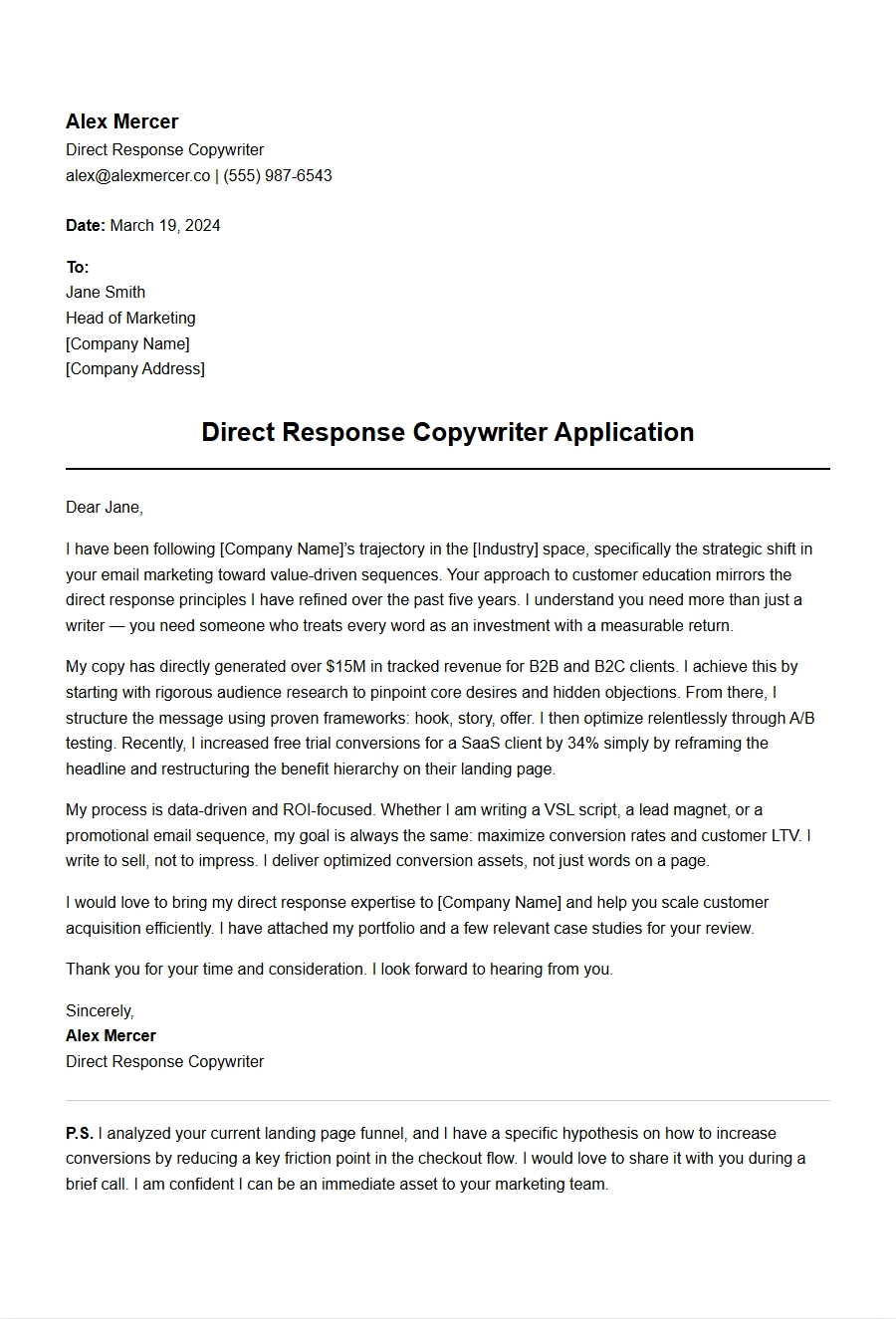
Copywriter Cover Letter for Direct Response Marketing
Direct Response Copywriter – Agency Job Cover Letter
Dear Hiring Manager,
I am writing to express my interest in the Direct Response Copywriter position at [Agency Name]. With over five years of experience crafting high-converting email campaigns, landing pages, and direct mail pieces for B2C brands, I understand the unique blend of persuasive writing and data-driven strategy that your team demands.
My recent campaign for [Previous Client] produced a 34% increase in click-through rates and a 22% lift in conversions within three months. Below is a snapshot of my core competencies:
Skill
Proficiency
Recent Result
Email Copywriting
Expert
27% open rate increase
A/B Testing & Optimization
Advanced
19% conversion lift
Direct Mail Strategy
Proficient
12% response rate
I am eager to bring this track record to [Agency Name] and help your clients achieve measurable results. I look forward to discussing how my direct response approach can contribute to your team’s success.
Sincerely, [Your Name]
Freelance Copywriter – Direct Marketing Client Proposal
Hi [Client Name],
I’m a freelance direct response copywriter specializing in lead generation and sales for e-commerce and SaaS companies. After reviewing your current campaign, I believe I can help you increase conversion rates and lower customer acquisition costs.
Here’s a proposed collaboration outline:
Discovery Phase: Research your target audience and analyze top competitors.
Copywriting: Write three email sequences, two landing pages, and one direct mail piece.
Testing: A/B test subject lines, calls-to-action, and offers for two weeks.
Reporting: Provide a detailed performance report with actionable insights.
I charge a flat project fee of $3,000, with 50% upfront and 50% upon delivery of final assets. I can begin next Monday and deliver within four business weeks. I’ve attached examples of similar work for your review.
Let me know if you’d like to schedule a quick call to refine the scope.
Best regards, [Your Name]
Senior Direct Response Copywriter – In-House Role Application
Dear [Company Name] Team,
I have followed [Company Name]’s growth in the health & wellness space for years, and I am thrilled to apply for the Senior Direct Response Copywriter role. My background includes six years of in-house experience driving revenue through direct mail, email, and digital ads for brands similar to yours.
In my current position at [Current Company], I led the copy strategy that resulted in a $2.3M lift in annual revenue from direct response channels. Key achievements:
Revamped the welcome email sequence, boosting first-purchase conversion by 18%.
Wrote and tested 40+ direct mail packages achieving a 5.2% average response rate.
Implemented a voice-of-customer framework that improved copy relevance and ROI.
I am comfortable with both performance metrics and creative storytelling. I would love to bring my direct response expertise to your internal marketing team.
Thank you for your time and consideration.
Warmly, [Your Name]
Email Marketing Copywriter – E-commerce Cover Letter
Hi [Hiring Manager],
I’m an email marketing copywriter with a focus on direct response for e-commerce brands. Your recent job posting for a Copywriter at [E-commerce Company] caught my eye because I have a proven track record of turning subscribers into repeat buyers through targeted, persuasive email sequences.
Here is a summary of what I’ve accomplished in the last year:
Campaign Type
Emails Sent
Revenue Generated
Welcome Series
150K
$89K
Abandoned Cart
95K
$62K
Win-Back Campaign
45K
$21K
I use data from past sends to craft subject lines and body copy that resonate with your audience segments. I also write clear, compelling calls-to-action that drive clicks without being pushy.
I’d love to discuss how my direct response email strategies can help [E-commerce Company] achieve its Q4 targets.
Best, [Your Name]
Direct Mail Copywriter – Nonprofit Fundraising Letter
Dear [Organization Name] Hiring Team,
I am a direct mail copywriter with six years of experience writing donor-facing appeals for nonprofit organizations. I understand that fundraising letters need to combine emotional storytelling with a clear, urgent call to action—exactly the skills your organization requires for the upcoming year-end campaign.
One of my most successful campaigns raised $340,000 from a single direct mail drop for a children’s education nonprofit. That letter achieved a 7.8% response rate, well above the industry average of 2–4%. My approach includes:
Personalized salutations and story hooks that connect donors to your mission
Strong use of urgency and impact statements
A clear “ask” with easy donation instructions
I also collaborate with designers to ensure the copy and layout work together to drive response. I am confident I can help [Organization Name] exceed its fundraising goals.
Thank you for considering my application.
Sincerely, [Your Name]
Conversion Copywriter – SaaS Company Cover Letter
Hi [Hiring Manager],
I’m writing to apply for the Conversion Copywriter position at [SaaS Company]. Direct response marketing has been the core of my copywriting career, and I specialize in SaaS landing pages, trial sign-up flows, and feature adoption emails.
In my last role at [Previous SaaS Company], I increased trial-to-paid conversion by 31% by rewriting onboarding emails and the pricing page. I rely on both user psychology and quantitative data to craft copy that moves prospects through the funnel.
Below are a few relevant metrics from recent projects:
Project
Metric Improved
Improvement
Landing Page Redesign
Sign-up Rate
+25%
Email Re-engagement Series
Reactivation
+40%
Feature Adoption Upsell
Upgrade Rate
+18%
I am excited about the chance to apply this direct response methodology to [SaaS Company]’s growing product line.
Best regards, [Your Name]
Direct Response Copywriter – Remote Position Cover Letter
Dear Remote Hiring Team,
I am an experienced direct response copywriter seeking a fully remote position where I can focus on writing high-converting copy without the distractions of a traditional office. I have over four years of remote work experience, using tools like Slack, Asana, and Google Docs to collaborate effectively.
My direct response results speak for themselves:
Wrote a series of 12 emails for a B2B client that generated $150K in new sales.
Created VSL scripts with conversion rates averaging 4.8%.
Produced direct mail pieces with a 6.1% average response rate across three campaigns.
I am fully self-sufficient, meet deadlines consistently, and communicate proactively. I can work in any time zone and am comfortable managing multiple projects simultaneously.
I would love to join [Company Name] as your Direct Response Copywriter and help you scale your revenue through proven copy strategies.
Thank you for your time.
Sincerely, [Your Name]
Junior Copywriter – Direct Marketing Internship Cover Letter
Dear [Company Name],
I am a recent graduate with a degree in Marketing and a passion for direct response copywriting. I am applying for the Junior Copywriter internship to learn from your experienced team while contributing fresh ideas and a strong work ethic.
During my coursework and personal projects, I have applied direct response principles:
Wrote and tested email subject lines for a campus fundraising drive, achieving a 35% open rate.
Created landing page copy using the AIDA framework for a mock SaaS product.
Analyzed 10 direct mail pieces to identify patterns in successful response rates.
I am proficient in writing persuasive copy, performing basic A/B testing, and using Google Analytics to measure results. I am eager to develop my skills further under your mentorship.
I have attached my resume and a portfolio of my academic and personal copywriting samples. I would be thrilled to contribute to [Company Name]’s client campaigns.
Thank you for considering my application.
Best, [Your Name]
Direct Response Copywriter – Portfolio Submission Cover Letter
Hi [Client Name or Agency],
I am sending you my portfolio as a direct response copywriter with a strong emphasis on measurable results. My work spans email, direct mail, landing pages, and paid ads—all crafted to drive response and revenue.
Below is a quick overview of the samples included:
Client Industry
Format
Key Metric
Health & Wellness
Email Sequence
22% conversion rate
Financial Services
Direct Mail Package
9.1% response rate
E-commerce Apparel
Landing Page
18% click-through rate
SaaS CRM
Paid Ad Copy
4.2 ROAS
Each sample includes a brief note on the copy strategy and the results achieved. I believe my direct response expertise can help you or your clients generate more leads, sales, and engagement.
I’m available for freelance projects or a full-time role—please let me know which would interest you. I look forward to hearing from you.
Best, [Your Name]
Cold Outreach Letter – Direct Response Copywriting Services
Dear [Prospect Name],
I’m a direct response copywriter who helps businesses like yours turn cold traffic into warm leads. I noticed that your current marketing materials could benefit from sharper, more action-driven copy—specifically in your email series and landing pages.
Here’s how I can help:
Rewrite your lead magnet page to increase opt-in rates
Create a 5-email sequence that nurtures subscribers and drives sales
Write direct response direct mail if you’re testing offline channels
To show you my capabilities, I can provide a free copy audit of one piece of your existing content. No obligation, just tangible suggestions.
Recent results from similar projects:
Project Type
Before
After
Email Welcome Series
8% Click Rate
14% Click Rate
Landing Page
3.2% Conversion
6.7% Conversion
If you’re interested, simply reply to this email or schedule a 15-minute call using [Link].
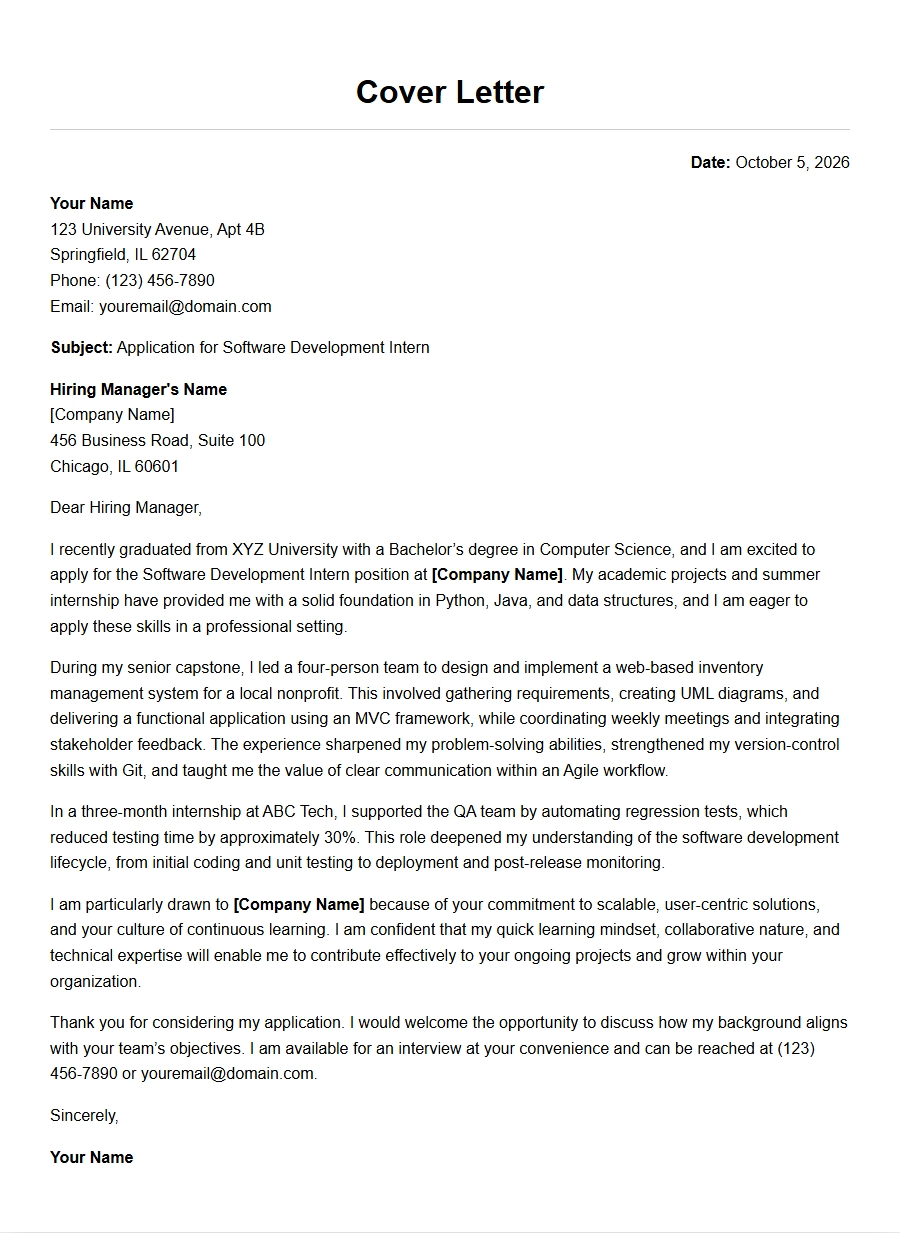 Recent College Student Cover Letter for Internship
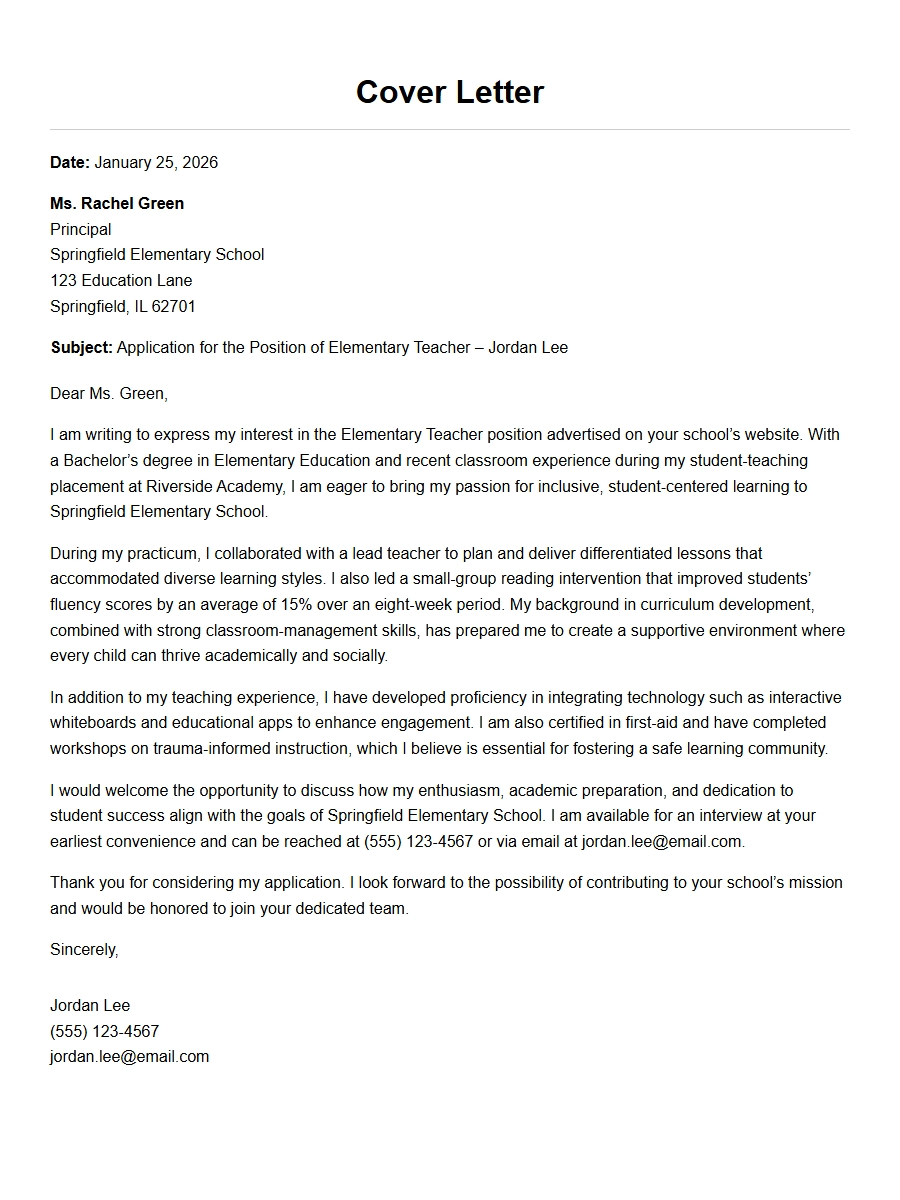 Entry Level Teacher Cover Letter Examples
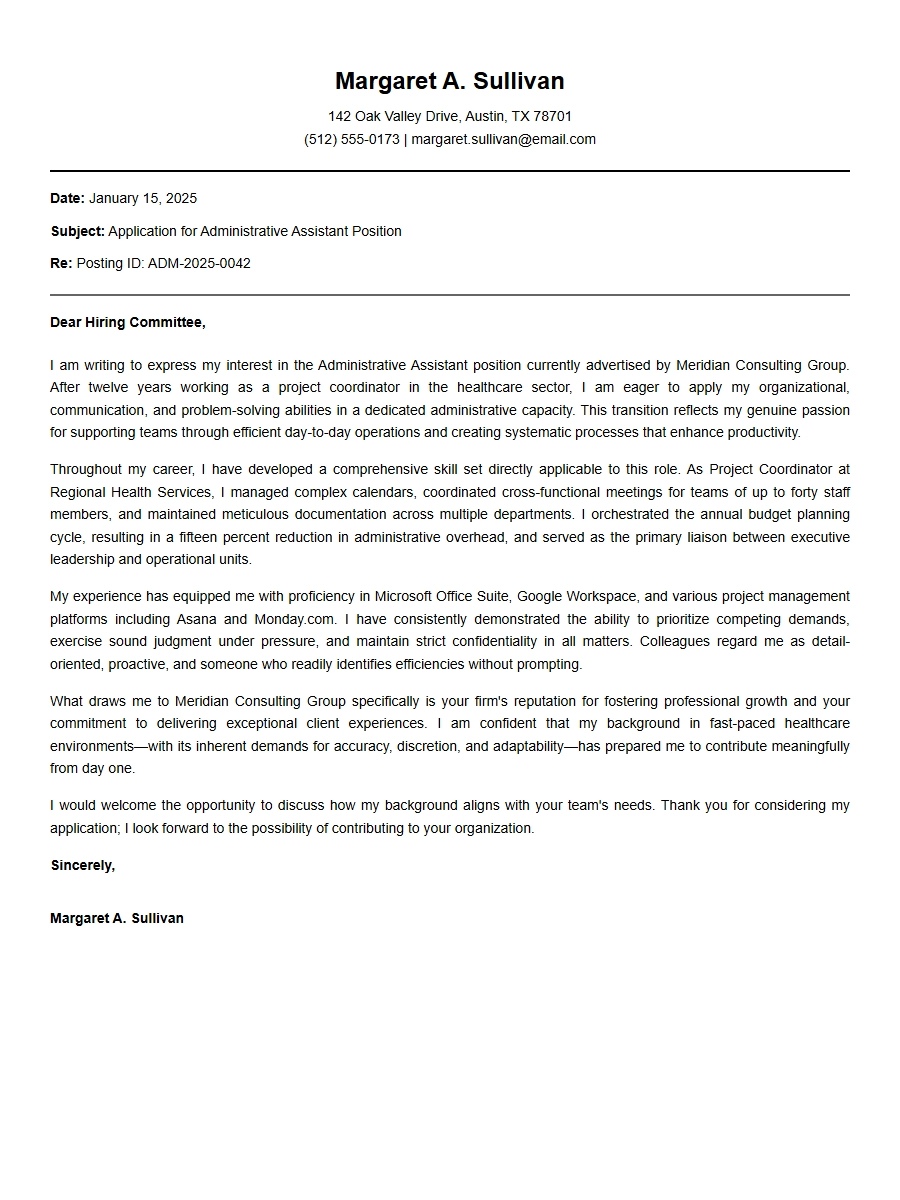 Career Changer Administrative Assistant Cover Letter
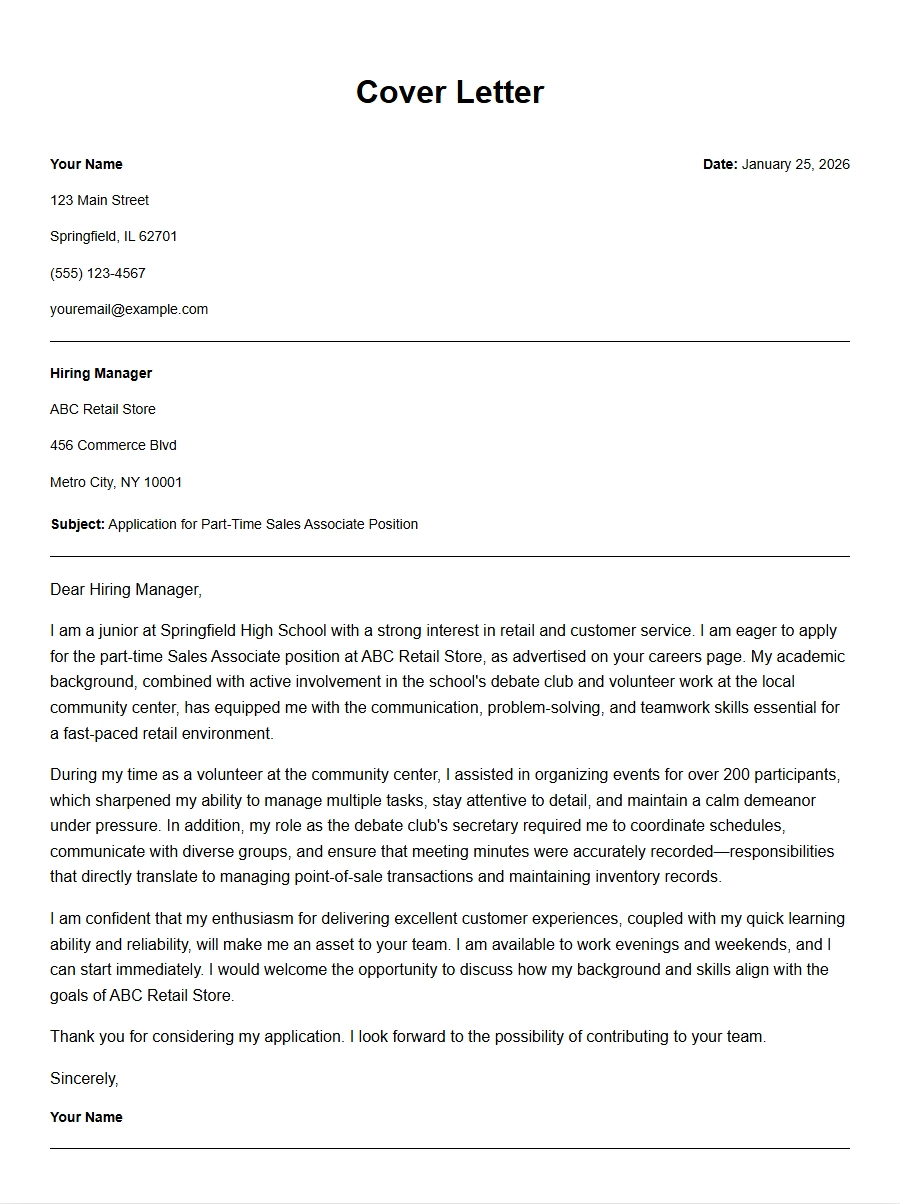 High School Student Part Time Job Cover Letter
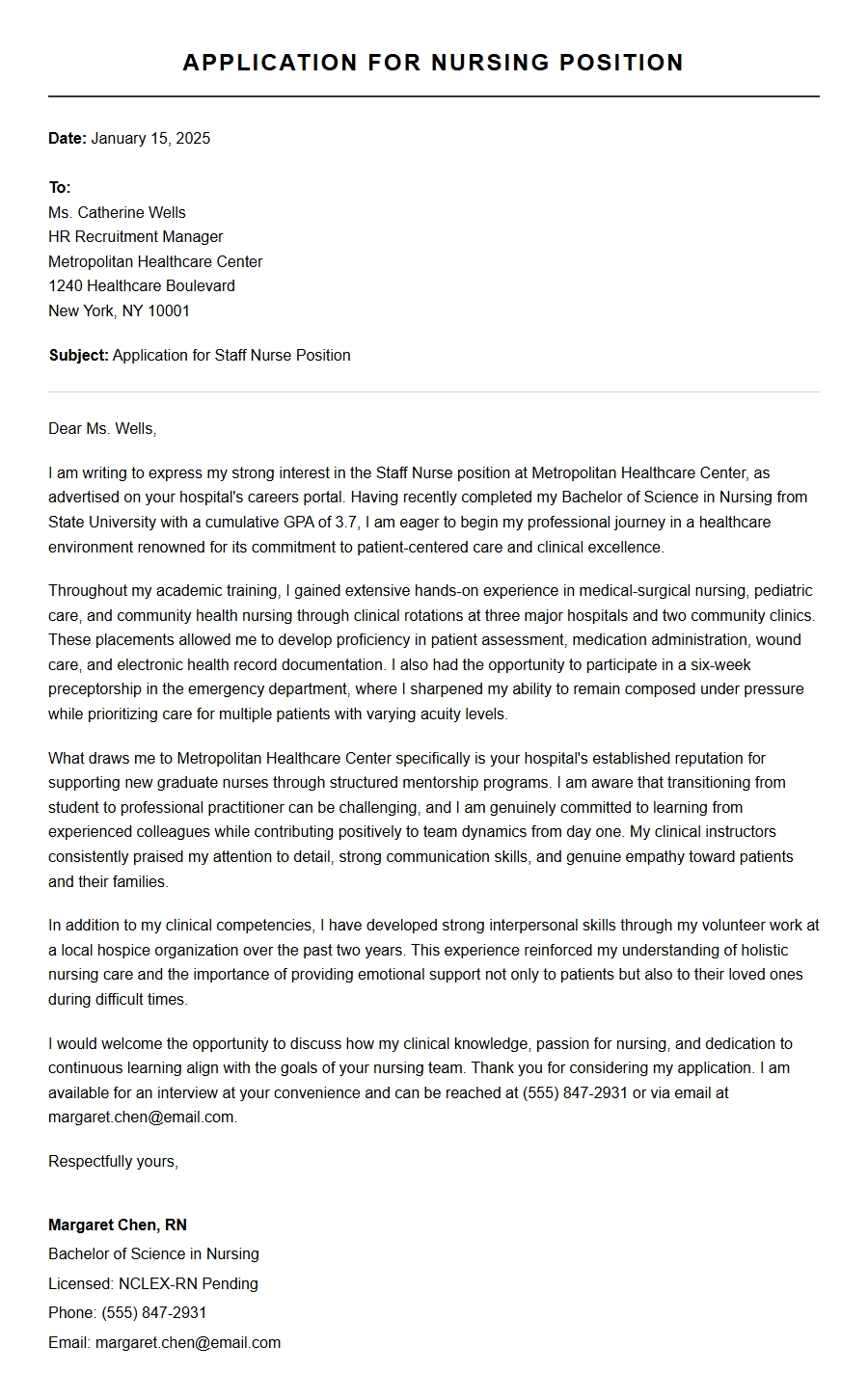 Fresh Graduate Nursing Application Letter
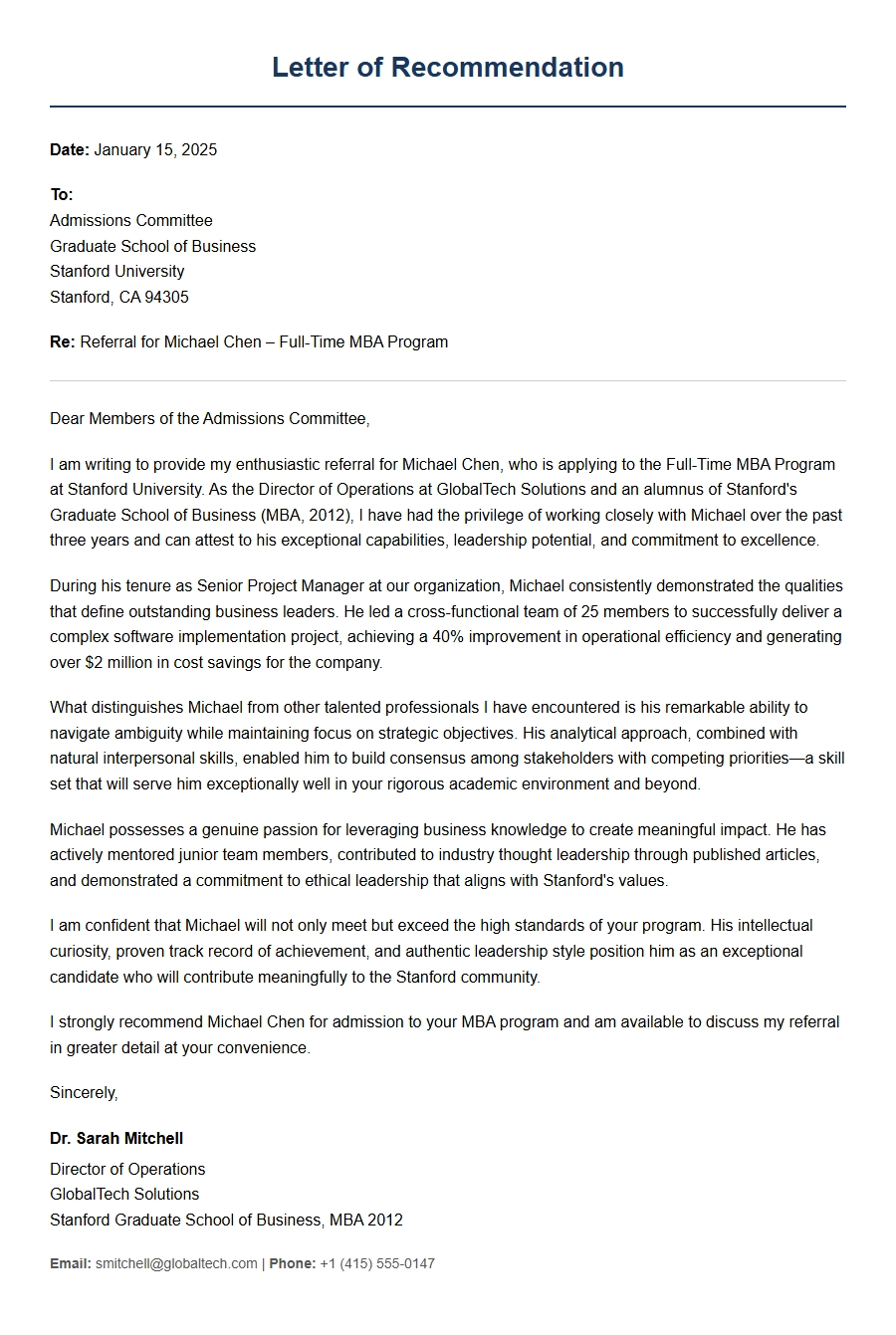 University Alumni Referral Email Cover Letter