accepting a formal dinner invitation reply wording - Invitation Letters
You’ve received a formal dinner invitation—maybe from a boss, a colleague, or a distant relative you rarely see. Now you need to reply, and suddenly the simple act of writing "yes" or "no" feels loaded with etiquette landmines. Should you handwrite it? Email? What do you say besides "I’ll be there"?
That’s where a formal dinner invitation reply wording sample helps. Using a sample isn’t cheating. It’s the smartest way to get the structure right—the salutation, the polite acceptance, the closing—so you can focus on adding your own personal touch. A good sample gives you a skeleton; you add the warmth and detail that makes it feel like you.
Let’s walk through how to adapt a sample for your specific situation—whether it's a black-tie gala, a small dinner at your boss’s home, or a charity fundraiser.
Start with the right format: printed vs. digital
First, decide on your digital letter format. If the invitation came by mail on heavy cardstock, reply the same way—handwritten on a nice note card or letterhead stationery. If it came by email, a polite email reply is fine. The key is matching the formality of the invitation.
For printed replies, use standard business letter format: your address, the date, the recipient’s address, a formal salutation, the body, and a closing. For emails, you can skip the addresses but keep the same respectful tone.
How to adapt a sample without sounding stiff
Here’s the trick most people miss: a sample gives you the letter structure and key phrases, but your voice makes it real. Let’s say the sample says:
“Mr. and Mrs. Smith accept with pleasure the kind invitation of Mr. and Mrs. Jones for dinner on Saturday, the fifteenth of March at seven o’clock.”
That’s perfectly correct, but stiff. If you’re close to the host, you can soften it:
“Dear Margaret and Tom, Thank you so much for the invitation to dinner on March 15th. We would be delighted to join you at seven o’clock. Looking forward to it!”
Notice what stayed: the clear acceptance, the date and time, and the polite tone. What changed: it now sounds like you. Always proofread your letter writing etiquette—especially the date and time—before sending.
Tailor your opening paragraph to the host
Your salutation and closing set the tone. For a formal invitation from your CEO, use “Dear Mr. Chen” and “Yours sincerely.” For your in-laws, “Dear Aunt June and Uncle Bob” with “Warmly” works better.
The most common mistake? Using “Dear Sir” or “To Whom It May Concern” when you know the host’s name. Never guess. If the invitation has a return address or phone number, you have all you need.
Watch out for outdated phrases
Ever received a letter that felt like it was written in 1952? Avoid phrases like “I beg to accept” or “Kindly oblige.” In modern professional correspondence, “I am pleased to accept” or simply “Thank you—I would love to come” are perfectly polite. Check your tone in writing: formal doesn’t mean cold.
Another mistake: forgetting to confirm the number of guests. If the invitation says “Mr. and Mrs. Smith,” that means two people. If it’s for you alone, don’t add a plus-one without checking. That’s a fast way to create awkwardness.
Category
This falls under Invitation Letters—specifically, how to respond to them like a pro.
Keep it simple, but complete
A good reply covers four things: thank the host, accept (or decline), restate the date and time, and close warmly. That’s it. You don’t need a long explanation of why you’re excited or what you’ll wear. Short and correct is better than long and wrong.
If you’re declining, do it honestly but briefly. “Thank you so much for the invitation to dinner on March 15th. Unfortunately, I have a prior commitment. I hope you have a wonderful evening.” No need to over-explain. That keeps the relationship smooth and leaves the door open for future invitations.
When to use a letter of recommendation or cover letter examples skill
Some of the same formal writing tips apply here that you’d use in a resignation letter sample or letter of recommendation: match the tone to the relationship, be specific, and proofread twice. If you’re unsure about your wording, read it aloud. If it sounds natural to you, it’ll sound natural to the host.
If you’re writing on behalf of an organization, a shareholder assembly invitation offers a good model for formal business tone. Or if you’re coordinating volunteers, a prom night chaperone request shows how to balance authority with warmth.
Use the sample as your springboard
The best replies feel both professional and personal—like a handshake with a smile. Use a sample to get the letterhead design right, the date format correct, and the closing polite. Then add your own words. Over time, you’ll write these replies faster and with more confidence. Practice really does make the process faster, and each time you polish a letter, you’re building a skill that serves you in many situations.
Browse Sample Ideas
accepting a formal dinner invitation reply wording - Invitation Letters
Simple and Direct Acceptance
Reply to: Mr. & Mrs. Harrison
Re: Formal Dinner Invitation – Saturday, 12th October 2024
Dear Mr. and Mrs. Harrison,
I am writing to accept with pleasure your kind invitation to the formal dinner on Saturday, 12th October 2024 at 7:00 PM. I look forward to an elegant evening and to seeing you both again.
Please find below my contact details for your records:
Detail
Information
Name
Jonathan West
Phone
555-0192
Email
j.west@example.com
Thank you for your gracious hospitality. I will be delighted to attend.
Yours sincerely, Jonathan West
Acceptance with a Guest
Reply to: Ambassador Elena Torres
Re: Dinner at the Embassy – 18th November 2024
Dear Ambassador Torres,
It is with great pleasure that I accept your gracious invitation to the formal dinner on Monday, 18th November 2024, at 8:00 PM. I will be accompanied by my spouse, Dr. Margaret Chen.
For your seating arrangements, please note:
Name: Dr. Samuel Ross
Guest: Dr. Margaret Chen
Dietary Note: Vegetarian (both)
We are both honoured to join you and the other distinguished guests. Thank you for including us.
With warm regards, Dr. Samuel Ross
Late but Polite Acceptance
Reply to: Mr. David Lambert
Re: Dinner Celebration – 22nd September 2024
Dear David,
I must apologise for the delay in replying to your thoughtful invitation for the formal dinner on 22nd September. Please accept my sincere gratitude and my enthusiastic acceptance.
I confirm I will attend the event at 7:30 PM. Below is my RSVP information:
Item
Details
Guest Name
Victoria Ainsworth
Number of Guests
1 (myself)
Special Requirements
None
I hope my late response does not cause any inconvenience. I am very much looking forward to the evening.
Kind regards, Victoria Ainsworth
Acceptance with Dietary Restrictions
Reply to: Lord William Harrington
Re: Formal Dinner – 5th January 2025
My Lord,
I am honoured to accept your kind invitation to the formal dinner on Sunday, 5th January 2025. I will certainly attend.
To assist with the menu arrangements, I wish to inform you that I have a gluten intolerance. I would be most grateful if you could accommodate this. For clarity, I have listed my details:
Name: Dr. Eleanor Blake
Dietary Restriction: Gluten-free (celiac-safe)
Alternate Preference: Fish or poultry dishes without breading
Thank you for your consideration. I look forward to a splendid evening.
Yours faithfully, Eleanor Blake
Acceptance on Behalf of the Family
Reply to: Mrs. Patricia O'Connell
Re: Family Dinner Invitation – 14th February 2025
Dear Mrs. O'Connell,
On behalf of my family, I accept with pleasure your warm invitation to the formal dinner on Friday, 14th February 2025. We are delighted to attend.
Our party will consist of four people:
Name
Relation
Robert Mitchell
Husband
Clara Mitchell
Wife
Leo Mitchell (age 12)
Son
Diana Mitchell (age 9)
Daughter
No dietary restrictions. We will arrive at 6:30 PM as requested. Thank you for your generous hospitality.
With sincere thanks, Clara Mitchell
Grateful Acceptance with Personal Note
Reply to: Professor James Lockhart
Re: Dinner at the Faculty Club – 8th March 2025
Dear Professor Lockhart,
I cannot express enough how grateful I am for your invitation to the formal dinner celebrating the end of term. With great joy, I accept.
I have admired your work for many years, and the chance to converse with you and other colleagues in such a setting is an honour. I will be attending alone unless you prefer that I bring a partner.
Please find my response details:
Accepting: Yes
Date: 8th March 2025
Time: 7:00 PM
Diet: No restrictions
Thank you once again. I look forward to a memorable evening.
Warmly, Dr. Susan Greer
Acceptance with Confirmation of Logistics
Reply to: Ms. Helen Carter
Re: Formal Dinner – 30th April 2025
Dear Ms. Carter,
I write to accept your invitation to the formal dinner on Wednesday, 30th April 2025. I am very pleased to be included.
To confirm the logistics, I have noted the following from your invitation:
Detail
My Confirmation
Venue
The Grand Ballroom – City Hotel
Time
7:30 PM (cocktails) – 8:00 PM dinner
Dress Code
Black tie
Number of Guests
1 (myself)
I will be there punctually. Should you require any further information, please let me know.
Yours sincerely, Gregory Barnes
Acceptance Offering to Bring a Contribution
Reply to: Mr. & Mrs. Chen
Re: Dinner at Your Home – 19th June 2025
Dear Mr. and Mrs. Chen,
With great pleasure, I accept your kind invitation to the formal dinner on Thursday, 19th June 2025. I look forward to sharing a wonderful evening with you.
I would like to contribute to the occasion. As a token of appreciation, may I bring a bottle of fine champagne or a dessert of my own making? Please let me know your preference or if there is any other way I can assist.
My details for your guest list:
Name: Olivia Hart
Guest Count: 2 (including partner, Thomas)
Allergies: None
Thank you for your hospitality. I await your guidance on the contribution.
With appreciation, Olivia Hart
Acceptance with Request for Late Arrival
Reply to: Chairman Richard Palmer
Re: Annual Formal Dinner – 11th July 2025
Dear Chairman Palmer,
I am delighted to accept your invitation to the annual formal dinner on 11th July 2025. However, I have a prior commitment that will delay my arrival until approximately 8:30 PM. I do hope this will not inconvenience the seating plan.
If it is acceptable, I will join the dinner at the first course or as soon as I arrive. Please let me know if you prefer a different arrangement.
My RSVP information:
Field
Response
Acceptance
Yes
Expected Arrival
~8:30 PM
Number of Guests
1
Dietary
No restrictions
I apologise for any inconvenience and thank you for your understanding. I look forward to the evening nonetheless.
Yours respectfully, Peter Sinclair
Enthusiastic Acceptance with Anticipation
Reply to: The Honourable Margaret Lee
Re: Formal Dinner Celebration – 2nd August 2025
Dear Mrs. Lee,
I am thrilled to accept your gracious invitation to the formal dinner on Saturday, 2nd August 2025. The prospect of an evening in such distinguished company is truly exciting.
I have marked my calendar and will certainly be there at 8:00 PM. I always appreciate the exquisite taste you bring to your gatherings.
For your convenience, my response is summarised below:
Accepts: Yes, with pleasure
Attendees: Myself alone
Menu Preference: No preferences; I enjoy culinary surprises
I await the evening with keen anticipation. Thank you warmly for including me.
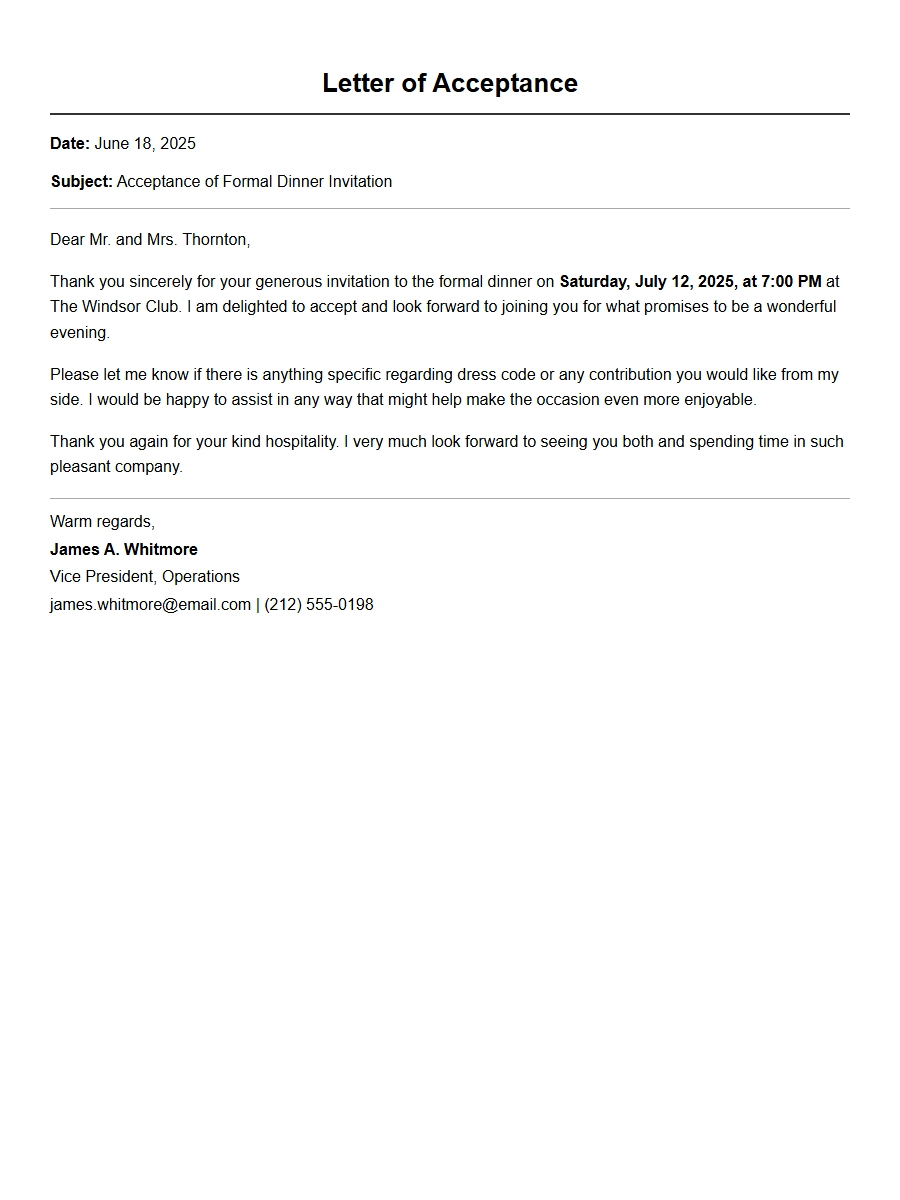
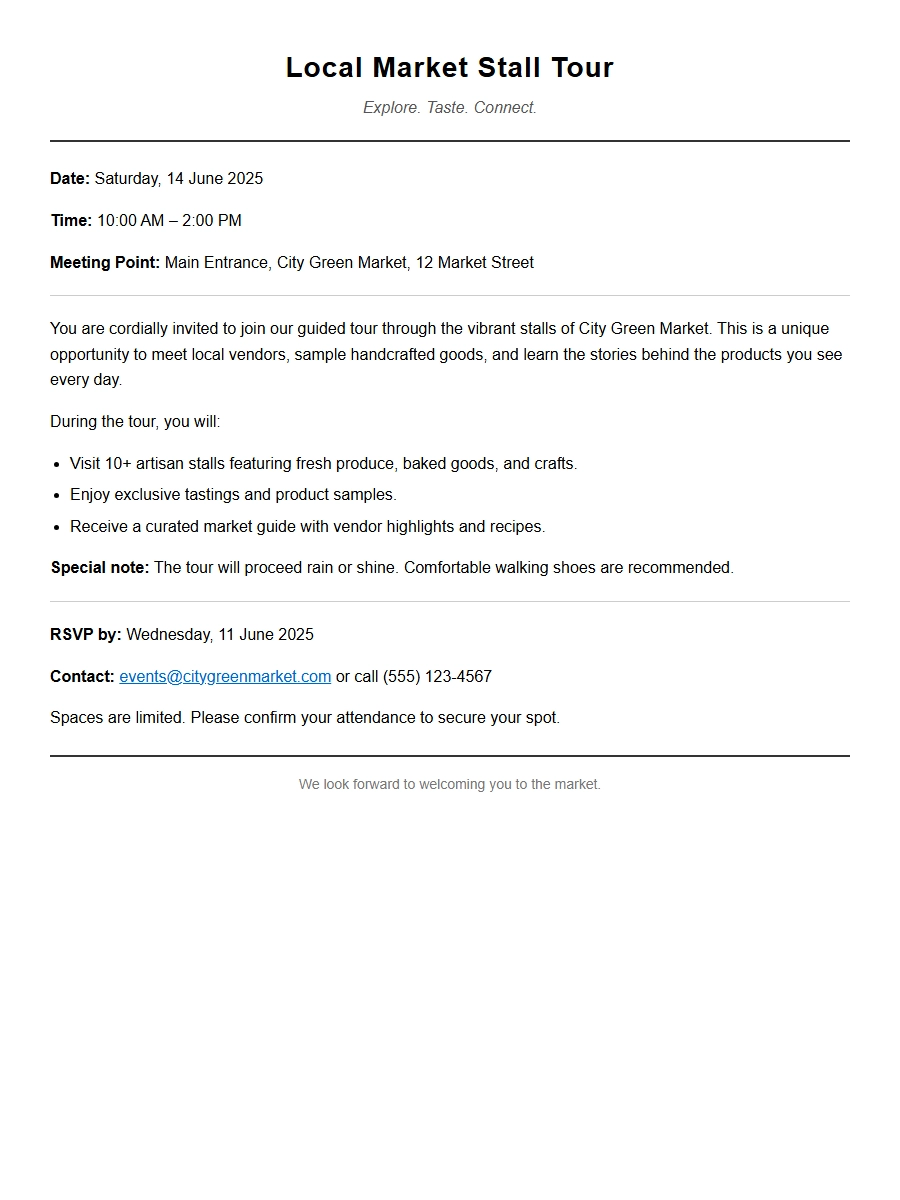 sample invitation for local market stall tour - Invitation Letters
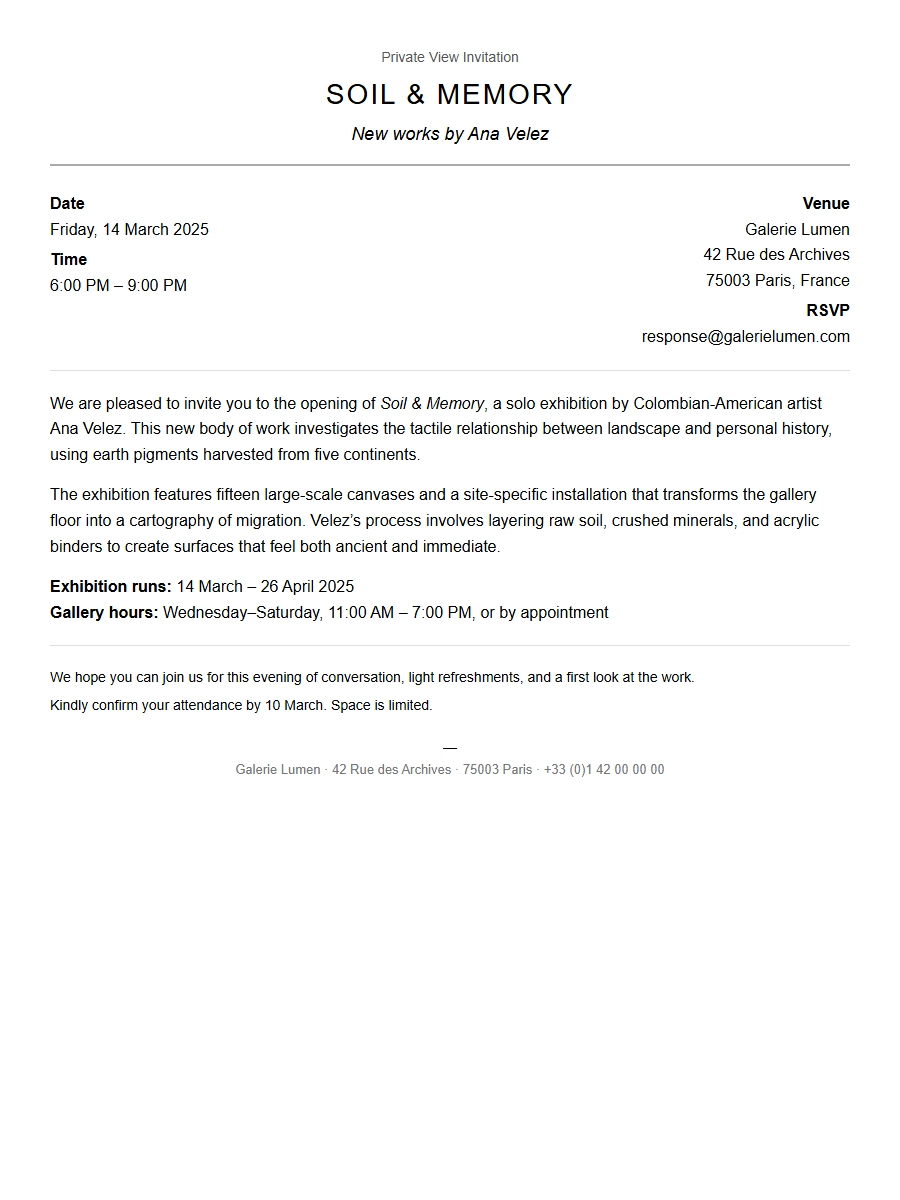 Art Exhibition Opening Invitation Wording Ideas
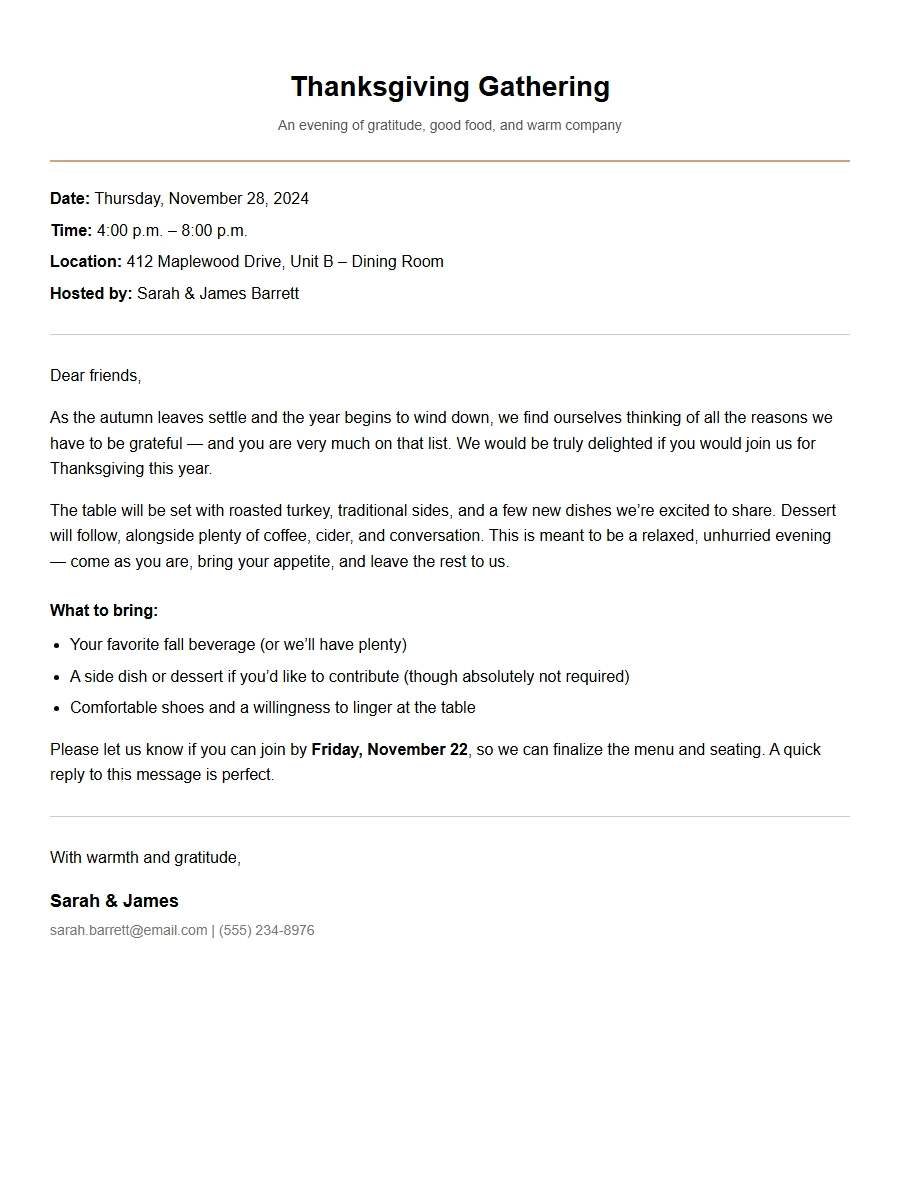 Thanksgiving Meal Gathering Invitation Text
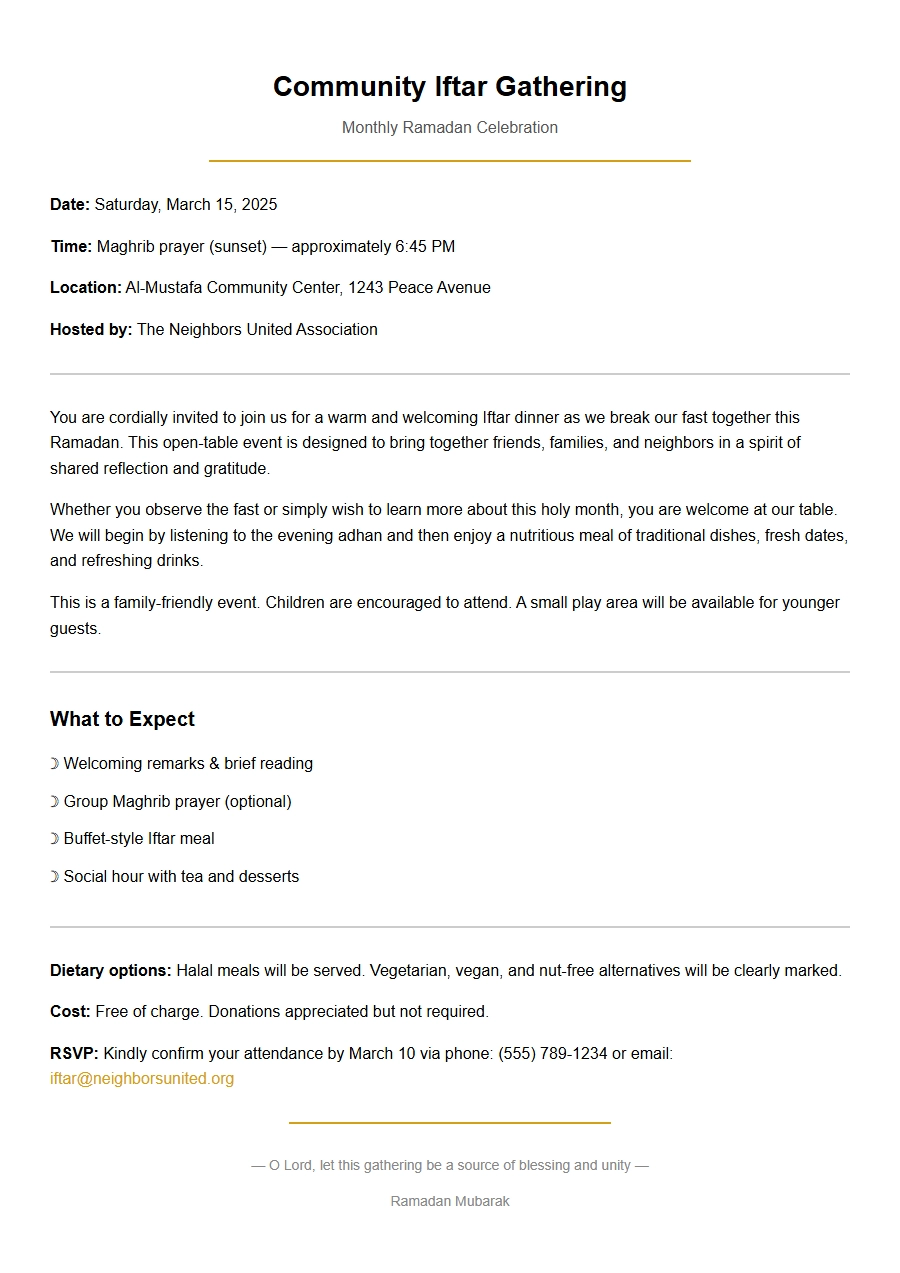 Ramadan Iftar Community Event Invitation
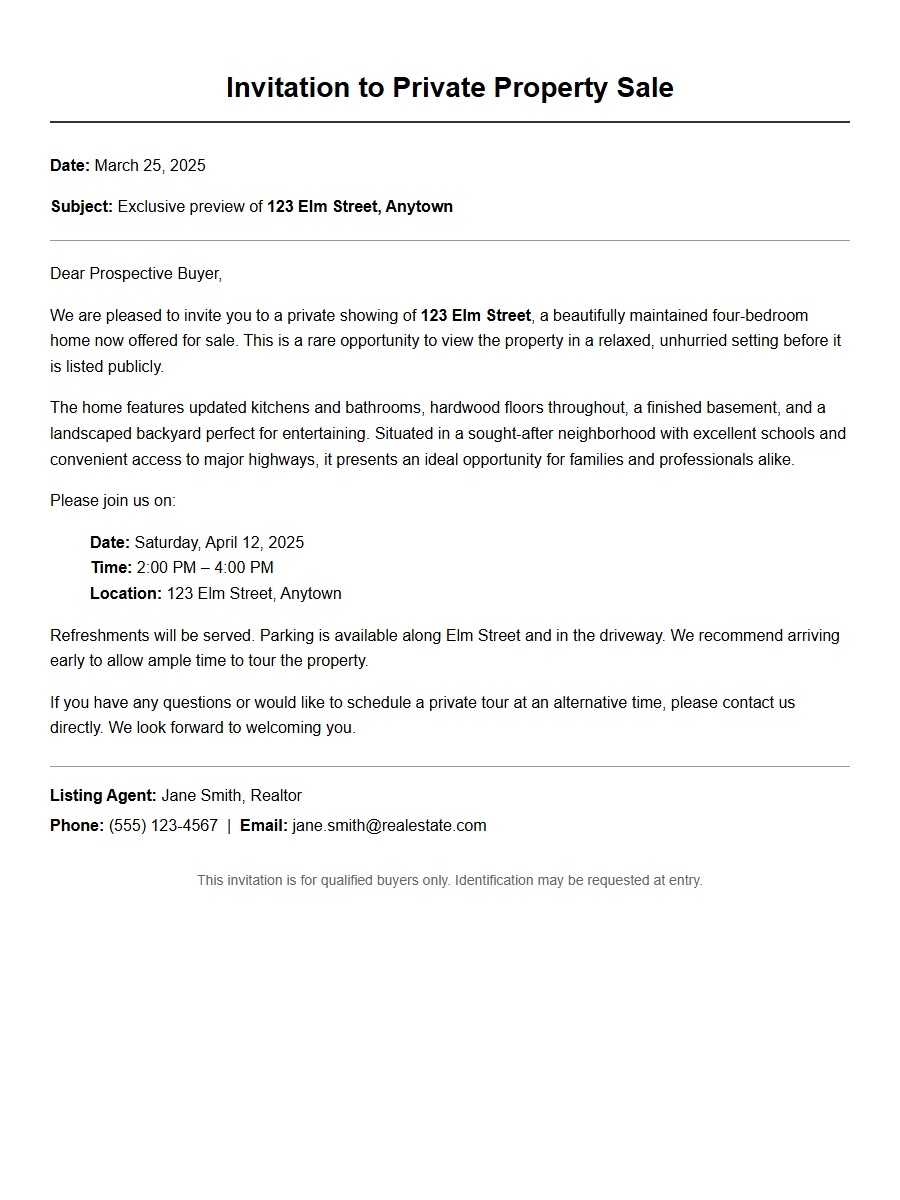 Sample Wording for Property Sale Invitations
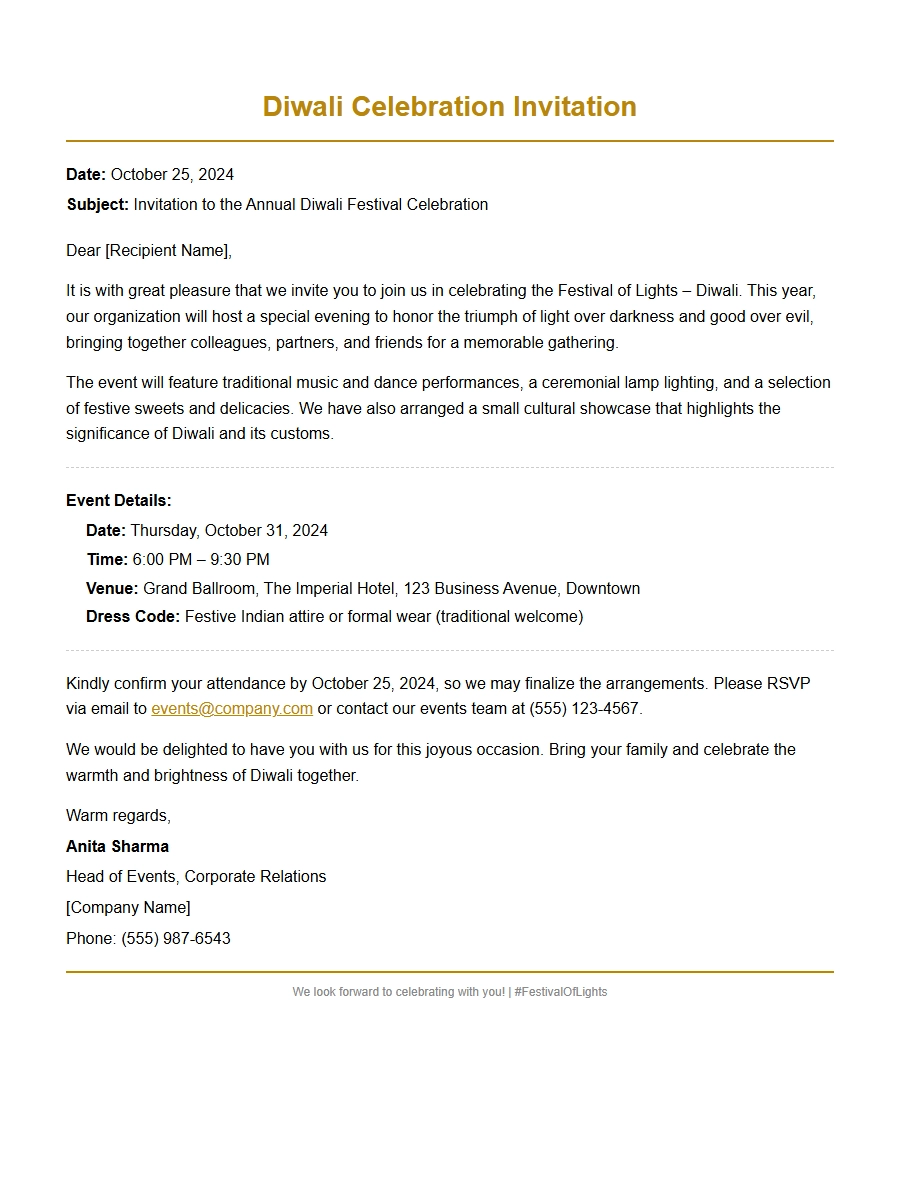 Diwali Festival Celebration Invitation Draft